Exxon CEO Darren Woods’ is concerned that US withdrawal from the Paris climate agreement would threaten carbon capture and sequestration (CCS), the foundation for which is government mandates and generous taxpayer subsidies.
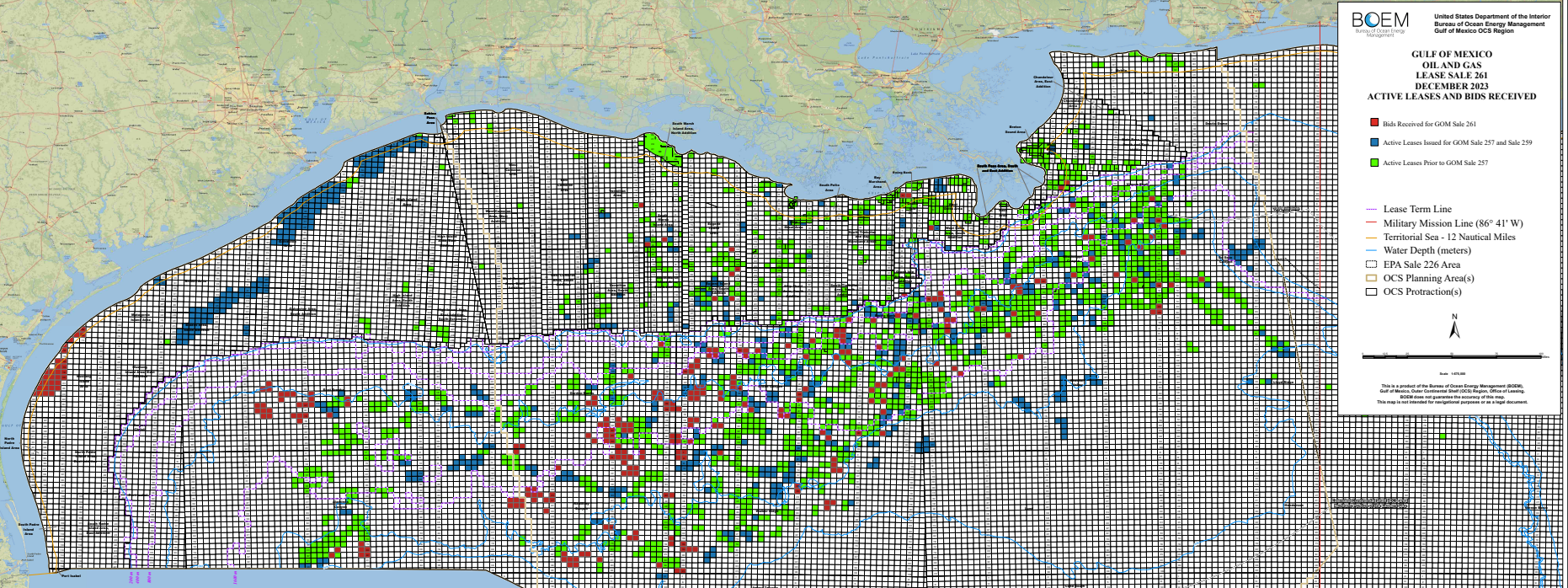
Exxon sought an edge over CCS competitors by improperly acquiring 163 OCS oil and gas leases (map below) for carbon disposal purposes. Conversion of these leases is not authorized, which means they will expire at the end of their primary (5 year) term absent legislative or regulatory action.
The only solid support for CCS is from companies hoping to benefit from subsidies and charges to industries and individual energy consumers. It’s time to end the Federal government’s CCS programs.
199 oil and gas leases were wrongfully acquired at Sales 257, 259, and 261 with the intent of developing these leases for carbon disposal purposes. Repsol was the sole bidder at Sale 261 for 36 nearshore Texas tracts in the Mustang Island and Matagorda Island areas (red blocks at the western end of the map above). Exxon acquired 163 nearshore Texas tracts (blue in map above) at Sales 257 (94) and 259 (69).
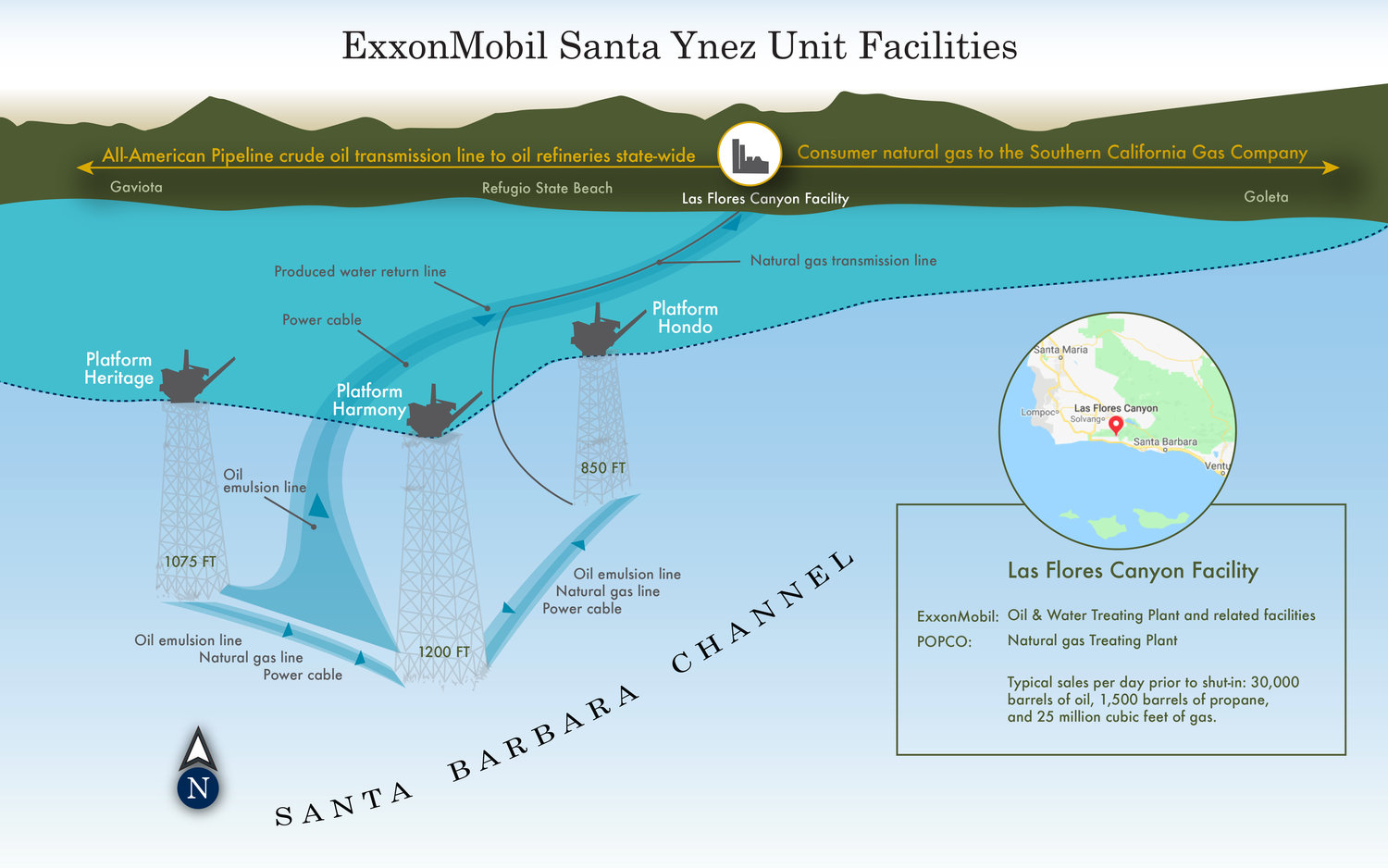
The Santa Barbara County Planning Commission has approved the transfer of the onshore pipeline from Exxon to Sable Offshore. Although the Environmental Defense Center (EDC) is appealing that decision to the Board of Supervisors, the Board’s vote will likely be a 2-2 tie. Supervisor Hartmann’s property is close to the pipeline and she has recused herself from votes on the matter. A 2-2 vote would be a win for Sable, because a tie vote means the planning commission decision stands.
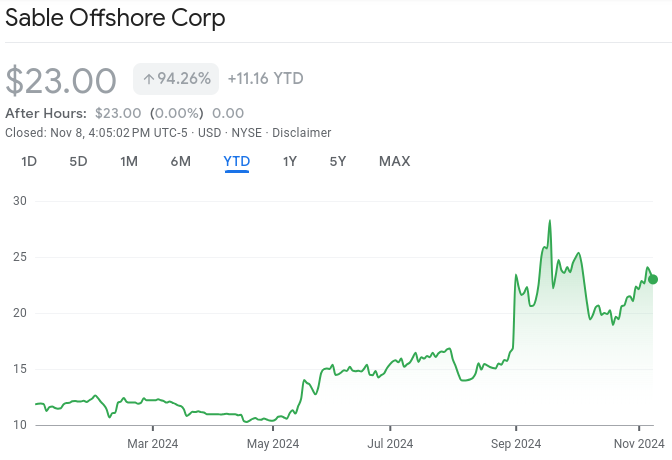
As an investment, Sable is a “pure California permitting play,” which means the risks are high. The company’s chances for success are almost entirely dependent on receiving the necessary approvals from State and local agencies.
Sable’s share price soared to $23.43 on 9/3 after the company reached agreement with Santa Barbara on the installation of required pipeline valves. The price bounced further to $28.30 on 9/19 before falling sharply to $19.43 on 10/9 after being cited for failing to get California Coastal Commission approval to install the required valves. The price rebounded to $24 following the County Planning Commission’s approval of the transfer from Exxon to Sable before settling at $23 on Friday, the date of the EDC appeal.
Expect the financial and psychological roller coaster ride to continue.
“On Sept. 16, 2024, a routine helicopter approach at an offshore facility nearly resulted in a serious accident due to a failure to follow proper helideck procedures. Before landing, the helicopter pilot visually confirmed that a nearby crane was securely stowed and stationary (Figure 1). However, as the helicopter neared the helideck, the crane operator unexpectedly raised the crane boom, bringing it alarmingly close to the landing area as the helicopter was 10 feet from touchdown. The pilots swiftly executed a go-around maneuver, successfully avoiding a collision and ensuring the safety of the crew and passengers onboard.”
The new program will include at least one Gulf of Mexico lease sale annually.
Where there is State support (e.g. Alaska), other offshore areas may be added to the program.
Reversal of the Beaufort Sea Presidential withdrawals, either by executive order or, if necessary, by congressional action, is a distinct possibility.
A Gulf of Mexico oil and gas sale will be held during the first half of 2025. This can be accomplished under the Biden administration’s 5 year plan.
Judge Boardman’s ruling requiring a new biological opinion under the Endangered Species Act (ESA) has created some uncertainty regarding the timing of a GoM sale. Her decision is being litigated and the effective date of her ruling is now 5/21/2024 (see attached). Congressional action could also reverse this decision.
Expect other litigation on NEPA and ESA grounds with the intent of stalling oil and gas leasing. Congressional action could reverse or limit such litigation.
Offshore wind:
Expect offshore wind leasing to be “paused.”
Current leaseholders are contractually entitled to continue developing and operating their leases. Expect construction and operation plans to be more closely scrutinized.
Expect BSEE’s report on the Vineyard Wind turbine blade failure to receive added attention and publicity.
Expect considerable tension between North Atlantic governors, strong supporters of offshore wind, and the new administration.
Mike Werth’s response to Jim Kramer’s question about US production leadership is spot-on (see the clip below).
Kudos to Kramer for visiting Chevron’s Anchor platform in the Gulf of Mexico. More business/energy reporters and government officials with energy responsibilities need to (1) learn more about offshore oil and gas exploration and development and (2) visit offshore facilities.
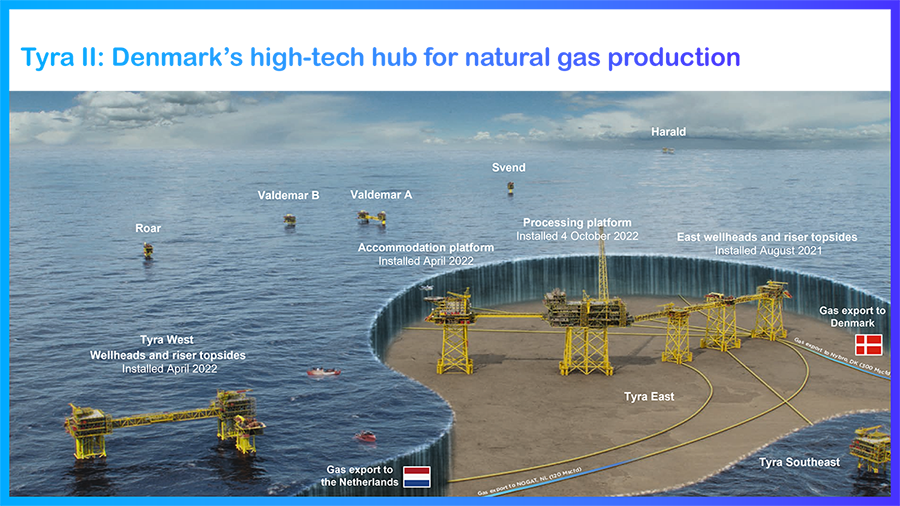
As the table below illustrates, Denmark’s highly publicized oil and gas exploration ban is more pragmatic than has been reported in the media. The expansion of production from existing fields is not restricted.
Denmark has brought an immediate end to new oil and gas exploration in the Danish North Sea as part of a plan to phase out fossil fuel extraction by 2050.
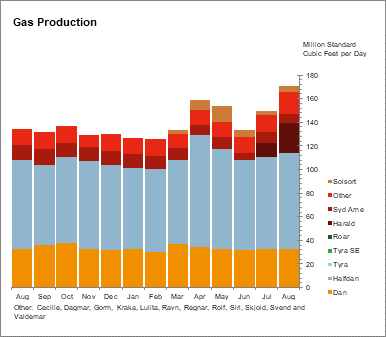
TotalEnergies announces that the Harald East Middle Jurassic nearby exploration well (HEMJ-1X) has discovered additional gas condensate resources in the Harald field, in the Danish North Sea.“The success of the Harald East Middle Jurassic well, nearby our Harald facilities in Denmark, demonstrates the strength of our Exploration strategy.”
As a result of new exploration, Danish gas production is on the rise (graphic below) after two decades of decline. August 2024 production (165.8 MMCFD) was 21% higher than August 2023 production (136.9 MMCFD)
While Total has proven to be resourceful in sustaining North Sea gas production, Denmark’s refusal to hold new licensing rounds dooms their production over the longer term. This is consistent with Denmark’s intent to cease domestic production by 2050. (Those of you who are young enough can report on whether that deadline is met 😉).
The demand for fossil fuels, which has yet to peak, will still be strong in 2050 and beyond. Phasing out domestic production may be Denmark’s choice, but it’s not a good choice for much of the world.
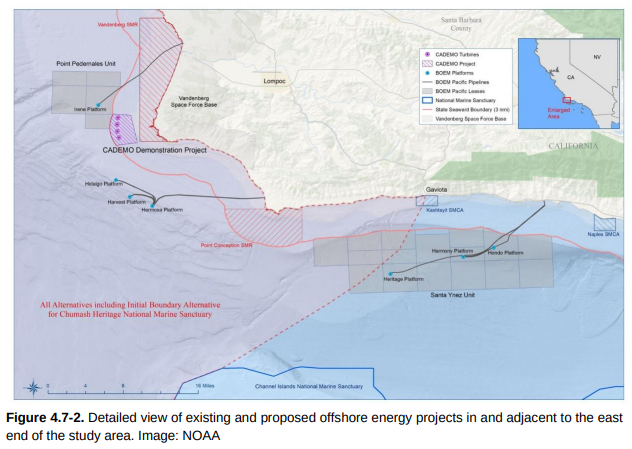
Almost 40 years ago, four large oil and gas platforms were installed in the beautiful offshore area that was part of our Santa Maria District (Pacific Region of the Minerals Management Service). Those platforms are now within the boundaries of the Chumash Heritage National Marine Sanctuary (see map above).
We watched those platforms being installed, inspected the drilling and production operations, and performed a myriad of other duties including the curtailment of offshore operations prior to launches from Vandenberg AFB. Those Vandenberg launches weren’t always perfect as this link clearly demonstrates. Even knowing that, it was still a bit unnerving when missiles were recovered during post-abandonment site clearance trawls.
All four of those Santa Maria District platforms are now on terminated OCS leases. All were installed by companies that are now part of Chevron Corp. (Chevron, Texaco, and Unocal). They are currently maintained by Freeport-McMoRan Oil & Gas, with Chevron retaining financial responsibility for decommissioning.
Platform
Install yr.
installed by
water depth (ft)
Est. removal weight (short tons)
wells drilled
Harvest
1985
Texaco
675
35,150
19
Hermosa
1985
Chevron
603
30,868
13
Hidalgo
1986
Chevron
430
23,384
14
Irene
1985
Unocal
242
8,762
26
BSEE reports that the 46 wells on Harvest, Hermosa, and Hidalgo have been plugged and tested, and that the well conductors have been removed. No information has been posted on the status of the wells at Platform Irene, but presumably they are (or will soon be) plugged in accordance with BSEE regulations.
Will the inclusion of these platforms in the Chumash Marine Sanctuary further complicate the already difficult decommissioning process? Decommissioning specialist John Smith thinks it may:
“In addition to the BOEM and BSEE approval process, Chevron and FMC are going to be dealing with the NOAA permitting regime for Sanctuaries. Those permitting and environmental compliance requirements are extensive. NOAA’s NEPA documentation for West Coast marine sanctuaries will also need to be amended to include the Chumash.”
So the “Mission Impossible” that is California OCS decommissioning now has yet another complex regulatory element.
“Even though most of the SYU facilities are outside the Sanctuary, the proximity of the operations to the Sanctuary is problematic. The Chumash are now going to be a co-manager of the Sanctuary, adding another player in the process. Sable is going to obtain multiple Federal, State and local permits to restart SYU, and law suits are likely at every stage of the process.”
A helideck incident killed 4 workers in 2022. Why are we still waiting for the final NTSB report?
The most recent Coast Guard – BSEE MOA for fixed platforms added to helideck regulatory uncertainty by assigning decks and fuel handling to BSEE and railings and perimeter netting to the Coast Guard. How does that make sense?
As is the case with all safety regulations, a systems based approach is needed.
Despite the muddled regulatory regime, BSEE is showing strong leadership in addressing helideck safety.
The broader issue of regulatory fragmentation is an important risk factor that needs to be addressed.
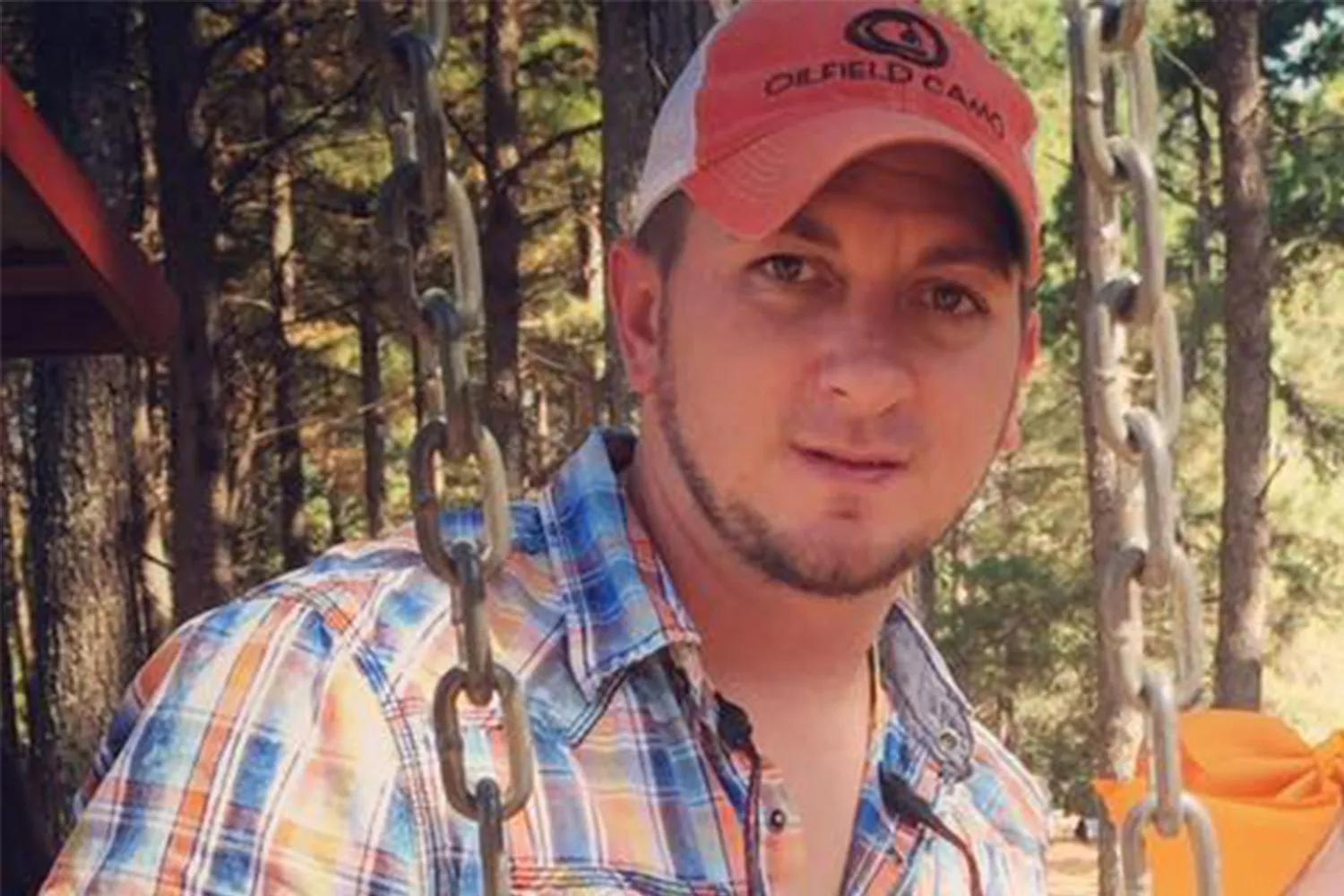
David Scarborough, Island Operating Co., was one of the 4 workers who died in the 2022 crashat a West Delta 106 platform.
The California Coastal Commission, which exercises enormous power and limited restraint, is making headlines for preventing SpaceX, arguably America’s most extraordinary company, from increasing the number of satellite launches from the Vandenberg Space Force Base, a Federal facility. The Coastal Commission made this decision just 3 days before SpaceX’s awe inspiring rocket booster catch in Texas:
Sable Offshore, despite being spawned by super-major Exxon, is a relative minnow compared to SpaceX, at least politically. The restart of production from Sable’s Santa Ynez Unit is facing another obstacle now that the Coastal Commission has entered the fray.
Sable argues that repair and maintenance activities are exempt from Coastal Act permitting requirements, and have been conducted under their existing permits for 35+ years.
The Commission does not like to see its authority questioned, and is influenced by groups whose sole objective is to prevent the restart of production. We’ll see how this sorts out.
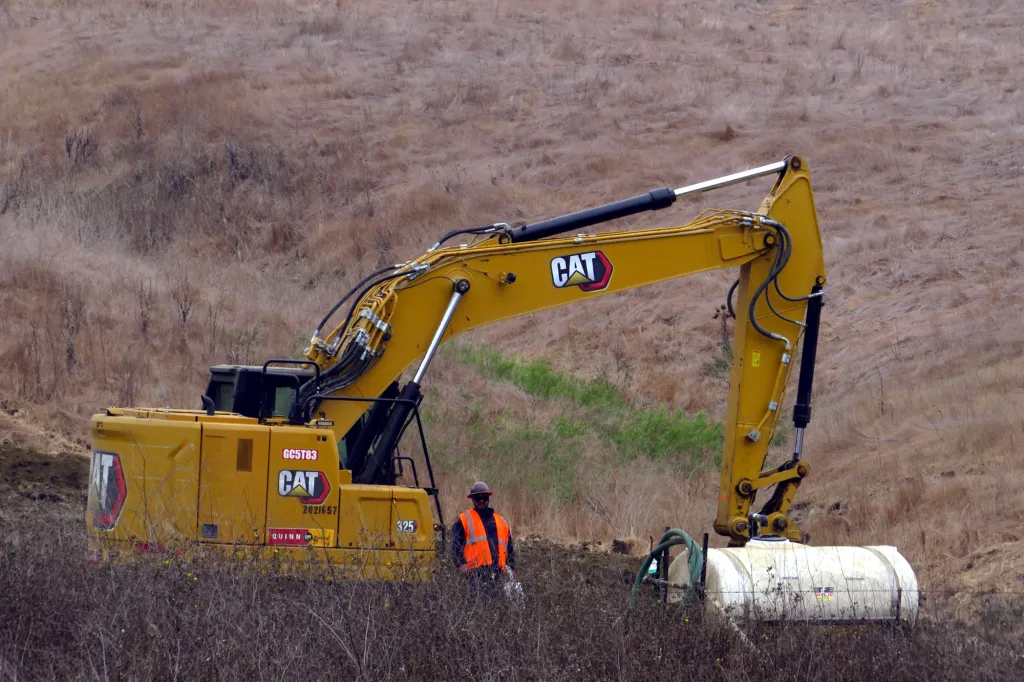
Center for Biological Diversity photo of pipeline repair work as published by Noozhawk
Meanwhile, Elon Musk did not hold back after the Commission’s decision not to allow an increase in the number of launches from Vandenberg:
“The California Coastal Commission should be dissolved as an organization. An utterly insufferable and misanthropic group of Karens if there ever was one! Their idea of the perfect coastline is one where there are zero humans or even signs of human! Anyone who has had any dealings with them will attest to this. They should not exist.”


 Bud's Offshore Energy (BOE)