Feeds:
Posts
Comments

Archive for the ‘Offshore Energy – General’ Category

2010-2011 Trend: Americans' Support for U.S. Offshore Drilling

Comments:

  1. The most remarkable figure is the 50% support for increased drilling during the Macondo blowout when oil was flowing into the Gulf live on national television
  2. The second most remarkable result is the very low percentage of people who have no opinion.
  3. The percentage in support would likely have been higher if they had not included the words “in US coastal areas” at the end of the question. Most new drilling would not be in what people think of as coastal areas, but far far from shore.

Other interesting Gallup findings:

  1. 49% of Americans support opening ANWR to exploration, a record high.
  2. The wisest Americans (i.e. those over 55 :)) are the strongest supporters (66% in favor).
  3. The youngest age group polled (18-34) also supports increased offshore drilling (52% in favor)
  4. A majority of both sexes support increased offshore drilling.
  5. Even in the East, where we are very comfortable consuming oil but not so keen on producing it, 49% of Americans support increased offshore production.
  6. 49% of Americans also support opening ANWR to exploration, a record high


Read Full Post »

Undersea nuclear

I’ll hold my opinions about nuclear power until the crisis in Japan eases. Instead, I thought I’d check on the status of offshore nuclear plant proposals.

Nuclear powered submarines date back to 1954 when the USS Nautilus was launched, and offshore nuclear plant concepts are almost as old. No such facilities have been built, but French companies are studying a subsea nuclear plant concept (see picture), and Russia has launched a floating nuclear plant prototype.

Less than a month ago, the Ecologist provided an update on the French and Russian projects. These plans will no doubt receive much more public attention as a result of the tragedy in Japan, but the French concept is quite interesting.

Pros:

Cores would be protected by three barriers: fuel cladding, reactor vessel and hull. The designers argue that immersion in sea water would ensure an infinite natural means of passive cooling and permit inherent safety and security. In addition, each plant would also be protected against potential intruders. The French argue that a submerged power plant would be less vulnerable to earthquakes, tsunamis, or floods, and would be far less vulnerable to terrorist attack.

Cons:

Sceptics are concerned that warmer water released from the reactors could be dangerous for local ecosystem. And, should there be a nuclear accident ‘the sea will be destroyed,’ according to the President of Anti-nuclear organisation Crilan, based in Cherbourg. ‘The fierce warming-up of the water will cause a massive thermal shock that will destroy sea life.’

Read Full Post »

Former President Bill Clinton said Friday that delays in offshore oil and gas drilling permits are “ridiculous” at a time when the economy is still rebuilding, according to attendees at the IHS CERAWeek conference. Politico.com

Read Full Post »

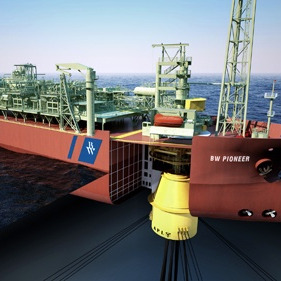
BW Pioneer

The US Coast Guard has issued the first ever Certificate of Compliance for a Floating Production Storage and Offloading (FPSO) facility in the Gulf of Mexico.

The BW Pioneer, under lease to Petrobras, will operate in the Cascade and Chinook fields.

Read Full Post »

“The Honda Civic GX (the only NGV available to U.S. consumers and repeat winner of the ACEEE Green List) has been so successful Honda predicts it will double GX sales in the U.S. this year after doubling them in 2009. Utah, Oklahoma and California have been very successful in building out natural gas infrastructure and deploying NGVs that are refueling with natural gas.” SeekingAlpha.com

While I don’t agree with everything in this article, the numbered points are right on target. Increased use of natural gas for transportation is the best near- and intermediate-term option for reducing oil consumption and imports, air emissions, and transportation costs.

Supply does not appear to be an issue in light of the numerous domestic options including shale gas, Alaskan gas, coalbed methane, and conventional onshore and offshore gas.  Given the proximity of enormous shale gas resources to major markets, shale gas is the featured attraction. However, this is an offshore blog, and from a strictly environmental perspective, offshore gas is the preferred option.  Why?

  • No freshwater contamination issues
  • Small environmental footprint – limited facilities needs and minimal space preemption
  • No production in or near residential areas
  • Potential production near major natural gas markets. For example, there is a natural gas discovery in the Atlantic approximately 100 miles southeast of the New York City area. (Before my geologist friends get upset, I will point out that the productive reservoirs are highly complex and further exploration is necessary to determine whether this field – the former Hudson Canyon Unit – and other Atlantic prospects are commercially viable.)
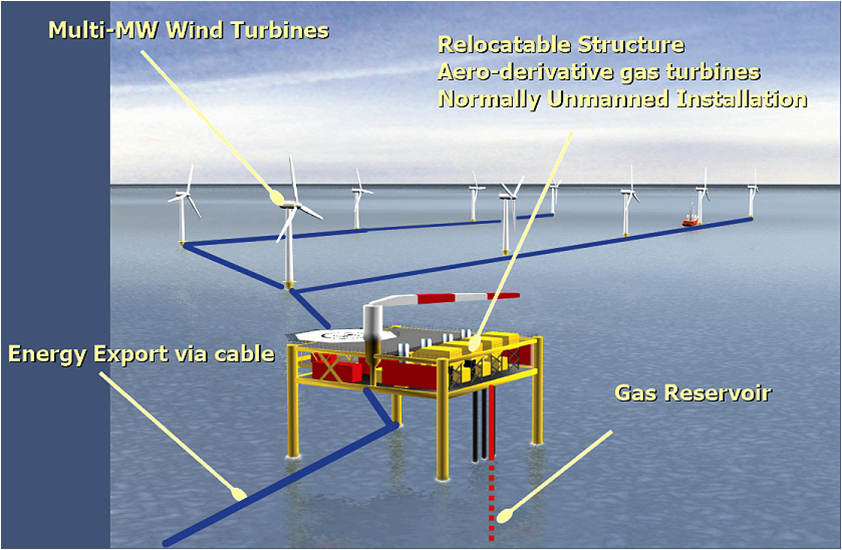
  • Potential for combining offshore gas and wind projects into offshore energy units that can ensure consistent power supply. (See slide below from a presentation by George Hagerman, Virginia Tech Advanced Research Institute)

Read Full Post »

Rep. Tim Murphy’s (R-Pa.) bill states that companies with drilling permits approved before early May 2010 can proceed with exploration or production “without further review” by the Interior Department, and “without further review or delay” under various environmental laws. The Hill.com

Read Full Post »

From Platts Oilgram News:

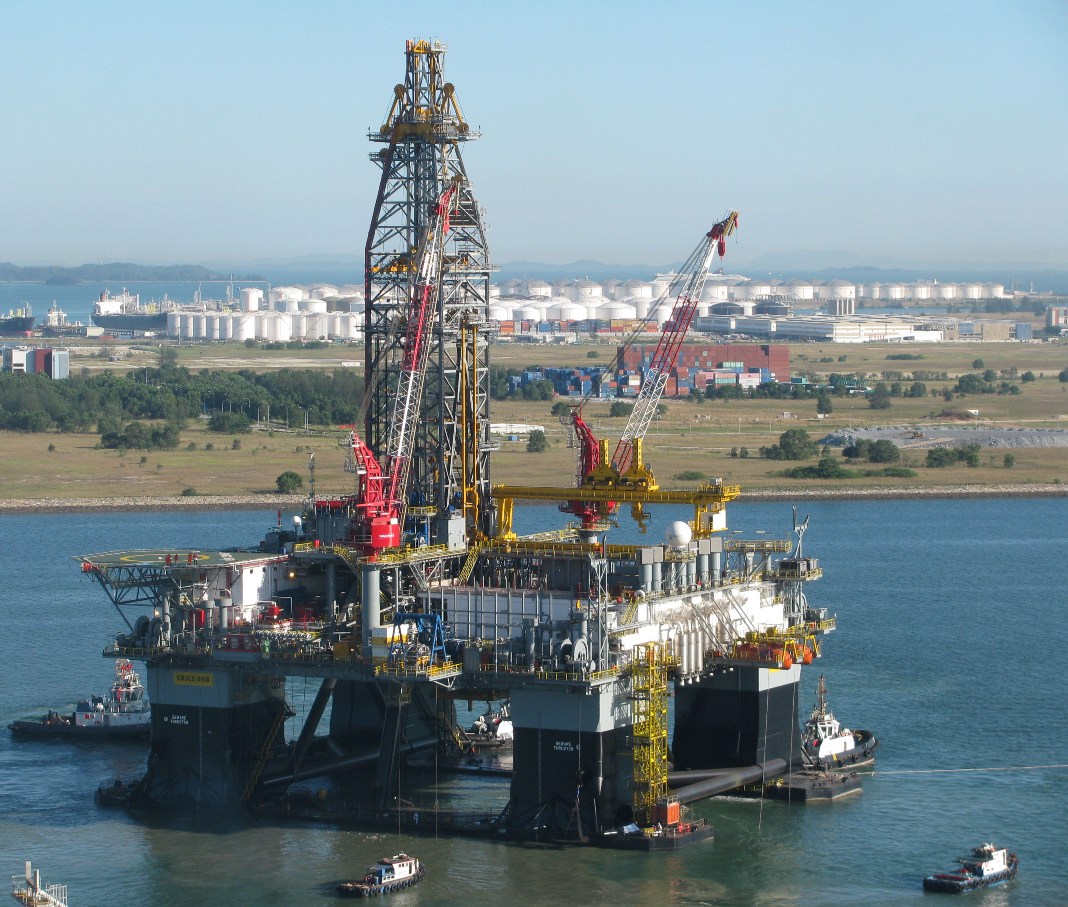
The well had previously been drilled to a depth of 13,585 feet at the time of the moratorium, Noble said. Drilling is expected to resume in late March, targeting total drilling depth of about 19,000 feet, Noble said. Results are expected by the end of May. Noble said it will use the Ensco 8501 rig for the project.

Ensco 8501

Read Full Post »

Secretary Salazar will appear before the Senate Energy and Natural Resources Committee on Wednesday (2 March) at 10:00 am ET and the House Natural Resources on Thursday (3 March) at 10:00 am ET. Expect deepwater drilling and other offshore energy questions.  Both hearings will be streamed live at the respective websites.

Read Full Post »


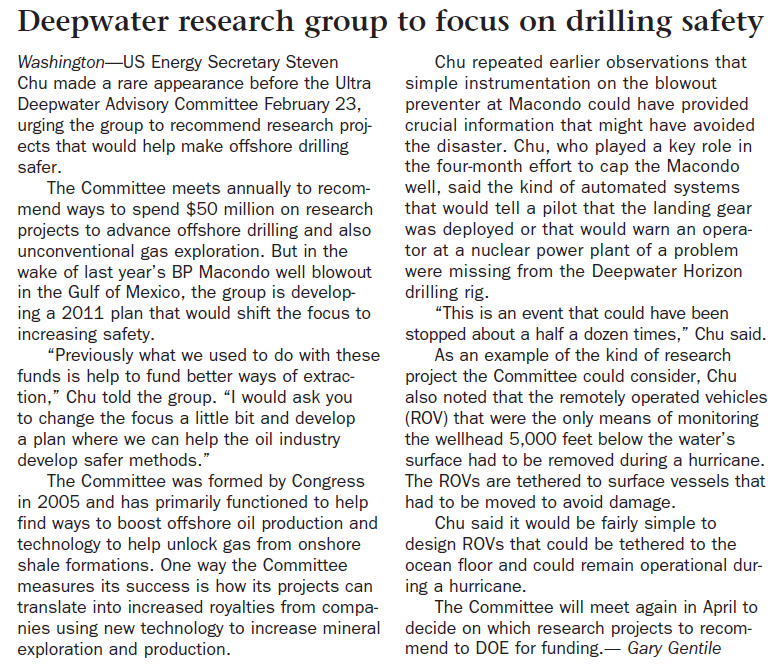
Few Cabinet Secretaries are scientists or engineers, and none has been a Nobel Prize winner. We expect Secretary Chu to be different and yesterday’s meeting with DOE’s Ultra-Deepwater Advisory Committee was not your typical Washington “hit and run” performance. Rather than making a quick speech and running along to his next appointment, Secretary Chu engaged in technical dialogue with our committee for a full hour, offering insights and responding to questions. Among the topics discussed were BOP instrumentation and monitoring, well integrity, ROV/AUV issues, and Macondo findings.

Kudos to Secretary Chu for his commitment to offshore safety.

Gary Gentile published this report on the meeting in Platts Oilgram News. (click on the story to enlarge)

Read Full Post »

Magne Ognedal

It’s impossible to inspect quality into the petroleum industry.  The latter must itself ensure quality. Magne Ognedal, Director General, Petroleum Safety Authority Norway

More thoughts from Magne:

Understanding risk is central here. We must all recognise first and foremost that the petroleum industry involves risk – just like any other activity.

However, accepting risk does not mean accepting accidents, he emphasises. “Quite the contrary. But we must constantly remind ourselves that accidents have happened – and can happen again.

“The risk of a major accident is present, in Norway and in all other nations with an oil and gas industry. This means that incidents will occur.

“Risk must accordingly be managed, with clear management responsibility, at every level and in every company which participates in the industry.”

Preventive measures can be a challenge, Mr Ognedal concedes, because they require that action is taken – often at a cost – without a disaster or other accident having occurred.

“However, history offers many examples where extensive measures are adopted after disasters. Companies in the petroleum business should consciously ask whether it would not be far better to have an established system which means that preventive measures based on learning, new technology and so forth are implemented, in order to be able to prevent accidents and disasters.

PSA Announcement

Safety – Status and Signals: This is a great publication – highly creative,  easy to read and understand, very current, and loaded with good information. Check it out!

Read Full Post »

« Newer Posts - Older Posts »