Feeds:
Posts
Comments

Archive for the ‘Offshore Energy – General’ Category

CNN Poll

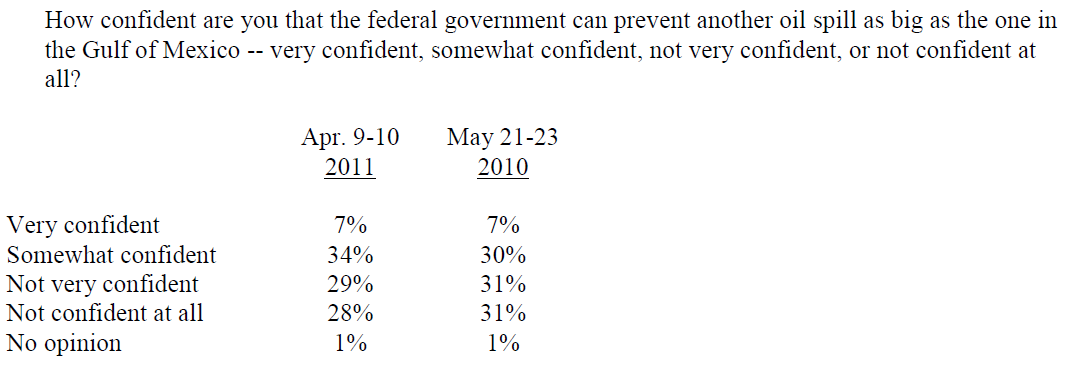
A CNN/Opinion Research Corporation survey released Tuesday indicates that 69 percent of Americans favor increased offshore drilling, with just over three in ten opposed. That 69 percent is up 20 points from last June, while the oil spill was still in progress, and is back to the level of support seen in the summer of 2008.

Confidence in government has shown a less significant increase.

Read Full Post »

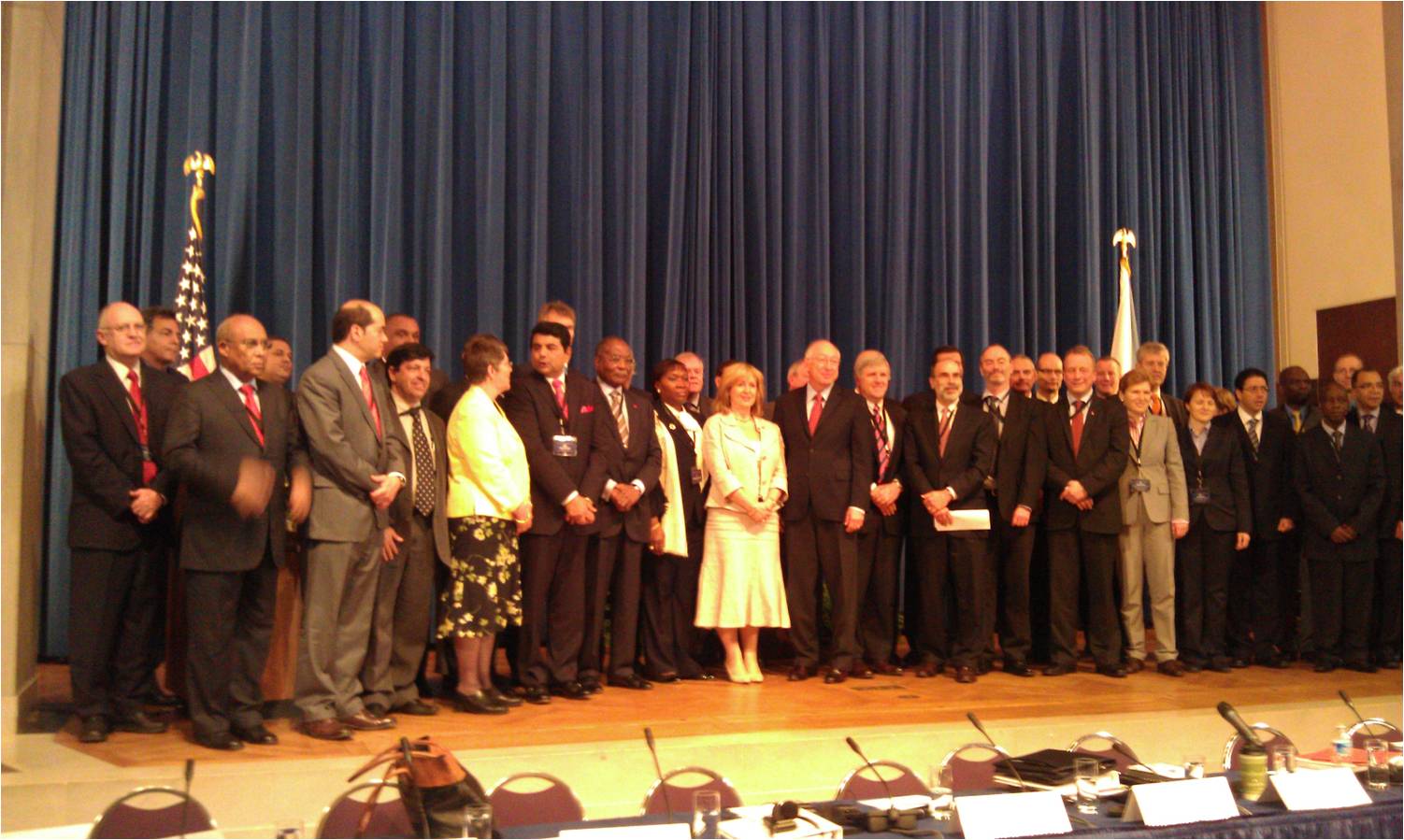
International Guests

  • The conference was nicely organized by the folks in the Department of the Interior and BOEMRE
  • Angola, Australia, Brazil, Canada, India, Mexico, Netherlands, Norway, the United Kingdom, Russia, and the US were represented. The European Union also participated.
  • Brazil was represented by two Petrobras managers, rather than governmental officials. This raised some eyebrows.
  • Australia formally announced yet another offshore regulators’ conference, the International Offshore Petroleum Regulators and Operators Summit in Perth (10-11 August). Do we need better coordination of the coordination conferences? Isn’t the International Regulators’ Forum (IRF) the best means of managing all of this?
  • The need for expanded offshore oil and gas operations was recognized by all participants.
  • Malcolm Webb of Oil and Gas UK, announced that UK operators would have a capping capability for subsea wells by the end of the summer. However,  no well containment system is planned. This omission, which was attributed to North Sea weather and sea conditions, is surprising. Capping is not an option if well integrity concerns prevent a well from being shut-in, either with the BOP or a cap (if the BOP failed). The absence of a well containment option would seem to be a significant gap in their response capability.
  • A working group was formed to consider a new or strengthened international organization for offshore safety and pollution prevention. In my view, the best option would be to enhance existing cooperation mechanisms, most notably the IRF. International cooperation on safety is not a new concept. The IRF, which was mentioned positively by many of the speakers at the Ministerial Forum, has existed since 1994 and has an ongoing international standards effort. A related group, ICRARD, has been coordinating offshore safety research for more than 15 years. Various industry organizations have international programs. ISO has a good system for developing and managing standards. The International Maritime Organization has official committees that address certain offshore safety and pollution issues. Making better use of existing committees and forums would seem to make more sense than starting new ones.

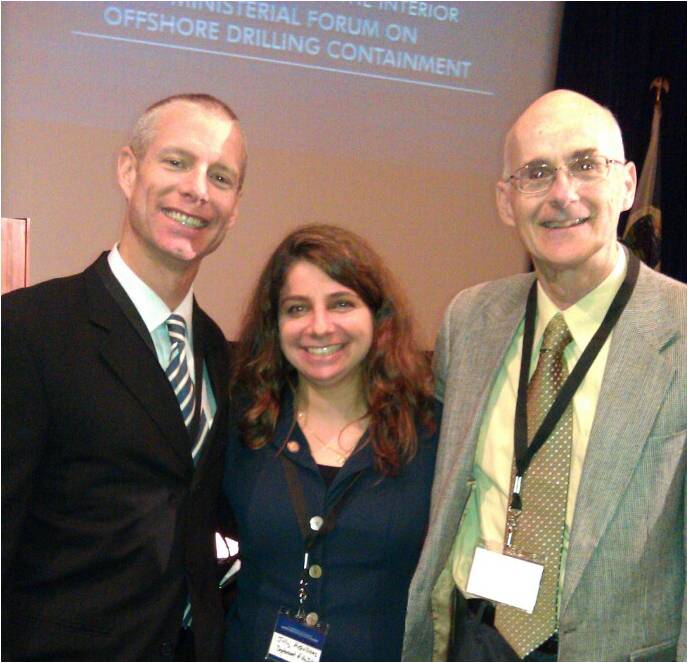
With BOEMRE dynamos - (Kona) Kevin Kunkel and July (Ms. COOL) McQuilliams

link to videos

Read Full Post »

John Milne Book Launch

John C Milne

“Dubs” is a term used in Aberdeen and northeast Scotland to describe all varieties of mud. That is the first thing I learned in reading John Milne’s excellent book “DUBS, How the Oil Came North.”  John’s first job in the offshore industry was with a drilling mud supplier back in 1969 when he was still a college student.  John presents a series of amusing and informative anecdotes about hie work experiences between 1969 and 1973 during the early years of North Sea offshore exploration. The book is available through the publisher, PlashMill Press. Good read!

I also recommend Bjørn Vidar Lerøen’s excellent book “Drops of Black Gold,” which

Drops of Black Gold - Statoil

chronicles the history of Statoil and Norwegian offshore oil and gas development. The book includes a now famous 1962 letter from Phillips Petroleum to the Norwegian government. In the letter, Phillips seeks exclusive rights to the entire Norwegian continental shelf in return for conducting a seismic survey program. Hey, nothing wrong with asking! 🙂

Read Full Post »

Previewing his speech at a New York City fundraiser last night, Obama said he wants to break “the pattern of being shocked at high prices and then, as prices go down, being lulled into a trance.”

“Let’s actually have a plan,” he said. “Let’s, yes, increase domestic oil production, but let’s also invest in solar and wind and geothermal and bio-fuels and let’s make our buildings more efficient and our cars more efficient.” USA Today

Encouraging.

Read Full Post »

Secretary of the Interior Salazar will be hosting the “Ministerial Forum on Offshore Drilling Containment” on April 14, 2011, in Washington DC. Click for the draft agenda and additional information.

Read Full Post »

Quebec and Ottawa have struck a “historic” deal to allow the province to draw oil and natural gas royalties from the disputed Old Harry area of the Gulf of St. Lawrence, says Quebec Premier Jean Charest.

…The new deal is expected to give Quebec 100 per cent of the royalties from offshore resources. CBC News

Read Full Post »

from SeabedRig.com

Advances in drilling technology tend to be evolutionary, not revolutionary. Floating rigs, dynamic positioning, top-drive systems, measurement-while-drilling, automated rig floors, and other important advances were logical next steps, not radical makeovers.

Many of us have long been fascinated by the possibility of locating drilling equipment on the seafloor, particularly for deepwater wells. Why operate from a massive floating vessel that requires a sophisticated stationkeeping system and a long riser to connect to the wellhead? Why link surface personnel to seafloor risks? Why increase the complexity of balancing well pressures (without fracturing formations) by adding thousands of feet to the mud column? Why heave and roll on the surface when you can operate from the seafloor?

It’s not that easy, of course, and there are many questions and issues. While fully automated drilling systems are no longer a reach, what about reliability and repairs?  How will casing be set and cemented? How will downhole measurements be transmitted to the control center? Cuttings samples? Coring? Well testing? The list of challenges is daunting.

At least one company, Seabed Rig, is committed to developing and demonstrating seafloor drilling technology. Earlier this month, Seabed Rig reached agreement with NASA to create the first autonomous drilling rig. While a lot of work remains, Seabed Rig and other pioneering companies are applauded for their innovative thinking and willingness to challenge conventional practices and wisdom.

Read Full Post »

  1. The Petrobras Cascade-Chinook project, which includes the first Floating Production Storage and Offloading (FPSO) facility in the Gulf of Mexico, received final approval.
  2. The US will be a major purchaser of Brazilian (Petrobras) deepwater oil production. Will some of the tankers pass through US offshore areas that are closed to exploration and production?

Read Full Post »

I just sent someone an email commenting that demand for Australian LNG (and their offshore gas production) was about to soar, but it  looks like the Wall Street Journal is already on this story.

A global shift away from nuclear power in response to the atomic plant crisis unfolding in Japan will likely spur a scramble for Australian energy, catapulting the country ahead of Qatar as the world’s biggest supplier of liquefied natural gas in the near future.

[OZLNG]

More Asian gas demand: China has suspended the approval of new nuclear projects.

Read Full Post »

Speakers list and link to live streaming

The Subcommittee on Energy and Power announces a multi-day hearing on “The American Energy Initiative.”  The first day of the hearing will be on Thursday, March 17, 2011, at 9:00 a.m. in 2123 Rayburn House Office Building.  It will focus on oil supplies, gasoline prices, and jobs in the Gulf of Mexico.


Read Full Post »

« Newer Posts - Older Posts »