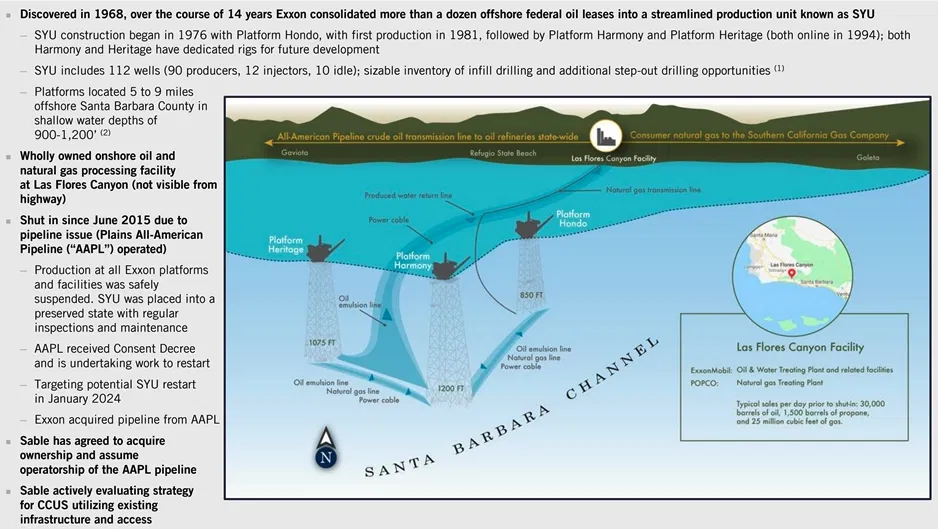
John notes that Exxon’s March 26 contractual deadline for Sable to have the SYU up and running is fast approaching. What will Exxon do in the likely event that Sable fails to meet that deadline? Does Exxon want to re-enter the SYU legal and regulatory quagmire?
The SYU’s 500+ million barrels of oil, 3 deepwater platforms, and onshore processing facilities are an enormous prize, but is that prize attainable?
Meanwhile, the latest skirmish between Sable and the Office of the State Fire Marshal (OFSM) pertains to metal loss anomalies and inspection tool tolerances. The dispute is summarized in the linked filing.
Sable contends that the Fire Marshal’s letter contradicts guidance from OSFM staff and provides examples. Sable goes a step further at the end of their response by calling for the FIre Marshal to coordinate better with the experts on his staff:
“We respectfully request that, given this background, you coordinate further with the expert team at OSFM and revisit the statements in your October 22nd letter.”
It’s not looking good for a quick resolution of these issues.
My comments in response to the Dept. of the Interior’s regulatory reform notice are attached. First and foremost, I believe these recommendations would reduce safety and environmental risks. Second, I am confident that they would also reduce governmental costs and the regulatory burden on industry.
The first attachment discusses regulatory fragmentation and recommends actions to reduce the complexity and redundancy of the offshore regulatory regime. The second attachment proposes a Drilling Safety Leaders Pilot Program as a means of evaluating a more adaptable framework regulatory framework for operators with outstanding performance records.
The EO requires agencies to issue a rule, effective not later than September 30, 2025, that inserts a sunset date into each “covered regulation.” The sunset date must be 1 year after the effective date of the sunset rule, but may be extended multiple times for a total of up to 5 years.
From an offshore energy perspective, the confusion starts with the EO’s applicability. One section of the order exempts regulatory permitting regimes authorized by statute. Another section specifies that the order “applies to all regulations issued pursuant to the Outer Continental Shelf Act of 1953 and any amendments thereto.” This is a fundamental contradiction given that OCSLA is a statutory planning and permitting regime. Which regulations are subject to the EO?
Comments:
For some reason (too complicated?), EPA and the Army Corps of Engineers are given 30 days to provide a list of statutes that are subject to the EO. Perhaps all affected regulators should have been given 30 days to comment on the draft EO before it was finalized.
The EO is sure to create chaos as regulators, under the direction of managers keen on complying with the President’s directive, attempt to determine the EO’s applicability and establish implementation procedures.
The EO, which is intended to provide order and certainty, will do exactly the opposite. How does the regulated industry plan for future operations while this vague and controversial “zero based regulatory budgeting” exercise is ongoing? What are the chances of this directive being sustained?
Reducing the number of pages in the US Code, while desirable, is not regulatory reform.
The order assumes that most regulations are meaningless, which is not the case. What is the plan for filling the void after regulations are deleted?
The EO should embrace, rather than circumvent, the notice and comment requirements of the Administrative Procedures Act. The tedious and sometimes burdensome APA has protected the public and the energy industry from countless unjustified, unauthorized, and poorly considered regulatory initiatives.
Eliminating rules is not synonymous with establishing a regulatory framework that will improve efficiency and stimulate innovation.
Other factors are paramount in improving regulatory effectiveness and efficiency. These include regulatory fragmentation, effective goal setting, management systems, culture, data gathering, performance monitoring, continuous improvement, collaboration, and the adoption of industry standards.
Quality regulators are more important than quality regulations. Regulating with fewer rules requires skilled regulators.
Agencies should be directed to consider how they can best reduce the regulatory burden without compromising safety and environmental performance. Page reduction should be secondary.
If regulatory efficiency is the goal, this EO is likely to do more harm than good. Federal agencies are largely comprised of bright people with good intentions. Challenge them to propose innovative reforms that will simplify and improve their regulatory regimes.
Addressing regulatory fragmentation will improve efficiency and lower costs for industry and government while reducing safety and environmental risks.
Unfortunately, the regulatory regime for US offshore oil and gas operations is noteworthy for redundancy, uncertainty, and complexity that divert industry and governmental attention from safety and environmental protection objectives to administrative processes, interpretations, and jurisdictional boundaries.
“Poster Child”for regulatory fragmentation?
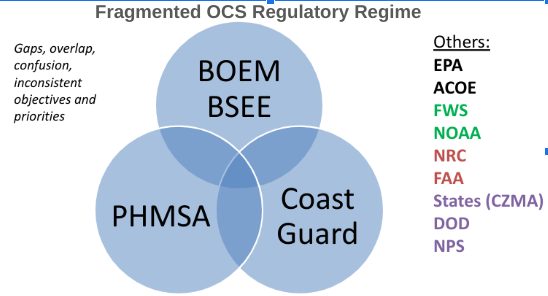
The 12 Federal entities that have some OCS regulatory responsibilities are identified in the above chart. The organizations with core regulatory roles are included in the overlapping circles. The responsibilities of BOEM and BSEE are so inextricably intertwined that those bureaus occupy the same circle.
Coastal states also have OCS regulatory roles through authority granted in the Coastal Zone Management Act.
When multiple agencies have jurisdiction over a facility, system, or procedure, the redundancy inevitably results in inconsistency, ambiguity, and gaps in oversight. The focus of operating companies and contractors is diverted from safety and risk management to understanding and satisfying the regulators. The inevitable result is a compliance mentality that weakens the safety culture.
Interagency agreements in the form of MOUs and MOAs, which are ostensibly for the purpose of managing redundancy, are often unclear or inconclusive. They tend to be more for the benefit of the agencies than the regulated industry. The interests of the regulators and protecting turf are paramount.
Where legislation is not required (e.g. BOEM and BSEE), use executive orders to combine and streamline the regulatory functions.
Where agencies have separate legislative authority, establish a lead regulator by executive order pending corrective legislation. Under the EO, the agencies would function as a joint authority under the direction of the lead regulator.
A combined BOEM/BSEE would be the logical choice for leading the joint authority given that OCS energy is their sole focus and they are accountable for the success of OCS programs.
Use a management system regulatory approach that holistically considers all of the legislatively enacted regulatory objectives.
Increase the attention given to regulator and operator performance in terms of both outcomes and efficiency.
Reduce and simplify permitting requirements for operating companies that have demonstrated outstanding safety and environmental performance over a sustained period.
A helideck incident killed 4 workers in 2022. Why are we still waiting for the final NTSB report?
The most recent Coast Guard – BSEE MOA for fixed platforms added to helideck regulatory uncertainty by assigning decks and fuel handling to BSEE and railings and perimeter netting to the Coast Guard. How does that make sense?
As is the case with all safety regulations, a systems based approach is needed.
Despite the muddled regulatory regime, BSEE is showing strong leadership in addressing helideck safety.
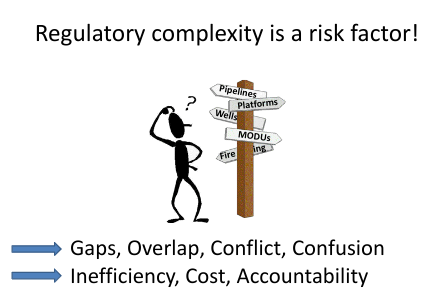
The broader issue of regulatory fragmentation is an important risk factor that needs to be addressed.
David Scarborough, Island Operating Co., was one of the 4 workers who died in the 2022 crashat a West Delta 106 platform.
Additionally, ultimate authority over the wind farm remained unclear, with various federal agencies claiming responsibility over different portions of the permitting, licensing, review, and operation of the wind farm.
“Sometimes I have a hard time figuring out, who do we talk to? Who is going to keep us safe? Who is the responsible boss here? Who is going to make the hard decision?” Select Board member Matt Fee asked.
Separate legislation granting redundant or overlapping authority to different departments or agencies.
Legislation that is non-specific, assigning broad authority to the President or cabinet level level officials, leaving it up to the bureaus to resolve.
Bi- and multi-lateral agreements like MOA’s and MOU’s, which are intended to “coordinate the redundancy,” often cause more confusion than they prevent, creating gaps in the process.
“Fixing” problems by adding redundancy.
The Dept. of the Interior’s division of responsibilities for offshore wind, which was finalized in January 2023, inexplicably assigns review and approval of Construction and Operations Plans to the Bureau of Ocean Energy Management (i.e. the land manager, lessor, and wind energy promoter) rather than the Bureau of Safety and Environmental Enforcement (i.e. the principal regulator of the activities described in those plans).
More significantly, the offshore wind responsibilities of the 2 bureaus are so intertwined (as is also the case for offshore oil and gas), that attempts to separate the functions have, at a minimum, created inefficiencies and increased regulatory and operational costs.
FTR, the idea that having the BOEM and BSEE functions combined in a single bureau, as was the case with the predecessor bureau (MMS), had anything to do with the Macondo blowout is a complete fallacy. Regarding the accusations that were made toward MMS, the Chief Counsel for the national commission that investigated the tragic incident found no evidence that ethical lapses on the part of MMS employees played any role in causing the blowout.
There were important regulatory changes made after the Macondo blowout. These included capping stack requirements, mandatory safety management systems, and updated rules and standards for cementing/zonal isolation and blowout preventer systems. None of these improvements were precipitated by or dependent on the division of MMS into two bureaus.
The active rig count in the GoM in 2001 was 148 (AL-4, LA-119, TX-25), which is >8 times the current Baker Hughes rig count of 18. The 2001 rig count was not a one year blip; the number of rigs active in the GoM exceeded 100 for the ten year period from 1994-2003.
While the current rig count is anemic by comparison, the capabilities of the fleet are anything but. Below is a list derived from drilling contractor status reports of deepwater rigs now operating in the Gulf.
All of these rigs are dynamically positioned and are capable of drilling in 12,000′ of water. They have dual derricks and 15,000 psi rated BOP rams (one has a 20,000 psi stack, and another can be upgraded to 20,000 psi). The annular preventers are rated at 10,000 psi. All have impressive storage and hook load capacities, the latest tubular handling equipment, advanced control systems, and efficient power generation.
Note that most of the rigs fly the flag of the Marshall Islands. This “flag of convenience” registration is preferred for reasons related to taxation and operational freedom. For the record, the fact that the Deepwater Horizon was registered in the Marshall Islands had little to do with the Macondo blowout. The DWH was subject to all Coast Guard and MMS regulations under the OCS Lands Act.
The main cause of the Macondo blowout was the poorly planned and executed well suspension operation. Certain equipment capability, maintenance, and employee training issues were contributing factors. However, with that said, the Marshall Islands report on the blowout candidly acknowledges that “the complexity of and interdependence between the drilling and marine systems and personnel suggests a need for increased communication and coordination between the flag State and coastal State drilling regulators.” Hopefully, that coordination is being achieved and the risks associated with the fragmented regulationof mobile drilling units are being effectively managed.
Contractor
Rig
Operator
Est. end date
Flag
Transocean
Deepwater Titan
Chevron
3/2028
Marshall Islands
Transocean
Deepwater Atlas
Beacon
4/2025
Marshall Islands
Transocean
Deepwater Poseidon
Shell
4/2028
Marshall Islands
Transocean
Deepwater Pontus
Shell
10/2027
Marshall Islands
Transocean
Deepwater Conqueror
Chevron
3/2025
Marshall Islands
Transocean
Deepwater Proteus
Shell
5/2026
Marshall Islands
Transocean
Deepwater Thalassa
Shell
2/2026
Marshall Islands
Transocean
Deepwater Asgard
Hess
4/2024
Marshall Islands
Stena
Evolution
Shell
4/2029
Marshall Islands
Noble
Stanley Lafosse
???
11/2024
Liberia
Noble
Valiant
LLOG
2/2025
Marshall Islands
Noble
Globetrotter I
Shell
5/2024
Liberia
Noble
Globetrotter II
Shell
5/2024
Liberia
Valaris
DS-18
Chevron
8/2025
Marshall Islands
Valaris
DS-16
Oxy
6/2026
Marshall Islands
Diamond Offshore
BlackHawk
Oxy
10/2024
Marshall Islands
Diamond Offshore
BlackHornet
bp
3/2027
Marshall Islands
Diamond Offshore
BlackLion
bp
9/2026
Marshall Islands
Short video about the Stena Evolution, the newest entry to the Gulf of Mexico fleet:
As we enter the third month of 2024, BSEE has finally updated the incident tables to include 2022 data.
The OCS program managers I was privileged to work for would never have accepted such delays in posting fundamental safety data. Carolita Kallaur (RIP) wouldn’t tolerate a delay of 14 days in publishing quarterly incident statistics, let alone a delay of 14 months for annual data with no quarterly updates. Transparency and timeliness in informing the public about offshore safety performance was her highest priority. Cynthia Quarterman, Tom Readinger, and other OCS program leaders were similarly insistent on timeliness and transparency in the reporting of incident data.
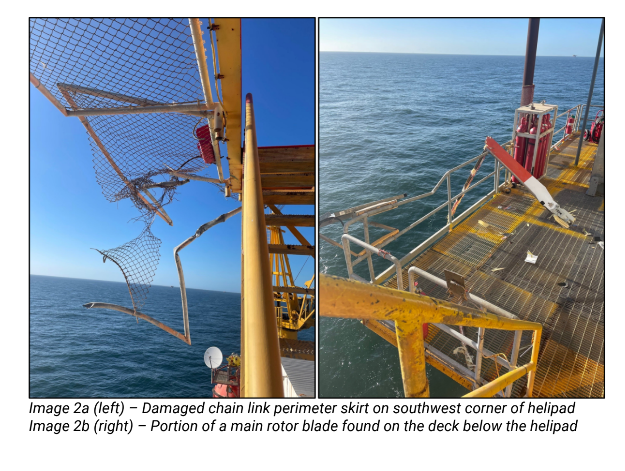
The belated 2022 BSEE tables also include a glaring error. The most important figure, the number of fatalities, is incorrect. Five workers died from US OCS incidents in 2022, not one. The fatal helicopter crash at the West Delta 106 A helideck on 12/29/2022 that killed four workers (photos below) is inexplicably not included.
Is the failure to include this fatal incident a regulatory fragmentation issue? OCS safety data should be reported holistically and should not be parsed based on perceived regulatory jurisdiction? In any event, the tragic accident at the West Delta 106 A platform occurred at the helideck, which per the MOA with the Coast Guard is under BSEE jurisdiction.
It’s unfortunate that 2023 data are not available, even in summary form. At a minimum, BSEE should be proudly reporting that 2023 was the first zero fatality year on the US OCS since at least 1963! While acknowledging that this outstanding achievement will be difficult to repeat, it most certainly deserves public attention.
Lastly, what about incident data for the offshore wind program? When will these data be posted?
Offshore facility decommissioning is a frequent target of Federal auditors given the complex financial and regulatory challenges. Unfortunately, the reviews have done little to better protect the public interest. As have previous inquiries, the new GAO report (attached for your convenience) calls for improved regulations and enforcement practices. That, of course, has been the objective for decades, but the problems have only worsened.
While the GAO recommendations are unsurprising, the body of the report is informative. Most notably, GAO (p. 29) raises a significant inconsistency on a key provision in the proposed decommissioning financial assurance regulations published last year:
One of the five criteria BOEM would no longer use under the proposed rule is demonstrated reliability, as shown by record of compliance with laws, regulations, and lease terms, among other factors. BOEM’s June 2023 regulatory analysis concluded this criterion is not a good predictive indicator of default on decommissioning obligations. However, BOEM and BSEE officials we spoke with told us that poor compliance records—such as safety and maintenance issues or delayed decommissioning obligations—can be an indicator of potential decommissioning noncompliance or financial stress.
Why was there such a disconnect between the opinions of BOEM and BSEE officials (who are directly involved with decommissioning) and BOEM’s decision not to include a company’s compliance record among the factors to be considered in determining the need for supplemental financial assurance? As pointed out here and here, safety performance is arguably the most important predictor of financial failure and decommissioning noncompliance.
The GAO report correctly acknowledges the difficulties in disqualifying operating companies. However, the regulations at 30 CFR § 250.135 specifically provide for disqualification for poor performance. While the regulations could be tighter, enforcing disqualifications regulations is dependent on persistence and strong support from management and DOI attorneys. Given the political risks associated with disqualifying operators, that support is often lacking.
Disqualification difficulties make it imperative that BOEM carefully consider past performance before approving lease assignments or determining financial assurance amounts. Provisions in 30 CFR §585.408 and §585.107 could have been used to disapprove assignments to Signal Hill, Fieldwood, Cox, and other problem operators. The failure to do so has significantly delayed decommissioning and increased public exposure to financial risks.
In some cases, lease assignments to unqualified companies have not only been approved but they have been facilitated by BOEM/MMS. The case of Platforms Hogan and Houchin, in the Santa Barbara Channel, is a particularly good example. (Did GAO inquire about the Inspector General report on this matter or ask why that report has still not been released?)
Most operating companies are responsible about planning for and fulfilling their decommissioning obligations. The problem is the exceptions, and they are not difficult to identify if you look at compliance data and obtain input from BSEE inspection personnel.
Other important decommissioning questions that need to be considered:
Given that decommissioning responsibility is divided between BSEE and BOEM, is regulatory fragmentation limiting their efficiency and effectiveness? Is coordination between BSEE and BOEM delaying action on fitness to operate and disqualification matters?
Less than a month ago BSEE issued an alert that addressed chronic and persistent helideck safety issues. This week BSEE again issued an alert (attached) following yet another near-miss. Per BSEE:
After receiving clearance for landing at an offshore helideck, the aircrew noticed upon landing that a section of the helideck’s safety skirting was not properly secured to the support structure and was blowing upward and downward due to the helicopter’s rotor downwash. This created an imminent hazard to safe helicopter operations with potentially catastrophic results.
The latest near-miss is yet another reminder that the muddled regulatory regime for helideck safety needs to be addressed. The most recent Coast Guard – BSEE MOA for fixed platforms only added to helideck regulatory uncertainty by assigning decks and fuel handling to BSEE and railings and perimeter netting to the Coast Guard. What about safety skirting? As is the case with all safety regulations, a holistic, systems based approach to helideck safety oversight is needed.
To their credit, BSEE has been addressing these helideck issues with safety alerts. Since they are bearing the responsibility for these incidents, they should have the unambiguous authority needed to take enforcement actions regardless of which helideck elements are involved.



 Bud's Offshore Energy (BOE)
Regulatory reform comments
Posted in energy policy, Offshore Energy - General, Regulation, tagged comments, Department of the Interior, drilling Safety leaders, pilot program, regulatory burden, regulatory fragmentation, regulatory reform on July 23, 2025| Leave a Comment »
My comments in response to the Dept. of the Interior’s regulatory reform notice are attached. First and foremost, I believe these recommendations would reduce safety and environmental risks. Second, I am confident that they would also reduce governmental costs and the regulatory burden on industry.
The first attachment discusses regulatory fragmentation and recommends actions to reduce the complexity and redundancy of the offshore regulatory regime. The second attachment proposes a Drilling Safety Leaders Pilot Program as a means of evaluating a more adaptable framework regulatory framework for operators with outstanding performance records.
Read Full Post »