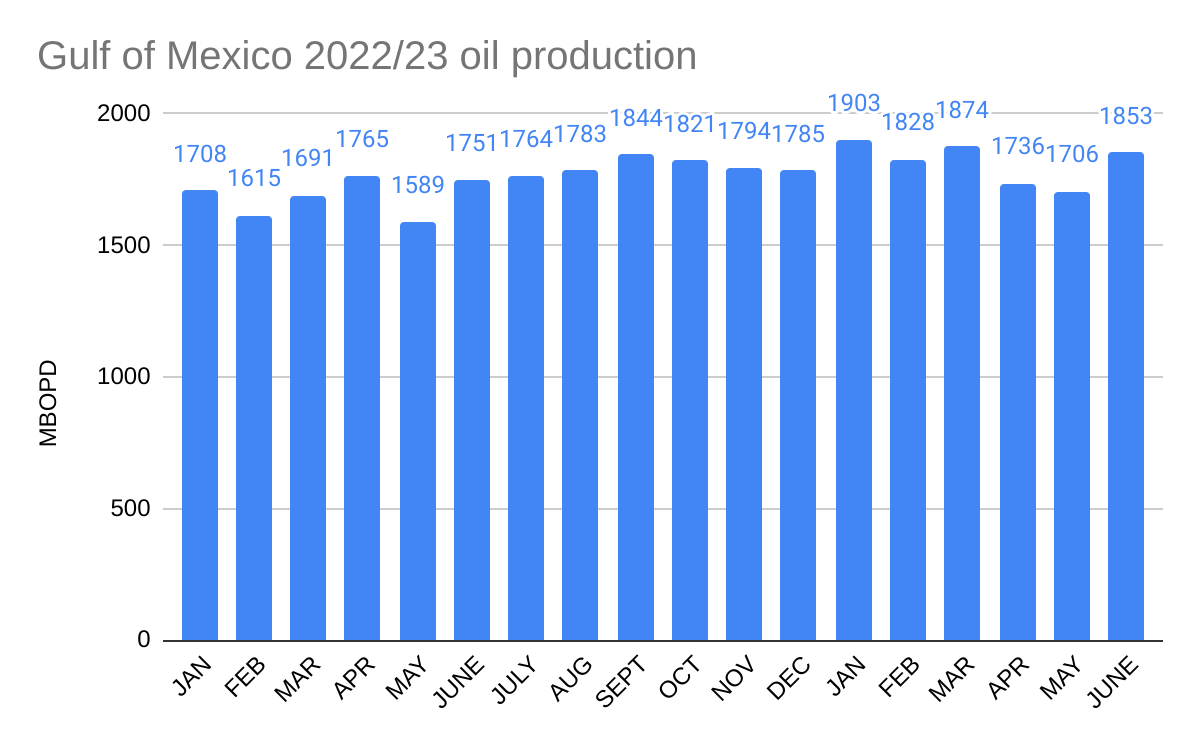
Gulf of Mexico oil production increased to 1.853 bopd in June which is more in line with production at the beginning of the year and the EIA 2023 forecast. Production remains well below BOEM’s 2.0 million bopd forecast for 2023.
Posted in Gulf of Mexico, Offshore Energy - General, tagged BOEM, EIA, Gulf of Mexico production on September 1, 2023| Leave a Comment »
Gulf of Mexico oil production increased to 1.853 bopd in June which is more in line with production at the beginning of the year and the EIA 2023 forecast. Production remains well below BOEM’s 2.0 million bopd forecast for 2023.
Posted in energy policy, Gulf of Mexico, Offshore Energy - General, tagged 5 year leasing plan, BOEM, EIA, Gulf of Mexico production, production forecast on August 3, 2023| Leave a Comment »
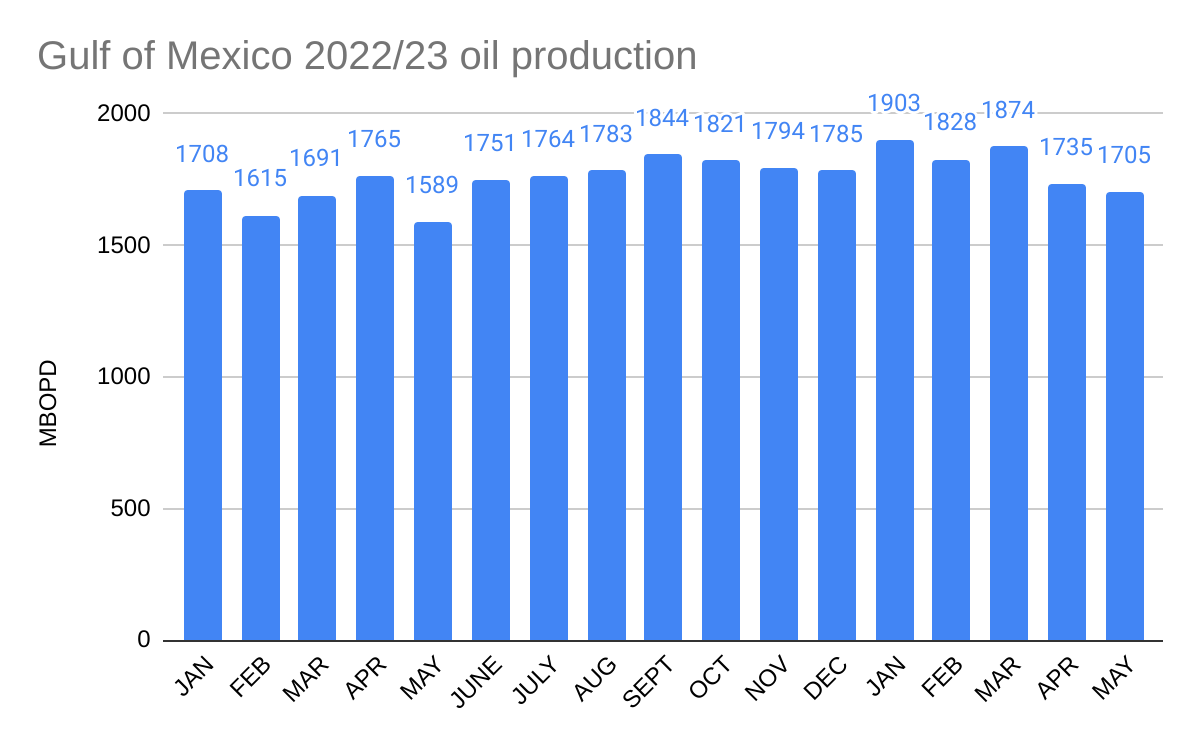
Gulf of Mexico 2023 oil production has dipped over the past 2 months, and is down 10% since January.
2023 production is reasonably well aligned with the EIA forecast which shows new production being offset by declines in existing fields.
Last year, BOEM forecast that production would average 2.0 million bopd in 2023. That forecast was justification for curtailing BOEM’s Proposed 5 Year Leasing Program. For the first time in the history of the OCS program, the primary concern of the program managers was that production might be too high for too long! This stunning quote from the 5 year leasing plan explains why so few lease sales were proposed:
“BOEM’s short-term (20-year) production forecast for existing leases shows steady growth from 2022 through 2024 and declining thereafter (see Section 5.2.1). The long-term nature of OCS oil and gas development, such that production on a lease can continue for decades makes consideration of future climate pathways relevant to the Secretary’s determinations with respect to how the OCS leasing program best meets the Nation’s energy needs.“
5 Year Leasing Program, p. 3
Posted in climate, flaring and venting, Gulf of Mexico, Offshore Energy - General, tagged EIA, flaring, gas-well gas, Gulf of Mexico, oil-well gas, ONRR, venting on May 3, 2023| Leave a Comment »
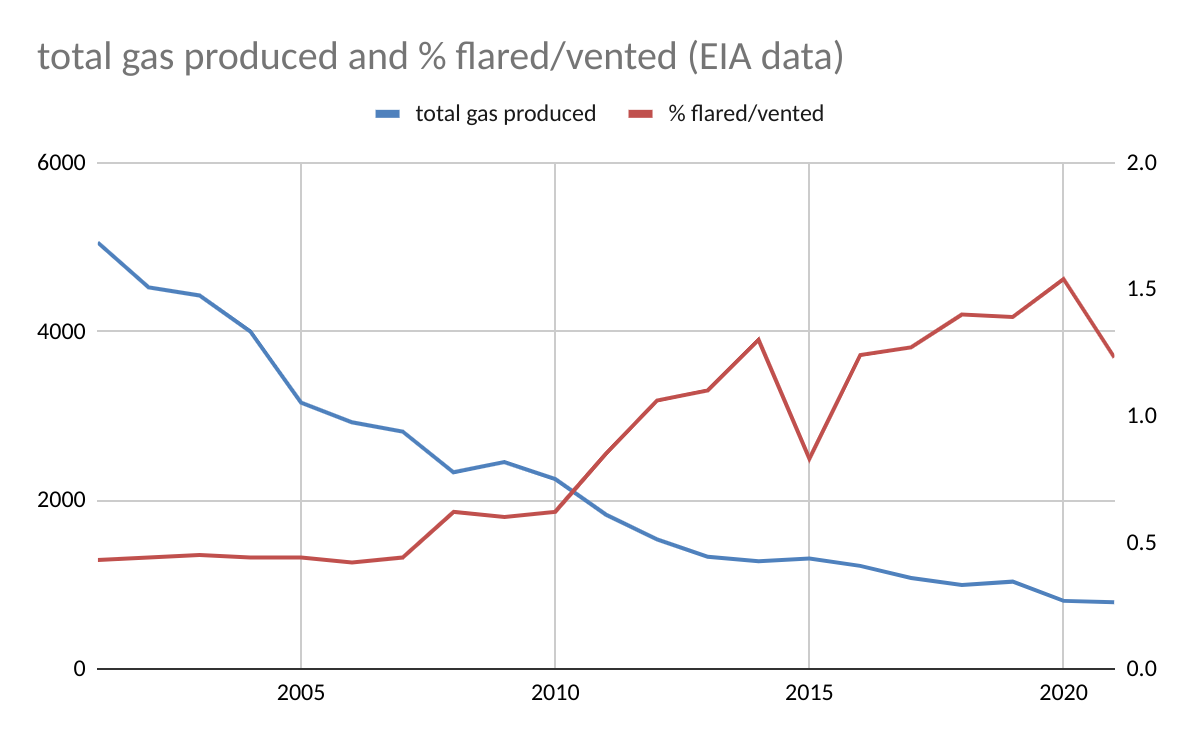
According to EIA data for 2001-2021, Gulf of Mexico flaring and venting volumes peaked in 2001 at 21.6 bcf, 2.25 times the volume flared or vented in 2022 (ONRR data for 2022). However, gas production in 2001 was 5.05 tcf, 6.4 times higher than in 2022. The % of the produced gas that was flared or vented in 2001 was thus 0.4%, less than 1/3 the 2022 rate of 1.22%.
Points to consider:
Posted in energy, energy policy, natural gas, tagged EIA, Energy Outlook 2023, natural gas production, oil production on March 17, 2023| Leave a Comment »
Yesterday, Lars Herbst attended the EIA’s Annual Energy Outlook presentation. The slides are attached.
Below is a custom chart from the EIA data tables. While EIA predicts growth in renewable generating capacity, US oil and gas production are nonetheless projected to increase slightly through 2050.

Posted in energy policy, Gulf of Mexico, Offshore Energy - General, tagged 5 year leasing plan, BOEM, EIA, Gulf of Mexico oil production, OCSLA, production forecasts on January 17, 2023| Leave a Comment »
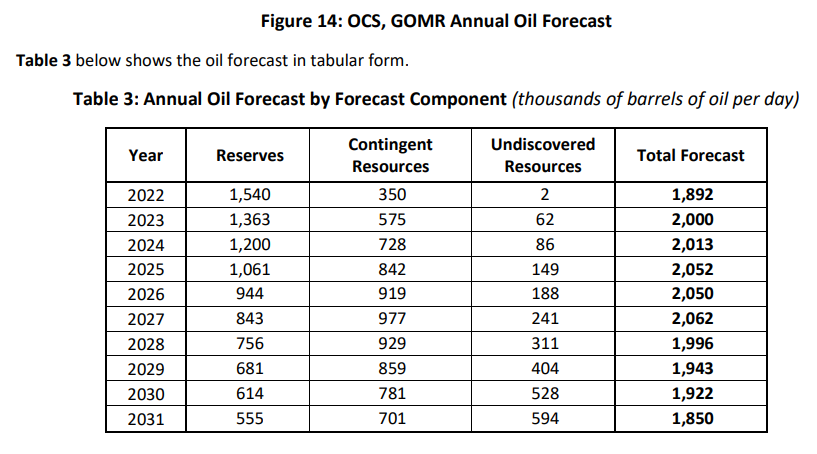
As is evident from the first table below, the EIA’s new short-term production forecast for the Gulf of Mexico differs significantly from the optimistic BOEM forecast.
The EIA 2022 figure is spot-on, as it should be given that 10 months of 2022 production data are now in hand. However, BOEM’s 2022 forecast (published in July) missed the mark considerably. (In fairness to BOEM staff, their work was probably completed months before publication pending internal reviews.)
Of greater concern, given the policy implications, is the rosy BOEM forecast for the out-years. Despite historically low levels of leasing and exploratory drilling, BOEM forecasts oil production to exceed 2 million BOPD through 2027 and to remain well above the current (2022) level through 2031 (second table below).
As previously noted, the authors of the proposed 5 year OCS leasing plan have used the BOEM forecasts to justify a skeleton leasing plan that is unprecedented in program history. Contrary to the OCS Lands Act’s mandate and EIA projections regarding future oil and gas consumption, the proposed leasing plan not so subtly announces the intention to phase out the offshore oil and gas program.
| 2022 | 2023 | 2024 | |
| EIA | 1.75 | 1.87 | 1.85 |
| BOEM | 1.892 | 2.000 | 2.013 |
Posted in Gulf of Mexico, Offshore Energy - General, tagged EIA, Gulf of Mexico production, July oil production on September 30, 2022| Leave a Comment »
Posted in energy, natural gas, tagged EIA, record natural gas consumption on September 15, 2022| Leave a Comment »
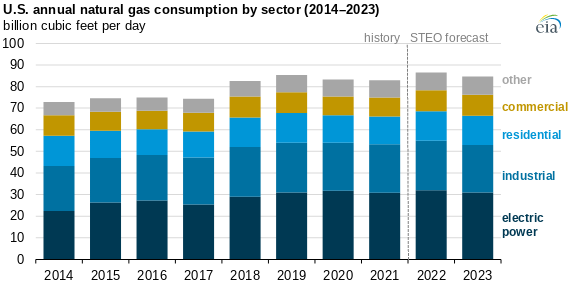
In our September Short-Term Energy Outlook (STEO), we expect natural gas consumption to increase by 3.6 billion cubic feet per day (Bcf/d) in the United States during 2022 to average 86.6 Bcf/d for the year, the most annual U.S. natural gas consumption on record. We forecast that U.S. natural gas consumption will increase in all end-use sectors this year. We expect the U.S. electric power sector to grow by 4% in 2022 to 32.1 Bcf/d, exceeding the 2020 record by 1%, which is the highest growth rate among all sectors.
EIA
Posted in climate, energy policy, Gulf of Mexico, Offshore Energy - General, tagged 5 year leasing plan, BOEM forecast, EIA, Gulf of Mexico production on September 1, 2022| Leave a Comment »
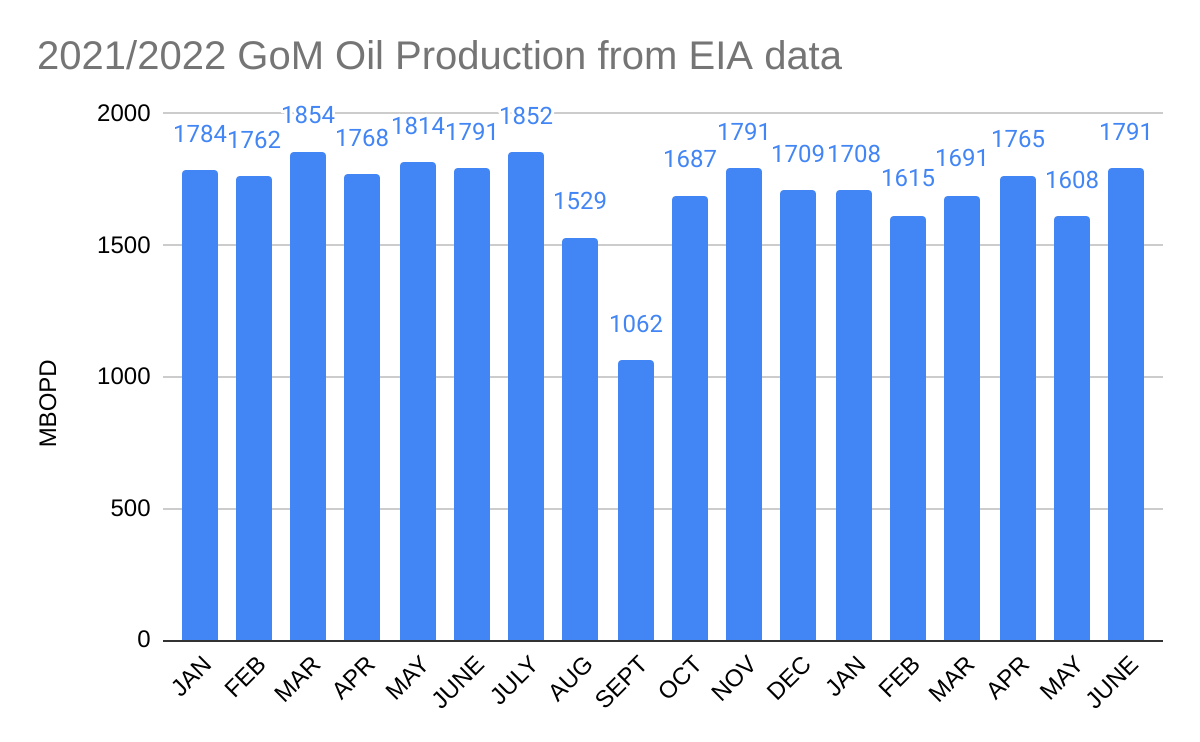
GoM oil production for June increased (see chart below) with King’s Quay and Spruance contributing to the uptick. Other anticipated 2022 startups are not yet producing.
The EIA production forecast for 2022 is proving to be pretty accurate. Kudos to them. However, BOEM’s 2022 forecast of 1.9 million bopd is not achievable and concerns about the intermediate and longer term persist. Unfortunately, BOEM’s highly optimistic forecast for 2022 and beyond, along with unrealistic expectations regarding the energy transition, have significant policy implications. This stunning quote from the 5 year leasing plan explains why so few lease sales were proposed:
“BOEM’s short-term (20-year) production forecast for existing leases shows steady growth from 2022 through 2024 and declining thereafter (see Section 5.2.1). The long-term nature of OCS oil and gas development, such that production on a lease can continue for decades makes consideration of future climate pathways relevant to the Secretary’s determinations with respect to how the OCS leasing program best meets the Nation’s energy needs.“
5 Year Leasing Program, p.3
Posted in Gulf of Mexico, Offshore Energy - General, tagged EIA, Gulf of Mexico production, production decline on July 29, 2022| Leave a Comment »
If last fall’s Hurricane Ida dip is excluded, the latest production figure in 2021/2022. New projects should boost production over the next 2 years, but not enough to reach the August 2019 peak of 2.044 million bopd.

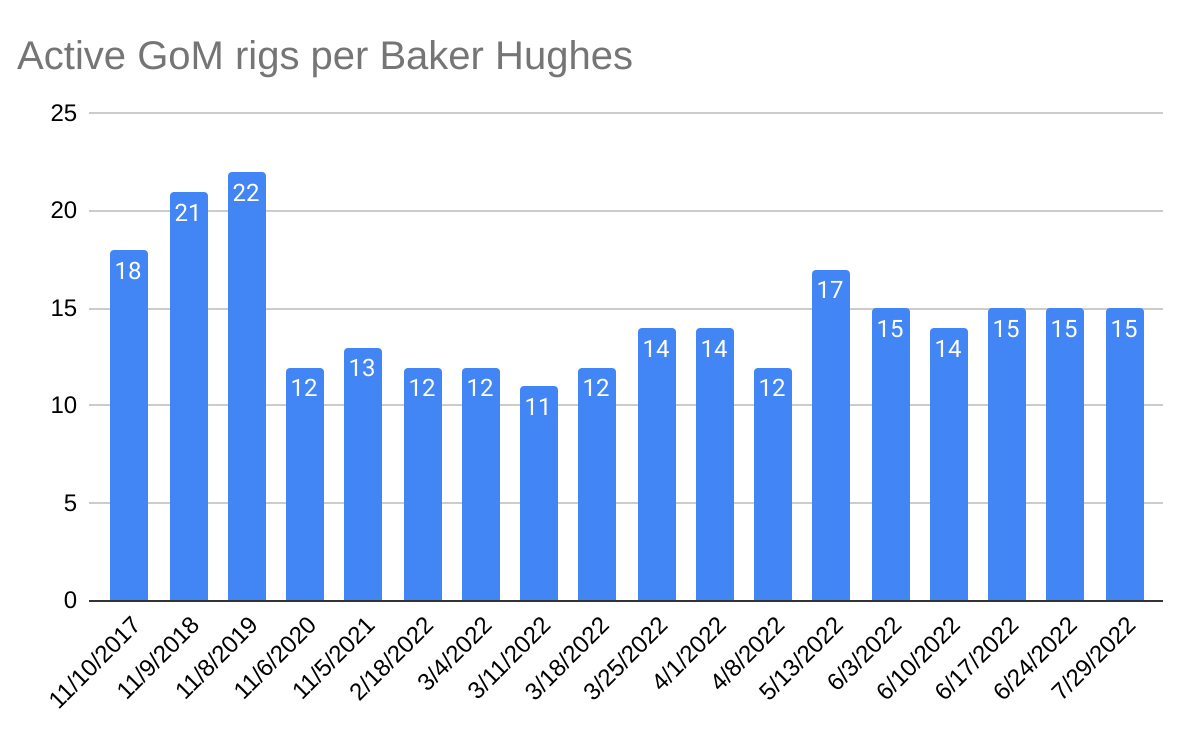
Meanwhile the GoM rig count remains sluggish at 15.
Posted in climate, energy policy, Gulf of Mexico, Offshore Energy - General, tagged 2022 production forecast, 5 year leasing plan, BOEM, EIA, Gulf of Mexico oil production, King's Quay on July 7, 2022| Leave a Comment »
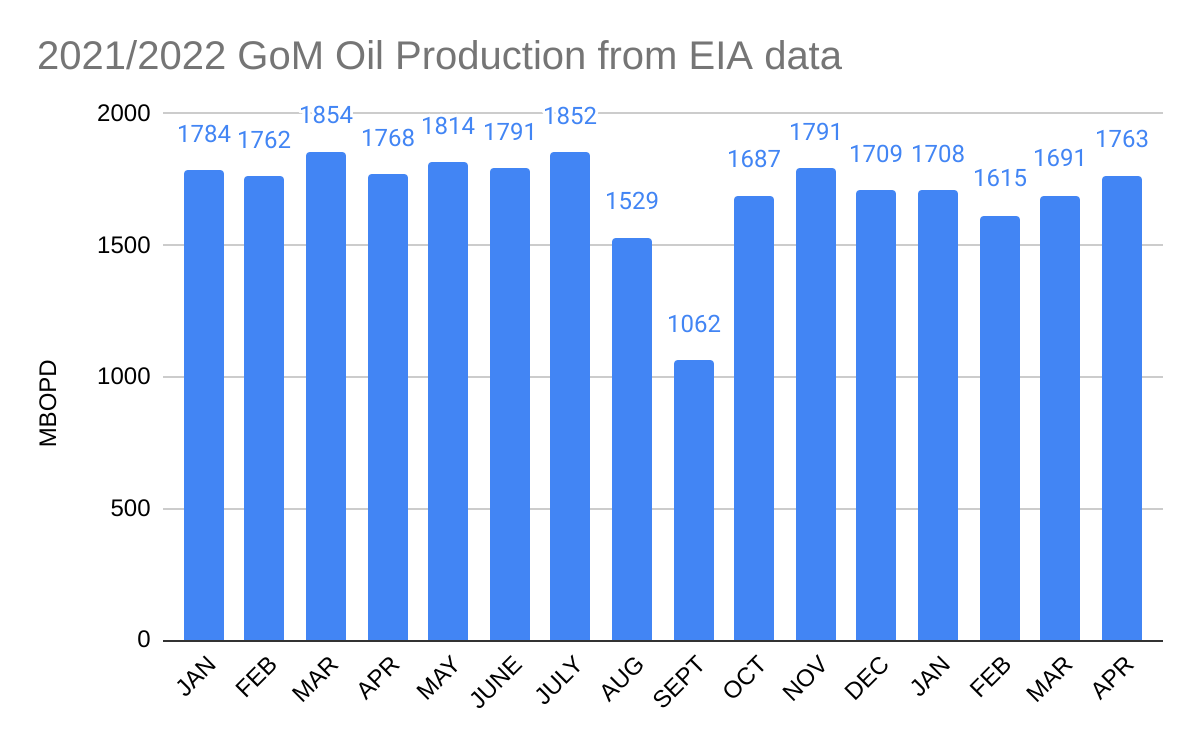
April production increased from March by 72,000 BOPD to 1.763 million BOPD. The increase is associated, at least in part, with Murphy’s King’s Quay field which began producing in early April. 2022 GoM production remains below the levels reached in the first 7 months (pre-Hurricane Ida) of 2021, and is well below BOEM’s forecasted 2022 production rate of 1892 MBOPD. Perhaps BOEM was assuming earlier startup dates for other projects that will begin production later this year or next year. The 2022 YTD dip in production points to the importance of sustained exploration and development.
BOEM’s short-term production forecast is considerably more optimistic than EIA’s. This optimistic forecast, along with unrealistic expectations regarding the “energy transition” are reasons for proposing so few lease sales in the new 5 year leasing program. The logic for this minimalist leasing program seems to be that future production is neither necessary nor desirable. Indeed the program implies that the long-term nature of offshore production is a liability and is justification for limiting OCS oil and gas leasing:
“BOEM’s short-term (20-year) production forecast for existing leases shows steady growth from 2022 through 2024 and declining thereafter (see Section 5.2.1). The long-term nature of OCS oil and gas development, such that production on a lease can continue for decades makes consideration of future climate pathways relevant to the Secretary’s determinations with respect to how the OCS leasing program best meets the Nation’s energy needs.“
5 Year Leasing Program, p.3
Basing leasing decisions on “future climate pathways” would seem to be a considerable stretch of the Secretary’s authority under the OCS Lands Act and may be inconsistent with the recent SCOTUS decision in West Virginia vs. EPA. A strategic shutdown of the offshore oil and gas program would dramatically increase energy supply and security risks going forward, and should be authorized by Congress.


