Feeds:
Posts
Comments

Posts Tagged ‘BSEE’

Among the more important workstreams of the International Regulators’ Forum, a group of offshore safety regulators, are country performance data which provide a means of measuring and comparing offshore safety performance internationally. As we near the midpoint of 2023, the last data posted are for 2020. This lag makes it difficult to assess current trends and risks.

In addition to more timely updates, there are significant holes in the IRF data sets. For example, per IRF guidelines fatalities associated with illnesses or “natural causes” are not counted; nor are helicopter incidents that are not in the immediate vicinity of an offshore facility. Also, incidents associated with geophysical surveys, many pipeline segments, and (inexplicably) subsea wells and structures are excluded (see excerpts below).

Excerpts from IRF Performance Measurement Guidelines:

  • Exclude Geophysical and Geotechnical surveying and support vessel operations not directly associated with activities at an Offshore Installation
  • Exclude horizontal components associated with incoming and outgoing pipelines and flowlines beyond either the first flange at the seabed near an Offshore Installation or a 500 meter radius, whichever is less.
  • Exclude helicopter operations at or near an Offshore Installation
  • Exclude mobile or floating Offshore Installations being transported to or from the offshore location.
  • Exclude subsea wells and structures.
  • Do not include Fatalities and Injuries that are self-inflicted.
  • Do not include Occupational Illnesses in Fatality or Injury counts.
  • Do not include fatalities that are due to natural causes.

Perhaps the IRF can consider these and other data collection and publication issues at their next conference. Because voluntary incident reporting schemes have always suffered from incomplete or selective reporting, the regulators have to drive incident data collection and transparency.

Parallel US concerns about offshore incident data: After a review of BSEE fatality data provided in response to a Freedom of Information Act request, WWNO reported that “nearly half of known offshore worker fatalities in the Gulf of Mexico from 2005 to 2019 didn’t fit BSEE’s reporting criteria.” They noted that 24 of the 83 known offshore worker fatalities during that period were classified as “non-occupational.” (As previously posted, the rash of “natural cause” deaths (12) at Gulf of Mexico facilities in 2021 and 2022 is particularly troubling and warrants further investigation.)
Read Full Post »

BSEE will continue to evaluate the process for issuing decommissioning orders and will continue to issue decommissioning orders to jointly and severally liable parties on a case-by-case basis.

Final decommissioning rule (preamble). 4/18/2023

Although the news release for BSEE’s final decommissioning rule asserts that the regulations “provide the certainty requested by industry,” that does not seem to be the case. The main change in the final rule was to delete the reverse chronological order (RCO) provision which called for issuing decommissioning orders to the most recent predecessor first. Instead, BSEE may continue to issue decommissioning orders arbitrarily.

While deleting the RCO provision may be advantageous for the regulator, and in some cases for the public, claiming that the decision provides certainty for industry is quite a stretch. BSEE may continue to issue a decommissioning order to anyone in the ownership chain, whether the company was a recent lessee or one that had owned the lease decades ago. Original or early lessees may be held liable for decommissioning old facilities regardless of subsequent damage, modifications, or neglected maintenance.

The absence of a defined procedure for issuing decommissioning orders may also expose BSEE to new legal challenges, particularly in cases where a company has not held the lease for decades. A 1988 letter from the Director of the Minerals Management Service to Amoco (attached below) explicitly relieves the assignor (predecessor) of decommissioning liability after the lease has been assigned. A revised bonding rule published on May 22, 1997 reversed that policy, but decommissioning liability for leases assigned prior to the 1997 rule may still be very much in question.

Another concern is the split jurisdiction for decommissioning between BSEE and BOEM. The financial, land management, operational, and environmental aspects of decommissioning are inextricably intertwined and attempts to divide these responsibilities between two bureaus with separate regulations is a prescription for gaps, overlap, inconsistency, inefficiency, disputes, and confusion. Decommissioning should be regulated holistically, not with separate “BOEM-only” and “BSEE-only” regulations.

Finally, wind facility decommissioning may prove to be even more challenging given the higher facility density and economic uncertainties. The regulatory regime needs to be clearly established early in the development phase.

Related posts:

Read Full Post »

This comment from Save LBI (Long Beach Island, NJ) on BOEM’s Renewable Energy Modernization Rule (proposed) highlights an important regulatory policy consideration:

Promoting the offshore wind program is a very high BOEM priority. The bureau is charged with deploying 30 gigawatts of offshore wind energy capacity by 2030, which requires extensive advocacy. However, BOEM is also a core regulator for offshore wind projects, and the concern is that their regulatory role could be compromised by their advocacy priorities.

Per Notice to Lessees 2023 N-01, which arguably should have been published for public comment given its regulatory significance, BOEM has retained important responsibilities for wind project development and operations. These include review and approval of construction and operations plans, site assessment plans, and general activities plans. BOEM may also exercise enforcement authority through the issuance of violation notices and the assessment of civil penalties.

BOEM exists because in 2010 the Administration wanted to separate the OCS program’s leasing (sales/advocacy) and safety (regulatory/enforcement) functions. The intent was to avoid conflicting missions (or the appearance thereof) in the post-Macondo era. (More on this in an upcoming post.)

Ironically, the Save LBI comment describes BSEE as “a distinct unit within BOEM.” That may seem to be the case, but BSEE is actually a separate bureau in the Department of the Interior.

Read Full Post »

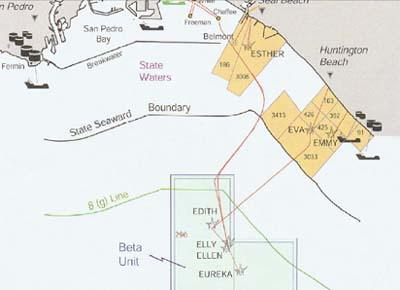
HOUSTON, April 10, 2023 (GLOBE NEWSWIRE) — Amplify Energy Corp. (“Amplify” or the “Company”) (NYSE: AMPY) today announced that it has received the required approvals from federal regulatory agencies to restart operations at the Beta Field. Initial steps to resume full operations will involve filling the San Pedro Bay Pipeline with production, a process which commenced over the past weekend and is expected to take approximately two weeks to complete. Following the line fill process, the pipeline will be operated in accordance with the restart procedures that were reviewed and approved by the Pipeline and Hazardous Materials Safety Administration (PHMSA).

Amplify Energy

Odd that the news release didn’t mention BSEE, the agency which would have had to approve the resumption of production.

18 months after the pipeline spill near Huntington Beach, settlements have been reached, fines have been paid, and production from the Beta Unit has resumed, but the Federal investigation report is still unavailable. Why?

Also, per our 10/6/2021 post:

One would hope that this spill will lead to an independent review of the regulatory regime for offshore pipelines. Consideration should be given to designating a single regulator that is responsible and accountable for offshore pipeline safety (a joint authority approach might also merit consideration) and developing a single set of clear and consistent regulations.


Read Full Post »

In the past 2 years, at least 12 workers died suddenly at Gulf of Mexico facilities from “natural causes.” BSEE’s recent medical evacuation presentation provided information on 6 non-operational fatalities that occurred in 2022:

7/28: Employee (galley hand) was found in the bathroom non‐responsive with minimal electrical activity indicated on the EKG.

8/2 Advised of person down in the galley/T.V. area. Upon arrival in the area observed person on the floor being held by his supervisor. A white foam was coming out of his mouth and nose. Placed him on his side in order for the foam to drain. He was breathing and had a faint pulse. It was observed that he then appeared to stop breathing. Unable to find a radial or carotid pulse. CPR was started and AED was retrieved. AED instructions were followed. A shock was administered and CPR continued for approximately 50 minutes with no pulse or response.

8/18: Contract Personnel (CP) complained of not feeling well and went to his assigned room. It was noticed that CP did not come down for lunch and other personnel went to check on CP and CP was unresponsive.

9/7: CI was in galley of the M/V GO Triumph, waiting on weather, with co‐workers, when he made an exclamation and collapsed to the floor. Co‐workers and contract safety technician immediately ran to his aid. Breathing was sporadic for a minute then ceased and he was unresponsive.

9/23: At approximately 8:20 AM on September 23rd, platform personnel discovered an unresponsive employee (IP) face down on the deck. IP was rolled onto his back, evaluated, and CPR began. Other personnel were dispatched to retrieve AED and medical supplies, while one went to make notifications. Shortly after, personnel arrived with the AED, and it was applied to the IP. Personnel continued CPR while waiting for medical evacuation helicopter. At approximately 12:00 PM, IP was removed from facility by medical evacuation helicopter and subsequently, formally, pronounced dead.

10/21: Employee was assisting production personnel fueling the crane when he suddenly collapsed onto the platform deck and became unresponsive. Personnel on the platform quickly responded and immediately applied an AED to the Employee and began CPR. A medivac aircraft was dispatched for medical support assistance while platform personnel continued to resuscitate the
employee. Medivac personnel arrived on location and relieved personnel working on employee. Following an unsuccessful attempt to revive the employee, he was transported to Houma, La. and released to the Terrebonne Parish Coroner’s Office. Workers on the platform stated the employee was acting normal during breakfast time and during the morning safety meeting. The employee did not complain of any type of illness during the morning time prior to the event occurring.

Why are screened and presumably healthy offshore workers dying suddenly at what seems to be a historically high rate? Is this happening elsewhere in the offshore world? Is anyone investigating this disturbing trend? if not, why not?

As suggested in a previous post, further investigation should be a high priority for the Coast Guard and BSEE with appropriate medical assistance.

Read Full Post »

15 years ago the Minerals Management Service pushed hard for better offshore medevac capabilities. Harlan King, the father of an offshore worker whose injuries were exacerbated by the delayed medical response, was the main impetus behind this effort. The industry responded favorably and Mr. King, BP, and Petroleum Helicopters Inc received Offshore Leadership Awards in 2009 for their initiatives. This 2009 article describes PHI’s dedicated medevac capabilities at the time.

The number of “non-occupational” fatalities (at least 6) at US OCS facilities in 2021 suggests that medical care and evacuation capabilities are once again a concern. BSEE is therefore applauded for their medical evacuation assessment initiative. Their recent presentation is attached.

BSEE’s presentation describes 6 more “non-operational” fatalities in 2022, and raises concerns about CPR training deficiencies, evacuation challenges posed by stairways, and the absence of medics at some facilities. BSEE’s findings (pages 14-21 of the presentation) are eye-opening and merit the attention of all operators, contractors, and others interested in offshore facility safety.

While historical data on health-related OCS fatalities are not readily available, 12 such fatalities over the past 2 years seems high relative to past experience, particularly given that the total number of hours worked has declined by more than 50% since 2011. As suggested in our 2 February post, further investigation into this disturbing trend is warranted. Given the sensitivity of the topic, it would seem best for the Coast Guard and BSEE, with appropriate medical assistance, to conduct this review.

Read Full Post »

The most common causes of offshore fatalities and serious injuries, falls and being struck by equipment, receive little media attention because there is no blowout, oil spill, or fire. However, these are often the most difficult types of incidents to understand and prevent. Human and organizational factors predominate, and prevention is dependent on a strong culture that emphasizes worker engagement, awareness, teamwork and mutual support, effective training and employee development, risk assessment at the job, facility, company, and industry levels, stop-work authority, innovation, and continuous improvement.

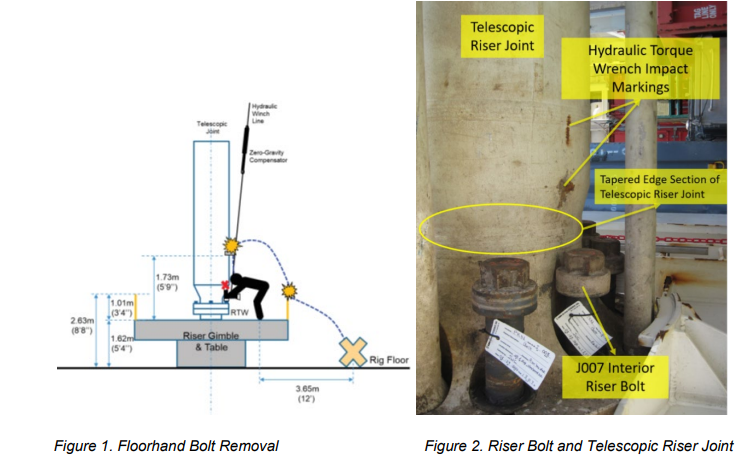
This new BSEE Safety Alert addresses such a fatal incident on the Pacific Khamsin drilling rig, and makes recommendations that have widespread applicability.

Incident summary:

While unlatching the lower Marine Riser Package from the Blowout Preventor in preparation for ship relocation, a crewmember was lifted into the air after being struck by a hydraulic torque wrench (HTW), hitting a riser clamp approximately six feet above the elevated work deck before falling to the rig floor. The crew member was given first aid and transported to the drillship’s hospital, where he was later pronounced deceased.

In an upcoming post, BOE will provide historical fatality data by cause and operations category.

Read Full Post »

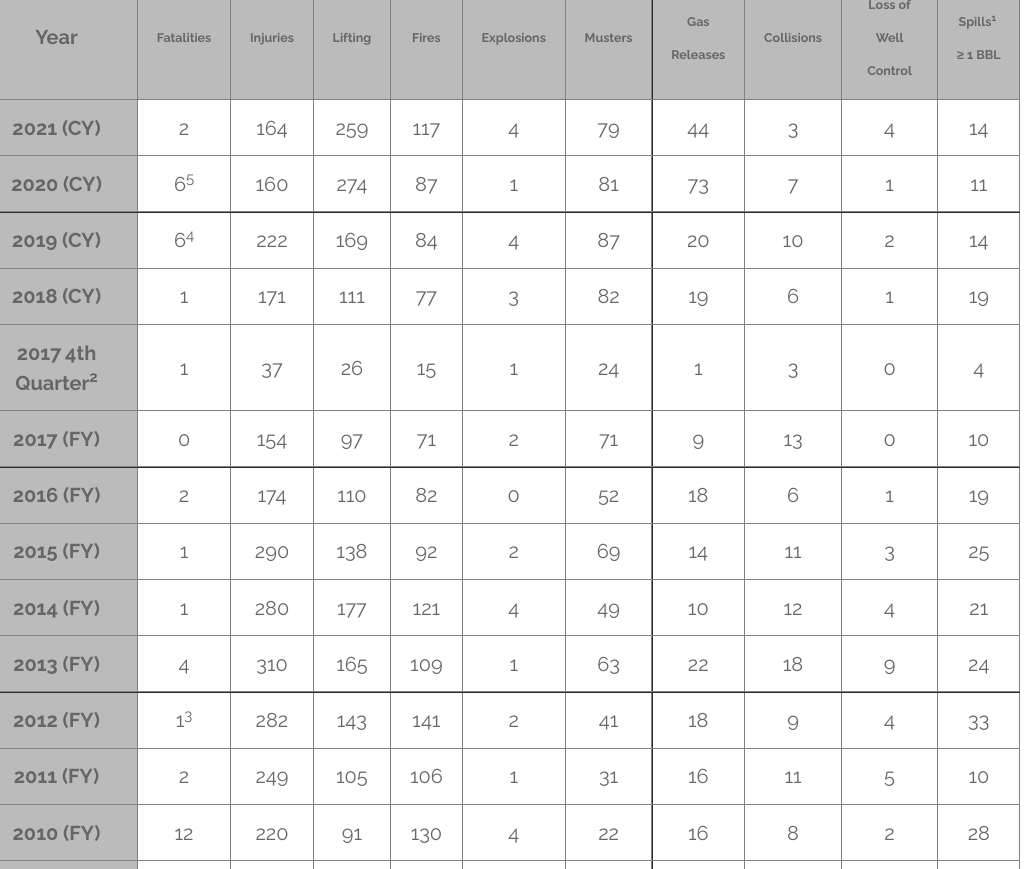
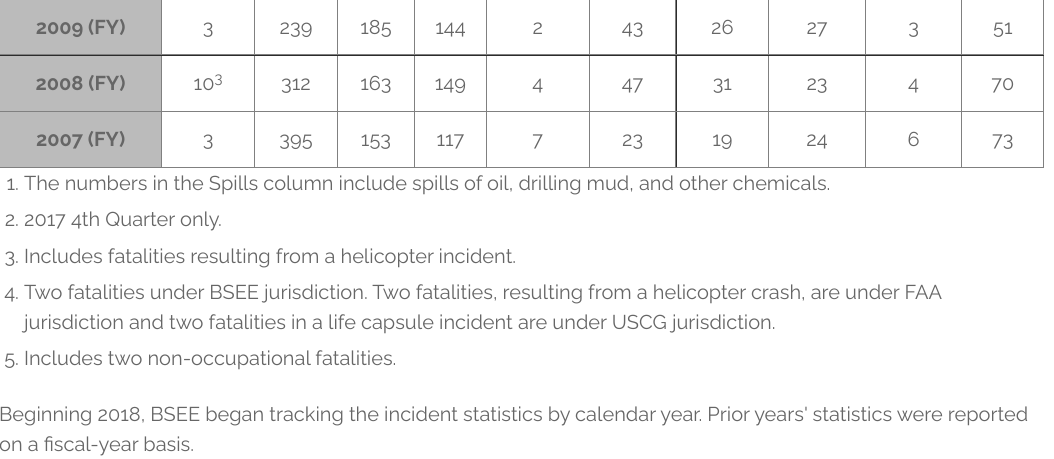
BSEE has posted the 2021 incident data for US OCS oil and gas operations. While the 13 month publishing lag is disappointing, the spreadsheet (below the table at this link and attached at the end of this post) appears to be comprehensive and complete.

Of the 8 fatalities in 2021, 6 are classified as “non-occupational” and are thus not included in the 2021 fatality count (see table below).

The 2 occupational fatalities are the result of falling metal plates on a drilling rig and the release of casing pressure on a production platform. These fatalities are still being investigated.

The 6 non-occupational fatalities on OCS facilities also merit further attention. While historical data on health-related OCS fatalities are not readily available, 6 such fatalities seems high relative to past experience, particularly given that the total number of hours worked has declined by more than 50% since 2011. Are these and other health related questions being considered?

  • Were covid or covid related health issues a factor?
  • Are health screening programs sufficient, particularly for contractors? Contractors are 80% of the workforce but accounted for 100% of the 2021 fatalities?
  • Are offshore medical care and evacuation capabilities sufficient?

Read Full Post »

“Former U.S. Rep. David Rivera, a well-connected Florida Republican, has been arrested on federal charges that include failing to register as a foreign agent. The case centers on Rivera’s signing of a $50 million contract with Venezuela’s government in early 2017, and his subsequent attempts to thaw Venezuela’s icy relationship with the U.S.”

NPR

Perhaps Mr Rivera’s conduct at a 2012 hearing on Cuban offshore drilling was a hint of things to come. Mr. Rivera inappropriately pressed BSEE, represented by Lars Herbst, to find ways to “bleed” Repsol should there be an incident while they were drilling in Cuban waters.

So, we need to figure out what we can do to inflict maximum pain, maximum punishment, to bleed Repsol of whatever resources they may have if there is a potential for a spill that will affect the U.S. coast. So, I hope you will look into that and verify that for us.”

Congressman David Rivera, 2012 Hearing on Cuban offshore drilling

Read Full Post »

David Scarborough, Island Operating Co. employee who died in the crash.
  • The bodies of the 4 victims have been recovered.
  • The 3 offshore workers were employees of Island Operating Co., a production contractor. The pilot worked for Rotorcraft Leasing Company, the owner of the Bell 406 helicopter that crashed. The platform is owned by Walter Oil and Gas, the operating company.
  • A preliminary FAA report confirms that the helicopter crashed onto the helideck during takeoff, breaking apart and falling into the Gulf.
  • 4 passengers had been dropped off at the platform before the fatal takeoff. Presumably there were witnesses to the incident.
  • According to the FAA report, the platform was located at West Delta Block 106. Per the BOEM platform data base, the platform was installed in 1994, is in 252′ of water, and is continuously manned.
  • Per the BSEE INC data base, the platform had not been cited for any violations since 2016.

Lacy Scarborough, wife of victim David Scarborough, is pregnant. Tragically, the couple lost their first child in an accidental drowning in March. David was heading home for the holidays after completing his 2 week shift on the platform. He had worked offshore for 8 years. Per Lacy, David’s last message was that he was taking off and would be home soon.

The only other victim who has been identified is Tim Graham of Quitman, Mississippi.

I trust that the NTSB will conduct a timely and thorough investigation, and hope they consider offshore helideck oversight, both in terms of industry programs and government regulation. The most recent Coast Guard – BSEE MOA for fixed platforms added to helideck regulatory uncertainty by assigning decks and fuel handling to BSEE and railings and perimeter netting to the Coast Guard. This is the antithesis of holistic, systems-based regulation.

More on the crash: ominous message, update #3

Read Full Post »

« Newer Posts - Older Posts »