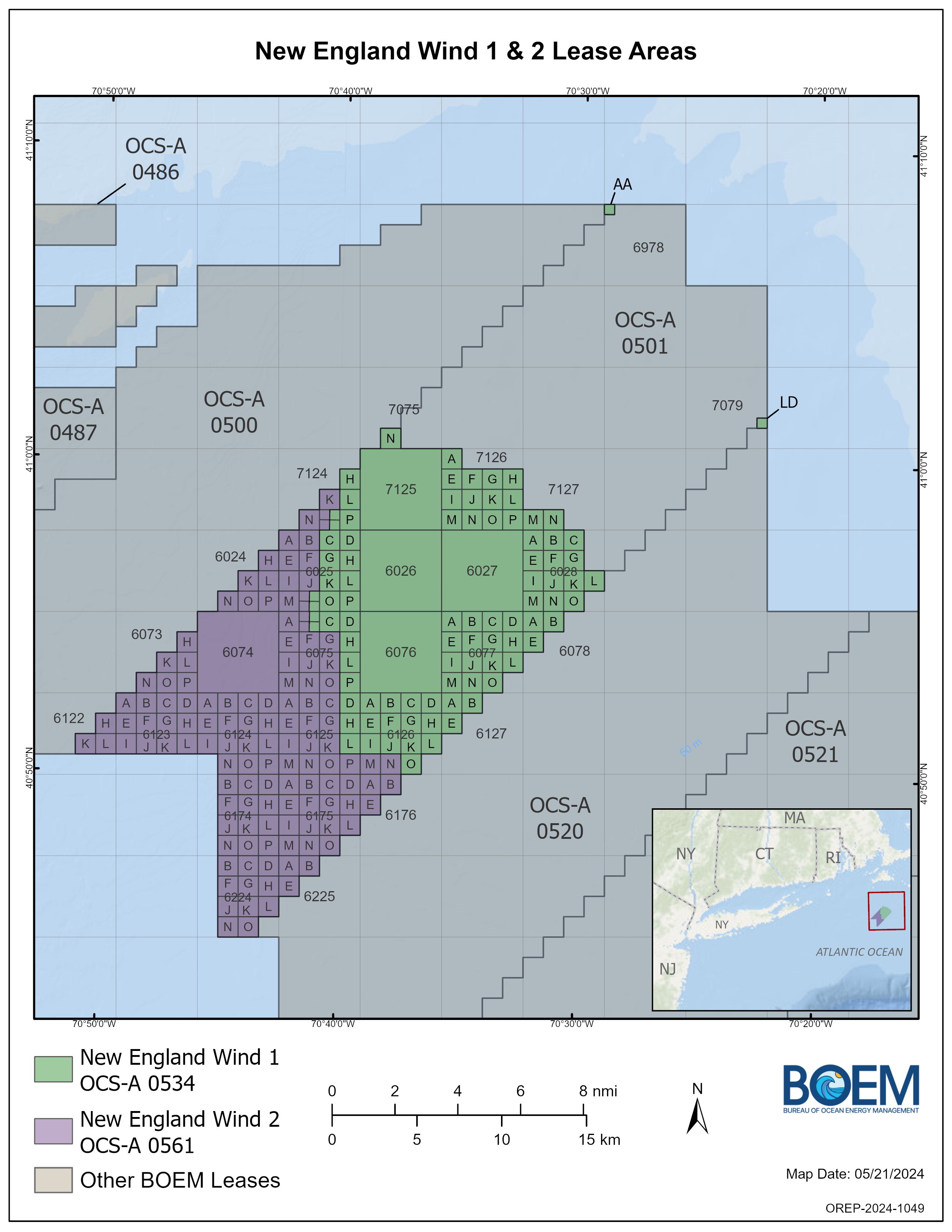
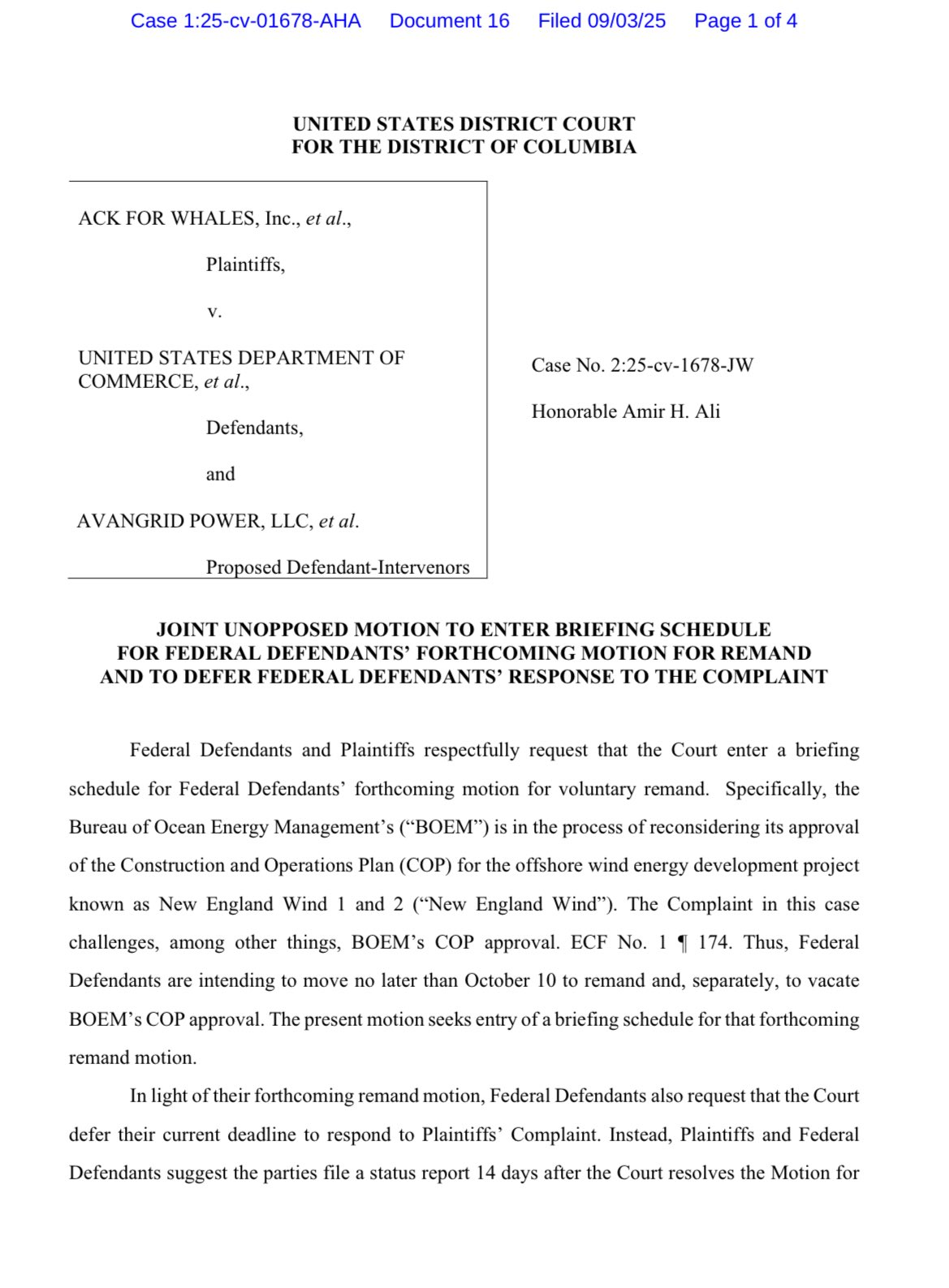
See below. BOEM is reconsidering its approval of the Construction and Operations Plan (COP) for New England Wind 1 and 2. The operator, Avangrid (Spain), is also a partner in the troubled Vineyard Wind project.
If you are keeping score, the approval of these COPs is being reconsidered:
Other projects: Work has been stopped on the Revolution Wind project. Work was previously halted on the Vineyard Wind and Empire Wind projects, but has been allowed to resume. BSEE has still not published its report on the Vineyard Wind turbine blade failure that occurred on 7/13/2024. Other projects have been suspended by the owners at their own initiative (e.g. Atlantic Shores South, Gulf of Maine, Starboard Wind, Vineyard Wind 2, Beacon Wind). Meanwhile, litigation abounds!
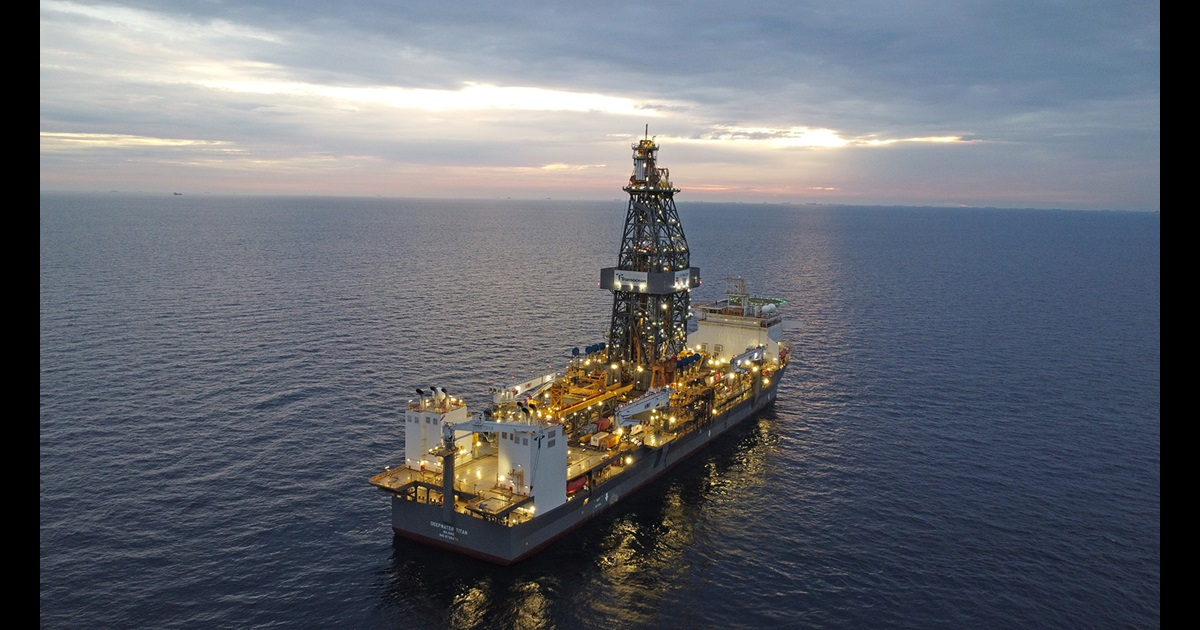
The latest Baker Hughes Rig Count Report shows only 10 rigs actively drilling in the Gulf. All are at deepwater locations – 7 in the Mississippi Canyon area, 2 in Green Canyon, and 1 in Alaminos Canyon. Per the BSEE borehole file, Shell accounts for most of the current MS Canyon wells and the Alaminous Canyon well. Beacon is also drilling in the MS Canyon, and the Green Canyon well appears to be a Chevron operation.
Only Anadarko/Oxy, Beacon/BOE, BP, Chevron/Hess, Shell, and Talos have spudded deepwater exploratory wells in 2025 YTD. Arena and Cantium are the only shelf drillers – all development wells.
Technological advances and extensions of past discoveries have sustained Gulf production, but declines are certain over the longer term if drilling activity doesn’t increase. Oil price uncertainty is an issue, but that’s always the case. Semiannual lease sales are now legislatively required and the terms will be attractive, so those issues are off the table. Let’s see what the bidding looks like at the upcoming sale.
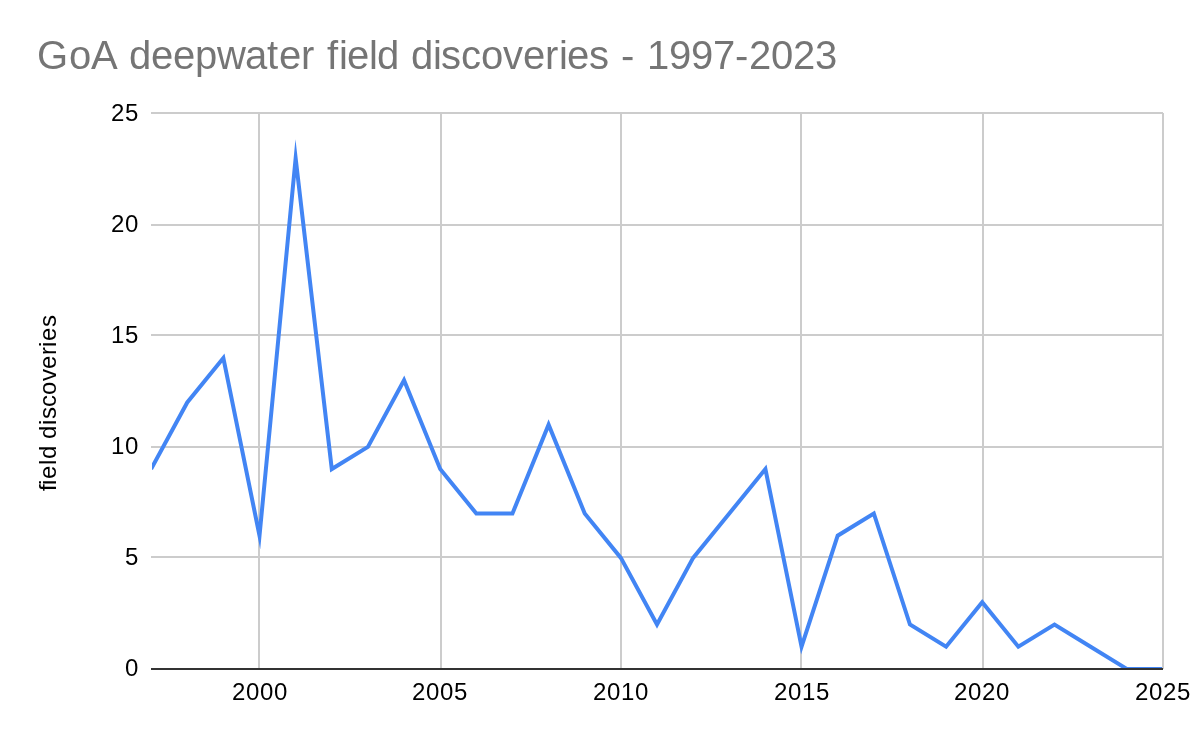
The decline in deepwater discoveries (BOEM data below) is particularly discouraging. Per BOEM, the last deepwater field discovery was in March 2023.
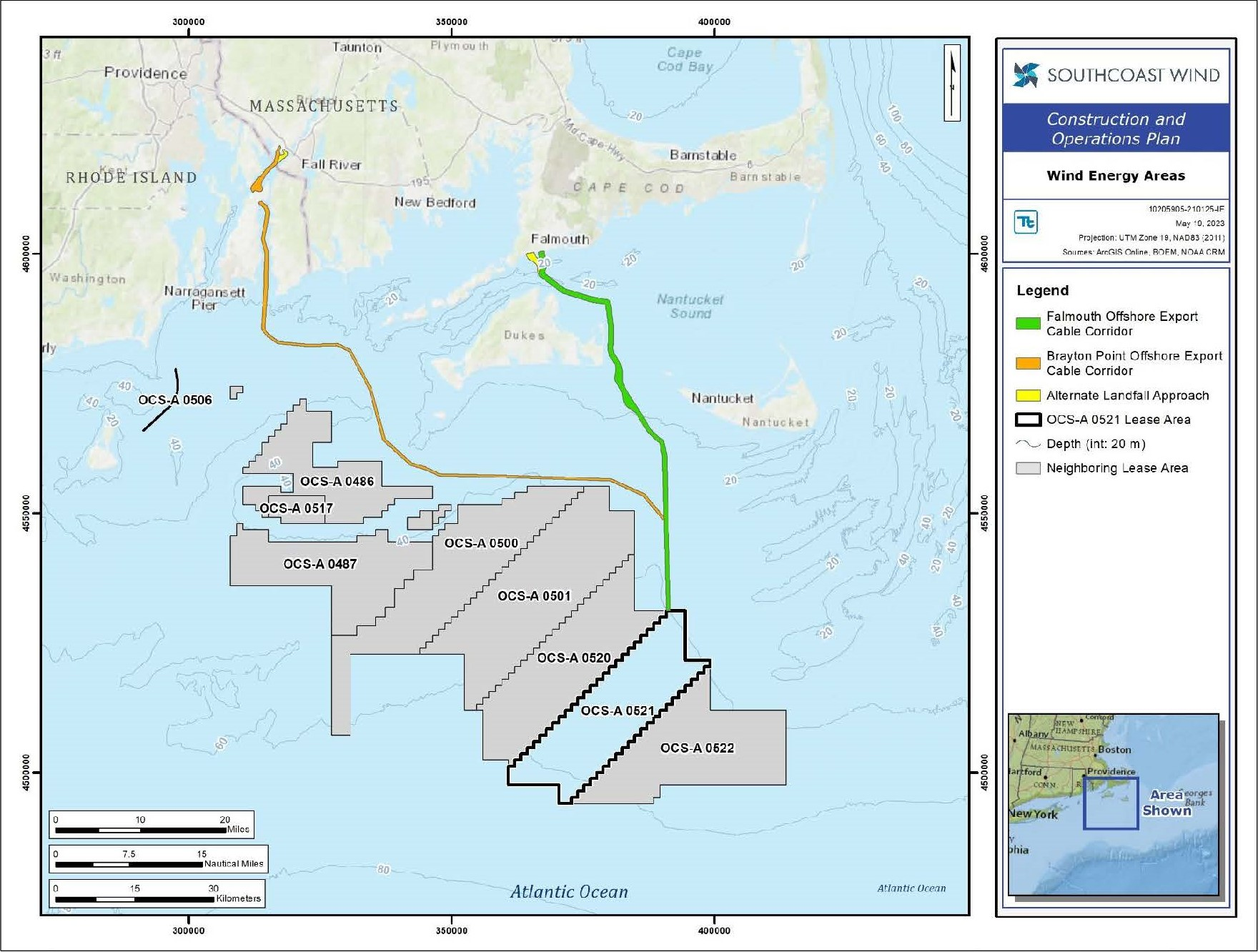
The Construction and Operations Plan (COP) for the SouthCoast Wind project was approved during the last week of the Biden Administration. That approval has been challenged by the Town and County of Nantucket. Ocean Wind, a joint venture of EDP Renewables (Portugal) and ENGIE (France), is the leaseholder.
As is the case for Maryland Wind, a court filing (attached) indicates that DOI is reconsidering the approval of the SouthCoast Wind COP. Construction has not begun on this project.
A further deferral of Federal Defendants’ responsive pleading deadline in this case is needed because Interior intends to reconsider its COP approval and will therefore be moving for a voluntary remand of that agency action by September 18, 2025.
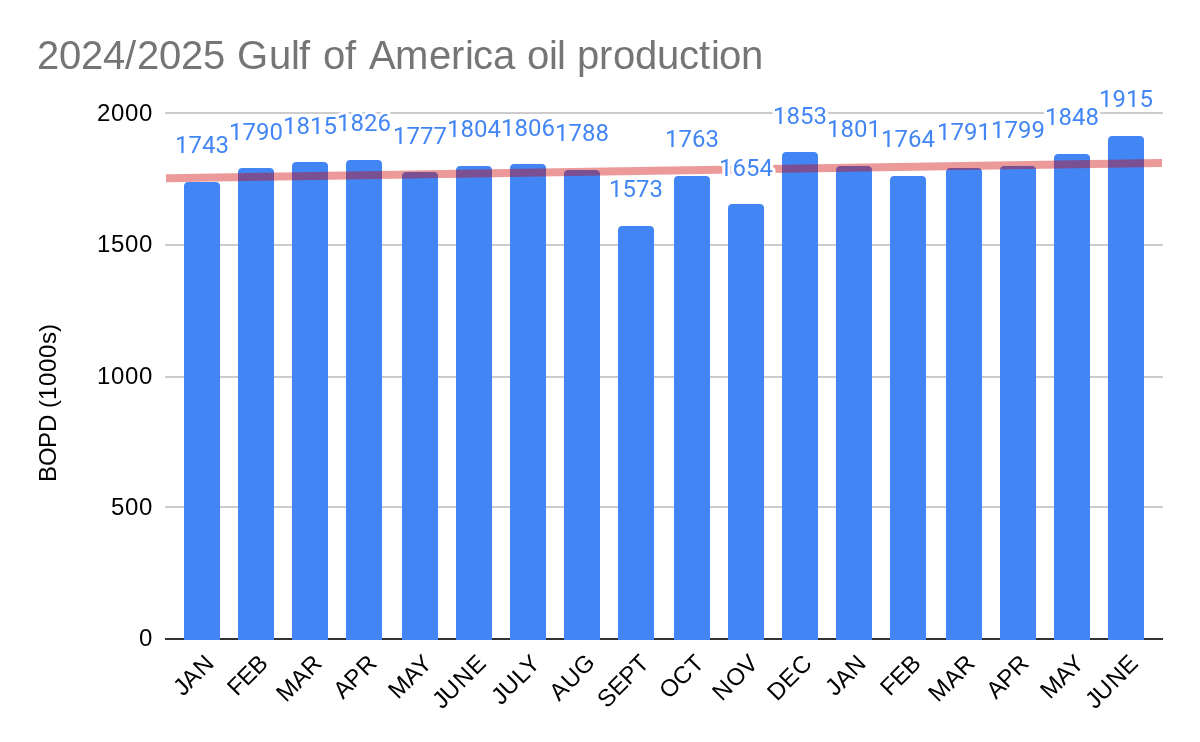
The average oil production rate for the Gulf OCS was 1.915 million bopd in June, the highest rate since Oct. 2023 and thus the highest in the history of the Gulf of America 😉.
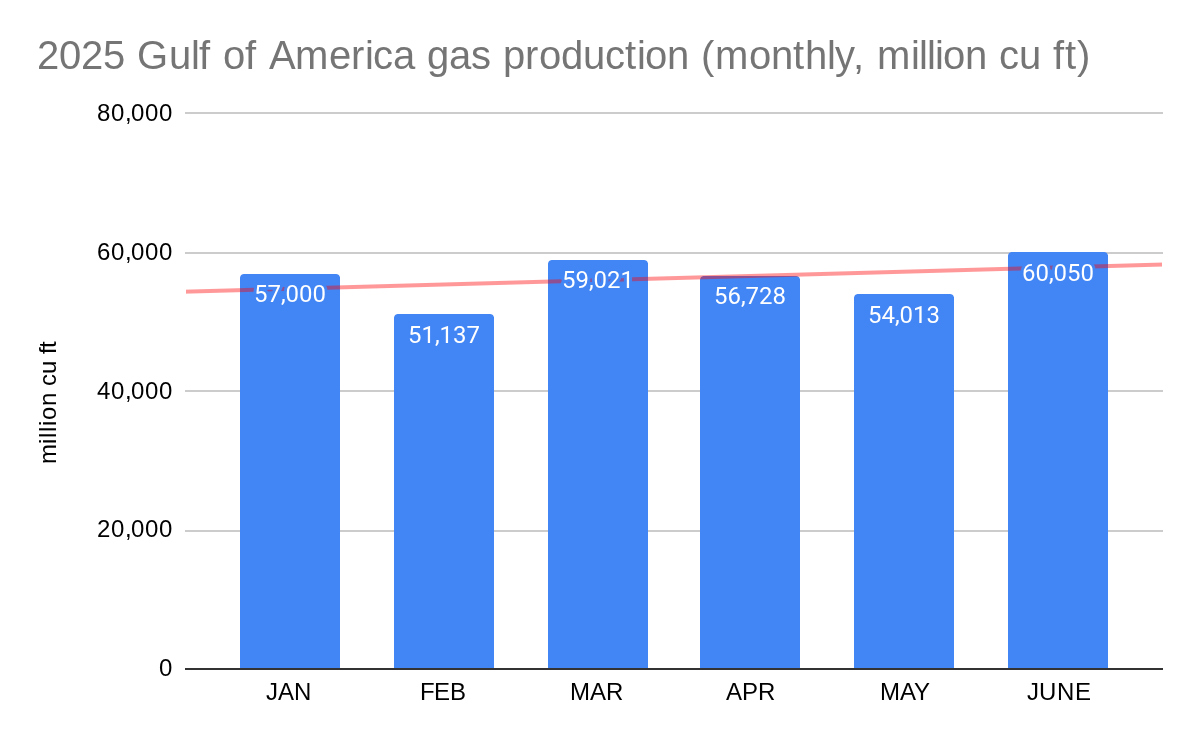
Natural gas production, which is now primarily from oil wells (i.e. associated gas) and is thus more closely linked to oil production rates, increased by >10% in June to over 60 bcf. As was the case for oil, gas production was the highest since Oct. 2023.
It is now peak hurricane season, so the eyes of production forecasters are focused on the tropics. Few need to be reminded about what happened 20 years ago when Hurricanes Katrina and Rita roared through the Gulf, preceded by Hurricane Ivan “The Terrible” one year earlier. Those 3 hurricanes triggered major improvements in hurricane preparedness, particularly with regard to stationkeeping capabilities.
Equinor (2/3 Norwegian govt owned) is increasing its position in Ørsted (50.1% Danish govt owned). Given the ownership structure, public money is at risk for both countries.
The comments below are from a DN Norway article. They were made by CEO Torgrim Reitan after Equinor announced that the company will contribute NOK 10 billion (USD 1 billion) in Ørsted’s special share offering.
“We want a closer partnership with Ørsted. We are two leading companies in offshore wind, and we believe a closer collaboration could create significant value for both Ørsted’s and our own shareholders.”
“This industry is now going through its first real crisis. That makes it quite clear what’s needed. We know a lot about this from oil and gas. What often happens in such times is consolidation.”
“We want a closer partnership with Ørsted. We are two leading companies in offshore wind, and we believe a closer collaboration could create significant value for both Ørsted’s and our own shareholders.”
“In recent weeks, we’ve had conversations with Ørsted management, and we’ve also had conversations with the Danish state. But the discussions have primarily been with Ørsted.”
“Ørsted is in a difficult situation right now. For us, as an industrial and long-term owner, it’s important to be supportive and helpful in such a situation. That’s why we’re putting in nearly a billion dollars.”
“This is a difficult decision, because clearly a lot of equity capital needs to be raised, but we have a fundamental belief in the industry, and also in the company. Ørsted’s underlying portfolio is a strong one.”
“Going forward, this will increase our debt ratio somewhat—maybe by about two percentage points. But we’re starting from a very low debt ratio. So we can manage this within our financial framework. As for capital distribution in 2026 and beyond, we will remain competitive.”
Meanwhile, Equinor is the only major oil company that remains invested in US offshore wind energy. Equinor’s Empire Wind project continues to be highly divisive.
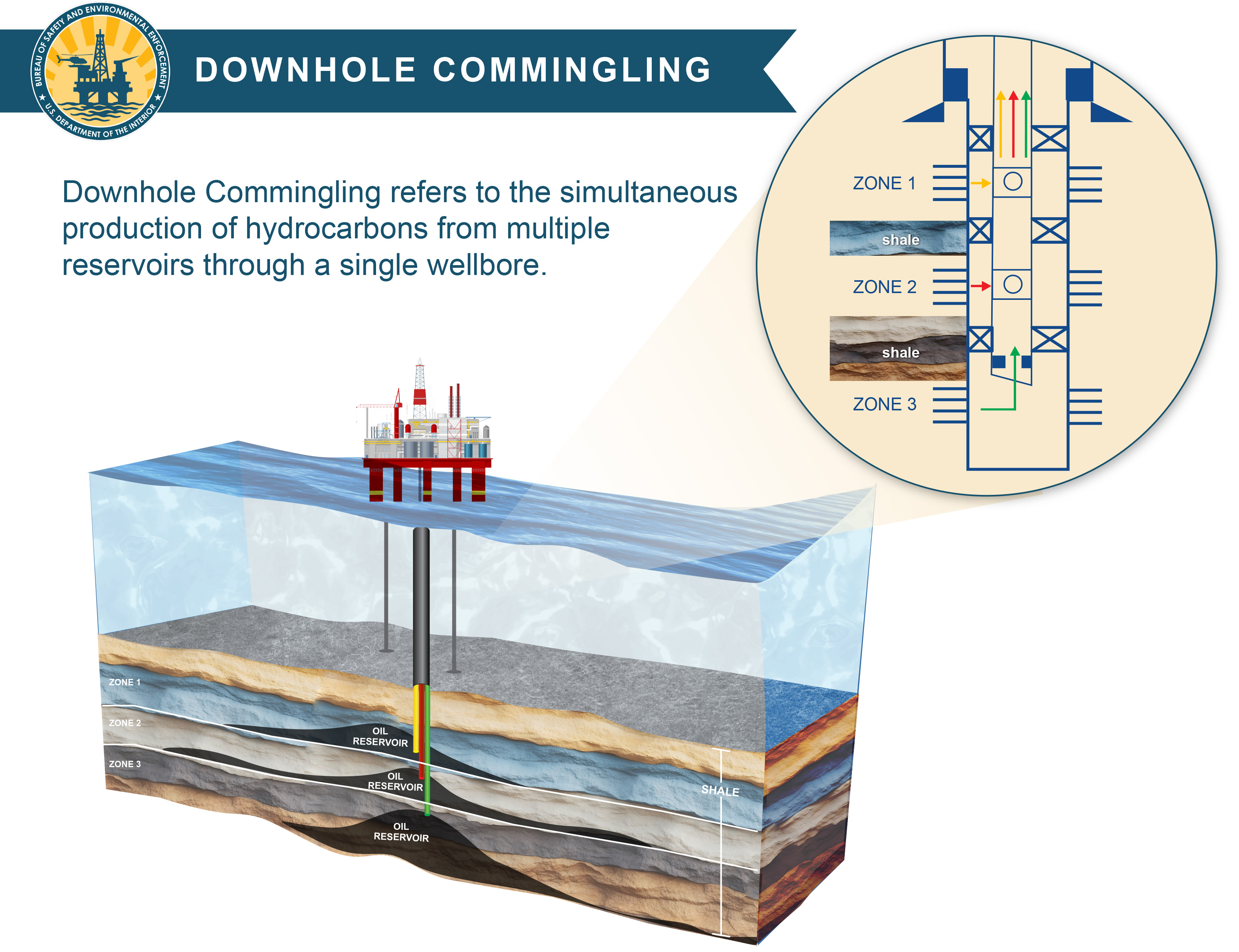
The “One Big Beautiful Bill Act of 2025” (OBBB), Public Law 119-21, which was signed into law on July 4, 2025, includes a significant offshore production directive (section 50102) that has received little public attention:
“The Secretary of the Interior shall approve a request of an operator to commingle oil or gas production from multiple reservoirs within a single wellbore completed on the outer Continental Shelf in the Gulf of America Region unless the Secretary of the Interior determines that conclusive evidence establishes that the commingling—(1) could not be conducted by the operator in a safe manner; or (2) would result in an ultimate recovery from the applicable reservoirs to be reduced in comparison to the expected recovery of those reservoirs if they had not been commingled.”
This is, to the best of my knowledge, the first time in the history of the OCS oil and gas program that Congress has directed the safety regulator to approve well completion practices that could increase safety, environmental, and resource conservation risks.
Rather than calling for the operator to demonstrate that a downhole commingling plan is safe and optimizes resource recovery, the plan must be approved unless BSEE proves conclusively that the operation could not be conducted safely or that resource recovery would be reduced. This is the antithesis of the operator responsibility doctrine, a fundamental principle of the OCS regulatory program, and safety management principles that call for the operator to demonstrate that safety, environmental, and resource conservation risks have been effectively addressed.
Only 40 days after the OBBB was signed, BSEE published a direct final rule implementing the downhole commingling directive. This is warp speed for promulgating a Federal regulation! In keeping with the rush to finalize the rule, the preamble asserts that “notice and comment are unnecessary because this rule is noncontroversial; of a minor, technical nature; and is unlikely to receive any significant adverse comments.”
I intend to submit comments prior to the Sept. 12 deadline. These comments will assert that the rule does not qualify for an exemption from the Administrative Procedures Act’s public review and comment requirement. I will also recommend that BSEE consider hosting a public forum during the comment period to present their research on downhole commingling and discuss the risk mitigations.
Below are some of the issues/questions that should be considered during the public comment period:
BSEE’s own fact sheet acknowledges the well-known pressure differential, crossflow, and fluid compatibility risks associated with downhole commingling. The public should have the opportunity to provide input on the extent to which “intelligent completions” and other production technology are effective in mitigating these risks.
The industry-funded Univ. of Texas (UT) study, which led to a relaxation of downhole commingling restrictions, was specific to the “unique Paleogene Gulf of Mexico fields.” Does BSEE have evidence that supports the applicability of the study to other fields?
The authors of the UT study acknowledged that their findings were based on a “simple but reasonable geological base case model.” They also acknowledged the need for “a more comprehensive study using advanced geological models to explore additional geological features.” What are BSEE’s plans for additional research?
Should an independent assessment of Gulf of America downhole commingling safety and resource recovery risks be conducted before finalizing a rule that essentially mandates approval of all applications?
BSEE’s April 2025 policy change raised the allowable pressure differential for commingling production in Paleogene (Wilcox) reservoirs from 200 psi to 1500 psi. Unlike the policy update, the new rule includes no boundaries whatsoever.
What criteria will BSEE use in determining that there is “conclusive evidence” that a commingling request would be unsafe or would reduce ultimate resource recovery? Will BSEE disapprove any requests outside the parameters in the current policy guidance or subsequent updates?
There are many more issues that remain to be discussed, which is why the downhole commingling rule should be published in draft form, with a comment period of at least 90 days.
Attached is a good update on the Walton Morant license offshore Jamaica. Note that the large Exxon deepwater block offshore Trinidad (7765 sq km) is only 1/3 the size of the massive Walton Morant license (22,400 sq km), and that the Walton Morant license is nearly 1000 times the size of a deepwater Gulf of America lease block.
Historically, State and local governments have tended to be aligned, either for or against offshore energy (primarily oil and gas) leasing. However, a new (offshore) world orderis emerging with local governments joining the new Administration in opposition to wind projects.
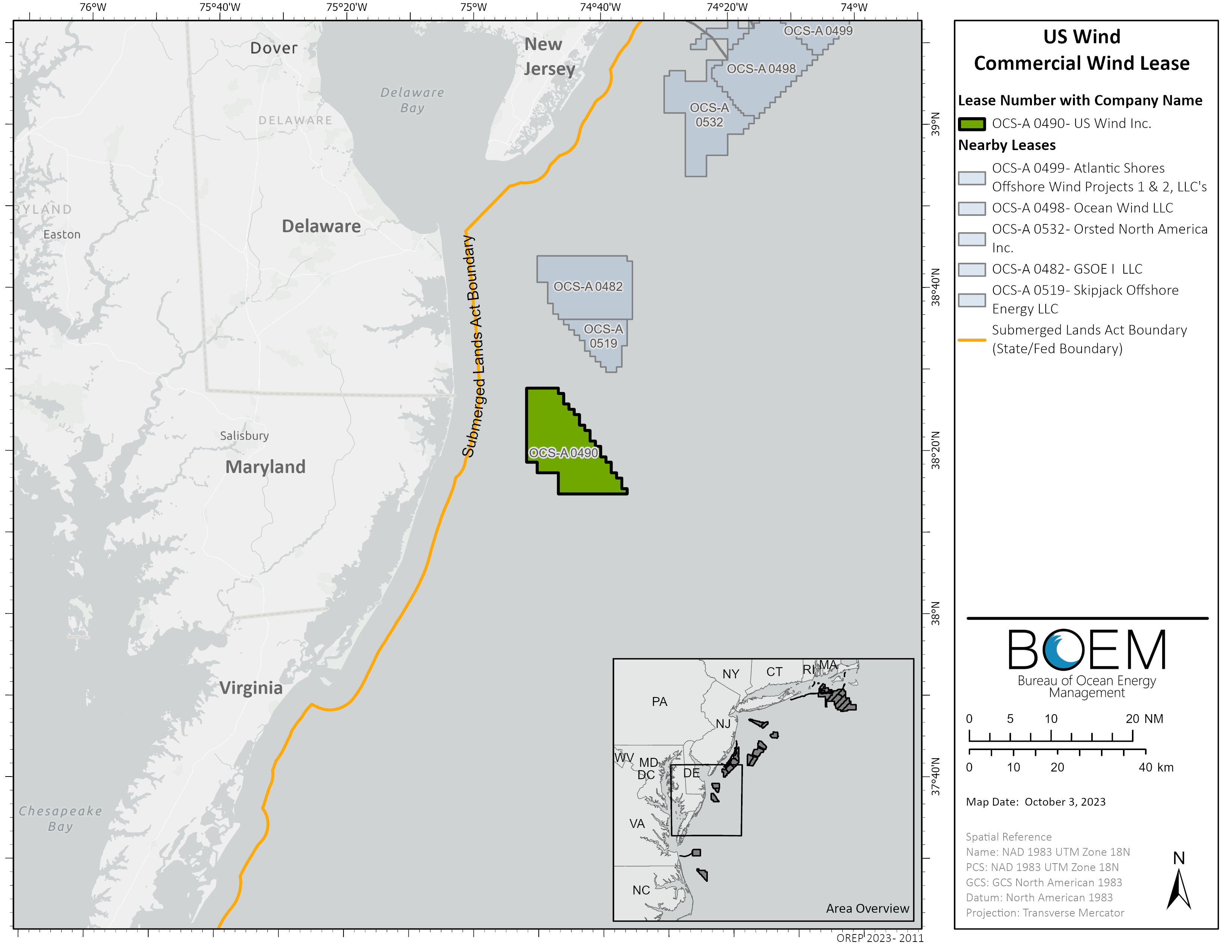
Most recently, and consistent with previous speculation, the Federal govt announced its intent to revoke approval of the Construction and Operations Plan for the US Wind project offshore Maryland and Delaware. (See the attached court filing.) This project is not yet in the construction phase.
Particularly noteworthy, as has been the case for other wind projects offshore Mid-Atlantic and New England states, is the alignment of Federal and local (coastal) govts in opposition to State policies.
Specifically, with regard to the US Wind project, the positions of State and local leaders couldn’t differ more:
Ocean City MD Town Manager Terry McGean:
“This is an extremely positive development in our fight against the irresponsible and costly US Wind project,”McGean said to WBOC on Monday. “We have stated all along that the approval of this project was fast and tracked without adequate public input and that approvals ignored significant risks to our economy, fishing industry, marine mammals, and the horseshoe crab. We are glad that our concerns are finally being taken seriously.”
“For the past eight years, Ocean City has voiced strong opposition to the proposed US Wind project. Unfortunately, we believe this project was fast-tracked and that our serious concerns have been largely ignored throughout the review process.“
“Canceling a project set to bring in $1 billion in investment, create thousands of good paying jobs in manufacturing, and generate more Maryland-made electrical supply is utterly shortsighted,” the Governor’s statement reads in part. “The President’s actions will directly lead to utility-rate hikes by taking off most promising ways for Maryland to meet its looming energy generation challenges.”
Such sharply divergent views are also evident in other coastal states. Offshore wind could be a factor in the upcoming gubernatorial race in NJ. The pro-wind energy candidate has the support of large environmental NGOs, while her opponent is supported by grass roots environmental groups that strongly oppose wind projects.
A short Quaise video (below) describes how conventional and millimeter wave drilling can be combined to reach superhot geothermal energy sources.
Keep in mind that superhot (300-500 deg. C) energy can be reached with conventional drilling at sites with high geothermal gradients. These “tier 1” sites will be the first targets (second video below).
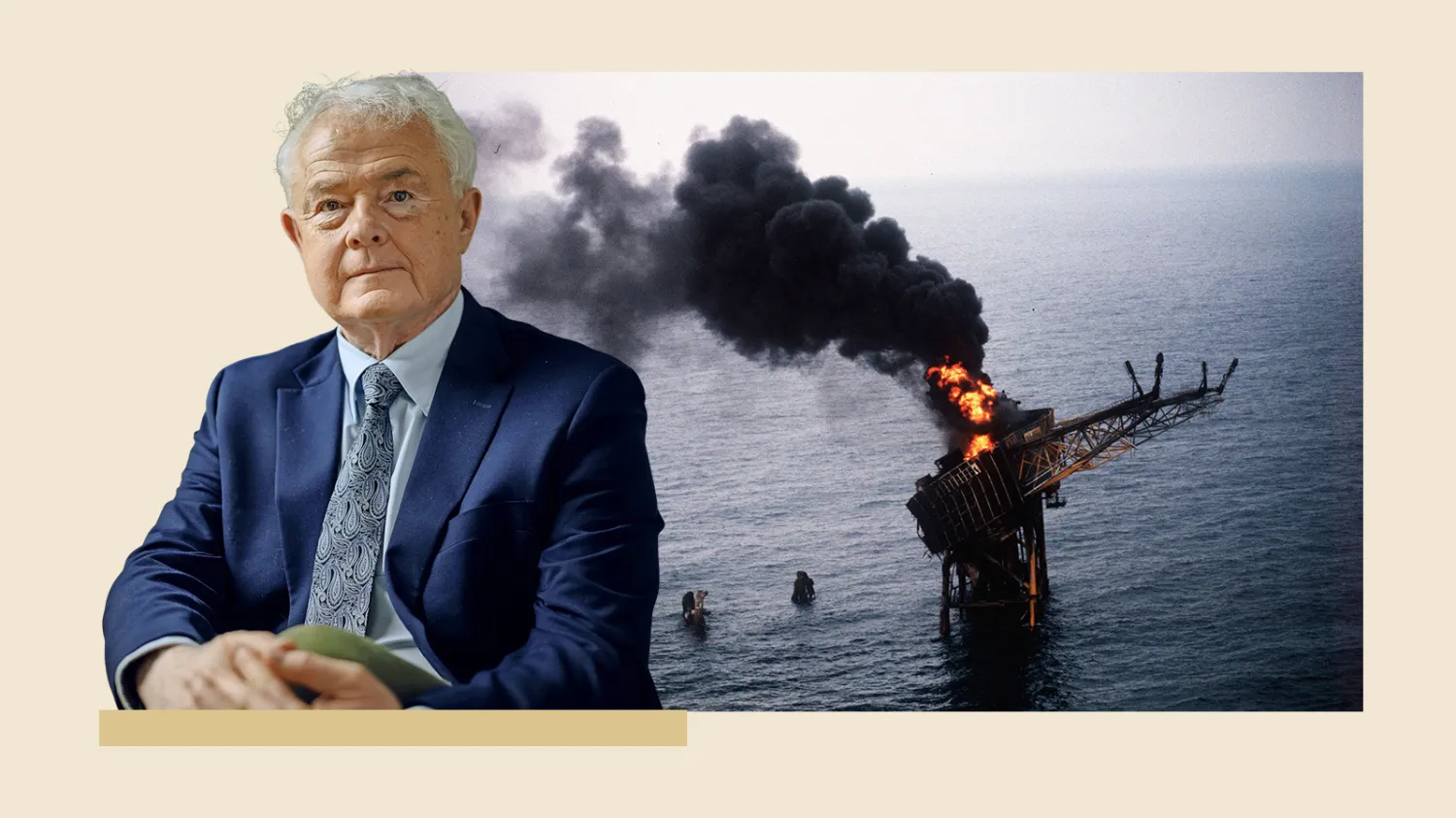
JL Daeschler shared a London Sunday Times piece about the Piper Alpha fire that killed 167 workers, the worst tragedy in the history of the offshore industry. We were troubled by the headline, because it seems inconceivable that any UK offshore worker could call July 6, 1988, the best day of their life. However, Punchard helped a number of workers escape the fire, so his mixed message is somewhat understandable.
Lord Cullen’s comprehensive inquiry into the Piper Alphatragedy challenged traditional thinking about regulation and how safety objectives could best be achieved, and was perhaps the most important report in the history of offshore oil and gas operations. That report and the US regulatory response to the tragedy are discussed in this post.
BSEE’s new downhole commingling rule, which responds to a Congressional mandate, is contrary to Cullen’s Safety Case principles in that it puts the burden of proof on the regulator to conclusively demonstrate that a potentially hazardous operation is unsafe.This is exactly the opposite of the approach recommended by Cullen. It’s also the first time in the history of the OCS program that Congress has dictated approval of complex downhole operations. More on this in a later post.


 Bud's Offshore Energy (BOE)