- Will Transocean be releasing any details on yesterday’s “water ingress?” Will the results of their internal investigation ever be made public? (We are still waiting for their report on the fatal crane incident last August offshore Nigeria.)

- Will an independent investigation be conducted? Will the authorities in Ghana participate?
- Did the damage that the Marianas incurred during Hurricane Ike (2008) or Tropical Storm Ida (2009) in any way contribute to yesterday’s apparent structural failure?
- When will we have an international system that ensures (a) prompt, independent, and complete investigations of all significant accidents, and (b) the timely release of findings?
This information is unconfirmed but the source is highly reputable:
We just received word this morning that the Transocean Marianas rig has developed a large crack in one of the pontoons on the #5/#6 anchor chain locker while they were picking up anchors, and is currently taking on water and listing. The bilge pumps are keeping up (barely), but there’s certainly concern that it might sink on location. So far, 68 people have been evacuated from location.
According to RigZone, the Marianas was working offshore Nigeria. [Per one of our readers, (see comment below) Petrodata shows the rig operating offshore Ghana.]
More: The Marianas, spudded the Macondo in October, 2009, but was damaged by Hurricane Ida and towed to shore. The Deepwater Horizon was the rig that replaced the Marianas.
Posted in Uncategorized | Tagged accidents, crack, drilling, evacuation, Nigeria, offshore drilling, safety, sinking, Transocean Marianas | 10 Comments »
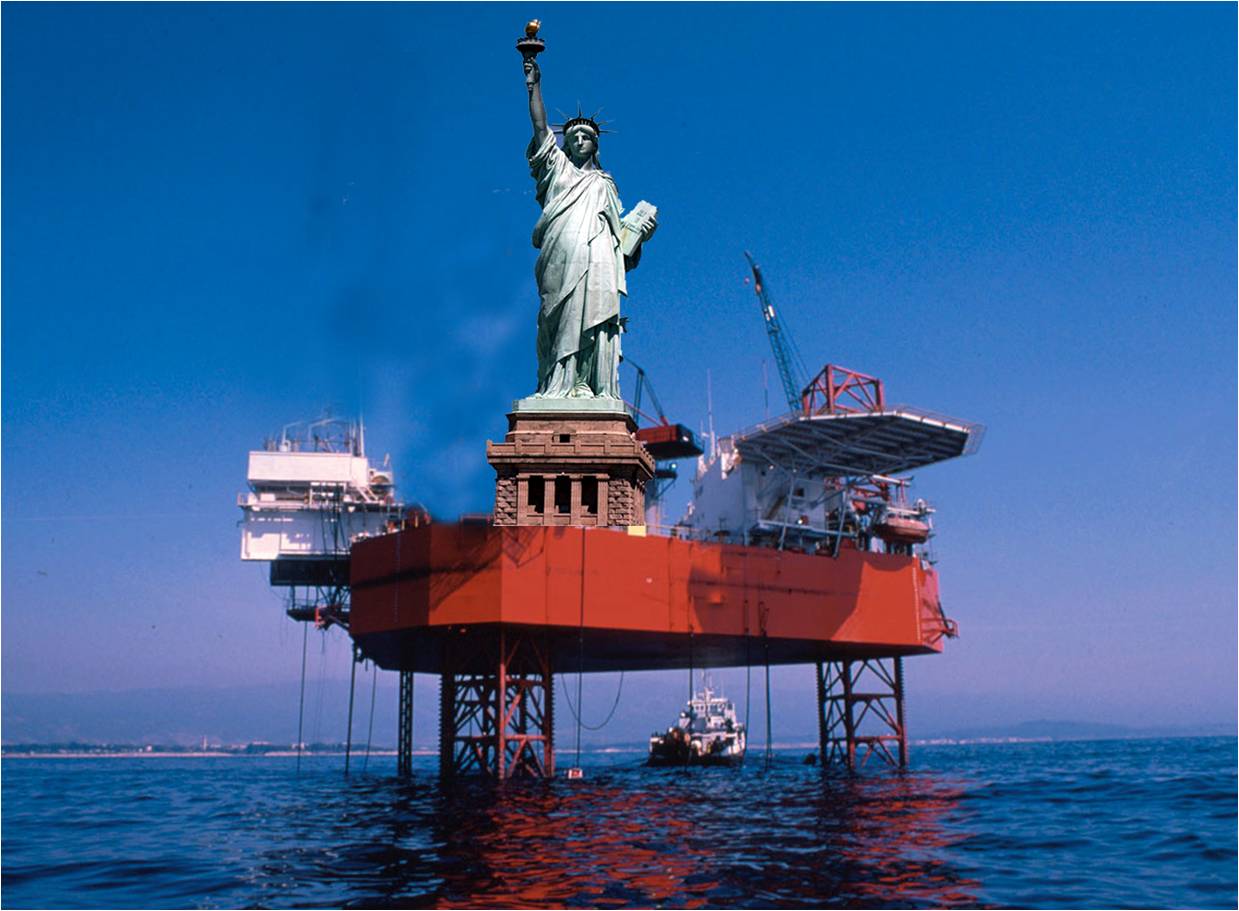
On Independence Day, four keys to realizing our offshore energy potential:
- A national offshore oil and gas program as required by the OCS Lands Act.
- Industry safety and pollution prevention leadership including comprehensive data analyses, research, standards development, management programs, and internal auditing. All operators, contractors, and service companies must participate.
- An efficient, risk-based regulatory program that scrutinizes performance, indentifies weaknesses, and demands excellence.
- Cooperative programs to develop cost-effective, reliable, and safe wind and hydrokinetic energy systems.
Posted in Offshore Energy - General | Tagged energy independence, Fourth of July, hydrokinetic energy, offshore energy, offshore oil and gas, Offshore Wind | Leave a Comment »
I thought this Platts Oilgram News report was interesting given PTT’s objection to Indonesia’s claim for damages from PTT’s Montara blowout:
Thai energy authorities are pointing fingers at South Korea’s Hyundai Heavy Industries for causing damage to one of its offshore pipelines that slashed natural gas supplies to the kingdom by 14%. State-controlled oil and gas company PTT is also planning to seek hefty compensation claims from Hyundai Heavy as well as from Diphaya Insurance, the Thai state-owned insurance firm, which provides coverage for the company’s works, a senior PTT executive said June 30.
Posted in accidents | Tagged Indonesia, Montara, pipeline rupture, PTT | Leave a Comment »
From Platts Oilgram News:
Shares of McMoRan Exploration jumped more than 12% June 29 after the company announced that additional drilling has confirmed its geological theories about the high potential of drilling ultra-deep natural gas prospects in the shallow waters of the Gulf of Mexico.
Hype, reality, or something in-between? One has to weigh the resource promise against the operational challenges, high costs, and gas market uncertainties.
Posted in gas, Offshore Energy - General | Tagged Gulf of Mexico, natural gas, ultra-deep gas | 1 Comment »
 I don’t buy the argument that industry and regulators have paid too much attention to personal safety at the expense of process safety. Casualties from falls, falling objects, helicopter crashes, and other workplace activities have been persistent, and safety management programs must emphasize practices and procedures that will reduce occurrence rates.
Also, process safety has hardly been ignored. API RP 14 C has proven to be an effective safety analysis procedure for addressing undesirable events associated with each process component of a production facility. For more complex facilities, Deepwater Operating Plans and API RP 14J, “Recommended Practice for Design and Hazard Analysis for Offshore Production Facilities, ” are good risk management supplements to RP 14C.
That said, we need better programs for sustaining the focus needed to further reduce the probability of low frequency, high consequence events. When memories about the most recent disaster start to fade, what do we do to keep workers on edge and prevent complacency? What more can be done to prevent events with enormous consequence potential? Some thoughts:
- Establish programs to remind employees about past disasters – how they happened and how they could have been prevented. How many offshore workers know the chain of events that led to the Santa Barbara blowout, Ocean Ranger sinking, Alexander Kielland capsizing, Piper Alpha fire and explosion, Ixtoc blowout, and other historic incidents? When discussing international incidents, we need to explain how our facilities or region might have been vulnerable under similar circumstances.
- Present information on minor incidents that could have escalated into disasters, emphasizing what could have gone wrong and why.
- Don’t just focus on the last disaster. While addressing the operational and organizational issues that surfaced at Montara and Macondo, we also must assess incident data and identify activities and practices that could lead to the next disaster.
- Operators should not rely on the regulator to manage their operations. Reading about Montara and Macondo, one senses that the regulators were called on to referee internal company disputes and protect the operators and contractors from themselves.
- Regulators should not be making day-to-day operating decisions. Regulators should make sure that the regulations are clear and that operators have effective management procedures for adjusting programs as new information is obtained. Regimes that provide for regulator approval of each activity or adjustment promote operator complacency and are not in the best interest of safety over the long term.
- Service companies and contractors must challenge operators and regulators. Operators should expect contractors to think and question, not to simply execute orders. There are impressive examples of contractors insisting on safety improvements, and being willing to forego business rather than compromise on safety.
- All sectors of the offshore industry should participate in standards development. Effective standards are dependent on diverse input.
- Industry and government leaders should promote innovation. Obvious weaknesses should be identified and industry should be challenged to propose solutions. For example, why do concerns about “false alarms” preclude automatic alarm activation (see Transocean’s Macondo report)? Data from redundant sensors can be analyzed by predictive software that is capable of quickly identifying real events. Similarly, why have advances in BOPE, including monitoring systems, been so slow? Why are BOP capabilities still poorly understood? Why are well integrity and casing pressure issues (producing wells) so common?
Posted in accidents | Tagged accidents, API, blowouts, Center for Offshore Safety, macondo, Montara, personal safety, process safety, Regulation, risk management, safety, well control | 1 Comment »
Very interesting Wall Street Journal article.
First, thanks to the unexpected shale gas boom in the U.S., liquefied natural gas cargoes once planned for the U.S. have gone looking for new buyers. Result: European customers have been able to shake off Russian long-term contracts linked to the price of oil.
Russia insists the gas glut is temporary. It has tried to fight back by pushing gas sales to China. But now those talks are stalled over price thanks to Beijing’s discovery that—guess what?—China back home may have the biggest shale potential of all.
And the hits will keep on coming, upending a high-price dynamic and European dependency that have suited Russia very well (and, admittedly, also suited some of its customers, especially German utilities).
Will the great potential of shale gas be fulfilled? In the US? In Europe? Elsewhere?
But what the Lord giveth, European politics may fritter away. French campaigner Jose Bove, having failed to kick McDonald’s out of Paris, is now jawboning Poland against developing its reserves, handing a Polish-subtitled copy of “Gasland,” the U.S.-made antifracking documentary, recently to Poland’s president.
France in May passed a ban on fracking. Poland is the anti-France, set to take the European Union’s rotating presidency next month and determined to move ahead on fracking. A mystery wrapped in an enigma is Germany, with its precipitous decision to retire its nuclear plants, and its big, Russia-friendly investment in Nord Stream, a gas pipeline whose board is headed by former German Chancellor Gerhard Schroeder.
Posted in energy, natural gas | Tagged shale gas | Leave a Comment »
Links
Animation of Transocean’s BOP analysis
Transocean’s BOP Defense:
Forensic evidence from independent post-incident testing by Det Norske Veritas (DNV) and evaluation by the Transocean investigation team confirm that the Deepwater Horizon BOP was properly maintained and did operate as designed. However, it was overcome by conditions created by the extreme dynamic flow, the force of which pushed the drill pipe upward, washed or eroded the drill pipe and other rubber and metal elements, and forced the drill pipe to bow within the BOP. This prevented the BOP from completely shearing the drill pipe and sealing the well.
In other words, Transocean contends that properly maintained BOPE was not up to the task of shutting-in and securing a high-rate well. If true, this finding has significant implications for the offshore industry. I’m looking forward to reading the government’s findings on the BOP failure when the Joint Investigation Team report is issued next month.
Posted in accidents, well control incidents | Tagged accidents, blowouts, BOP, Deepwater Horizon, drilling, Gulf of Mexico, macondo, oil spill, safety, transocean, well control | Leave a Comment »

