Posted in accidents, Regulation | Tagged bp, Deepwater, drilling, Regulation, standards | 2 Comments »

14.07.2011 | On Wednesday 13 July, a fire broke out in the compressor area of Valhall PCP. Today the Petroleum Safety Authority Norway (PSA) will send two representatives to Valhall to investigate the incident.
The fire, which was reported to the authorities yesterday afternoon, started at around 4.40 p.m. A standby vessel was deployed to put out the fire and at 6.45 p.m. it was confirmed that the fire had been extinguished. All personnel were evacuated and there were no injuries.
Posted in accidents | Tagged accidents, compressor, fire, Norway, offshore oil and gas, PSA, safety, Valhall | Leave a Comment »
A fire at BP’s Valhall oil platform off Norway in the southern part of the North Sea forced the UK supermajor to halt production and evacuate the facility today.

Valhall Complex (www.mfox.nl)
Posted in accidents, Norway | Tagged fire, North Sea, Norway, offshore oil, production, Valhall | Leave a Comment »
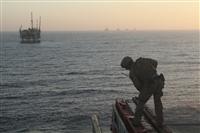
Platform Hogan, Santa Barbara Channel
A Marine with the 11th Marine Expeditionary Unit’s maritime raid force searches the oil platform Hogan for threats during an exercise July 10. The MRF, along with a section of the unit’s aviation combat element, Marine Medium Helicopter Squadron 268 (Reinforced), and command element, are taking part in a large-scale exercise with ocean and urban-based scenarios.
Posted in California | Tagged California, exercise, Hogan, Marines, Pacific, security | Leave a Comment »
BOE’s Cheryl Anderson picked up this AP report. Helicopter accidents continue to be a leading cause of offshore casualties.
A helicopter carrying crew from an offshore drilling rig crashed into the sea off Myanmar, killing three people on board. Eight were rescued.
The aircraft was carrying staff of the Malaysian oil company Petronas from the Yetagun offshore gas field in the Andaman Sea.
The oil field is operated by Petronas Carigali of Malaysia, PTTEP of Thailand and Japan’s Nippon Oil company. Petronas also operates a cross-border gas pipeline to transport gas from Yetagun to Thailand.
Posted in accidents | Tagged accidents, helicopter crash, helicopters, Maylasia, Myanmar, Petronas, PTTEP | 1 Comment »
If someone had asked me a few years ago what the highest risk offshore system was, I certainly would not have said a fully cased well in the process of being suspended. Yet that was the scenario for both of the recent mega-incidents, Montara and Macondo.
I would have instead suggested that dynamic production risers were the highest risk offshore system. The combination of relatively new technology, movement, fatigue potential, exposure in the splash zone, and continuous hydrocarbon flow poses risks that must be carefully managed. That is why investigations of incidents like the Visund gas leak are so important. In that regard, PSA does an excellent job and prominently posts all of their reports so that we all may benefit. I recommend that you take a look at this one.
In connection with the planned shutdown on Visund on 9 April 2011, a hydrocarbon leak occurred from well A21’s 6” flexible riser UK-18-0009. The Petroleum Safety Authority Norway (PSA) has carried out an investigation of certain aspects of the incident.
We have identified three nonconformities within the areas of establishment and follow-up of preconditions for safe operation of dynamic risers, training and expertise and governing documentation.
Posted in accidents | Tagged accidents, gas lieak, Norway, offshore, PSA, safety, Visund | 1 Comment »
The Commonwealth of Virginia, home of BOE headquarters, continues to provide national leadership on energy issues, most notably offshore oil and gas exploration. The Governor (Republican), both US Senators (Democrats), and both candidates for the US Senate support offshore leasing.
“Opening up and expanding Virginia’s offshore resources to responsible natural gas and oil exploration holds significant promise for boosting needed domestic energy production while bolstering the commonwealth’s economy.” Quote from Senator Jim Webb in the Richmond Times Dispatch
Posted in drilling, Offshore Energy - General | Tagged offshore drilling, Virginia | Leave a Comment »
A new system to regulate the offshore gas and oil industry – a direct response to the 2009 Montara north of the Kimberley – has been approved by the Federal Parliament’s lower house.
Under the changes, the seven state and territory authorities will be replaced by a single Commonwealth body, the National Offshore Petroleum Safety and Environmental Management Authority.
It will regulate all safety issues from exploration to well decommissioning.
In the US, the jurisdictional conflicts (offshore) differ in that they typically involve multiple Federal regulators with overlapping jurisdiction and different priorities. Since most of the necessary streamlining would only involve Federal agencies, one would think that regulatory reform would be achievable, especially after a major blowout that killed eleven. Unfortunately, meaningful US reform appears to be highly unlikely.
Posted in accidents | Tagged accidents, Australia, blowouts, Montara, NOPSA, safety, well control | Leave a Comment »

