Feeds:
Posts
Comments

On September 14, 2022, BOEM announced that 307 high bids from Lease Sale 257 in the Gulf of Mexico were accepted. BOEM also announced that one high bid was rejected for not providing the public with fair market value. BOEM has not identified the rejected bid.

Per BOEM’s Lease Area Block Online Query file, 306 Sale 257 leases were effective on Oct. 1, 2022. A comparison of these data with the sale results identified 2 Sale 257 leases that have not been awarded:

leaseblockhigh bidder(s)bidcomments
G37261GC 70BHP$3.6 millionlone bid; 7th highest
bid in sale
G37294GC 777BP (75%),
Talos (25%)
$1.8 million2 bids; next highest
$1.185 million

So one of these 2 bids was rejected and the other has lease not yet been awarded for some reason (or perhaps there has been a clerical/IT issue).

Which bid was rejected? I would guess it was the BHP bid even though that bid was the 7th highest bid in the entire sale. The fact that this bid was $2.5 to $3 million higher than the other 7 BHP bids (all of which were accepted) tells us that the company valued this tract highly. Perhaps BOEM, which has all of the geologic data, thought the value was even higher, which is why the bid may have been rejected.

There was another bidder (Chevron) for the BP/Talos tract, so the competition makes it less likely that the bid would have been rejected.

Ironically, the 94 carbon sequestration bids, which made something of a mockery of the lease sale, could not be rejected on fair market grounds. The bids exceeded the minimum required, and the tracts have little or no value from an oil and gas production standpoint. A competitive process would be require to repurpose these leases for carbon sequestration.

Was 2021 the low point? Hopefully that is the case, but consistent leasing is essential.

Looks like Woodside is now officially the GoM operator of record (was BHP prior to merger). Kudos to them.

Shell continues to be the GoM bellwether. There is no OCS program without them.

What’s up with BP and Chevron? Big declines from both.

US super-majors Exxon and ConocoPhillips remain out of the picture, both in terms of lease acquisition and exploration. Disappointing.

Tip of the hat to Hess, LLOG, Murphy, and Talos – independents committed to deepwater production.

Sweden’s prosecutor’s office said Friday that an investigation into gas leaks from two underwater pipelines connecting Russia to Germany found traces of explosives, confirming that it is a case of “serious sabotage.”

CNBC

Update on the most promising renewable energy alternative:

Quaise has received a grant from the Department of Energy to scale up Woskov’s experiments using a larger gyrotron. With the larger machine, the team hopes to vaporize a hole 10 times the depth of Woskov’s lab experiments by the end of this year. After that, the team will vaporize a hole 10 times the depth of the previous one — what co-founder Matt Houde calls a 100-to-1 hole.

“That’s something [the DOE] is particularly interested in, because they want to address the challenges posed by material removal over those greater lengths — in other words, can we show we’re fully flushing out the rock vapors?” Houde explains. “We believe the 100-to-1 test also gives us the confidence to go out and mobilize a prototype gyrotron drilling rig in the field for the first field demonstrations.”

Rather than getting deep in the weeds of carbon capture, imagine powering those existing facilities with steam generated without carbon emissions at all.

The key is that ultradeep geothermal has the power density and scalability of fossil fuels.

On Monday, the offshore world lost Mike Conner, an outstanding engineer and a major contributor to the success of the US offshore program.

Mike is the person most responsible for the Deepwater Operations Plan (DWOP), a pioneering safety-case approach to regulating deepwater oil and gas development. The DWOP program was initiated 30 years ago and facilitated deepwater production at a time when there were no deepwater-specific regulations or standards. Innovative tension leg platform, compliant tower, spar, production semisubmersible, and subsea projects would not have been possible without the DWOP program. 93% of Gulf of Mexico oil production and 76% of the gas is now attributable to deepwater production facilities. Thanks in large part to the DWOP program, these facilities have had a nearly flawless safety and environmental record.

While his obituary is no yet available, this link announces Mike’s well-deserved selection for the OTC Heritage Award in 2017, and provides good information on Mike and his career.

 Lowest volume since 3/30/1984; 46% below capacity; 36% one year decline

Using the World Bank’s worldwide flaring data and ONRR flaring and venting data for the GoM, I compared GoM flaring intensity for 2021 with that of the World Bank’s top ten flaring nations. This is just one example of why US offshore production is a preferred and vital component of our energy mix.

Further discussion: Kudos to the World Bank for their use of satellite data to estimate flaring volumes worldwide. Their primary performance indicator is flaring intensity (volume flared per bbl of oil produced). Absent better worldwide reporting regimes, satellite data are essential. However, there are issues with the World Bank’s system that merit further consideration:

  • Satellites miss some flares and vented gas (a more significant GHG concern) is not detected
  • A prior review of Gulf of Mexico data indicated that the World Bank flaring estimates are low.
  • The flaring intensity indicator penalizes higher gas-oil ratio (GOR) wells. Production upsets of the same duration yield higher flaring intensity scores at higher GOR facilities.
  • Associated gas is an environmentally favorable energy source that should not be discouraged. Most Gulf of Mexico gas production is now from oil wells. Efficient collection and utilization is the key.
  • There will always be some production upsets that result in flaring. The objective should be to minimize the % of oil-well and gas-well gas that is flared, irrespective of the amount of oil production. See the recent GoM summary data posted here and here.

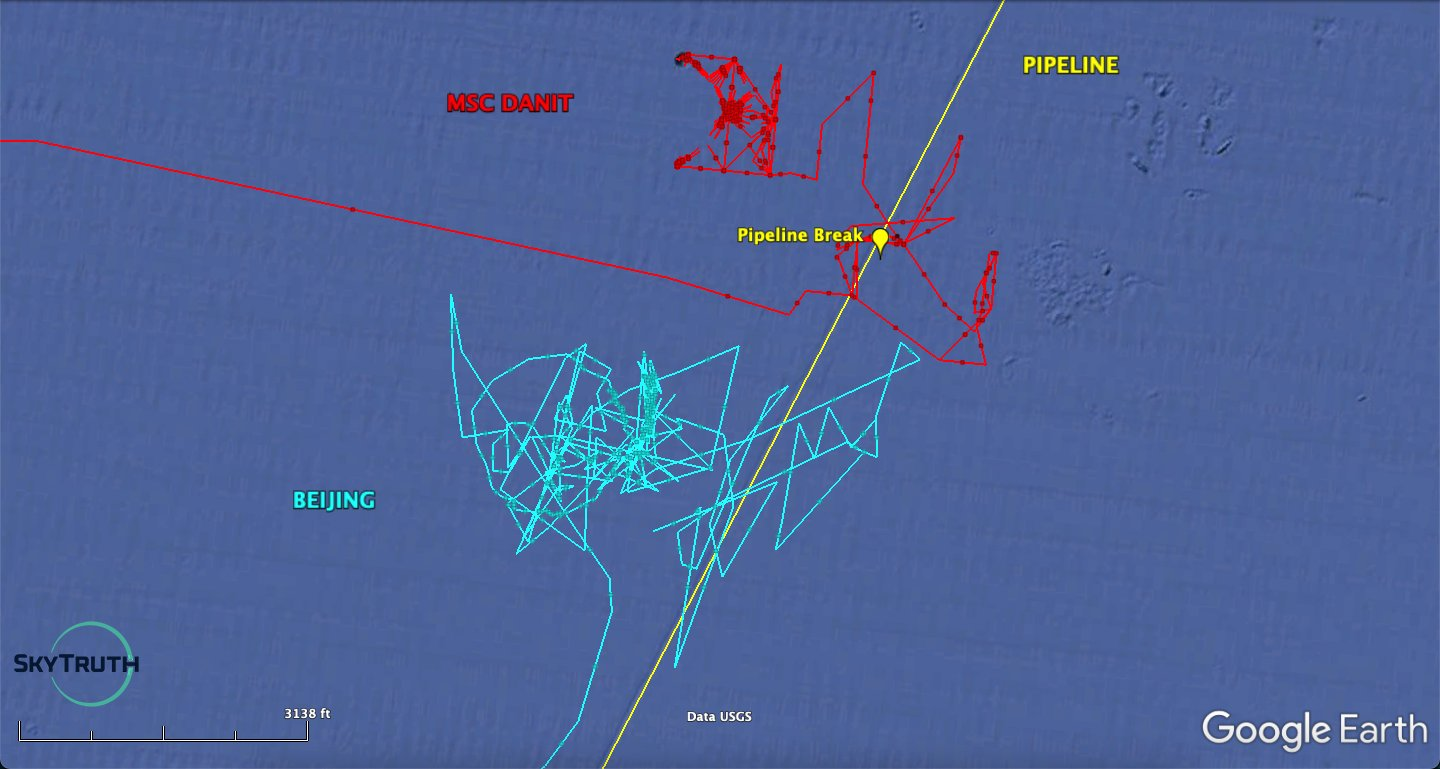
Using satellite data, SpaceKnow detected 2 “dark ships” near the pipelines prior to the explosions. The ships were operating with their automatic identification system (AIS) transponders turned off or malfunctioning. While this is cause for suspicion, no data were provided on the frequency of such issues in the Baltic. Also, what were the specific routes and timelines for these vessels? Absent this information. the “dark ship” reports aren’t terribly meaningful.

Although the assumption that the explosions occurred outside the pipeline seems most likely, some observers have suggested that the explosions were internal. It’s unknown whether the investigators have ruled out this possibility.

Meanwhile, the folks in Germany and elsewhere in Europe are understandably impatient. They want answers from their governments!

A. Pangea dining

B. Seismic touchdown

Lars Herbst assures us that no marine mammals were harmed by the Baton Rouge shock waves!