The Jones Act, protectionism at its finest, was enacted 113 years ago, and stipulates that vessels which transport merchandise or people between two US points must be US built, flagged, owned, and crewed. Congress tightened the screws further by ordaining that offshore energy facilities, including wind farms, are US points. That precludes the transportation of wind turbine components from US ports to offshore wind farms.
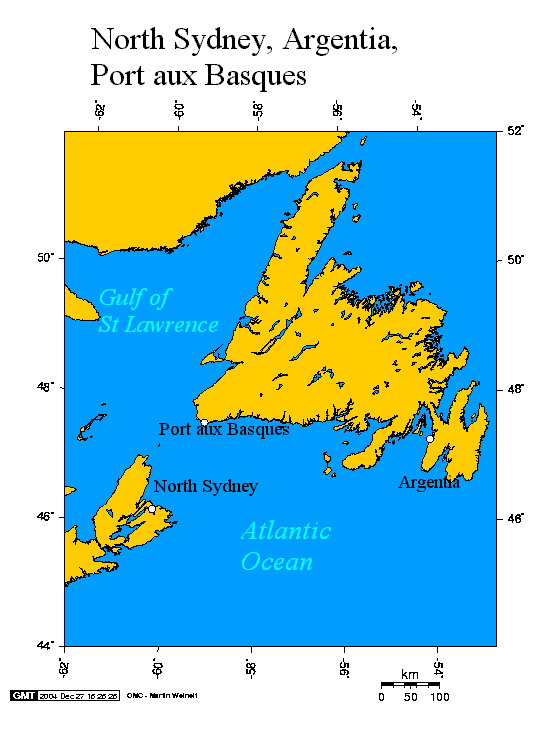
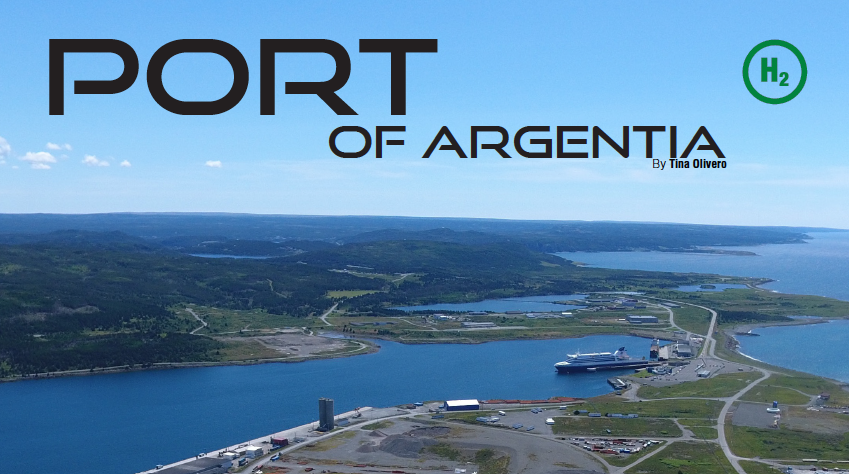
The Jones Act has thus provided an opportunity for the Port of Argentia, a former US Navy base in southeast Newfoundland, and the port is set to become a key node in the offshore wind supply chain. Monopiles constructed in Europe will be stored in Argentia, until they are delivered to US wind farms in the North Atlantic. Kudos to the folks at the Port of Argentia for taking advantage of this opportunity.
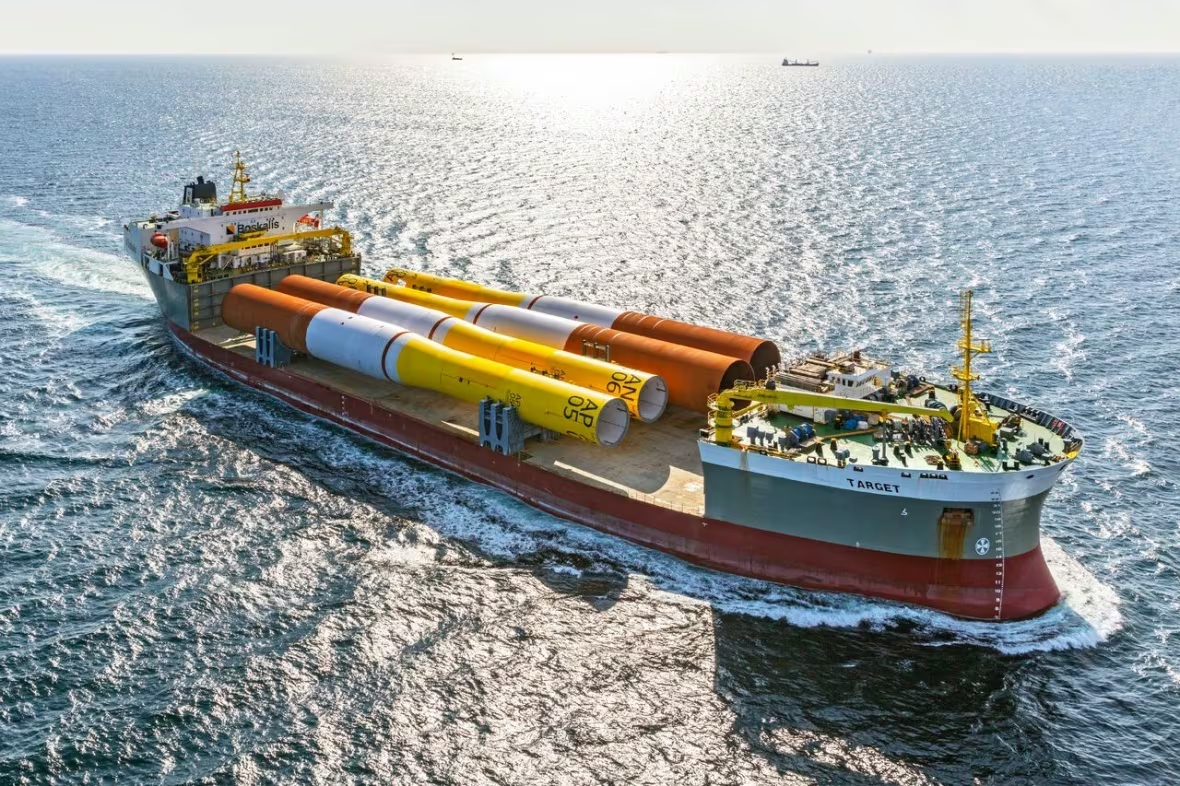
Dutch company Boskalis will be transporting the monopiles, which are expected to land in the Port of Argentia in a few weeks. (Boskalis)
BOEM has rather surprisingly proposed to eliminate consideration of a company’s compliance record in determining the need for supplemental financial assurance.An opposing view will be posted tomorrow.
If a lease has proved reserves with a value of at least three times that of the estimated decommissioning cost, no supplemental financial assurance would be required. Comparing two imprecise and variable estimates is neither a simple nor reliable method for determining the need for supplemental financial assurance. BOEM should look at the history of the Carpenteria field (Santa Barbara Channel) and the reserve estimates that were provided to discount decommissioning risks. More on this at a later date.
Transferor liability applies only to those obligations existing at the time of transfer; new facilities, or additions to existing facilities, that were not in existence at the time of any lease transfer are not obligations of a predecessor company and are considered obligations of the party that built such new facilities and its co- and successor lessees. This is a good policy, but is difficult to implement. Some of the complexities may need to be addressed.More later.
The “reverse chronological order” provision was withdrawn in April, so there is no defined process for issuing decommissioning orders to predecessor lessees. Is it good policy to first issue such orders to companies who may have owned leases decades ago, in some cases prior to the establishment of transferor liability in the 1997 MMS “bonding rule?”
The proposed rule would clarify that BOEM will not approve the transfer of a lease interest until the transferee complies with all applicable regulations and orders, including the financial assurance requirements. BOEM needs to be firmly enforce this policy. See tomorrow’s post.
The proposed rule would not allow BOEM to rely upon the financial strength of predecessor lessees when determining whether, or how much, supplemental financial assurance should be provided. This is a good provision.
BOEM proposes to use the P70 probabilistic value to set the amount of any required supplemental financial assurance. These estimates do not seem sufficiently conservative to protect other parties and the public in the event of default. This is particularly true after storm damage which can increase plugging costs more than tenfold.
The probabilistic cost estimates were updated in 2020 and are based on data submitted subsequent to 2016 and 2017 NTLs. How often will these estimates be updated?
The final rule should specify that funds may not be withdrawn from decommissioning accounts for operational purposes, and that BOEM approval is required for such withdrawals.
Interestingly, none of Exxon’s 69 high bids for shelf leases have been accepted to date. Given that the Exxon bids were for tracts that are presumably considered “nonviable” from an oil and gas production standpoint, those bids should have been accepted by now were they deemed to be valid.
Perhaps BOEM, to their credit, is planning to reject the CCS bids as they may when an unusual bidding pattern has been identified. It is now quire clear (unlike in the immediate aftermath of Sale 257) that Exxon was seeking to acquire these leases for carbon sequestration purposes. That is not allowed given that both Sales 257 and 259 were oil and gas lease sales. As similarly noted for Sale 257:
Sale 259 was an oil and gas lease sale. The Notice of Sale said nothing about carbon sequestration and did not offer the opportunity to acquire leases for that purpose. Therefore, the public notice requirements for CCS leasing (30 CFR § 556.308) were not fulfilled.
Because there was no draft or final Notice of Sale for CCS leases, interested parties and the public did not have the opportunity to consider and comment on CCS leasing, tract exclusions, bidding parameters, and other factors.
30 CFR § 556.308 requires publication of a lease form. No CCS lease form was posted or published for comment.
CCS operations were not considered in the environmental assessments conducted prior to the sale.
No evaluation criteria for CCS bids have been published.
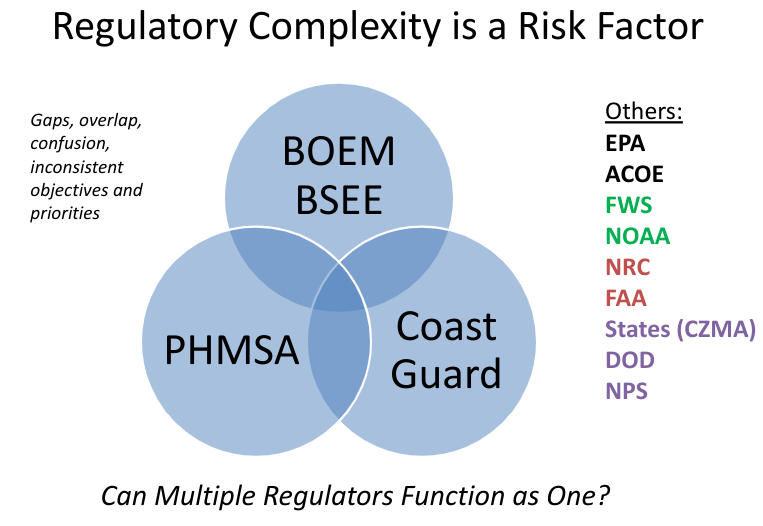
Regulatory fragmentation occurs when multiple federal agencies oversee a single issue. Using the full text of the Federal Register, the government’s official daily publication, we provide the first systematic evidence on the extent and costs of regulatory fragmentation. We find that fragmentation increases the firm’s costs while lowering its productivity, profitability, and growth. Moreover, it deters entry into an industry. These effects arise from regulatory redundancy and, more prominently, regulatory inconsistency between agencies. Our results uncover a new source of regulatory burden: companies pay a substantial economic price when regulatory oversight is fragmented across multiple government agencies.
The US has a highly fragmented offshore regulatory regime that has become even more fragmented with the complex division of responsibilities between BOEM and BSEE. The slide below is from a presentation on this topic.
While the linked paper focuses on costs and productivity, fragmentation may also be a significant safety risk factor. A UK colleague once asseted that “overlap is underlap,” and I believe there is something to that. If multiple agencies have jurisdiction over a facility, system, or procedure, the resulting redundancy, inconsistency, and ambiguity may create significant gaps in industry and governmental oversight.
For example, regulatory fragmentation was arguably a significant factor in the most fatal US offshore fire/explosion incidents in the past 35 years – the South Pass B fire in 1989 and the Macondo blowout in 2010. More specifically:
South Pass 60 B: The investigation of the 1989 South Pass 60 B platform explosion that killed 7 workers noted the inconsistency in regulatory practices for the platform, regulated by DOI, and the pipeline regulated by DOT. Cutting into the 18-inch pipeline riser did not require an approved procedure, and the risks associated with hydrocarbon pockets in the undulating pipeline were not carefully assessed. Oversight by the pipeline operator was minimal, and the contractor began cutting into the riser without first determining its contents. A massive explosion occurred and 7 lives were lost.
One would hope that this major spill will lead to an independent review of the regulatory regime for offshore pipelines. Consideration should be given to designating a single regulator that is responsible and accountable for offshore pipeline safety (a joint authority approach might also merit consideration) and developing a single set of clear and consistent regulations.
Macondo: While the root causes of the Macondo blowout involved well planning and construction decisions regarding the casing point, cementing of the production casing, and well suspension procedure, the blowout would likely have been at least partially mitigated (and lives saved) if the gas detection system was fully operable, the emergency disconnect sequence was activated in a timely manner, flow was automatically diverted overboard, or engine overspeed devices functioned properly. Indeed, regulatory overlap led to underlap as summarized below:
Macondo contributing factor
jurisdiction
flow not automatically diverted overboard
DOI/USCG (also concerns about EPA discharge violations)
some gas detectors were inoperable
DOI/USCG
generators did not automatically shutdown when gas was detected
USCG/DOI
failure to activate emergency disconnect sequence in a timely manner (training deficiencies and chain-of-command complications)
USCG/DOI
engine overspeed devices did not function
USCG/DOI
hazardous area classification shortcomings
USCG/DOI
MOUs and MOAs are seldom effective regulatory solutions as they are often unclear or inconclusive, and tend to be more about the interests of the regulator and protecting turf. They also do nothing to ensure a consistent commitment among the regulators. In the case of the US OCS program, BOEM-BSEE have a greater stake in the safety and environmental outcomes given that offshore energy is the reason for their existence. That is not the case for any of the other regulators identified in the graphic above.
Oil and Energy Minister Terje Aasland takes over the constitutional responsibility for the Petroleum Safety Authority with effect from 11 May 2023. Labor and Inclusion Minister Marte Mjøs Persen previously held responsibility. With this, the government wishes to strengthen comprehensive and good management of HSE, safety and preparedness on the Norwegian continental shelf.
The transfer of responsibility to the Ministry of Oil and Energy (OED) is in line with the main principle in Norwegian administration that one ministry and one cabinet minister have the constitutional responsibility for the sector as a whole.
The Petroleum Safety Authority and the Norwegian Petroleum Directorate, the resource management agency, now report to the same ministry. Prior to a December 2003 decree that established the PSA, both the safety and resource functions were administered by the NPD.
Could this be the start of a trend toward better coordination of regulatory and resource management functions? If so, that would be a positive development. Fragmented oversight is neither in the best interest of safety nor resource management. (More on this in an upcoming post.)
There are a number of recent articles related to the Guyana Supreme Court ruling on Exxon’s financial assurance obligations. An Oil Now piece (quoted below) is the most informative. It seems that the Supreme Court decision is based on a provision of Exxon’s EPA permit and that EPA is siding with Exxon in this dispute.
The Guyana government and the Environmental Protection Agency (EPA) are set to appeal a recent Guyana Supreme Court ruling that determined that the EPA and ExxonMobil affiliate, Esso Exploration and Production Guyana Limited (EEPGL), breached the terms of the Liza 1 environmental permit. The permit was revised and granted to EEPGL last year for operations in the Stabroek Block, offshore Guyana.
Justice Sandil Kissoon granted several declarations, including that the EPA failed to enforce compliance by EEPGL of its Financial Assurance obligations to provide an unlimited Parent Company Guarantee Agreement and/or Affiliate Company Guarantee Agreement to indemnify and keep indemnified the EPA and the Government of Guyana against all environmental obligations of the Permit Holder (EEPGL) and Co-Venturers (Hess and CNOOC) within the Stabroek Block.
While acknowledging the court’s ruling, the Government of Guyana, as a major stakeholder, maintained in a statement that the Environmental Permit imposes no obligation on the Permit Holder to provide an unlimited Parent Company Guarantee Agreement and/or Affiliate Company Guarantee Agreement. The government believes that Justice Kissoon erred in his findings and that the ruling could have significant economic and other impacts on the public interest and national development.
Unlimited liability is a rather daunting and open-ended obligation that would trouble permittees in any industry.
In the US, the liability for oil spill cleanup costs is unlimited for offshore facilities, but there is a liability cap for the resulting damages. That cap is currently $167.8 million after a recent inflation adjustment. BP, of course, paid far more than that for damages associated with the Macondo blowout. BP’s costs, which amounted to an astounding $61.6 billion, were both voluntary and compulsory as a result of agreements and settlements. Keep in mind that the damage liability limit was only $75 million at the time. One can imagine what would have happened if a company with less financial strength or more inclination to fight had been responsible for the spill.
Dr. Malcolm Sharples, a leading marine engineer and offshore safety advocate, brought this Supreme Court’s decision and the resulting regulatory confusion to my attention.
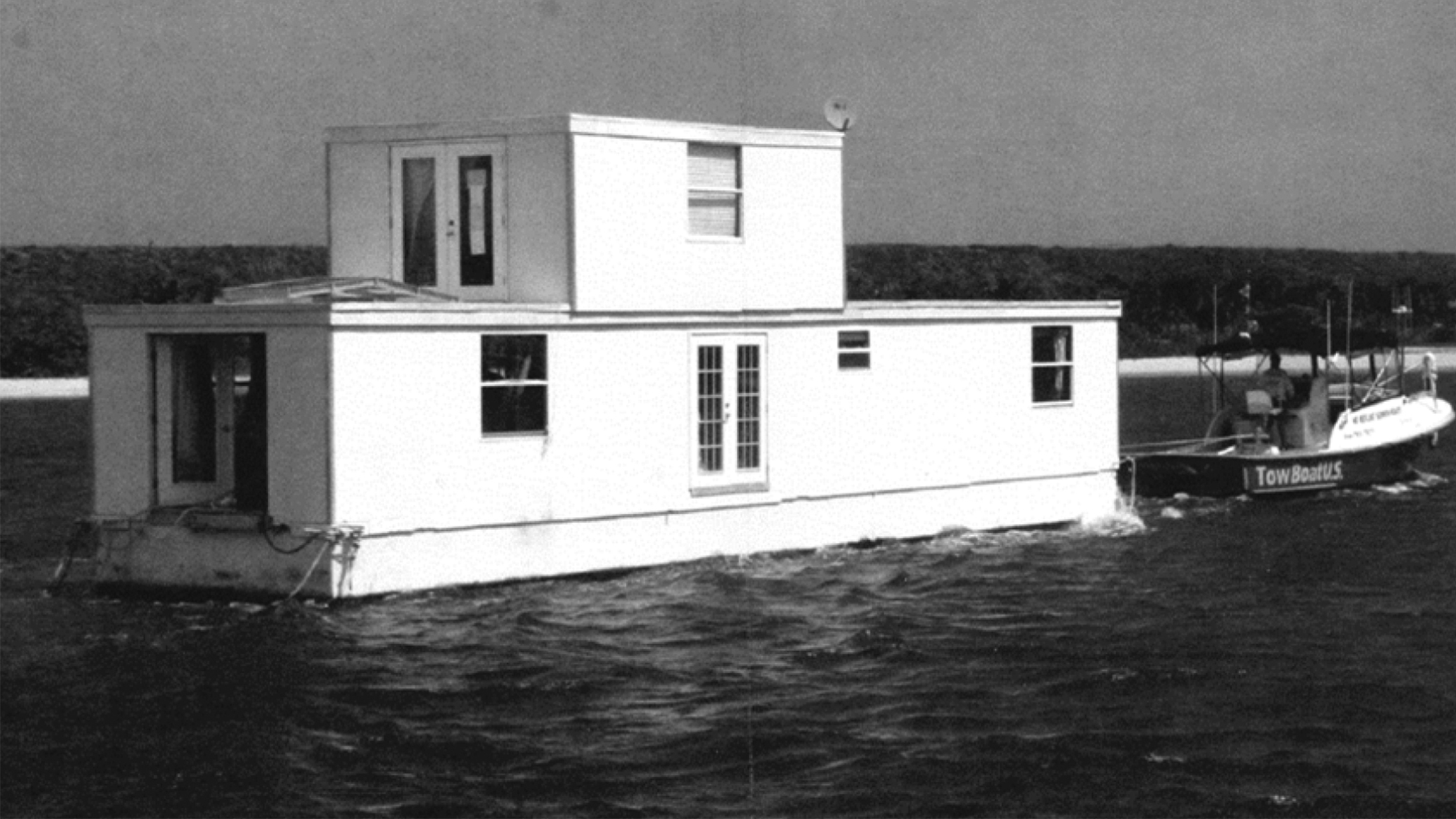
has created regulatory uncertainty for floating production facilities like this:
In a 7-2 decision, the court ruled that a gray, two-story home that its owner said was permanently moored to a Riviera Beach, Florida, marina was not a vessel, depriving the city of power under U.S. maritime law to seize and destroy it.
The floating production facilities are still subject to Coast Guard regulation and inspection pursuant to separate authority under the OCS Lands Act. The extent to which Coast Guard approval and inspection practices will change is not entirely clear. The Coast Guard will issue new certificates of inspection for these floating facilities, and new policy guidance is being developed.
Attached are answers that the Coast Guard provided to questions from the Offshore Operators Committee.
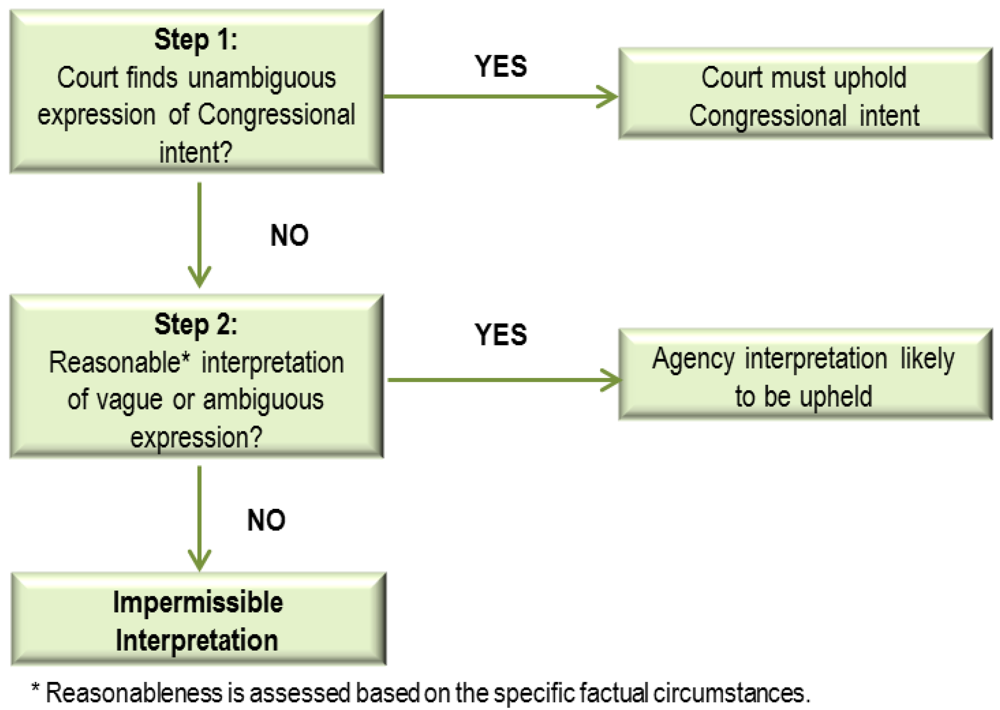
The Supreme Court will hear a case that could significantly scale back federal agencies’ authority, with implications for regulations affecting the US offshore program. The court could overturn a precedent known as the “Chevron doctrine” that instructs judges to defer to federal agencies when interpreting ambiguous federal laws.
Few Supreme Court doctrines have been stretched more by regulators and lower-court judges than Chevron deference, which says judges should defer to regulators’ interpretations when laws are supposedly ambiguous. The High Court agreed Monday to give Chevron a much-needed legal review.
One of the most important principles in administrative law, the “Chevron deference” was coined after a landmark case,Chevron U.S.A., Inc. v. Natural Resources Defense Council, Inc., 468 U.S. 837 (1984). The Chevron deference is referring to the doctrine of judicial deference given to administrative actions. In Chevron, the Supreme Court set forth a legal test as to when the court should defer to the agency’s answer or interpretation, holding that such judicial deference is appropriate where the agency’s answer was not unreasonable, so long as Congress had not spoken directly to the precise issue at question.
The OCS Orders were the foundation for the current operating regulations in the US and many states and other countries. They were logically organized, easily updated, and published for public comment prior to being finalized.
I have an email message indicating that the first OCS Order No. 1 (Identification of Wells, Platforms, and Structures) was signed on 1/31/1957 and the first OCS Order No. 2 (Drilling) dates back to 2/3/1958! (If anyone has access to the actual documents, please let me know.) The orders were developed much further in the 1970s and 1980s.
Contents of the 1/1980 Atlantic Orders:
OCS Order No. 1: Identification of Wells, Platforms, Structures, Mobile Drilling Units, and Subsea Objects
OCS Order No. 2: Drilling Operations
OCS Order No. 3: Plugging and Abandonment of Wells
OCS Order No. 4: Determination of Well Producibility
OCS Order No. 5: Production Safety Systems
OCS Order No. 6: Well Completions and Workover Operations
OCS Order No. 7: Pollution Prevention and Control
OCS Order No. 8: Platforms and Structures
OCS Order No. 9: Oil and Gas Pipelines
OCS Order No. 10 (reserved)
OCS Order No. 11: Oil and Gas Production Rates, Prevention of Waste, and Protection of Correlative Rights
OCS Order No. 12: Public Inspection of Records
OCS Order No. 13: Production Measurement and Commingling
There has been much discussion, particularly since the 1988 Piper Alpha tragedy, regarding the optimal approach to offshore safety regulation be it prescription, goal setting, safety cases, management systems, or some combination, and how to best influence facility, company, and industry safety culture.
My personal view is that the quality and type of regulations are not nearly as important as the people implementing them. My take:
Good regulators are more important than good regulations and are the key to a successful regulatory program.
Regulatorsmust understand and be committed to their organization’s mission and the strategy for achieving that mission.
While they should have a good understanding of the activities that they regulate, their focus is on challenging operators, not directing them.
Regulators should audit operator activities and carefully review incident and performance data. They should identify problems and concerns, but should not direct solutions.
Safety leaders should be applauded and poor performers should be penalized.
The quality of regulators is more important than the quantity.
Internal and external communication and collaboration are critical to their success.
Management should ensure that regulators are able to focus on their mission and that organizational distractions are minimized.