It’s a great country! ๐
Archive for the ‘Regulation’ Category
What did OSHA do when the 5th Circuit stayed implementation of their mandatory vaccine standard?
Posted in Health, Regulation, tagged OSHA, vaccine standard on December 10, 2021| Leave a Comment »
They extended the comment period. (Only an old regulator would find this amusing. Love OSHA’s panache ๐)
The ETS on Vaccination and Testing was published in the Federal Register on November 5, 2021. The ETS also acts as a proposal for a permanent standard and OSHA has decided to extend the comment period for that rule by 45 days. Written comments on any aspect of the ETS must now be submitted by January 19, 2022
OSHA
DOI Report on the Federal Oil and Gas Leasing Program (11/26/2021)
Posted in energy policy, Gulf of Mexico, Offshore Energy - General, Regulation, tagged BOEM, BSEE, DOI, financial assurance, leasing report, royalty on November 29, 2021| Leave a Comment »
Observations and comments on the offshore findings and recommendations in the Dept. of the Interior’s report:
- From an offshore perspective, this report is more moderate than expected. No major complaints.
- The report was issued the Friday after Thanksgiving. Was there a desire to minimize attention?
- The report does not include a recommendation on raising royalty rates. DOI will continue to study such actions (prudent decision).
- BSEE estimates current liability for “orphaned infrastructure” at only $65 million. They must be using a very narrow definition of orphaned infrastructure.
- “Financial assurance coverage should be strengthened.” (Few would argue with that statement.)
- “BSEE and BOEM will carefully consider comments on the 2020 proposed financial assurance rule.” (Deja vu? Expect a long, slow process.)
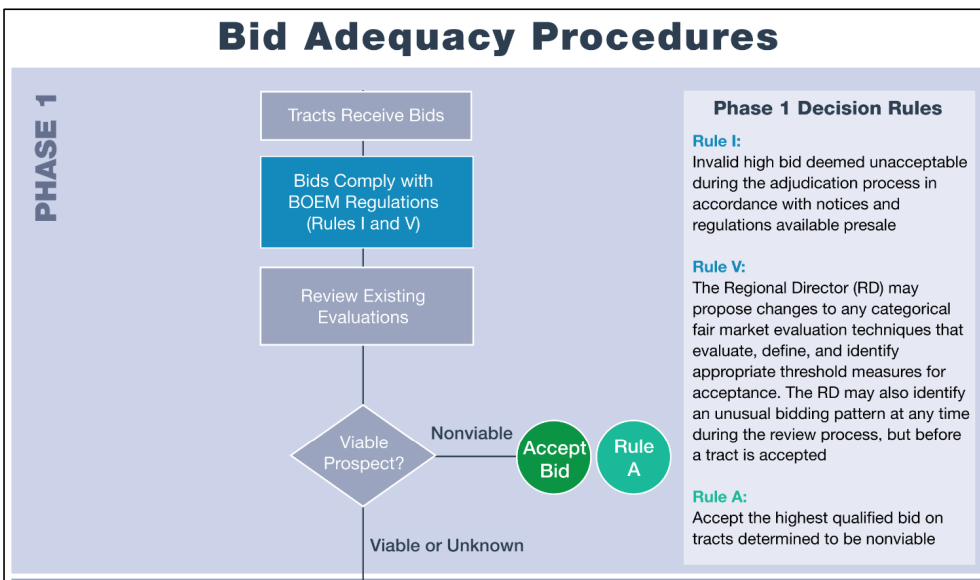
- BOEM will establish a “fitness to operate standard.” Comments: (1) This is an old concept that has proven to be difficult to execute. Hold companies accountable, make them demonstrate financial assurance, and don’t pander to bad actors (see the case of Hogan and Houchin) (2) Why is BOEM establishing this standard and not BSEE, the safety bureau? (The division of responsibilities between BOEM and BSEE has created serious overlap, inefficiency, and confusion and needs to be addressed.)
- “BOEM should consider advancing alternatives to the practice of area-wide leasing.” Tract selection makes sense in frontier areas with little operational history. It would have been perfect for the Mid- or South Atlantic or the EGoM, all of which were cynically removed from future leasing consideration by the previous President just before the 2020 election. The Central and Western Gulf of Mexico is too mature for a return to tract selection; employing that approach after 40 years of area-wide leasing is likely to generate less revenue and production.
Almost 15 years ago, the first US offshore CCS Project was proposed for the Atlantic
Posted in CCS, energy policy, Offshore Energy - General, Regulation, tagged Atlantic OCS, CCS, New Jersey, PureGen One on November 22, 2021| Leave a Comment »
The plan was for SCS Energy’s PurGen One plant in Linden, NJ to burn coal to generate electricity and produce fertilizer. SCS proposed to inject 90% of the CO2 into subsurface reservoirs 70 miles offshore. The project faced strong opposition and was ultimately nixed by the State. The plan had been presented to the Federal offshore regulator (MMS), but the company was advised that there was no legal framework for disposing CO2 beneath the OCS.
Often attempted in industry and government, but seldom successfully executed ๐
Posted in energy policy, Regulation, Uncategorized, tagged reorganization on November 15, 2021| Leave a Comment »

OSHA vaccine mandate on ice
Posted in hurricanes, Regulation, tagged OSHA, Regulation, vaccine mandate on November 7, 2021| Leave a Comment »
The 5th U.S. Circuit Court of Appeals granted an emergency stay of the requirement by the federal Occupational Safety and Health Administration that those workers be vaccinated by Jan. 4 or face mask requirements and weekly tests.
NPR
This court action was completely predictable from the outset. OSHA no doubt knew this but had no option but to dedicate substantial resources to the task. In all likelihood, the ETS/regulation will never be finalized.
Many (probably most) proposed regulations are never completed. Others never get beyond the concept stage. Establishing an OSHA rule takes an average of 7 years. That is not at all atypical for Federal regulators. There are much better ways to accomplish the regulatory objectives as was demonstrated after Hurricanes Katrina and Rita in 2005. Unfortunately our political system frowns on collaborative approaches so we do things the hard way – accomplishing much less in much more time and at a far greater cost.
Vaccination mandate: feeling OSHA’s pain (sort of)
Posted in Offshore Energy - General, Regulation, tagged emergency temporary standard, offshore industry, OSHA, vaccination on November 5, 2021| Leave a Comment »
- Executive Branch fiats don’t work in this country (and we can be thankful for that), but those in power sometimes don’t get that (or don’t care). Fortunately, we (MMS) weren’t tasked with many political rules, largely to the credit of our leadership.
- OSHA had done a good job of reinventing itself and improving its reputation and image. Now this.
- OSHA has a no-win assignment: issue a complex rule disguised as an Emergency Temporary Standard (a convenient regulatory hook that is being challenged legally).
- This is a very labor intensive exercise for OSHA. The 490 page
rulestandard that was issued today is just the beginning. - Well managed companies should have already developed a policy that best serves their business interest and fully considers the needs of customers and employees.
- The OSHA directive takes the lagging companies off the hook. Rather than actually managing, corporate execs can simply point to the government directive.
- It looks like enforcement falls on the companies which “must maintain a record and a roster of each employee’s vaccination status.”
- OSHA is a bit late to the party. BSEE has been collaboratively working COVID issues with the offshore industry for nearly 2 years. Will they now be asked to inspect facility COVID records and enforce the OSHA mandate?
- For the record, 100% of BOE’s employees are thrice vaccinated for COVID (initial Pfizer doses plus the booster).๐
The legal challenges are already in motion, and the arguments are compelling:
“The order is unconscionable. OSHA does not know how to run our companies. We do,” said Steve Fettig, Secretary and Treasurer of Tankcraft and Plasticraft. “OSHA does not know how to keep our employees safe. We do. And we have done so successfully since the start of the pandemic without the interference of a federal bureaucracy. We respect our employeesโ fundamental right to make their own private, difficult medical choices.”
Milwaukee Journal
Proposed EPA rule prohibits venting of associated gas
Posted in energy policy, Gulf of Mexico, natural gas, Offshore Energy - General, Regulation, tagged Argonne, BSEE, EPA, flaring, methane, venting on November 4, 2021| Leave a Comment »
Among other provisions, EPA’s proposed rule, issued on 11/2/2021, specifies that associated gas be handled as follows:
Route associated gas to a sales line. If access to a sales line is not available, the gas can be used as an onsite fuel source, used for another useful purpose that a purchased fuel or raw material would serve, or routed to a flare or other control device that achieves at least 95 percent reduction in methane and VOC emissions.
Because the Dept. of the Interior has jurisdiction over air emissions on most of the Gulf of Mexico OCS, I assume this proposed rule does not apply to those facilities. However, the EPA proposal is not entirely clear in that regard. If the EPA proposal does not apply, will BOEM/BSEE be proposing similar restrictions in their regulations?
MMS/DOI considered prohibiting venting, but determined that adding flaring capability was not feasible for many shelf platforms, and for some platforms there would have been a net increase in emissions. That said, venting is not insignificant. A 2017 Argonne study indicated (table 2) that, for shelf platforms from 2011 through 2015, more than 3 times as much gas was vented as was flared. More recent data should be reviewed to get a better sense of the costs, benefits, and safety considerations associated with achieving further reductions in venting.
Current flaring/venting regulations for OCS facilities are here.
Is the removal of decommissioned offshore pipelines good policy?
Posted in decommissioning, energy policy, Offshore Energy - General, pipelines, Regulation, tagged decommissioning, pipelines, Regulation, Scandpower on October 19, 2021| Leave a Comment »
Scandpower study (2004) for MMS:
Overall Conclusion
Currently, there are no regulations that require removal of subsea pipelines if they are not an obstruction to navigation. Based on the high costs for removing the pipelines, the personnel risk involved in the removal operations, the negative effect on overall emissions to air and the very limited reduction in discharges to sea, the overall conclusion is that it is better to leave the pipelines in place. If possible, re-use of the pipelines is the optimal solution.
Environmental Impacts
The impacts on the environment and the marine environment from pipelines and cables left in place were found to be very minor. Conversely recovery operations will have a negative impact on the environment. The number of vessels required for removal operations and long operating hours will result in considerably more releases and emissions than leaving the pipelines in place. In addition the energy savings benefit from recycling the pipeline materials will be exceeded by the energy required to remove the pipelines and separate the materials.
Pipeline Decommissioning: Environmental Impact Metric (per Scandpower)
| Remove/ recycle | Remove/ landfill | Reuse or preserve | Bury | Abandon in place | |
| Energy | High | High | Low | Moderate | None |
| Emissions | High | High | Low | Low | Low |
| Discharges | Low | Low | Moderate | Low | Low |
| Habitat | Low | Low | Moderate | Low | Low |
| Aesthetics | Low | Moderate | None | None | None |
| Resource Utilization | High | None | High | None | None |
| Littering | Low | Low | Low | Low | Moderate |
The “Habitat” impacts row seems questionable. Pipeline removal certainly has a greater impact on habitat than abandonment in place, particularly for buried pipelines.
“It’s one of the cleanest lines I’ve ever seen” – Chris Fox, CA State Lands Commission
Posted in accidents, California, Offshore Energy - General, oil, Regulation, tagged Amplify, Beta Unit, Huntington Beach, inspections, pipeline spill, SLC on October 17, 2021| Leave a Comment »
This quote from an AP article is consistent with the view expressed here after our review of the inspection reports for the Beta Unit (Platform Elly to shore) pipeline. Further per the AP article:
Safety inspections in 2015, 2017 and 2019 found anomalies in Amplifyโs pipeline, including instances of metal loss and three dents that were previously repaired. But several experts who reviewed the reports said the metal loss — which can be a sign of a pipe wall thinning as it corrodes with age — was relatively minor. The dents were not in the same area as the spill.
AP