Tyler Priest, the leading historian on US offshore oil and gas operations, has informed me that his much anticipated book, “Offshore Oildom,”is now available for order from LSU Press.Tyler’s book is a fascinating account of the history of the technologically innovative and economically important, yet controversial, OCS Oil and Gas program.Β See the attached flyer.
Consider this recommendation by Daniel Yergin:
βTyler Priest, a preeminent historian of energy and the environment, explores how a single well drilled off a pier near Santa Barbara in 1898 gave rise to a major American industryβoffshore oil and gas. In spirited prose, Priest demonstrates how this U.S. industry was created not only by innovation, creative engineering, and complex execution; it was also the result of fierce political battles.β ~Daniel Yergin, Pulitzer Prizeβwinning author of The Prize: The Epic Quest for Oil, Money, and Power and The New Map: Energy, Climate, and the Clash of Nations.
Robert “Bobby” Nelson, a beloved father and husband, and a highly respected engineer, died suddenly last Saturday.
Jason Mathews, a Supervisory Petroleum Engineer with the Bureau of Safety and Environmental Enforcement, had this to say about his admired colleague:
“A legacy is not just what you leave for others; it’s the impact of your presence, the influence of your actions, and the memories you create.
Bobby was an exceptional engineer, father, husband and friend who had a lasting impact on many of us. In fact, I would argue Bobby was one of the most impactful engineers in my tenure on developing and transforming younger engineers on how to think critically on complex offshore systems and processes.
Bobbyβs legacy in my industry will push on for many years, and we are forever grateful for the time we had with him.”
More from his colleagues:
Bobby dedicated much of his professional life to BSEE, where he served as a Technical Advisor since January 2020, and for the previous seven years as Well Operations Section Chief and Drilling Engineer in the Houma District.
His expertise in well control, drilling engineering, and offshore regulatory compliance was invaluable. He contributed significantly as a subject matter expert and assistant content writer for the BSEE Well Control Rule Revision Team, helping shape post-Deepwater Horizon reforms, and provided technical insights on critical projects ranging from tropical cyclone risk assessments for floating rigs to hydrate pressure coring expeditions and incident investigations. Β
Bobby’s commitment to safety and environmental stewardship on the Gulf of America’s Outer Continental Shelf left a lasting impact on his colleagues and the industry.
He is survived by his loving wife, Amber, whom he met at BSEE, and their young daughter. In this time of grief, please keep Bobby’s family in your thoughts and prayers.
For 40 years, challenges associated with bankruptcies (or the threat thereof), a divided offshore industry, political pressure, hurricane damage, and unresolved legal issues have hindered initiatives to better protect the public from decommissioning liabilities. Nonetheless, regulators and industry were able to prevent taxpayers from incurring any decommissioning costs. Unfortunately that is no longer the case.
For the first time in history, the govt has funded decommissioning on the OCS (and bragged about it – photo below).
Federally funded decommissioning operation in the Matagorda Area of the Gulf.
BOEM’s proposed revisions to the decommissioning regulations (attached) would facilitate the transfer of aging structures to companies with limited assets, and in some cases, poor or undemonstrated safety records.
The proposal would reduce or eliminate the supplemental financial assurance requirement if a predecessor lessee has a strong credit rating. For that strategy to work, related decommissioning issues must be addressed. and clarifications and boundaries provided to ensure taxpayers are protected from decommissioning liabilities.
Predecessor liability, which is important because it helps prevent companies from assigning leases for the purpose of avoiding decommissioning obligations, was not established in the regulations until much of the OCS infrastructure was already installed. In a final rule that was effective on 8/20/1997,my office (thanks to the perseverance of Gerry Rhodes, John Mirabella, and Dennis Daugherty) codified the joint and several liability principle in 30 CFR 250.110 as follows:
(b) Lessees must plug and abandon all well bores, remove all platforms or other facilities, and clear the ocean of all obstructions to other users. This obligation: (1) Accrues to the lessee when the well is drilled, the platform or other facility is installed, or the obstruction is created; and (2) Is the joint and several responsibility of all lessees and owners of operating rights under the lease at the time the obligation accrues, and of each future lessee or owner of operating rights, until the obligation is satisfied under the requirements of this part.
Prior to the that rule, the official policy of the Dept. of the Interior, as expressed in a 1988 letter from the Director of the Minerals Management Service (see excerpt pasted below), was that lease assignors would NOT be held accountable should their successors fail to fulfill their decommissioning responsibilities.
A major unanswered question regarding decommissioning obligations is thus the extent to which predecessor liability applies to leases assigned prior to the 1997 regulation. According to BOEM data, 771 remaining platforms were installed at least 10 years before the rule change, and 504 were installed at least 20 years prior. For assets transferred prior to the rule change, do the predecessors retain liability? BOEM should explain its position on this issue.
Other predecessor liability questions that need to be answered:
Now that the reverse chronological guidance has been scrapped, what will be the process for determining which predecessors will be held responsible?
If the govt doesn’t ensure that the new lessees fulfill their performance obligations (e.g. funding escrow accounts, well plugging, insurance, etc.), are predecessors still liable?
What if the structures were poorly maintained by the new lessees, complicating decommissioning and increasing the costs
Should a predecessor several transfers removed from operating the facilities still be held responsible?
Two examples of what can happen (and has happened):
Example 1: Big AAA Oil assigns a lease to Proud Production, a reputable independent. After years of operations, Proud can no longer profitably produce from the lease. Proud assigns the lease to CCC Oil & Gas, a small and highly efficient operator. After the lease is no longer profitable, even for a company with a low cost structure, CCC assigns the lease to Elmer’s E&P, a sketchy, barely solvent operating company with a poor compliance record. Elmer rather predictably neglects maintenance and declares bankruptcy after a decline in oil prices. Should Big AAA Oil, which had no say in the last 2 transfers in the assignment chain, be financially responsible for decommissioning the facilities?
Example 2: Big AAA Oil assigns a lease to DDD Development Company. Per the terms of the assignment, DDD establishes an Abandonment Escrow Account, as provided for in 30 CFR 556.904. BOEM allows DDD to withdraw funds from the account for purposes not authorized in the regulations. Should Big AAA Oil be liable for decommissioning costs after DDD is no longer solvent? (See “The troubling case of Platforms Hogan and Houchin.”)
For predecessor liability to be fairly and effectively implemented, and survive legal challenges, BOEM should:
Before approving lease assignments, verify that the assignors and assignees have contractually specified, to BOEM’s satisfaction, how the decommissioning of assigned assets will be funded.
Not approve subsequent lease assignments until the predecessor that is being held financially responsible has approved a funding agreement with the new lessees.
In 2025, more natural gas was produced in the Appalachia region of the Northeast than in any other US region, accounting for 31% of marketed natural gas production. (See the chart below.) Were it not for pipeline capacity limitations, recent growth in Appalachia production would have been greater.
Appalachia production is primarily from the Marcellus and Utica shales in PA, WV, and Ohio.
OCS gas production, 80% of which is now associated gas from deepwater oil wells, continues to lag the shale basins. This is a big change from 25 years ago when the OCS produced more gas than any state but Texas. (See the chart below.) Interest in ultradeep (subsurface) OCS shelf gas prospects remains scant despite favorable demand forecasts and technological advances.
red=blocks receiving bids at BBG2; blue=BBG1 and Sale 261 leases; green=active leases issued prior to Sale 261
Although bidding at Sale BBG2 was rather subdued, Gulf heavyweights BP, Chevron, Shell, and Oxy/Anadarko, along with increasingly important Woodside Energy, competed for the 4 red blocks in the Green Canyon area (map above and table below). These elephant hunters presumably see excellent Paleogene (Wilcox) prospectivity in those blocks.
17 of the sale’s 38 bids (45%) and $32.8 milion of the sale’s $47 million in high bids (70%) were for these 4 blocks. BP’s $21 million bid for GC 404 was by far the sale’s highest bid.
Green Canyon Block No.
No. of bidders
High Bidder
Bid
404
5
BP
$21,009,990
405
2
BP
$885,99
448
5
Chevron
$4,967,067
492
5
Chevron
$5,887,188
At this time, the high costs and technical complexities (e.g. deepwaterand high pressure/high temperature reservoirs) limit Wilcox development to major oil companies and well financed, technically savvy independents. Expect some of the international majors that did not participate in BBG2 to acquire lease interest at a later date, which will again raise questions about the merits of joint bidding restrictions.
From AAPG graphic-Wilcox trend map. Eastern area can be subdivided into an outboard and inboard trend, with wells in the latter area showing variable thickness due to salt tectonics contemporaneous with deposition (From Zarra et al. 2019βs AAPG Search and Discovery article).
Imbedded below is a good presentation on the Paleogene Wilcox by Dr. Mike Sweet, Univ. of Texas:
Although no one was expecting a barnburner only 3 months after the previous sale, BBG2 was historically weak for a Gulf-wide sale. The table below compares BBG2 with the previous 4 Gulf sales, none of which were particularly impressive.
However, the sale was not without highlights. There was some spirited bidding for tracts in the Green Canyon area. BP’s bid was the highest of 5 for GC Block 404. BP bid $21 million for the block, 45% of the high bids sum for the entire sale. The BP bid was also $20 million higher than the next highest bid for that tract (ouch!).
Also interesting was Chevron edging Shell $5,887,188.00 to $5,501,240.00 to acquire GC Block 492.
Sale No.
257
259
261
BBG1
BBG2
date
11/17/2021
3/29/2023
12/20/2023
12/10/2025
3/11/2026
companies participating
33
32
26
30
13
total bids
2233
2842
3161
219
38
tracts receiving bids
2143
2442
2751
181
25
sum of all bids $millions
198.5
309.8
441.9
371.9
69.9
sum of high bids ($millions)
101.7
263.8
382.2
279.4
47.0
highest bid company block
$10,001,252 Anadarko AC 259
$15,911,947 Chevron KC 96
$25,500,085 Anadarko MC 389
$18,592,086 Chevron KC 25
$21,009,990 bp GC 404
most high bids company sum ($millions)
46 bp 29.0
75 Chevron 108.0
65 Shell 69.0
50 bp 61.0
6 Anadarko (Oxy) 4.0
sum of high bids ($millions) company
47.1 Chevron
108 Chevron
88.3 Hess
61.0 bp
22.6 bp
most high bids by independent
14-DG Expl.
13-Beacon 13-Red Willow
22-Red Willow
14-Murphy
5-LLOG
1excludes 36 leases improperly acquired for carbon disposal purposes; 2excludes 69 leases improperly acquired for carbon disposal purposes; 3excludes 94 leases improperly acquired for carbon disposal purposes
For historical comparison purposes, Gulf Sale 206 drew $3.7 billion ($5.6 billion in today’s dollars) in 2008. Twenty-siz sales between 1972 and 2013 garnered more than $1 billion in high bids.
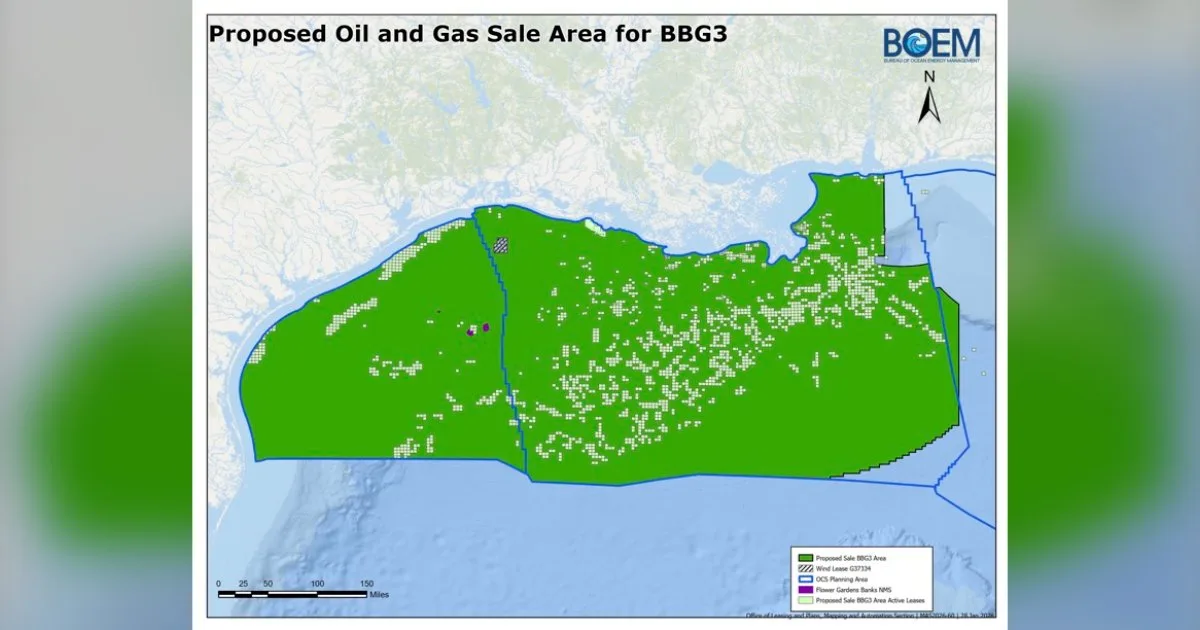
Gulf of America oil and gas lease sale BBG2 will be held tomorrow. The Notice of Sale is attached.
Although Big Beautiful Gulf 1 (BBG1) was rather lackluster, BBG 2 is unlikely to match it in terms of the number of bids and their sum. Prior to BBG1, there had been no lease sale for two years. BBG 2 is being held only 3 months later.
Given the short duration between sales, the bid evaluations for BBG1 are not yet completed. However, the sale notice advises that any block which received a bid in BBG1 is excluded from BBG2.
Will the recent increase in oil prices influence bidding? Probably not given the longer term nature of offshore development and expectations that the current price spike will be of short duration. Onshore shale oil production is more responsive to price fluctuations.
December 2025 Gulf oil production had to average 1.993 million bopd for 2025 to match the 2019 record. It exceeded that mark by 0.003 million bopd. However, October and November production were revised slightly downward resulting in a near dead heat annual average.
A closer look at the numbers (table below) shows that 2025 edged 2019 by a mere 250 bopd. Amazing!
Major caveat: The Nov and Dec 2025 figures will likely be revised slightly when EIA releases the next update at the end of January. Fingers crossed!π
Per Baker Hughes, the latest (2/20/2026) Gulf of America rig count (2/20/2026) slipped to 9. The count was 10 the previous week and 12 a year ago. In 2023 and 2024, the BH rig count was a more healthy 15-20.
8 of the 9 rigs currently drilling are at high potential deepwater locations: 3 in the Mississippi Canyon Area, 3 in Green Canyon, 1 in Walker Ridge, and 1 in Alaminos Canyon. One rig was drilling on the shelf in the Eugene Island Area.
Per MMS data,the active Gulf rig count in 2001 was 148. The 2001 count was not a one year blip; the number of rigs active in the Gulf exceeded 100 for the ten year period from 1994-2003.
Although drilling and production have become more efficient with improved exploration technology, modern well completion practices, high pressure/temperature equipment, and enhanced recovery programs, drilling activity must still be sufficient to replace reserves and sustain production over the longer term.
2025 may have been a record production year for the Gulf; we’ll find out at the end of this week. However, that level of production is not sustainable without increased drilling activity.
The EIA (chart below) is forecasting another banner year for Gulf oil production in 2026. However, they are pointing to a decline in 2027, when new production is not anticipated to be sufficient to offset natural declines. The decline in production is likely to continue beyond 2027 absent increased drilling.
BH rig count criteria: To be counted as active a rig must be on location and be drilling or ‘turning to the right’ for 4 out of 7 days during a week. A rig is considered active from the moment the well is βspuddedβ until it reaches target depth or “TD”. Rigs that are in transit, rigging up, or being used in non-drilling activities such as workovers, completions, or production testing, are NOT counted as active.