NRW contracted with Array Petroleum to operate the former Cox Assets. Array subsequently sued NRW, asserting that NRW received $78,000,000 in revenue, but disbursed only about $48,000,000 to pay Array’s invoices and those of the subcontractor.
The court filing claimed that NRW failed to pay Array $2.5 million, the subcontractors $10.7 million, and the United States $12 million. A large share of the subcontractor costs were probably for well operations given that 21 Array workover applications were approved in 2024 and 2025. The $12 million due to the Federal government is reportedly for royalty payments. Were any revenues set aside for decommissioning liabilities?
Array’s lawsuit was dismissed by the court on January 3, 2025, after a joint motion to dismiss was filed by the defendants. Information on the reasons for the dismissal is not publicly available.
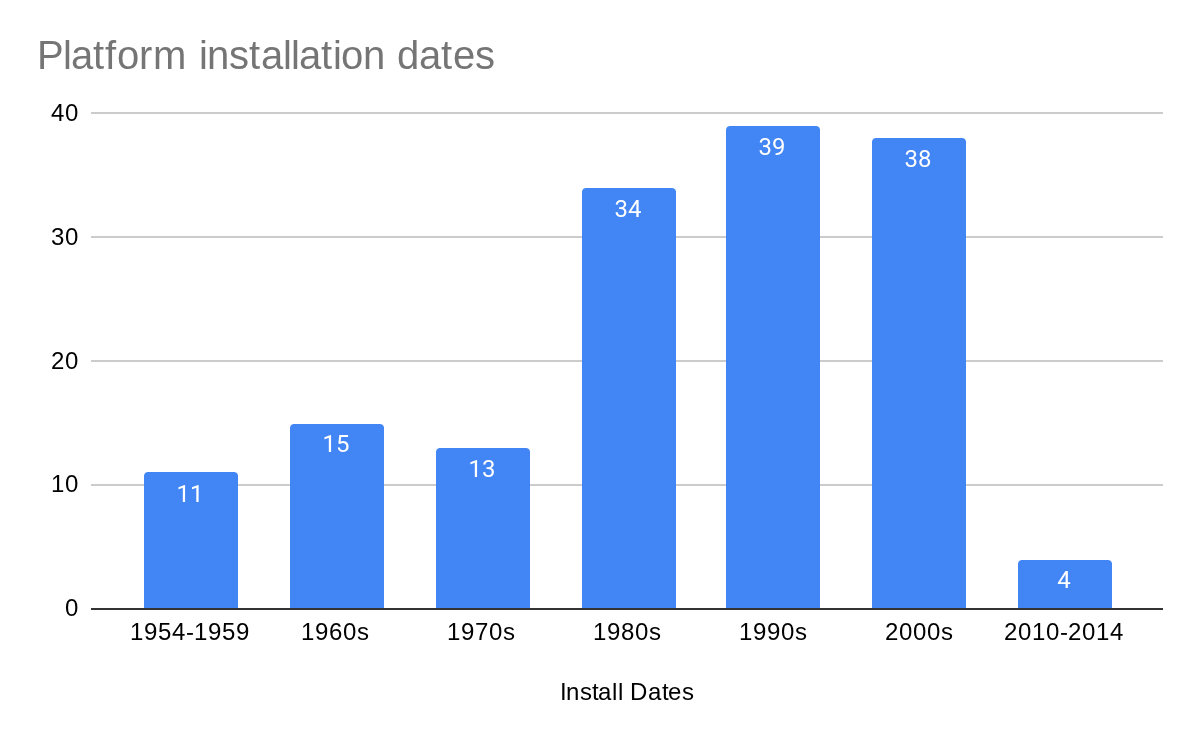
Old platforms: According to BOEM records, Array operates 154 platforms previously owned by Cox. These platforms are in the Ship Shoal, South Marsh Island, and West Delta areas of the Gulf of America. Most are >30 years old and four are more than 70 years old (see chart below). 41 are classified as major structures including 15 of the 26 platforms installed in the 1950s and 1960s. 44 are manned on a 24 hour basis. 79 have helidecks. Massive decommissioning liabilities loom.
Violations: NRW/Array ranks 37th out of 42 companies in GoA oil production (2025 YTD) and 36th out of 42 companies in gas production, but leads the pack in Incidents of Noncompliance (INCs):
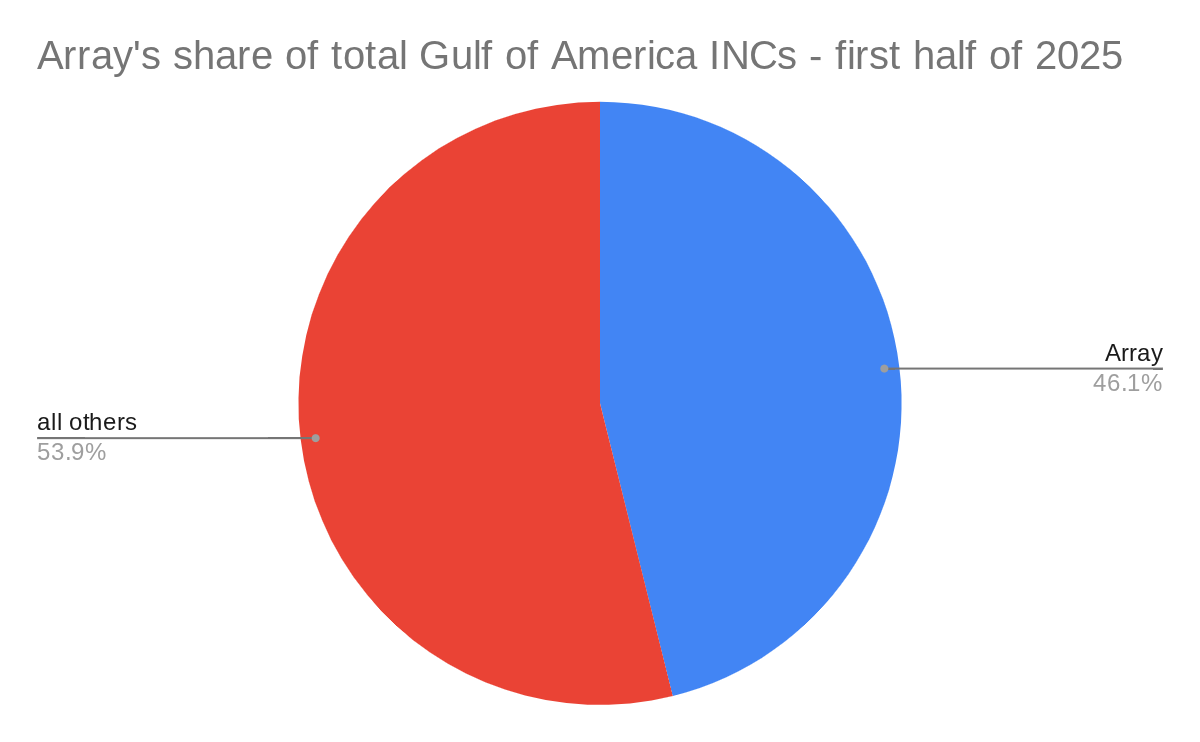
Array accounted for nearly half of all GoA INCs issued in the first half of 2025 (chart below).
Array was issued 9 times more warning INCs (311) than any other operator. Apache was second with 34.
There are many small and mid-sized companies that are responsible operators. Their participation in the OCS program should be encouraged. However, others have demonstrated, by their inattention to financial and safety requirements, that they are not fit to operate OCS facilities.
The growth of Fieldwood, Cox, Signal Hill, and Black Elk was in part facilitated by lax lease assignment and financial assurance policies.
Operating companies should have to demonstrate that they can operate safety and comply with the regulations before they are approved to acquire more properties.
Expect the ultimate public cost of the Cox bankruptcy, in terms of decommissioning liabilities and the need for increased oversight, to be large.
The Federal govt (Justice/Interior) should strongly oppose bankruptcy court asset sales that increase public financial, safety, and environmental risks.
Not mentioned in the film are the extraordinary efforts of the Mineral Management Service’s Villere Reggio in establishing the Rigs to Reefs program. Villere (pictured below), has a most interesting family history as summarized in the caption. See p. 3 of this issue of MMS Today for the complete article.
Reuters and others report that zinc from a new Chevron well has contaminated oil production destined for an Exxon refinery via Shell’s Mars Pipeline System. Because contaminated crude may cause maintenance issues and reduces the quality of refined products, Exxon will not accept crude from the Mars system until the zinc issue has been resolved.
The Mars system delivers about 575,000 bopd raising concerns about supplies to Gulf Coast refineries. But fear not, DOE authorized the delivery of up to 1 million barrels of oil from the Strategic Petroleum Reserve to the Exxon’s Baton Rouge refinery.
(Ironically, yesterday’s post pointed to the importance of the SPR and questioned the decision to drastically reduce crude oil purchases. This zinc incident is likely to be minor, and Exxon will repay the SPR in kind. However, more serious regional, domestic, and international events could call for much greater SPR withdrawals.)
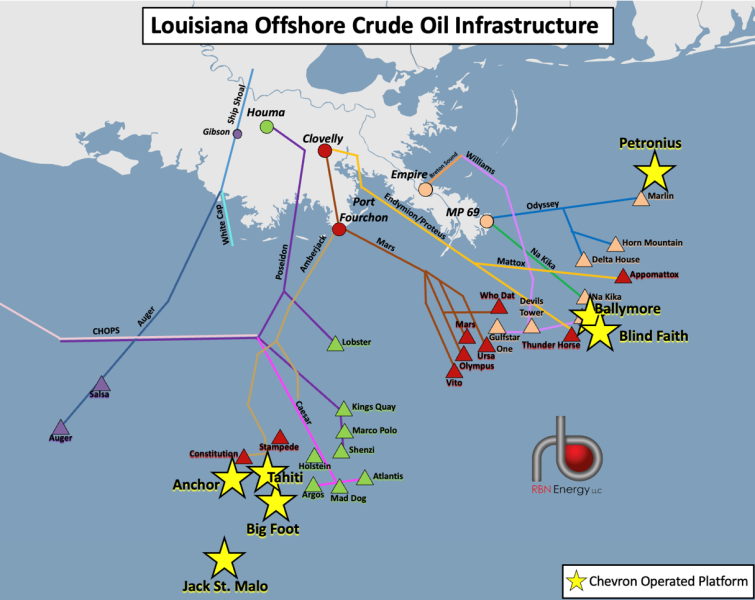
The above map shows Chevron platforms that connect with the Mars system at Port Fourchon.
Speculation/commentary:
The well/platform responsible for the zinc contamination has not been identified. Given that production is ramping up at Chevron’s Anchor facility, a new well on that platform may be the source of the zinc. Other Chevron platforms that connect to the Mars system are indicated in the diagram above.
Given that zinc in crude oil is rare, a well completion fluid containing zinc bromide may be the culprit.
Note the integration of offshore production streams, and the involvement of 3 industry super-majors. These companies are highly competitive, as evidenced by the Chevron-Exxon Stabroek dispute, but are also cooperative in producing, transporting, and refining oil and gas. However, they and other majors are restricted (rather illogically) from bidding jointly for leases.
“Leases awarded through Lease Sale 262 will be for oil and gas exploration and development only.” (News Release)
“Leases issued as a result of GOA Lease Sale 262 are expressly limited to oil and gas exploration and development.” (p. 16 of the Sale Notice)
Comment: Why would BOEM stipulate, for the first time ever, that an Oil and Gas Lease Sale is only for oil and gas exploration and development? Perhaps because, at the last 3 sales, 2 companies wrongfully acquired oil and leases for carbon disposal purposes. Those leases will likely expire at the end of their primary term, and the lessees will have nothing to show for their investment.
Other items of interest:
“Congress may enact legislation through reconciliation efforts sometime after publication of this Proposed NOS“
Comment: The Offshore Oil and Gas Leasing provisions in the “Big Beautiful Bill” make OCS leases more attractive in that they minimize sale uncertainty and return royalty rates to pre-IRA levels.
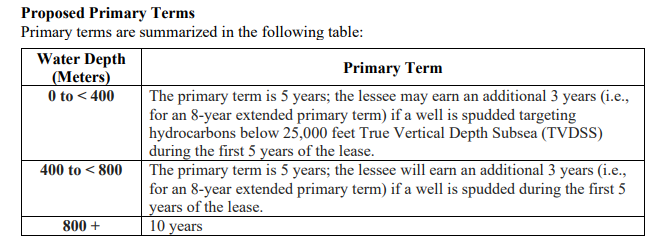
Proposed Primary Terms
Comment: Time for an update. The drilling requirements for a primary term extension should be the same for leases in 0-400 m as for those in 400-800 m. The requirement for an ultra-deep subsurface well is selectively punitive to shelf operations. These operations, although typically less lucrative, are important to the Gulf’s infrastructure.
Restricted Joint Bidders On April 29, 2025, BOEM published the most recent List of Restricted Joint Bidders in the Federal Register (90 FR 17832). Potential bidders are advised to refer to the Federal Register prior to bidding for the most current list at the time of the lease sale. Please refer to the joint bidding provisions at 30 CFR 556.511-556.515
The differences between the House and Senate versions of the Big Beautiful Bill are summarized in the table below. (See the previous post on the House version.)
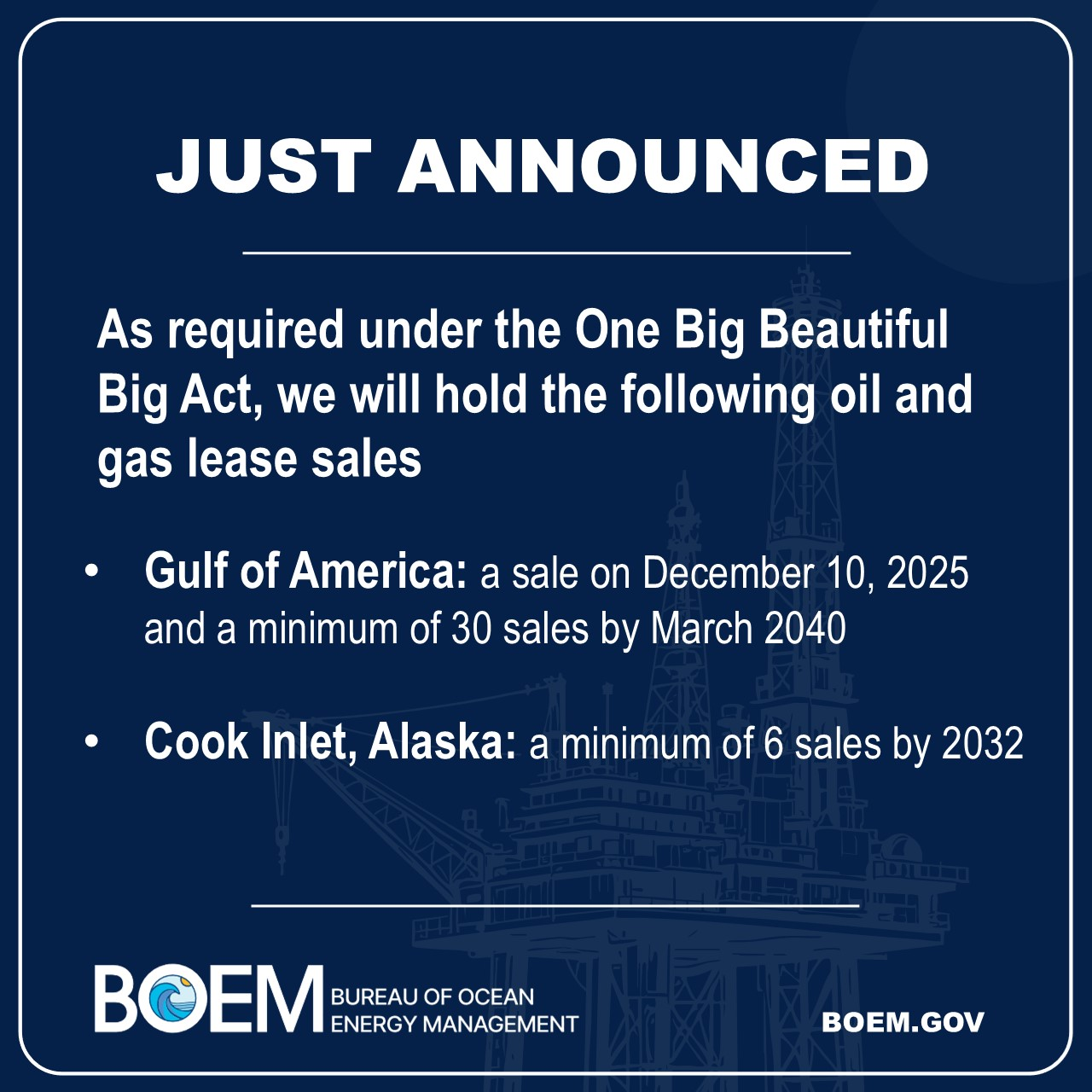
The Senate bill includes royalty and lease terms that favor deepwater lessees, but excludes the provisions in the House bill that streamline the leasing process and minimize litigation risks. At least some of those House provisions were rejected by the Senate Parliamentarian.
The House will vote on the version that passes the Senate. So the Senate version is more likely to be enacted.
House
Senate
Comment
royalty: 12.5% to 18.75%
royalty: 12.5% to 16 2/3%
Lowering the royalty cap to 1/6 (16 2/3%) unduly limits the Secretary’s discretion and may reduce revenues without significantly increasing production.
2 GOA sales/yr over next 15 yrs.
same as House
Would have liked the opportunity for consideration of very limited Atlantic leasing or stratigraphic test drilling, but that is not politically feasible at this time.
use Sale 254 form and stips 4-10, may update stips 1-3
sale 254 lease form and stips 4-9, may update stips 1-3 and 10
The minor difference favors the Senate version. Stip 10 pertains to restrictions due to Rights-of-Use and Easement for Floating Production Facilities, and needs to be updated with each sale
mandates 10 year lease term for water depths >800 m
Although a 10 year term for deepwater leases is generally prudent, the Secretary should be able to choose a shorter term if concerns about timely exploration and diligent development arise (more likely given the increase in leases that could be issued as a result of the 2 sales/yr mandate).
requires approval of subsurface commingling unless there is “conclusive evidence” of safety or ultimate recovery issues
Although BSEE’s policy change on downhole commingling was warranted, the legislative change removes essentially all discretion by mandating approval unless there is “conclusive evidence” to the contrary. Conclusive evidence is dependent on production history, at which point it may be too late.
Adherence with the Biological Opinion shall satisfy the Secretary’s obligations under the Endangered Species Act of 1973 and the Marine Mammal Protection Act of 1972
This provision reduces govt/lessee litigation risks
Previous EIS’s for the Gulf of Mexico shall satisfy the Secretary’s NEPA obligation.
Rejected by the Senate Parliamentarian.
Consistency determinations prepared by BOEM for Lease Sale 261 for the States of Texas, Louisiana, Mississippi, Alabama, and Florida will satisfy the Secretary’s CZMA obligations.
The States or Parliamentarian may not have been comfortable with this provision which simplifies plan approval processes.
The Secretary may waive any requirement under the Outer Continental Shelf Lands Act that the Secretary determines would delay issuance of a lease.
Rejected by the Senate Parliamentarian?
A lease must be issued to the highest responsible qualified bidder not later than 90 days after the sale date.
Rejected by the Senate Parliamentarian.
A Governor may nominate for leasing under a lease sale held under this section an area of the OCS that is adjacent to the waters of the State
Never understood the need for this provision.
G&G surveys must be approved within 30 days after a complete application is received.
Not feasible in some cases given endangered species concerns.
A lease awarded under Lease Sale 259 or Lease Sale 261 shall not be set aside, vacated, enjoined, suspended, or cancelled except in accordance with section 5 the Outer Continental Shelf Lands Act (43 U.S.C. 1334). Also, new terms or conditions may not be added to these leases.
Reduces litigation risks.
Any action to approve, require modification of, or disapprove any exploration plan, development and production plan, bidding procedure, lease sale, lease issuance, or permit or authorization related to oil and gas exploration, development, or production, or any inaction resulting in the failure to hold a lease sale shall be subject to judicial review only in a United States court of appeals for a circuit in which an affected State is located.
This provision significantly reduces litigation risks. Rejected by Parliamentarian?
6+ Cook Inlet sales over next 10 yrs.
6+ Cook Inlet sales over the next 7 years
90% of Cook Inlet revenues to the State of Alaska.
70% of Cook Inlet revenues to the State of Alaska.
The percentages are high, but the revenues are likely to be low.
Today’s Supreme Court decision limits the power of federal district judges to issue universal injunctions. I wonder if this decision restricts courts in DC and Maryland from ruling on oil and gas operations in the Gulf of America? Perhaps not, because those decisions are linked to Federal agencies in the DC area even though the activity is in the Gulf.
Minimizing flaring and venting is important from both environmental and resource conservation standpoints.Flaring and venting volumes are also good indicators of how well production systems are designed, managed, and maintained.
The best performance indicators are the percentages of produced gas that are flared and vented both for oil-well gas (OWG, also known as associated or casinghead gas) and gas-well gas (GWG or non-associated gas).
Updated flaring and venting volumes for the Gulf of America have been compiled using monthly data submitted to the Office of Natural Resources Revenue (ONRR). This is the best data source because reporting is mandatory and strictly enforced, and flaring and venting are accounted for separately.
In assessing performance trends, it’s important to segment venting and flaring volumes for both OWG and GWG production. Venting produced gas (mostly methane) is a more significant environmental concern from both air quality and greenhouse gas (GHG) perspectives.
Flaring and venting data for 2019-2024 are summarized in the table below. All volumes are in millions of cubic feet (MMCF).
Notes and comments:
The more disappointing 2024 numbers are entered in red. The blue numbers, all related to OWG venting, are encouraging.
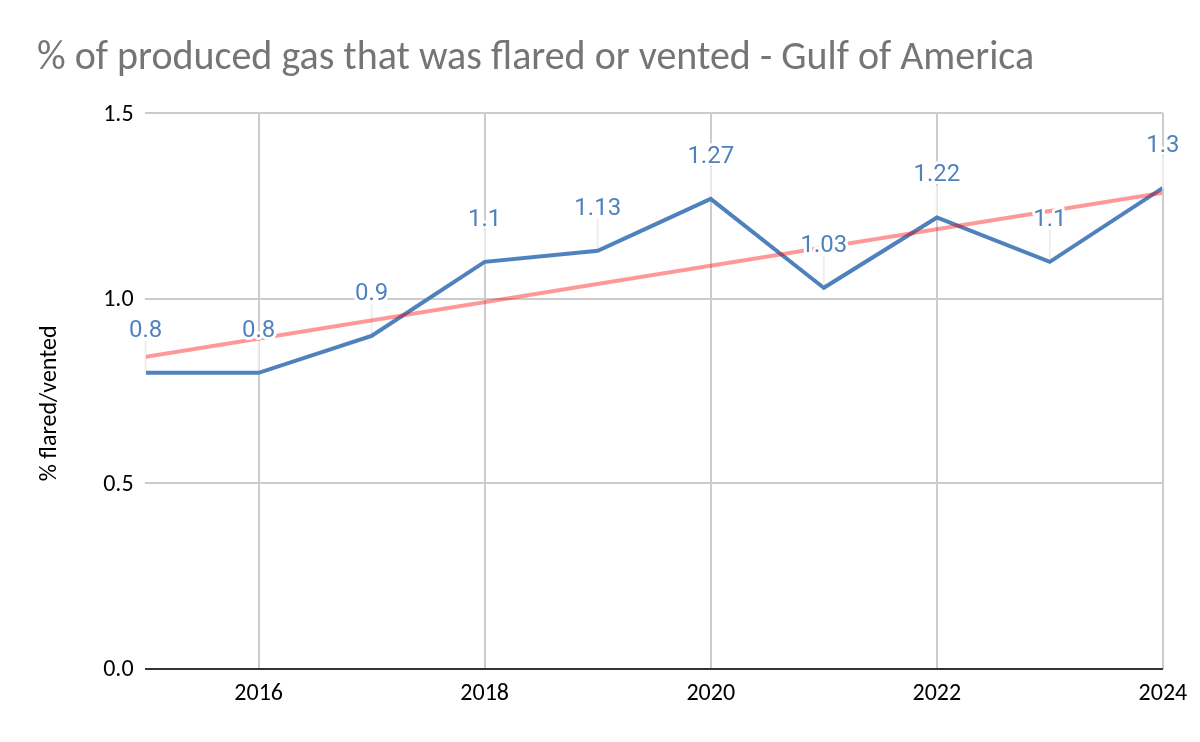
The % of all produced gas that was flared or vented in 2024 (1.3%) was the highest in the past 10 years (see the chart below the table). Until 2018, annual flaring/venting rates of <1% of production were commonly achieved. This should be the target going forward.
OWG flared increased significantly from 2023 levels, both in terms of the volume (7.26 billion cu ft) and the % of OWG produced (1.22%).
Production curtailments and restarts related to Tropical Storms Francine and Helene may have contributed significantly to the 2024 flaring increase. ONRR’s monthly reports show a near doubling of the average monthly flaring volume in Sept., when Francine and Helene shut-in 42% and 29% of oil production respectively. However, even if the Sept. flaring surge is normalized to the monthly average for the other 11 months, the total 2024 flaring still exceeds the 2023 volume by 361 MMCF.
The % of GWG vented in 2024 was the highest in the 6 year period and double the 2019, 2020, 2021 rates. Inefficiencies associated with the dramatic decline in GWG production, down 41.5% from 2023, may be a contributing factor.
The continued decline in OWG venting to only 0.16% in 2024 is encouraging. The decline should be sustainable given that most OWG is now produced at modern deepwater platforms equipped with efficient flare stacks.
Given the significance of these data, from safety, conservation, and environmental perspectives, a more comprehensive analysis by the offshore industry and regulators should be a priority.
As the chart indicates, the % of flared or vented Gulf of America gas production increased over the past 10 years. This trend is presumably due, at least in part, to the sharp increase in the % of gas production from oil wells (associated gas), which have a higher flaring rate. In 2024, 87% of Gulf gas production was from oil wells.
Flaring/venting summary tables and comments, updated through 2024, will be posted later in the week.