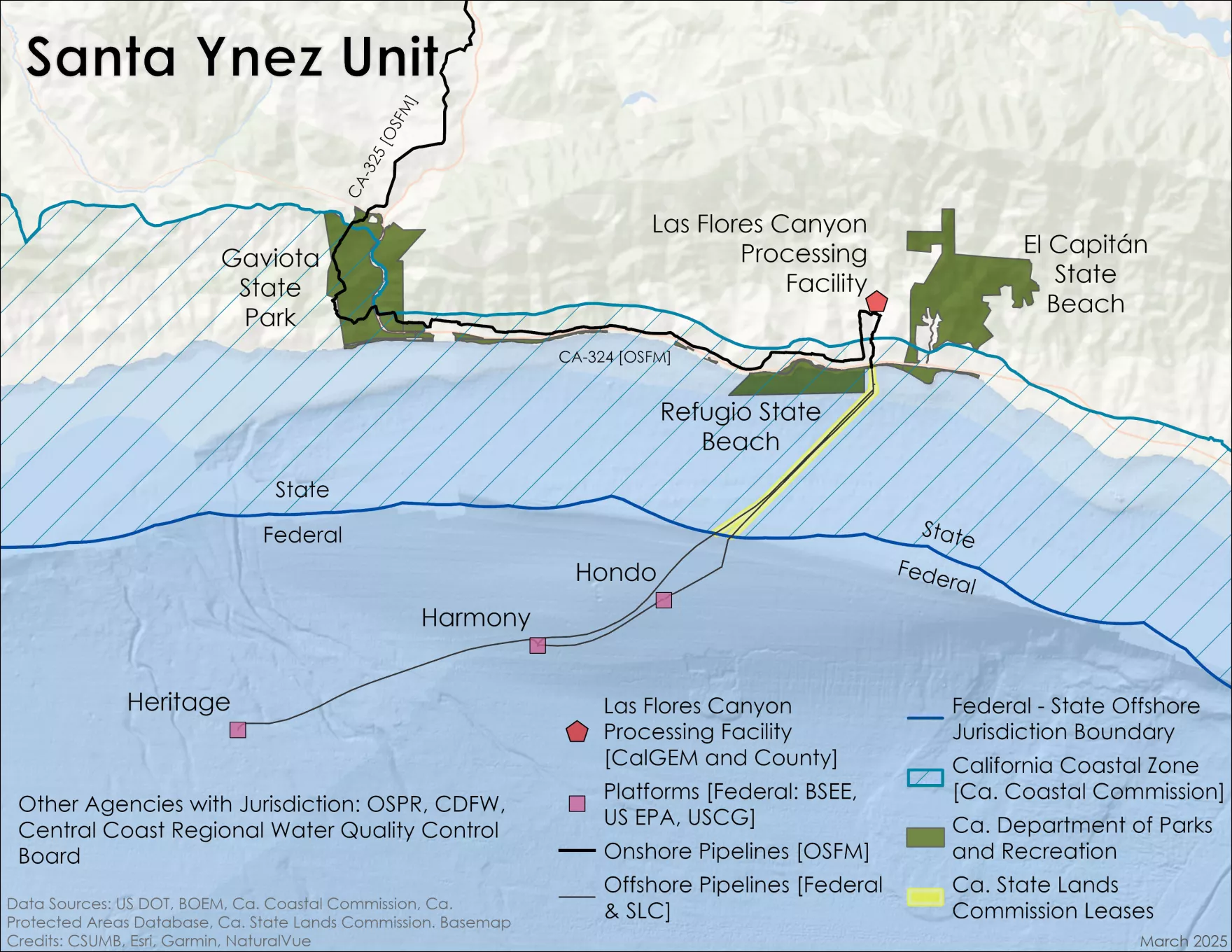
The anticipated State-Federal jurisdictional battle over Sable’s Las Flores Canyon Pipeline is on! See the attached letter from the Pipeline and Hazardous Materials Safety Administration (PHMSA) declaring that the pipeline is under Federal jurisdiction.
The major hurdle for PHMSA/Sable is thecourt approved Consent Decree that was executed following the 2015 Refugio pipeline spill. The Decree, which designates the California Fire Marshal as the sole regulator for the pipeline, is not mentioned in the PHMSA letter. Needless to say, another major legal battle looms.
Excerpt from the PHMSA letter:
PHMSA’s evaluation of the Las Flores Pipeline confirms that it transports crude oil from the OCS to an onshore processing facility at Las Flores Canyon and continues the transportation of crude oil from Las Flores Canyon to Pentland, California. Consistent with Appendix A, the Las Flores Pipeline is an interstate pipeline. As portions of the Las Flores Pipeline were previously considered to be intrastate and regulated by OSFM, PHMSA is notifying OSFM that the Las Flores Pipeline is subject to the regulatory oversight of PHMSA.
The vote on the transfer of Santa Ynez Unit (SYU), Pacific Offshore Pipeline Company (POPCO) Gas Plant, and Las Flores Pipeline System permits from Exxon to Sable Offshore was the last item on the Board’s agenda, so those of us who were streaming the meeting for that topic had to be patient.
The Sable session began with a surprise announcement that opened the possibility that perhaps the outcome might not be as expected. Supervisor Hartmann, who owns property close to the pipeline, had once recused herself from voting on this matter. When it was thought that her property was ~900′ from the pipeline, the Fair Political Practice Commission (FPPC) cleared her participation. However, after a 12/3/2025 letter from Sable informed that her property was as close as 8′ from the pipeline, the FPPC reversed its position and Supervisor Hartmann again recused herself.
Supervisor Hartmann’s re-recusal added some drama to the session given that there were two sure votes against Sable and one sure vote in favor. The swing vote would be that of Supervisor Lavagnino, who was very much supportive of the oil industry, but not Sable.
After strong but predictable presentations by the Environmental Defense Center/Center for Biological Diversity team and Sable, the floor was open to public comments. Although there were more speakers opposed to the Sable position (13), this observer found the Sable supporters (7) to be more compelling. Most were California natives who worked on the project and demonstrated a sincere commitment to the safety and environmental values that we all support. One aptly noted that California unnecessarily imports 2/3 of its oil from foreign sources, some of which aren’t particularly friendly.
As an aside, a County staffer pointed out that 400,000 barrels of SYU oil were in storage as a result of the resumption of production in May prior to receiving the necessary approvals to transport oil through the onshore pipeline.
The vote opened with Supervisor Nelson supporting the transfer of permits to Sable. His commented that the County was “attacking Sable’s finances at the same time they were trying to bankrupt them.”
Sable opponents held serve with Supervisors Capps and Lee opposing the transfer. Ms. Capps deserves credit for the sincere respect she showed for the Sable workers who were present.
So Supervisor Lavagnino would cast the deciding vote. He once again voted against the transfer noting that he was a long time supporter of the oil industry, but that he had lost confidence in Sable.
Bottom line: The outcome was as expected, but the recusal drama and strong presentations made the stream worth watching.
The attached Memorandum of Understanding between Vineyard Wind (VW) and the Town of Nantucket is long on bureaucratic procedures and short on risk mitigation and penalties.
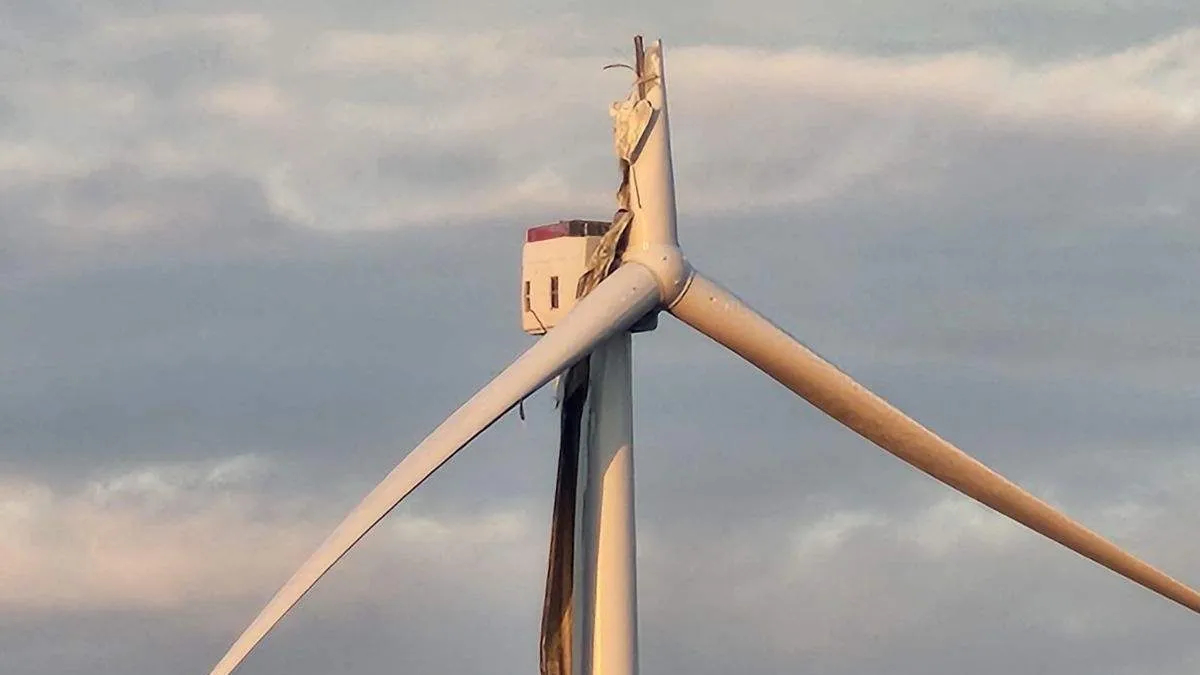
The agreement details requirements for monthly reports, liaisons, written correspondence, plan reviews, and participation on incident management teams, but excludes any monetary penalties for past or future incidents. (With regard to penalties, should BSEE have assessed civil penalties for the 2024 turbine incident in accordance with 30 CFR § 285.400 (f)? This was a major pollution event.)
This MOU provision gives the impression that the Town is subordinate to VW:
“The Town will provide Vineyard Wind 1 up to 4 business days, if required, to identify and correct errors in the Town’s intended public communications about the Project.”
The responsible party should not be exercising oversight over the communications of an affected local government. Can you imagine Santa Barbara County reaching such an agreement with Sable Offshore?
Finally, the MOU further establishes the Town as a de facto partner in the project. VW, not the Town, is the responsible party and must be held fully accountable for project performance.
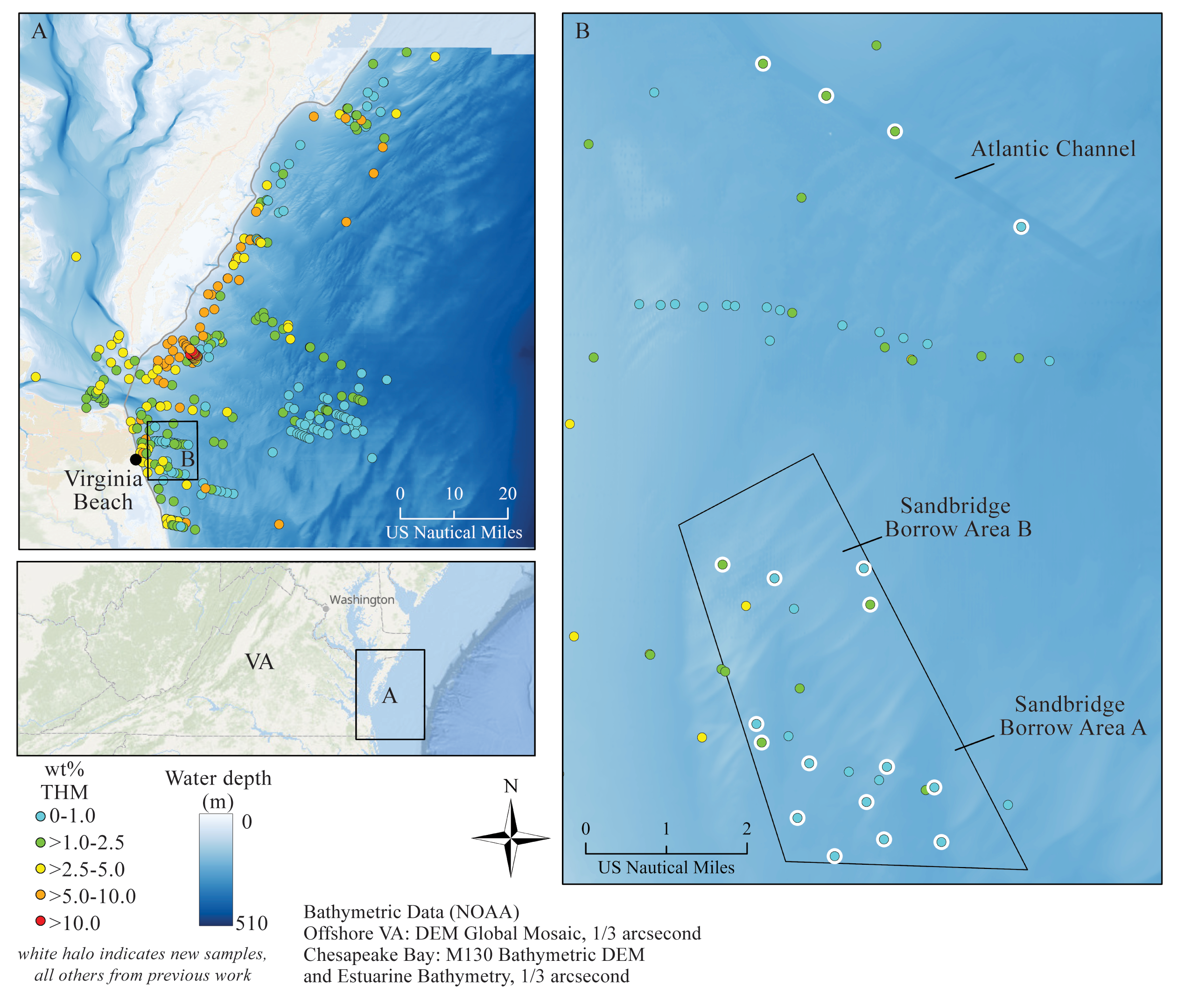
Heavy mineral geodatabase showing marine samples offshore of Virginia. A: 620 samples with heavy mineral data from previous projects, symbol colors determined by the percent of total heavy minerals (THM) obtained through gravity spiral separation methods. B: M21AC00010 samples (indicated with white halo) from Sandbridge Shoal and Atlantic Channel vibracores for THM and mineralogical analyses.
Odyssey’s primary targets are phosphate, which is now on the critical minerals list, and rare earth element’s titanium and zirconium. This would be a shelf dredging operation, in partnership with Great Lakes Dredge & Dock Company, rather than the deepwater module collection being proposed for the Pacific.
The fact that the sand recovered during the dredging process could be used for beach nourishment should appeal to adjacent coastal communities.
Odyssey Marine’s CEO discusses the proposed Virginia offshore program starting at the 4:00 minute mark in the video below.
While the majors and large independents garner most of the attention, smaller companies are an integral part of the mosaic that is the Gulf of America petroleum province. Some focus on producing and identifying remaining reserves on the shelf; others partner in deepwater projects.
Sale participants like Arena, Cantium, Walter, W&T, Beacon, Kosmos, and Houston Energy are well established Gulf leaseholders. Red Willow has attracted attention as a successful Southern Ute energy corporation.
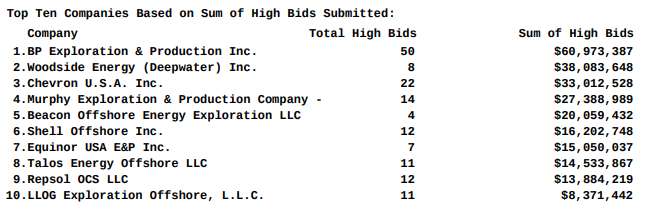
Which majors will be the most active bidders? BP (50 high bids), Chevron (22), and Shell (12)
Will former Gulf of Mexico stalwarts Exxon and Conoco Phillips participate for the first time in years? They did not.
How many companies will submit bids? Would like that to be a number >35. Only 30 companies participated.
How many tracts will receive bids? A number >300 would be very encouraging. Only 181 tracts received bids.
Will the total high bids exceed $400 million? No, the total was $279.4 million.
Will we see an increase in shelf interest? Shelf bidding continued to be limited (map). Renaissance, Byron, Arena, GOM Shelf LLC, Walter, W&T, Cantium, and WYOTEX Offshore submitted bids for shelf leases.
Which independents will be the most active? Woodside and Murphy are large independents, and their participation was most impressive. Murphy submitted 14 high bids totaling $27.4 million. Woodside had 8 high bids including the sale’s two highest for a total of $38.1 million, second only to BP in terms of the sum of their high bids.
The sale was beautifully conducted by BOEM, and Leslie Beyer – Assistant Secretary for Land and Minerals Management, Dept of the Interior – and Matt Giacona, Acting BOEM Director, delivered strong messages in support of the OCS oil and gas program.
However, as a colleague commented just after the sale, it was beautiful but not big. He and I expected more given the time since the last sale and the attractive terms.
Below is a comparison with the previous 3 Gulf sales. More to follow.
Sale No.
257
259
261
BBG1
date
11/17/2021
3/29/2023
12/20/2023
12/10/2025
companies participating
33
32
26
30
total bids
2233
2842
3161
219
tracts receiving bids
2143
2442
2751
181
sum of all bids $millions
198.5
309.8
441.9
371.9
sum of high bids ($millions)
101.7
263.8
382.2
279.4
highest bid company block
$10,001,252.00 Anadarko AC 259
$15,911,947 Chevron KC 96
$25,500,085 Anadarko MC 389
$18,592,086 Chevron KC 25
most high bids company sum ($millions)
46 bp 29.0
75 Chevron 108.0
65 Shell 69.0
50 bp 61.0
sum of high bids ($millions) company
47.1 Chevron
108 Chevron
88.3 Hess
61.0 bp
most high bids by independent
14-DG Expl.
13-Beacon 13-Red Willow
22-Red Willow
14-Murphy
1excludes 36 leases improperly acquired for carbon disposal purposes; 2excludes 69 leases improperly acquired for carbon disposal purposes; 3excludes 94 leases improperly acquired for carbon disposal purposes
Judge Patti Saris vacated part 2 of Trump’s 1/20/2025 “Wind Memo.”Part 1, which withdrew all OCS lands from wind leasing, was not in dispute. Part 2 suspended issuing wind energy permits and other authorizations.
The judge ruled (full order attached) that the suspension of wind permitting violates Administrative Procedures Act provisions requiring agencies “to proceed within a reasonable time and to set and complete proceedings expeditiously.”
She concluded further that “the moratorium halts all wind energy authorizations indefinitely, pending a comprehensive assessment with no timeline, which is inconsistent with statutory deadlines and general commands for prompt processing in laws like OCSLA, the Clean Water Act, and others governing wind projects.”
Although the judge’s assessment of the permitting moratorium seems sound, the merits of offshore wind as a primary energy source remain very much in doubt.
BOEM informs (post below) that Wednesday’s BBG1 oil and gas lease sale will be streamed live here at 10 AM ET. Given that this is the first sale in two years and the first BBG sale, some dignitaries may be in attendance.
On December 10, we will host the Big Beautiful Gulf 1 oil and gas lease sale, our first under the One Big Beautiful Bill Act.
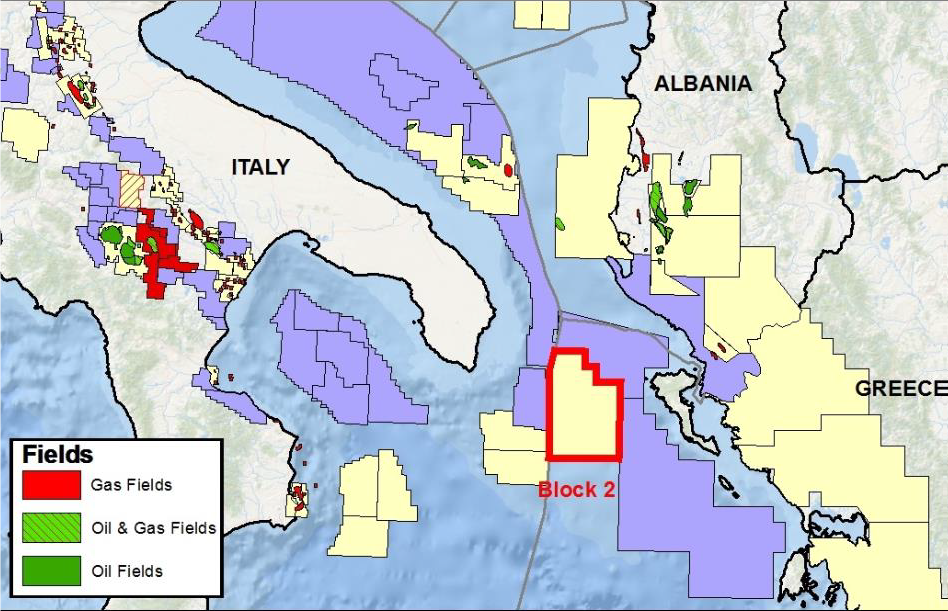
Location: In the Ionian Sea 30 km west of Corfu Island (note: that’s 18.6 miles, not the 125 mile buffer that Florida views as sacred)
Water depth: 500 to 1,500 m
Block size: 2,422.1 sq Km, the largest unexplored offshore structure in the Mediterranean (note: Gulf of America leases are only 23.3 sq km or < 1% as large)
First drilling: late 2026 or early 2027. This will be the first exploratory offshore drilling in Greece since 1981!
Energean’s participation is set at 30%, down from 75%.
Helleniq participation is now 10%, down from 25%.
Energean will remain the operator during the exploration stage.
In the event of a commercial discovery, Exxon will assume the operatorship during the development phase.
Andreas Shiamishis, CEO of HELLENiQ ENERGY: “Greece is emerging as one of Europe’s newest and promising regions for hydrocarbon exploration and development. This transaction represents a positive step not only for the joint venture partners, but also for the Greek economy.”





 Bud's Offshore Energy (BOE)