Feeds:
Posts
Comments

Archive for the ‘accidents’ Category

Photo by Capt. Carl Bois shared with the Nantucket Current
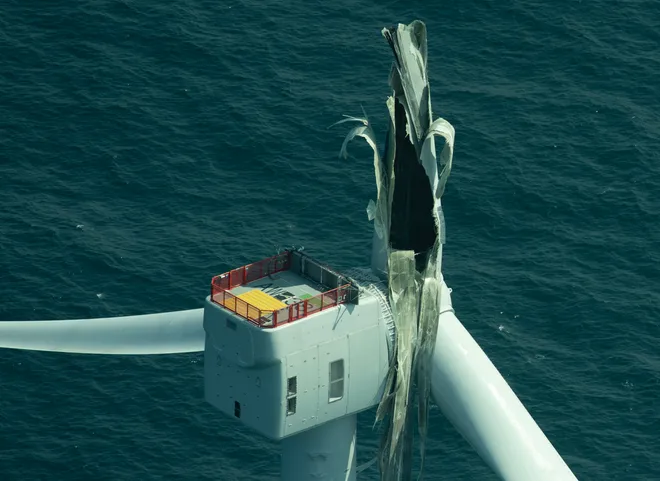
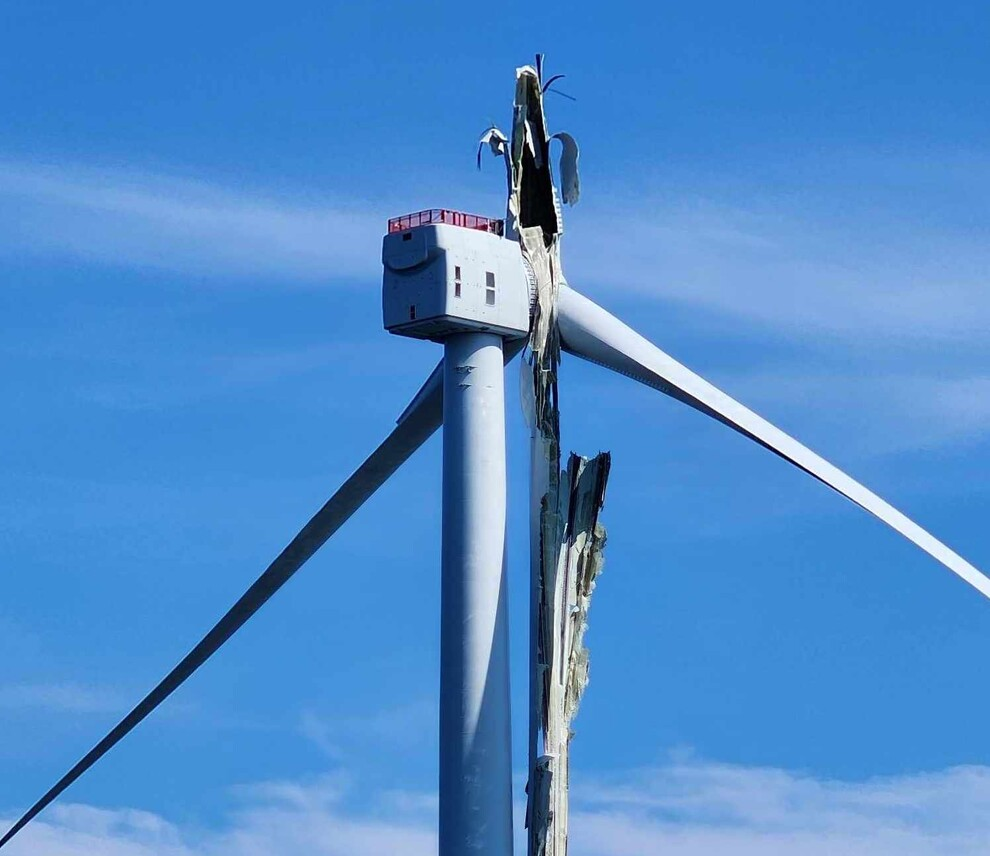
Ack4whales photo of the damaged turbine

On Sunday (7/14), Capt. Carl Bois, of the fishing charter Topspin out of Nantucket, told the Current he noticed a significant amount of debris in the Vineyard Wind lease area.

“There was so much debris at the wind farm,” Bois said. “We covered many miles and only saw the debris at the wind farm site: big sheets of fiberglass with foam core and lots of loose foam.”

On Saturday night (7/13) the Coast Guard warned Mariners as follows: “Coast Guard received a report of 03 floating debris 10 meters by 2 meters in the vicinity of approximately 26 NM SE of Marthas Vineyard and 22 NM SW of Nantucket in position 40 59.559N 070 25.404W. All marines are requested to use extreme caution while transiting the area.

On Monday (7/15), Vineyard Wind confirmed that a turbine blade incident occurred on 7/13: “On Saturday evening, Vineyard Wind experienced blade damage on a wind turbine in its offshore development area. No personnel or third parties were in the vicinity of the turbine at the time, and all employees of Vineyard Wind and its contractors are safe and secure.”

On 7/16, Vineyard Wind issued another statement advising that they were deploying teams to Nantucket to clean up debris from the incident.

Comments:

  • Not a good look for the first large-scale offshore wind project in the US.
  • It’s unclear what the status of operations was at the time of the incident.
  • Vineyard Wind seems to be passing the buck a bit when they note that “GE, as the project’s turbine and blade manufacturer and installation contractor, will now be conducting the analysis into the root cause of the incident.” While GE’s findings are critical, Vineyard Wind, as operator, is fully responsible and accountable for the incident and should be leading the analysis.
  • Was their a third party review of the turbine design?
  • Was the incident reported to BSEE, the safety regulator for offshore wind? State and local government?
  • BSEE and the Coast Guard should ensure that Vineyard Wind’s findings and their own independent report are made publicly available in a timely manner. Ditto for Safety Alerts.
  • What other incidents have occurred during offshore wind facility construction and operations?
  • In 2017, Vineyard Wind requested to defer providing the full amount of the required financial assurance until year 15 of actual operations. That request was denied, but was approved when resubmitted in 2021. The regulations have now been revised to allow such deferrals of financial assurance on all offshore wind projects.

Vineyard Wind is a joint venture between Avangrid, a Spanish company, and Copenhagen Infrastructure Partners. They were

Read Full Post »

As is the case with many Federal and corporate entities, the Secret Service website is long on promotion and short on substantive details and performance data. The limited “Measurable Impact” statistics on their webpage advise that the Secret Service protected 6623 foreign and domestic visits “without incident” in Fiscal Year 2022, which ended 22 months ago.

Their 2024 budget request overview includes a bit more information (pasted below). The Secret Service gives themselves a perfect score if protectees arrive and depart safely. When your scores are always 100%, your performance measures are clearly inadequate.

Like drilling blowouts, assassinations are low frequency, high consequence events. Prevention requires gathering data on lesser events, identifying leading indicators, and tracking high-potential precursors. You don’t prevent high consequence events by only tracking high consequence events.

Inspections are also critical. Does the Secret Service inspect events to assess protective measures such as verifying that the surrounding areas are cleared and being observed? If so, what do those numbers look like.

BSEE, the OCS safety regulator, does a good job of collecting data, but fails to compile and post updates in a timely manner. Their latest incident tables are for 2022, and even those data are incomplete. Panel investigations, which are conducted for the more serious incidents, now take 2.5 years to complete. This is unacceptable for an organization with BSEE’s talent, resources, and safety mandate.

Read Full Post »

This is very true, but engineers may not have a choice when directed to optimize a flawed decision.

Gaza pier

For example, the installation of the Gaza pier was a political decision imposed on military engineers without assessing the operational risks. The $230 million pier was in operation for only 20 days, long enough for several serious injuries to result from the reckless decision.

Some of the worst offshore drilling incidents were largely the result of culture or management driven attempts to save time and money. Modest cost savings were prioritized over verifying well integrity during both the Montara and Macondo well suspensions. The Santa Barbara blowout was the result of eliminating a casing string during development drilling, which virtually assured an uncontrolled flow in the event of a well kick.

Danenberger slide


Read Full Post »

A Bell 212 helicopter is in the news following the crash that killed Iran’s President and Foreign Minister. Given the difficult weather conditions and mountainous terrain, the crash was most likely an accident.

As noted in this vintage newsletter (p. 8), we flew to Georges Bank drilling rigs in the early 1980’s in a Bell 212 contract helicopter, owned and operated by Petroleum Helicopters Inc (PHI).

The Bell 212 was chosen by the USGS aviation expert because of its range, reliability, and IFR capabilities that enabled flying in limited visibility. Because of difficult fog conditions on Georges Bank, drilling rigs were sometimes not visible until we were descending to land.

For the most part, the offshore industry has replaced Bell 212 helicopters with newer models, but the 212 was in use for many years and had an excellent performance record.

PHI Bell 212 prepares to land at a platform in the Gulf of Mexico, 1974, Vertiflite.

Read Full Post »

Nord Stream AG has responded to their insurers’ a goverment did it, so we don’t have to pay” defense. Nord Stream’s full response, courtesy of Swedish engineer Erik Andersson, a leader in seeking the truth about the the pipeline sabotage, is linked.

Key excerpts from the Nord Stream AG filing (p.5):

(a) On their proper construction, in the context of Exclusion 2.i as a whole, the words “destruction of or damage to property by or under the order of any government or public or local authority” relate only to destruction or damage that arises out of or is related to the confiscation, nationalisation or requisition of therelevant property (and/or attempts thereat). In the premises, those words do not apply to the Damage.

(b) Alternatively, in the event that the Defendants establish that the Damage does constitute destruction of or damage to property by or under the order of any government, then it is therefore covered by the Deliberate Damage clause because it would have been “loss, damage, liability, cost or expense caused or inflicted by order of any governmental or regulatory body or agency” and Exclusion 2(i) to Section I does not apply: paragraphs 8 and 9.2 above are repeated.

If the insurers contend that one or more governments were responsible, shouldn’t they have to identify the government(s)? That would be nice. However, Erik doesn’t think the Nord Stream AG response puts the insurers in that politically difficult position. I agree. This case is about getting the insurers to pay for the damages, not identifying the responsible parties, something that the Swedes, Danes, and Germans have shied away from.

Read Full Post »

JL Daeschler, pioneering subsea engineer and BOE contributor, recounted a frightening incident in 1976, a year after UK North Sea production began:

We found ourselves in a drastic situation. While working on a subsea well, the wireline retrievable tubing safety valve got tangled up in the tree area. We had an open well situation and couldn’t cut the wire in the subsea tree. Further, the weather was bad, and keeping on location was difficult. The riser hydraulic release was faulty, so there was an imminent high risk of a “jammed ” subsea tree, bent/damaged riser, and uncontrollable well flow.

We got through this, but recognized that improved well control capabilities were needed during workover operations. Management decided that any future workover operations on a subsea tree/well would require a small diameter workover BOP with shearing capability immediately above the Xmas tree. A year later, we had the hybrid kit pictured below (with JL). Note that the guide funnels are slim to run on guide lines and not overshoot the guide base posts.

JL’s story reminds us once again that safety achievement is dependent on continuous improvement driven by experience, research, and technological advances.

When I was a young engineer with the US Geological Survey, the OCS safety regulator at the time, my boss and mentor Richard Krahl (known as “Mr. OCS” for his commitment to offshore safety) slammed😀 a copy of the first edition of API RP 14C (Analysis, Design, Installation, and Testing of Safety Systems for Offshore Production Facilities) on my desk and told me to read it carefully. That pioneering process safety document has grown with the offshore industry and is now in its 8th edition.

Similarly, API RP 2A-WSD (Planning, Designing, and Constructing Fixed Offshore Platforms— Working Stress Design) is now in its 22nd edition and API STD 53 (Well Control Equipment Systems for Drilling Wells) is in its 5th edition. There are countless other examples of the progression in safety equipment and practices.

As individuals, companies, agencies, and collectively as an industry, there can be no standing still. Nothing is routine and the challenges continue to grow: deeper wells, more complex geology, higher temperature and pressure, deeper water, harsher environments, remote locations, new security risks, and more. We get better or we get worse, and the latter is not an option. Onward!

Read Full Post »

The government’s decision to require that a capping stack be located in Guyana is prudent. Although the need for a capping stack is dependent on multiple barrier failures and is thus extremely low, the environmental and economic consequences of a prolonged well blowout warrant timely access to this tertiary well control option.

A capping stack must be properly maintained and deployable without delay. In that regard, BSEE has a good program for testing Gulf of Mexico capping stack readiness. Capping stack drills are an important post-Macondo addition to the unannounced oil spill response program that dates back to 1981.

The capping stack designed during the Macondo blowout shut-in the well on 15 July 2010. The decision process that allowed the well to remain shut-in was a bit perplexing, and we had a bizarre situation where the Federal Incident Commander threatened to require the resumption of the blowout. The same well integrity concerns had prematurely ended the “top kill” operation on 28 May, allowing the well to flow unnecessarily into the Gulf for an additional 48 days (5/28-7/15). (See this important paper by LSU Petroleum Engineering professor Dr. Mayank Tyagi et al: Analysis of Well Containment and Control Attempts in the Aftermath of the Deepwater Blowout in MC252)

“Troy Naquin, BSEE New Orleans District, observes as a capping stack is carefully lowered onto the deck of ship to be transported more than 100 miles offshore for a drill designed to test industry’s ability to successfully deploy it in case of an emergency, May 8, 2023.” BSEE photo/Bobby Nash

Read Full Post »

As promised, the Norwegian petroleum safety regulator (Havtil) has posted their risk trend report (RNNP) for 2023 in English.

Havtil prioritizes risk assessment and publishes their comprehensive annual analysis of safety trends in a timely manner. The 2023 RNNP was posted in Norwegian earlier this year and the summary report is already available in English. RNNP reports are an important safety resource that should be reviewed and discussed wherever oil and gas operations are conducted.

As an example of the breadth of these reviews, the two sets of charts below convey data that are not typically documented by offshore safety regulators. The first set documents near-misses that did not result in injuries, but did expose workers to that risk.

The second set of charts is a summary of worker responses to a survey, a means of assessing the safety culture. The big jump in favorable responses to the HSE questions is encouraging. In particular, the report notes (p. 14) that responses to a question about being pressured not to report incidents has moved in a positive direction in the last two surveys. Hopefully, this is an industry-wide trend.

Read Full Post »

Our last Nord Stream pipeline post discussed the Nord Stream AG suit to recover damage costs from insurers Lloyd’s and Arch.

In a court document (excerpt below) obtained by Swedish engineer Erik Andersson, Lloyd’s and Arch assert that the damage was inflicted by, or under order of, a government , and therefore the insurers are not liable.

Given that the suspect governments have denied responsibility, shouldn’t the insurers have to prove that a government did it, and identify the government? That is what Nord Stream AG is asserting in their filing (except below).

Long, but interesting video with Erik Andersson:

Read Full Post »

I had the pleasure of working with Jason Mathews when he was a young MMS engineer. He truly cared about our safety mission and has taken that commitment to the next level at BSEE. Jason shared this important, heartfelt message on the anniversary of the Macondo blowout.

One of the greatest gifts I ever received in life is having a little girl and having the opportunity to go home every evening and spending time with her at cheer, softball, doing homework, etc. I have a great deal of respect for the men and women who work offshore and put their lives on hold for 14-28 days to deliver much needed OCS production to meet US demand. Undoubtedly, they are better / tougher people than me.

Over the last year, my team has seen multiple incidents that had a high potential severity that could have led to a fatal / serious injury or major incident in the GOM. Although we can sit and debate the causal factors for hours, one that jumps to the top of the discussion is the Human Factor – Complacency. Of all the things a leader should fear, complacency heads the list. There is no doubt success breeds complacency, and complacency breeds failure.

To this day, I am still shook by the mindset and complacency of many onboard the Deepwater Horizon prior to the incident. During testimony in the public hearings, John Guide, the BP well team leader for the Horizon, believed that the rig crew had become “too comfortable” because of its good track record for drilling difficult wells. Ross Skidmore, a BP contractor on the rig on April 20, testified that the crew became complacent after completing drilling because “when you get to that point, everybody goes to the mindset that weʹre through, this job is done.”  To me, the complacency on the Deepwater Horizon could be attributable to the crew not having access to all of the well data (OptiCem reports – cement job risk) available to BP personnel onshore and the well site leaders on the rig. Our investigation concluded, the overall complacency of the Deepwater Horizon crew was a possible contributing cause of the kick detection failure.

As regulators, we have special roles in the GOM as it relates to safety:

  • Driving the avoidance of complacency and risk-free mindsets of the offshore employees
  • Understanding we can’t be selfish – Our success is not our individual personal growth / gains, but it is being unwavering in your promotion of offshore safety to ensure all offshore employees return home to their families safely
  • Holding each other (internally) and industry (externally) accountable when necessary

In order to achieve greatness offshore, we ,as a regulator,  have to believe we can, and never sit still until we achieve it. 

Everyone on this email has a very critical function and role. Never underestimate the value of what you do, have the proper mindset, and avoid complacency.

Do whatever it takes to ensure the people offshore are gifted the same gift we receive every day – going home to our families.

All In –

Jason P. Mathews, Petroleum Engineer, Field Operations – OSM

Friday Night LIghts: Coach Mathews and his daughter

Read Full Post »

« Newer Posts - Older Posts »