Exxon’s Santa Ynez Unit facilities are now owned by Sable Offshore, a company headed by offshore production veteran Jim Flores. Apparently Exxon had suffered enough, and Flores accepted the challenge. Sable hopes to restart production in July, but has some big permitting hurdles to clear before that can happen.
Flores and his company are indeed the underdogs in this story. Pending are the pipeline CBAT (coastal best available technology) plan being reviewed by the Office of the State FIre Marshall and approvals by Santa Barbara County. Administrative and legal appeals are a given.
Flores is saying the right things and seems undaunted by the massive challenge. He may just pull this off. We’ll be watching.
Sable Offshore Corp. is going to do it right!
Our proven track record of responsible operations in Santa Barbara County at Point Arguello and Point Pedernales fields over the past couple of decades reflects our commitment to safe, reliable operations at SYU.
Less than a month ago BSEE issued an alert that addressed chronic and persistent helideck safety issues. This week BSEE again issued an alert (attached) following yet another near-miss. Per BSEE:
After receiving clearance for landing at an offshore helideck, the aircrew noticed upon landing that a section of the helideck’s safety skirting was not properly secured to the support structure and was blowing upward and downward due to the helicopter’s rotor downwash. This created an imminent hazard to safe helicopter operations with potentially catastrophic results.
The latest near-miss is yet another reminder that the muddled regulatory regime for helideck safety needs to be addressed. The most recent Coast Guard – BSEE MOA for fixed platforms only added to helideck regulatory uncertainty by assigning decks and fuel handling to BSEE and railings and perimeter netting to the Coast Guard. What about safety skirting? As is the case with all safety regulations, a holistic, systems based approach to helideck safety oversight is needed.
To their credit, BSEE has been addressing these helideck issues with safety alerts. Since they are bearing the responsibility for these incidents, they should have the unambiguous authority needed to take enforcement actions regardless of which helideck elements are involved.
Expected appeals by API (first attachment) and Earth Justice et al (second attachment) were filed on 12 Feb, 60 days after Secretary Haaland approved the 5 year plan and thus the first day appeals could be filed pursuant to 43 U.S. Code § 1349.
The statute (language below) requires that leasing program appeals be filed in the DC Court of Appeals. API would have undoubtedly rather filed in Louisiana while Earth Justice is likely content with the DC venue.
43 U.S. Code § 1349 (c)(1)Any action of the Secretary to approve a leasing program pursuant to section 1344 of this title shall be subject to judicial review only in the United States Court of Appeal for the District of Columbia.
The filings don’t include any arguments except for API’s general assertion that “the Record of Decision and Approval is arbitrary, capricious, and not in accordance with law.”
Earth Justice presumably filed for defensive reasons given that the 5 year plan has the fewest lease sales in history and would seem to be favorable to their point of view.
API will likely contend that the plan is not balanced as require by the statue:
43 U.S. Code § 1344 (a)(3)The Secretary shall select the timing and location of leasing, to the maximum extent practicable, so as to obtain a proper balance between the potential for environmental damage, the potential for the discovery of oil and gas, and the potential for adverse impact on the coastal zone.
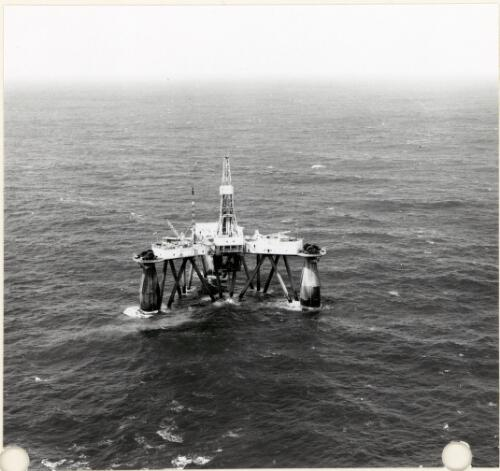
In 1980, Don Kash, the great leader who was Chief of the Conservation Div. of USGS (the current equivalent of the Conservation Div. is BSEE plus the resource evaluation functions in BOEM plus some royalty management functions now in ONRR) asked me to move to Cape Cod to head a new office responsible for overseeing exploratory drilling operations on Georges Bank. We established a small office in an old maintenance building at Barnstable Municipal Airport in Hyannis. The space was decidedly unglamorous but functional and ideal for helicopter transit to the offshore rigs.
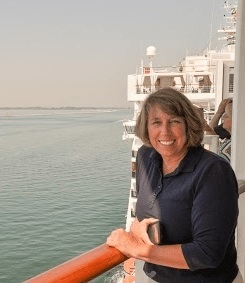
Karen was a Cape Cod artist and art teacher at Nauset Middle School in Orleans (for baseball lovers, that is where the Orleans Firebirds of the famous Cape Cod League play). Some of her teacher friends were connected to a running club I belonged to, and unknown to me at the time, Karen had designed my beloved Provincetown Dunes Run t-shirt.
We had another connection in that we had bought condominiums built by the same company. Hers was in Orleans and mine was in Hyannis. A couple that owned a condo in each project got to know both of us and thankfully introduced us. A year and many great experiences later we were married at the historic Captain Linnell House in Orleans.
Interestingly, Karen’s mother was an opponent of Georges Bank drilling until she realized that her only daughter would be leaving Cape Cod when the drilling ended. She then changed her position, proving once again that all politics is local 😀
I was very lucky to have spent 4 challenging and exciting years on Cape Cod. The Georges Bank drilling story was uniquely remarkable for me and led to a daughter born at my next duty station (Santa Maria, CA) and 5 grandchildren (good ratio 😀). While I was particularly fortunate, I think the Georges Bank drilling experience was generally positive for all that participated including the State and local officials, Woods Hole scientists, media, industry personnel, commercial fishermen, and even the Greenpeace protesters who were on the scene 155 miles southeast of Nantucket!
Energy experts like Dan Yergin have a different, and far more credible view. Yergin explains that energy transitions don’t happen on command, noting that the world uses almost three times as much coal today as in the 1960’s when oil finally surpassed coal as the world’s primary energy source.
Oxy CEO Vicki Hollub’s recent remarks should serve as a reality check for the 5 Year Plan authors and their counterparts elsewhere in western governments. More oil and gas exploration and production are needed, not less. Leading Oxy investor Warren Buffet agrees.
Crude reserves are being found and developed at a much slower pace than they’ve been in the past. Specifically, she said the world has only newly identified less than half the amount of crude it’s consumed over the course of the past 10 years. Given the current trends, this means demand will exceed supply before the end of 2025.
Recent trends in the Gulf of Mexico, where Hollub’s Anadarko unit is one of the more active and successful operators, reflect Hollub’s concern. Note below the sharp decline in discoveries, as determined by BOEM, over the past 20 years. Effective development of older discoveries and improved resource recovery practices are sustaining GoM production, but declines are inevitable without consistent leasing and increased exploration.
Updated BSEE incident data tables. The last data are for 2021. The public should have timely access to information about safety and pollution events on Federal lands and the performance records of companies conducting these operations. During the MMS era, these tables were updated quarterly and the Directors (all administrations) did not tolerate delay.
The final NTSB report on the 12/29/2022 GoM helicopter crashthat killed 4. The preliminary report was timely, but the final report has yet to be published. Is the NTSB considering the muddled regulatory regime for helidecks. (Regulatory fragmentation is a safety risk factor).
Corrected IRF performance data. This is arguably the IRF’s most important work stream and the data should be accurate. Some commentary about safety performance would also be helpful. What do the incident trends tell us? How does safety performance compare internationally?
Data on safety incidents associated with the OCS wind program during the site assessment, construction, and operational phases.
Information on the mysterious sinking of the Aban Pearl semi-submersiblein May 2010. We know an investigation was conducted. 14 years have now elapsed and the report has still not been shared.
Jean-Louis Daeschler, a native of France who lives in Scotland, was a pioneering subsea engineer who worked on rigs worldwide. Below, he recounts a 1969 incident on the Sedco 135 E.
Sedco 135 E
Sept. 1969 on the Sedco 135 E offshore Miri, East Malaysia
At about 10.00 PM the crew was running 24 ” riser pipe. The rig used a 2 stack BOP system. The weather was superb – no wind and a temperature of 26 deg C.
When the 4th joint of riser pipe (45 ft) was picked up through the “V” door and was almost vertical, it unlatched from the elevator. There was a massive clang followed by silence. The riser pipe hit the drill floor, fell backward into the derrick frame and got jammed there. No one was hurt.
The incident would have been much worse if the pipe had fallen through the catwalk, perforated the maindeck, fell into the water, and damaged the the rig’s sponson tanks !!!! A piece of pipe falling overboard turns into a high velocity torpedo. A dropped 13 3/8″ casing joint is sometimes found 400 ft away. Heavy drill collars go almost straight down, which is the worst case given the potential for damage to the wellhead equipment.
I left the office and went to the rig floor, which was silent. Everyone was looking up and down. With the brake tied down, I asked Bill Ellis what we were going to do now. Bill was an experienced 45+ year old driller from Ruidoso New Mexico. His answer was “Go back home to the USA” with a big smile. He was always in control.
Bill demonstrated great leadership; there was no panic or blame. The all-Chinese and Malay crew was listening and smiling. After some rigging up, we got the operations back into swing. We checked the elevator latch and other equipment, laid down the joint that had been stuck, picked up another one, and continued running the riser.
I met again with Bill and Jo, his wife, in Aberdeen in 1975, and we still talked about that night-shift event.
Putin suggests that people consider who had an interest in sabotaging the pipelines and who had the capability. He also asks why Germany isn’t allowing gas to flow through the one Nord Stream line that wasn’t damaged.
As the Minerals Management Service’s liaison to the Marine Board of the National Academies and subsequently as a Marine Board member, I had the privilege of working with many outstanding engineers on matters related to offshore safety and environmental protection. Dr. Martha Grabowski was a clear standout because of her exceptional leadership and communications skills, modest ego, and willingness to assist.
Dr. Grabowski excels in analyzing and mitigating operational risks including those associated with human and organizational factors. As such, she was a great resource in our work on safety management and culture.








 Bud's Offshore Energy (BOE)