This picture was posted on the “Rig Pigs” Facebook page by Huston Funk. Per Huston: “First crew photo from the Deepwater Horizon. Taken in the Indian Ocean after we had left Singapore.”
Commenters identified 3 Macondo victims in the photo: Jason Anderson, Don Clark, and Stephen Curtis 🙏
The active rig count in the GoM in 2001 was 148 (AL-4, LA-119, TX-25), which is >8 times the current Baker Hughes rig count of 18. The 2001 rig count was not a one year blip; the number of rigs active in the GoM exceeded 100 for the ten year period from 1994-2003.
While the current rig count is anemic by comparison, the capabilities of the fleet are anything but. Below is a list derived from drilling contractor status reports of deepwater rigs now operating in the Gulf.
All of these rigs are dynamically positioned and are capable of drilling in 12,000′ of water. They have dual derricks and 15,000 psi rated BOP rams (one has a 20,000 psi stack, and another can be upgraded to 20,000 psi). The annular preventers are rated at 10,000 psi. All have impressive storage and hook load capacities, the latest tubular handling equipment, advanced control systems, and efficient power generation.
Note that most of the rigs fly the flag of the Marshall Islands. This “flag of convenience” registration is preferred for reasons related to taxation and operational freedom. For the record, the fact that the Deepwater Horizon was registered in the Marshall Islands had little to do with the Macondo blowout. The DWH was subject to all Coast Guard and MMS regulations under the OCS Lands Act.
The main cause of the Macondo blowout was the poorly planned and executed well suspension operation. Certain equipment capability, maintenance, and employee training issues were contributing factors. However, with that said, the Marshall Islands report on the blowout candidly acknowledges that “the complexity of and interdependence between the drilling and marine systems and personnel suggests a need for increased communication and coordination between the flag State and coastal State drilling regulators.” Hopefully, that coordination is being achieved and the risks associated with the fragmented regulationof mobile drilling units are being effectively managed.
Contractor
Rig
Operator
Est. end date
Flag
Transocean
Deepwater Titan
Chevron
3/2028
Marshall Islands
Transocean
Deepwater Atlas
Beacon
4/2025
Marshall Islands
Transocean
Deepwater Poseidon
Shell
4/2028
Marshall Islands
Transocean
Deepwater Pontus
Shell
10/2027
Marshall Islands
Transocean
Deepwater Conqueror
Chevron
3/2025
Marshall Islands
Transocean
Deepwater Proteus
Shell
5/2026
Marshall Islands
Transocean
Deepwater Thalassa
Shell
2/2026
Marshall Islands
Transocean
Deepwater Asgard
Hess
4/2024
Marshall Islands
Stena
Evolution
Shell
4/2029
Marshall Islands
Noble
Stanley Lafosse
???
11/2024
Liberia
Noble
Valiant
LLOG
2/2025
Marshall Islands
Noble
Globetrotter I
Shell
5/2024
Liberia
Noble
Globetrotter II
Shell
5/2024
Liberia
Valaris
DS-18
Chevron
8/2025
Marshall Islands
Valaris
DS-16
Oxy
6/2026
Marshall Islands
Diamond Offshore
BlackHawk
Oxy
10/2024
Marshall Islands
Diamond Offshore
BlackHornet
bp
3/2027
Marshall Islands
Diamond Offshore
BlackLion
bp
9/2026
Marshall Islands
Short video about the Stena Evolution, the newest entry to the Gulf of Mexico fleet:
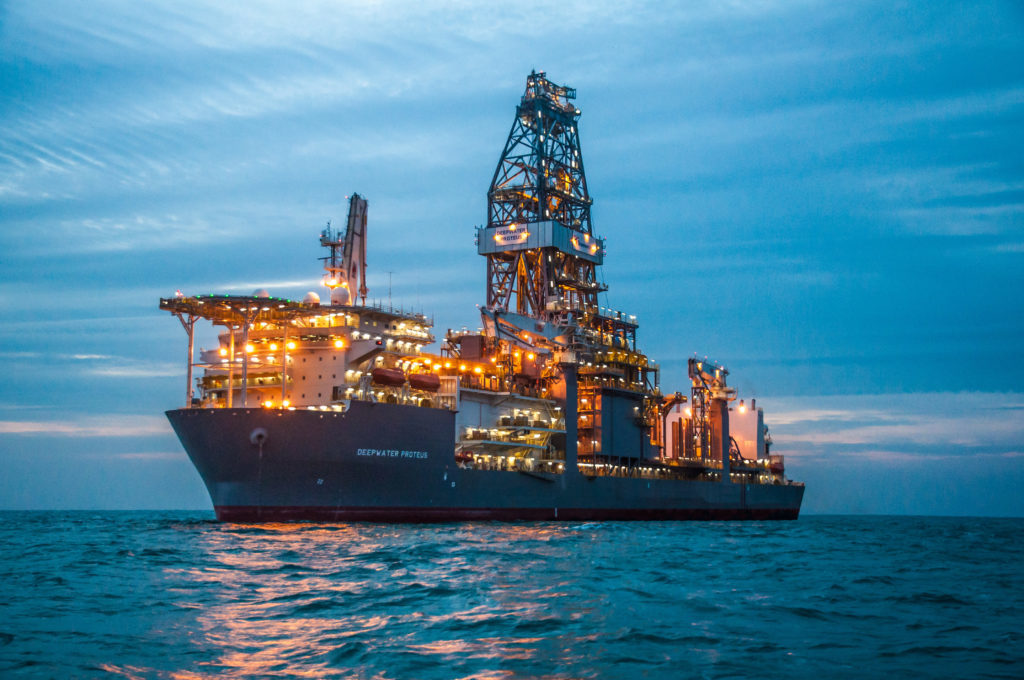
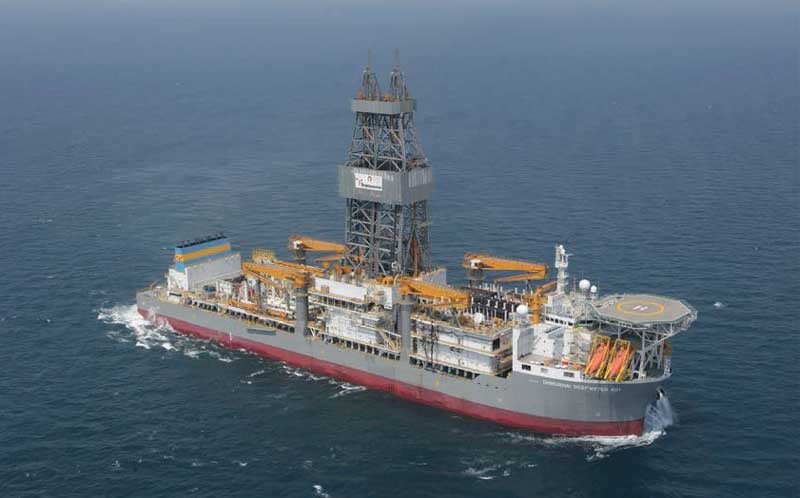
Pictured: Transocean’s Deepwater Proteus. T/O should name one of their drillships Deepwater Diligence 😉
Seven of the deepwater exploratory wells drilled in the Gulf of Mexico in 2023 (YTD) were spudded within 4.5 years of the effective date of their leases. Three of these wells were spudded within 3 years of their lease effective dates (see table below).
These are impressive achievements when you consider the time required for consultation with partners (if any) and contractors, site surveys, exploration plan development and approval, well planning, and drilling permit preparation and approval.
The subject wells accounted for 28% of thedeepwater exploratory well starts in 2023 (25 net YTD wells after subtracting restarts at the same location).
date lease effective
spud date
elapsed time (months)
water depth (ft)
operator
3/1/2021
8/27/2023
30
6498
Shell
8/1/2020
5/21/2023
34
2211
Talos
8/1/2020
3/15/2023
31
3338
Talos
12/1/2019
6/5/2023
42
4228
Chevron
11/1/2019
6/1/2023
43
4603
Hess
7/1/2019
7/11/2023
48
7486
Kosmos
12/1/2018
6/6/2023
54
4127
bp
Below are the exploration plan (EP) and permit (APD) approval timeframes for these 7 wells. With the exception of the Kosmos EP which required a number of modifications, the regulator actions appear to have been timely. For the bp, Shell, and Chevron wells, only 4-6 months elapsed between EP submittal and APD approval.
operator
block
date EP received
date EP approved
APD received
APD approved
Shell
WR 365
3/1/2023
5/17/2023
5/11/2023
8/8/2023
Talos
GC 78
1/19/2021
4/16/2021
3/8/2023
5/26/2023
Talos
MC 162
4/1/2022
7/13/2022
8/2/2022
3/2/2023
Chevron
MC 937
12/7/2022
5/19/2023
4/21/2023
5/21/2023
Hess
MC 727
8/30/2022
11/3/2022
12/21/2022
4/24/2023
Kosmos
KC 964
1/3/2020
10/12/2022
4/18/2023
7/3/2023
bp
GC 436
1/18/2023
4/14/2023
3/29/2023
6/5/2023
Notes: EP=Exploration Plan, APD=Application for Permit to Drill, WR=Walker Ridge, GC=Green Canyon, MC=Mississippi Canyon, KC=Keathley Canyon
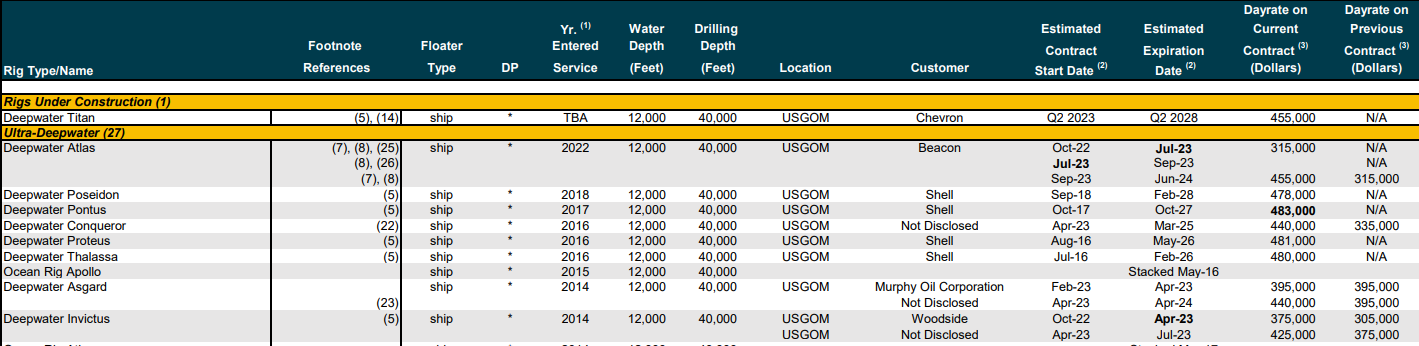
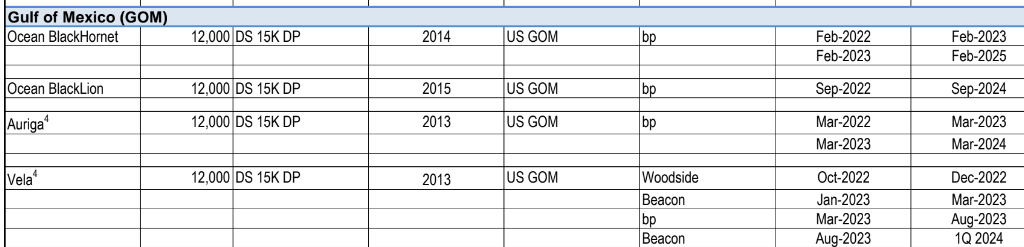
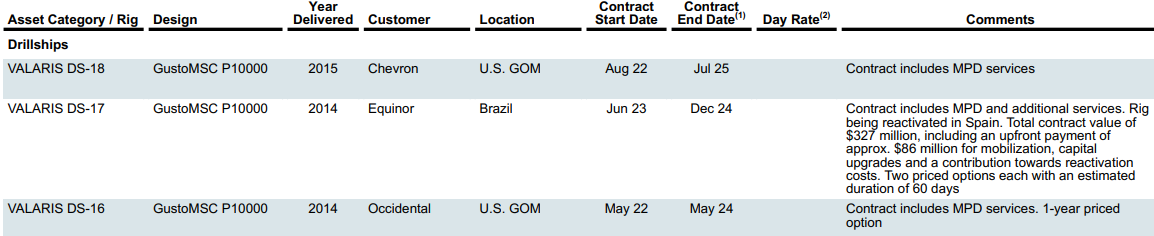
Based on drilling contractor rig activity reports, the table below lists 19 deepwater MODUs under or soon to begin contracts in the GoM. (Further details are pasted at the end of this post.) Per the Valeris report, platform rigs are operating on bp’s Thunder Horse and Mad Dog platforms. Per the BSEE borehole file, Arena and Cantium continue to drill development wells on the GoM shelf.
Deepwater Titan is also the second 8th-generation drillship constructed by Sembcorp Marine based on its Jurong Espadon 3T design. The dual-derrick drillship is the first-ever unit delivered with two 20,000-psi blowout preventers (BOPs), well-control, riser, and piping systems for high-pressure and high-temperature drilling and completion operations. Like its sister rig, the Deepwater Atlas — delivered in June 2022 — Deepwater Titan is also equipped with three-million-pound hook-load hoisting capacity and capabilities to drill up to 40,000 feet and operate in water depths of up to 12,000 feet.
Lars Herbst notes that the Atlas, which has been drilling for Beacon in the Shenandoah field with 15k BOPs, will switch to the 20k equipment before any well completion operations. The Titan, equipped with the 20k NOV BOPE, will begin drilling in the Gulf of Mexico for Chevron later this year.
The drilling business, particularly the deepwater sector, has never been for the faint of heart, and the past few years have included the added stresses of COVID, negative oil prices, anemic exploration activity, and offshore leasing “pauses.” Transocean nonetheless managed to build two 8th generation drillships, the Deepwater Atlas and Titan, both of which are slated to operate in the Gulf of Mexico.
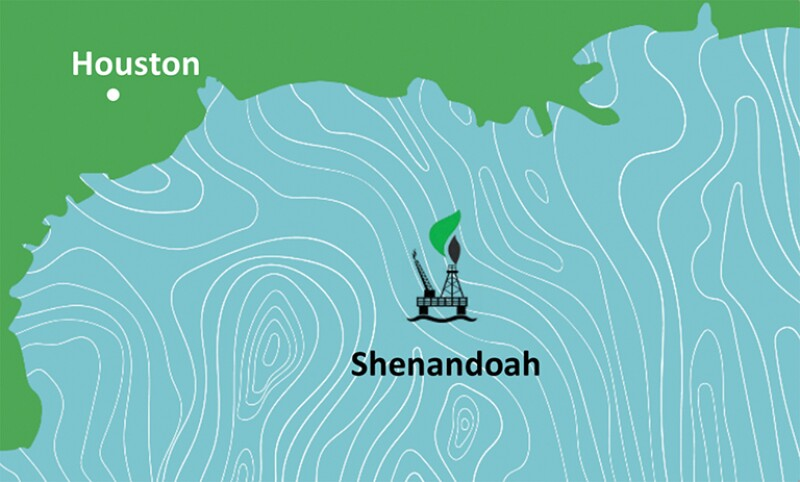
The Atlas will begin drilling for Beacon Offshore Energy (unrelated to the BOE blog 😀) in the Shenandoah field (almost heaven?😀) later this year. The Titan is expected to begin drilling for Chevron next year. The rigs will be outfitted with 20,000 psi blowout prevention equipment and will be well-equipped for the growing number of high pressure prospects in the Gulf. Here is Transocean’s promotional video for the two rigs.
Both Beacon and Chevron fared well on our Gulf of Mexico scorecard. A bit of information about Beacon (BOE):
CEO Scott Gutterman was previously the CEO of LLOG.
There are a number of related investment partnerships under the Beacon umbrella and they are often joint lease owners.
Per BOEM data, BOE has interest in 11 Gulf of Mexico leases.
The company has an excellent compliance record: 12 facility inspections (presumably all were drilling units) resulted in only 1 INC (violation).
Per BSEE, Beacon had 22 well starts since 2008. (Mystery: While the Blackstone and Beacon websites indicate that the company was formed in 2016, BSEE’s online borehole file shows 10 well starts prior to that year with the exact same company name. Presumably, the borehole file data are in error because BOEM data do not show any Beacon lease interest prior to 2018.)
Beacon bid on one tract in Lease Sale 257 (Nov. 2021) and was the sole bidder (sale was voided by DC Federal Court).
Beacon bid on 3 tracts in Sale 256 (Nov. 2020) and was the high bidder on one.
Beacon acquired interest in 2 leases in Sale 254 (March 2020), 7 in Sale 252 (March 2019), and 2 in Sale 251 (Aug. 2018)
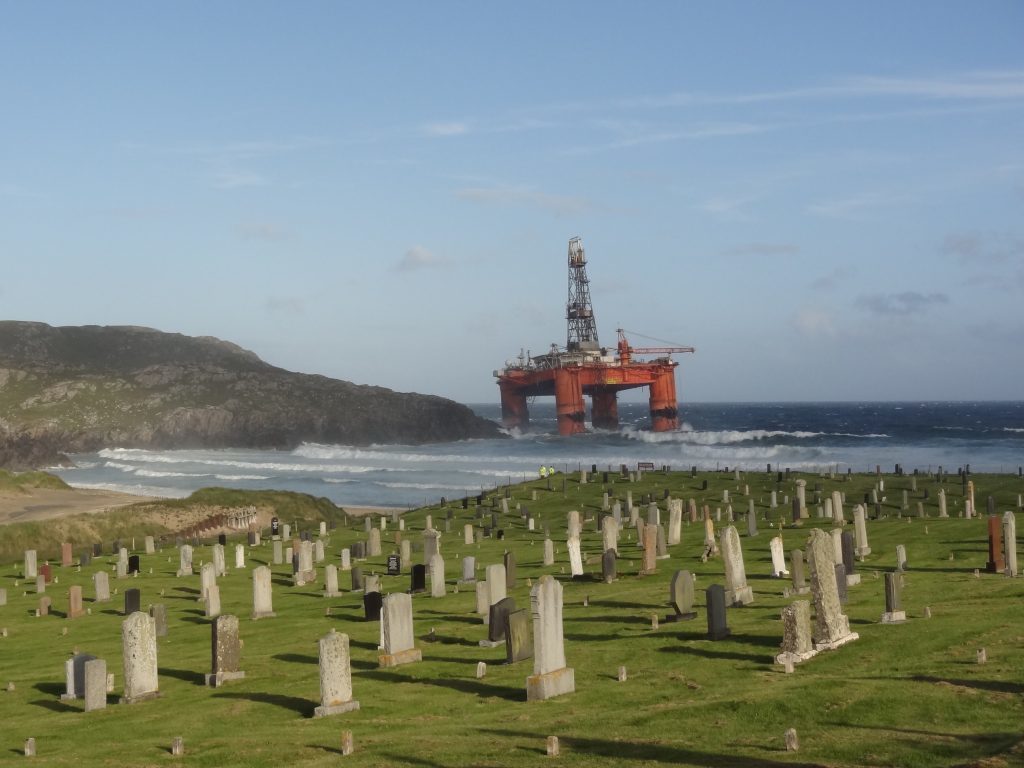
In 2016, this old Transocean semisubmersible was being towed from Norway to Malta prior to being scrapped in Turkey. The rig broke free and grounded at Dalmore, Scotland. This picture, with a Scottish cemetery in the foreground, is a fitting tribute to old rigs, the wells they drilled, the storms they endured, and the people they served.
The picture and title will be added to our world-famous Rigs-to-Reefs+++ page. Many thanks to those who have contributed to this important resource over the years.
While the previously discussed planning, cementing, and well suspension issues allowed the well to flow, there were many other equipment, operational, and management deficiencies that elevated the incident to a disaster. Below are those that bother me the most:
Blowout Preventers
The Deepwater Horizon BOP stack had a single blind shear ram. Regardless of what the regulations allowed, you don’t drill a complex well like this without redundant shearing capability (and at the time of the blowout most deepwater drillers were using rigs with dual shear rams). All well control emergencies requiring the emergency disconnect sequence, deadman, and autoshear functions are dependent on effective shearing capability. You can have redundancy in every other BOP element, but without dual shear rams, you don’t have a redundant BOP system. Further, for full redundancy both shear rams should be capable of sealing the well bore after shearing. In that regard, the present regulations and the applicable standard (API S 53) require only one shear ram capable of sealing. They are thus deficient and should be updated.
The DWH BOP system did not have full bore shearing capability (available at the time) which may have sheared the deflected drill pipe.
The DWH BOP system was not properly maintained and recertified as required by regulation.
Transocean’s “condition based maintenance” was a euphenism for “fix it when it fails.” Perhaps worse, BP authorized the continuation of operations knowing that an annular preventer was leaking.
The initial flow from the well was directed to the mud-gas separator instead of being routed overboard via the diverter. Routing the flow to the diverter would have provided additional time for the crew to safely evacuate.
Gas detectors
Not all gas detectors were fully operational. As justification, Transocean’s report expressed concerns about alarm fatigue, a weak excuse. Alarm issues can be effectively managed without disabling the devices.
The gas detectors did not automatically shutdown the generators, the source of the initial explosion. This is somewhat understandable on a dynamically positioned rig that is dependent on power to maintain position. However, someone should have shut down the generators as soon as gas was detected.
Engine overspeed devices didn’t work, and apparently weren’t tested regularly. Had they worked, the engine room explosion may have been prevented.
The crew had time to activate the Emergency Disconnect Sequence, but did not.
Forensic evidence from independent post-incident testing by Det Norske Veritas (DNV) and evaluation by the Transocean investigation team confirm that the Deepwater Horizon BOP was properly maintained and did operate as designed. However, it was overcome by conditions created by the extreme dynamic flow, the force of which pushed the drill pipe upward, washed or eroded the drill pipe and other rubber and metal elements, and forced the drill pipe to bow within the BOP. This prevented the BOP from completely shearing the drill pipe and sealing the well.
In other words, Transocean contends that properly maintained BOPE was not up to the task of shutting-in and securing a high-rate well. If true, this finding has significant implications for the offshore industry. I’m looking forward to reading the government’s findings on the BOP failure when the Joint Investigation Team report is issued next month.
By glossing over the contours of the regulatory language, the Draft Report unilaterally converts API Recommended Practice 53 from an advisory guideline into a mandatory requirement. Notwithstanding the Draft Report’s insistence otherwise, the API’s recommendation that the BOP “should” be disassembled and inspected according to the manufacturer’s guidelines is not mandatory. The API clarifies that the word “should” indicates a recommended practice for which a comparably safe alternative is available or which may be impractical or unnecessary in some conditions. In contrast, to denote a recommended practice that is “advisable in all circumstances,” the API uses the word “shall.” The API also emphasizes that “the formulation and publication of API standards is not intended in any way to inhibit anyone from using any other practices.” Though it recommends specific practices, API acknowledges that “equivalent alternative installations and practices may be utilized to accomplish the same objectives.” On its face, the language of API RP 53 makes clear that the recommendation that the BOP “should” be disassembled and inspected in accordance with the manufacturer’s guidelines is a recommendation, and nothing more.
Although the MMS regulations governing BOP maintenance incorporate API RP 53 sections 17.10 and 18.10 by reference, this does not convert the API’s recommendations into a mandatory requirement. As the MMS has clarified, “[t]he legal effect of incorporation by reference” is merely that “the material is treated as if it were published in the Federal Register.”
Treating API RP 53 as if it had been published in the Federal Register does not imbue its language with more regulatory significance than it had before. The API’s recommendations regarding BOP maintenance—as well as the API’s acknowledgement that alternative practices “may be utilized to accomplish the same objectives”—remain recommendations, not requirements.Transocean’s complete comments are posted on their website.
I’ll withhold my comments on the above statements, except to say that my opinion differs substantially from Transocean’s.
More significantly, these and other recent industry and government comments demonstrate the complexity of standards policy issues. How are standards most effectively applied by operators in formulating safety management programs, operating plans, and safety cases? Contractors? How should deviations from standards be assessed and documented? How should regulators use standards? To what extent should standards be incorporated into regulations? What is the appropriate role for regulators in standards development? These issues may prove to be more challenging than updating technical requirements. Stay tuned!








 Bud's Offshore Energy (BOE)