Feeds:
Posts
Comments

Posts Tagged ‘transocean’

In their comments on the Coast Guard’s Deepwater Horizon Joint Investigation Team Report, Transocean made these statements about BOP maintenance standards incorporated in MMS drilling regulations:

By glossing over the contours of the regulatory language, the Draft Report unilaterally converts API Recommended Practice 53 from an advisory guideline into a mandatory requirement. Notwithstanding the Draft Report’s insistence otherwise, the API’s recommendation that the BOP “should” be disassembled and inspected according to the manufacturer’s guidelines is not mandatory. The API clarifies that the word “should” indicates a recommended practice for which a comparably safe alternative is available or which may be impractical or unnecessary in some conditions. In contrast, to denote a recommended practice that is “advisable in all circumstances,” the API uses the word “shall.” The API also emphasizes that “the formulation and publication of API standards is not intended in any way to inhibit anyone from using any other practices.” Though it recommends specific practices, API acknowledges that “equivalent alternative installations and practices may be utilized to accomplish the same objectives.” On its face, the language of API RP 53 makes clear that the recommendation that the BOP “should” be disassembled and inspected in accordance with the manufacturer’s guidelines is a recommendation, and nothing more.

Although the MMS regulations governing BOP maintenance incorporate API RP 53 sections 17.10 and 18.10 by reference, this does not convert the API’s recommendations into a mandatory requirement. As the MMS has clarified, “[t]he legal effect of incorporation by reference” is merely that “the material is treated as if it were published in the Federal Register.”

Treating API RP 53 as if it had been published in the Federal Register does not imbue its language with more regulatory significance than it had before. The API’s recommendations regarding BOP maintenance—as well as the API’s acknowledgement that alternative practices “may be utilized to accomplish the same objectives”—remain recommendations, not requirements.  Transocean’s complete comments are posted on their website.

I’ll withhold my comments on the above statements, except to say that my opinion differs substantially from Transocean’s.

More significantly, these and other recent industry and government comments demonstrate the complexity of standards policy issues. How are standards most effectively applied by operators in formulating safety management programs, operating plans, and safety cases? Contractors? How should deviations from standards be assessed and documented? How should regulators use standards? To what extent should standards be incorporated into regulations? What is the appropriate role for regulators in standards development? These issues may prove to be more challenging than updating technical requirements. Stay tuned!

Read Full Post »

Transocean Ltd., the world’s largest offshore oil driller, may attempt to recover some or all of the Deepwater Horizon rig that exploded and sank during last year’s Macondo well disaster. Bloomberg

U.S. Attorney Steve Overholt told District Judge Carl Barbier that testing of the failed blowout preventor (BOP) that led to the Deepwater Horizon oilrig explosion should be done by the end of this week. Louisiana Record


Read Full Post »

“Our internal investigation into the events of that tragedy is nearing completion,” Newman told investors during a conference call to discuss Transocean’s fourth-quarter earnings. “In light of continuing delays and obtaining information on the third-party testing of the Horizon’s (blowout preventer), we expect to release findings in the next month or two.” Fox Business


Read Full Post »

1. Helix has inked 19 Gulf of Mexico customers for its Deepwater Containment System. What will happen to the Marine Well Containment Company which was announced with much fanfare in July? Does it make sense to have two such consortiums operating in the Gulf?

2. No new reports on the Apache gas leak in the press or on the company’s website.  More transparency is needed in the post-Macondo era.

3. The Deepwater Horizon BOP testing remains a mystery. If you disregard the erroneous January 5th and 6th updates (which pertain to hearings held last summer), the official investigation website has not been updated since before Christmas. Given the importance of this work, the absence of status updates is disappointing.

4. Useful listing of deepwater Gulf projects in Offshore magazine.

5. The National Commission Chairs will appear before the Senate Energy and Natural Resources Committee tomorrow.  The hearing will be webcast live beginning at 0930. Here is some pre-hearing chatter.

6. The Aban Pearl semisubmersible drilling rig sunk offshore Venezuela last May.  Will the world ever find out what happened? In fairness to Venezuela, they aren’t the only ones sitting on reports.

7. “The oil spill [has] definitely [been] blown out of proportion.” Judith McDowell is a highly respected scientist. If this is an accurate quote, it is quite significant.

8. Transocean wants to pay dividend.

9. Interested in serving on DOI’s Safety Committee?

10. A great painting completes the list!

Read Full Post »

Transocean Ltd. (RIG, RIGN.VX) said Thursday that a Swiss administrative court ruled that the company cannot pay out about $1 billion to shareholders because of the numerous Deepwater Horizon-related lawsuits pending against the rig owner in the U.S. Wall Street Journal

The $40 billion question: How much will Macondo ultimately cost Transocean? Halliburton? Anadarko? Mitusi? Cameron?

Read Full Post »

Max Ruelokke

As a precaution in advance of Hurricane Igor, all personnel were removed from two Transocean rigs operating offshore Newfoundland.  The rigs are the GSF Grand Banks and the Henry Goodrich.  Igor headed for Newfoundland after battering Bermuda yesterday.

Max Ruelokke, Chairman and CEO of the Canada-Newfoundland and Labrador Offshore Petroleum Board, told BOE that this is the first time he can recall a Grand Bank’s rig being down-manned to zero in advance of a storm.  Personnel are expected to return to both rigs tomorrow.

Read Full Post »

Transocean slams the BP Macondo report:

However, rig owner Transocean slammed the report, saying: “This is a self-serving report that attempts to conceal the critical factor that set the stage for the Macondo incident: BP’s fatally-flawed well design.”

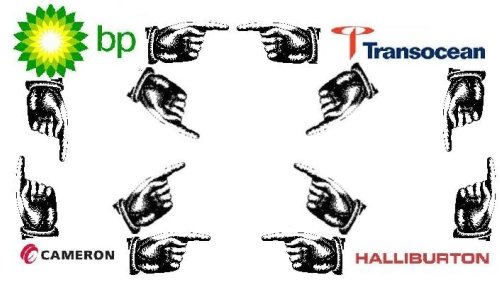
BOE Comment: At a time when the safety of oil and gas operations is rightfully under intense scrutiny, this ugly dispute further undermines public confidence in offshore exploration and development.  BP, Transocean, Halliburton, Cameron, and other feuding companies need to resolve their disputes so they can fully and credibly participate in the critical industry and governmental programs that are addressing offshore safety and pollution prevention issues.

Read Full Post »

Courtesy of Upstream:

UK Workers Accuse Transocean of Bullying and Intimidation.

Union Calls for Shutdown of the P-31, 33, and 35 Floating Production Facilities offshore Brazil.

Read Full Post »

Aban Pearl

According to our 15 May post,  Venezuela established a special commission to investigate the sinking of the Aban Pearl, a semi-submersible rig that sank on 13 May 2010.  In the subsequent 3 months, we have not seen any updates on that commission or the status of the investigation.

BOE will also be tracking any reports on the recent crane failure and apparent fatality on the Jack Ryan, and the Bayou St. Denis blowout.  Let us know if there are other major offshore accidents that we should be tracking. With regard to the Jack Ryan, a description of the tragic crane accident is posted in a thread on the Oil Rig Photos site (see the 3 August post).

Read Full Post »

A newspaper says it has obtained an internal audit conducted by BP PLC on the Deepwater Horizon oil rig that details severe safety flaws months before the Gulf of Mexico spill.

link

Comment: Was this a planned leak?  If so, how does this strengthen BP’s legal position?  The DWH had deficiencies (bad for Transoocean), but BP knew about the deficiencies and didn’t ensure that they were corrected (worse for BP?).  As indicated by the poster below (More “Mike Talk”), the poor working relationship between the operator and contractor may have been the real core problem.

Read Full Post »

« Newer Posts