Feeds:
Posts
Comments

Posts Tagged ‘Talos’

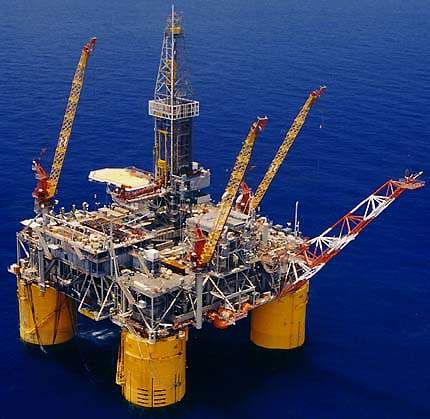
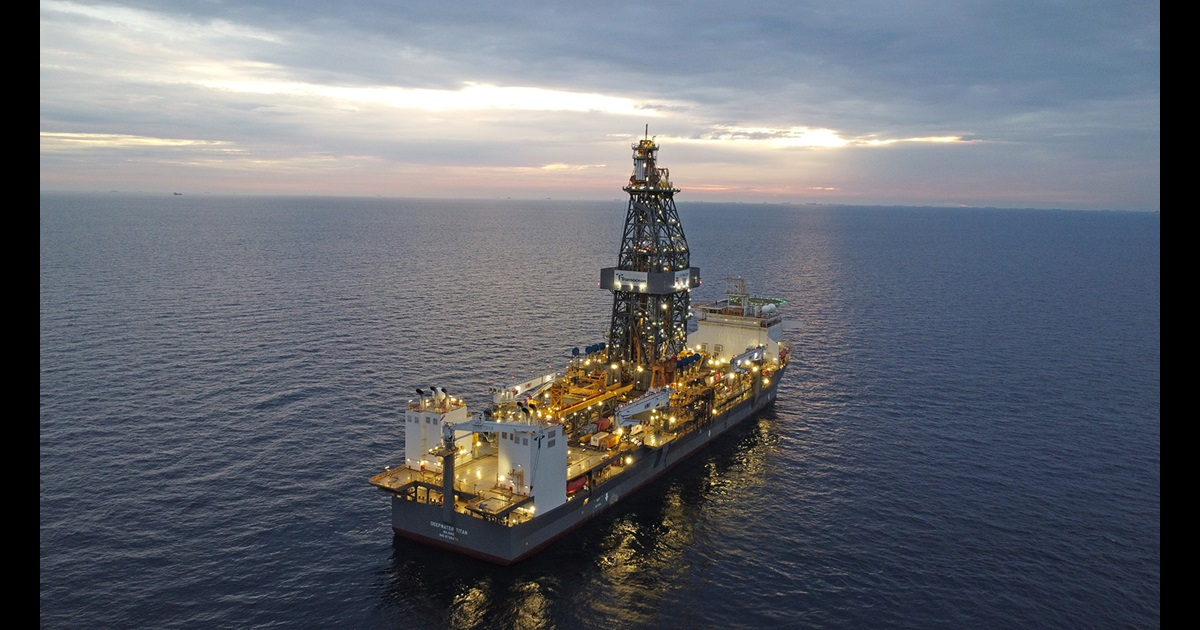
Deepwater Titan, Gulf of America

The latest Baker Hughes Rig Count Report shows only 10 rigs actively drilling in the Gulf. All are at deepwater locations – 7 in the Mississippi Canyon area, 2 in Green Canyon, and 1 in Alaminos Canyon. Per the BSEE borehole file, Shell accounts for most of the current MS Canyon wells and the Alaminous Canyon well. Beacon is also drilling in the MS Canyon, and the Green Canyon well appears to be a Chevron operation.

This current rig count, which has hovered between 9 and 12 all year, is troubling if you are concerned about long-term production. By comparison the Gulf rig count reached 22 last year and was 100+ during the 10 year period from 1994 to 2003.

Only Anadarko/Oxy, Beacon/BOE, BP, Chevron/Hess, Shell, and Talos have spudded deepwater exploratory wells in 2025 YTD. Arena and Cantium are the only shelf drillers – all development wells.

Technological advances and extensions of past discoveries have sustained Gulf production, but declines are certain over the longer term if drilling activity doesn’t increase. Oil price uncertainty is an issue, but that’s always the case. Semiannual lease sales are now legislatively required and the terms will be attractive, so those issues are off the table. Let’s see what the bidding looks like at the upcoming sale.

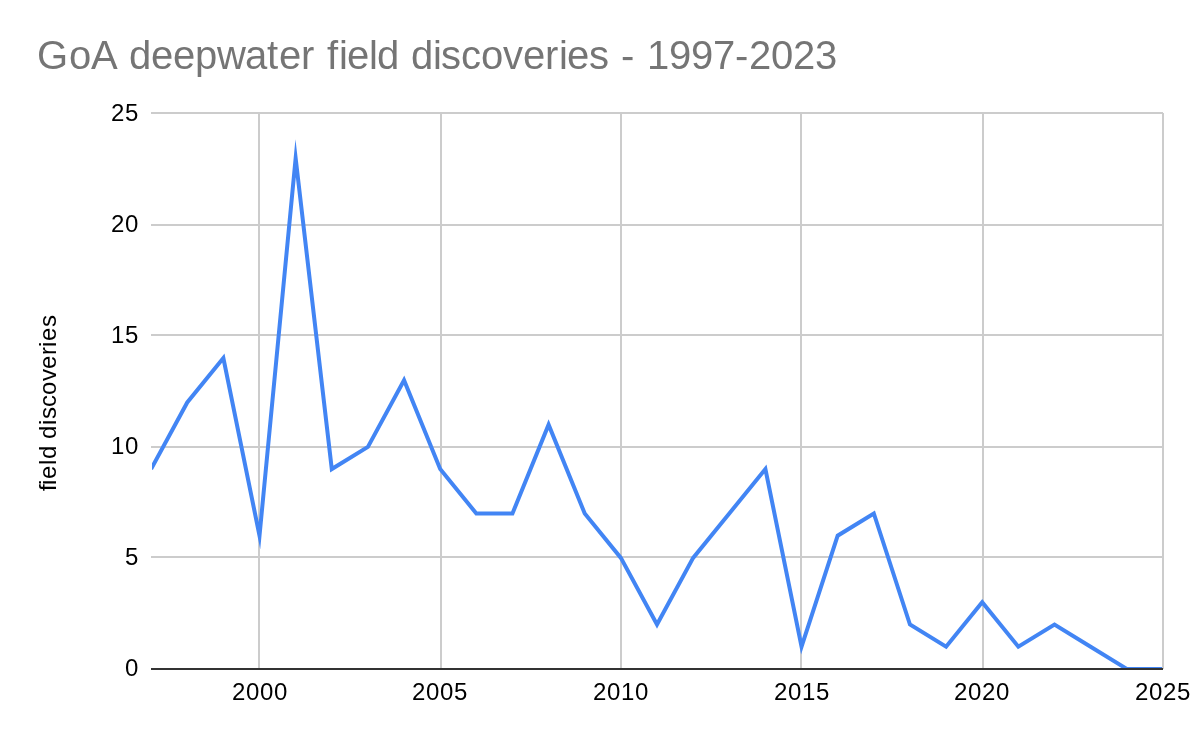
The decline in deepwater discoveries (BOEM data below) is particularly discouraging. Per BOEM, the last deepwater field discovery was in March 2023.
Read Full Post »

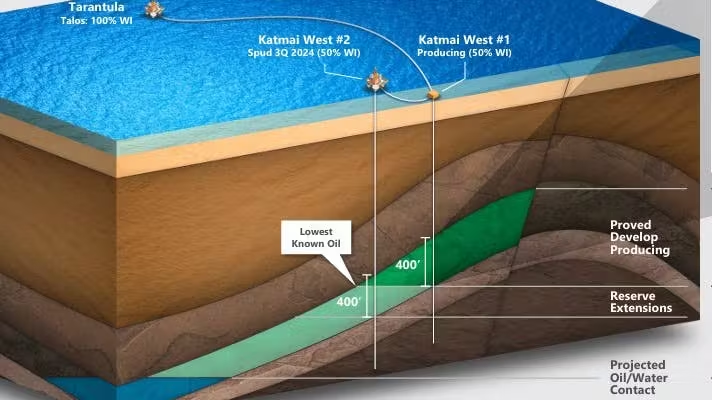
Talos announced successful drilling results at the Daenerys prospect (Katmai West #2) in the Gulf of America (Walker Ridge blocks 106, 107, 150, and 151).

Daenerys is a good example of the evolution of deepwater project ownership, which was once exclusively the domain of major international oil companies. Over the past 20 years, participation by independents increased gradually, followed by smaller independents and informed investment companies.

Impressively, the Daenerys partnership (table below) includes a tribe that has the same % ownership as a super-major, and a highly efficient investment company owned by a single person.

Talos (operator)large US independent27.0% share
Shellinternational supermajor22.5%
Red Willowprivate company owned by the Southern Ute Tribe22.5%
Houston Energyprivate independent focused on deepwater energy resources10.0%
Cathexisholding company owned by a single individual9.0%
HEQ portfolio company
focused on deepwater Gulf
9.

Read Full Post »

After a zero fatality year in 2023, the first in at least 60 years, Jason Mathews of BSEE advises that one worker was killed during US OCS oil and gas operations in 2024.

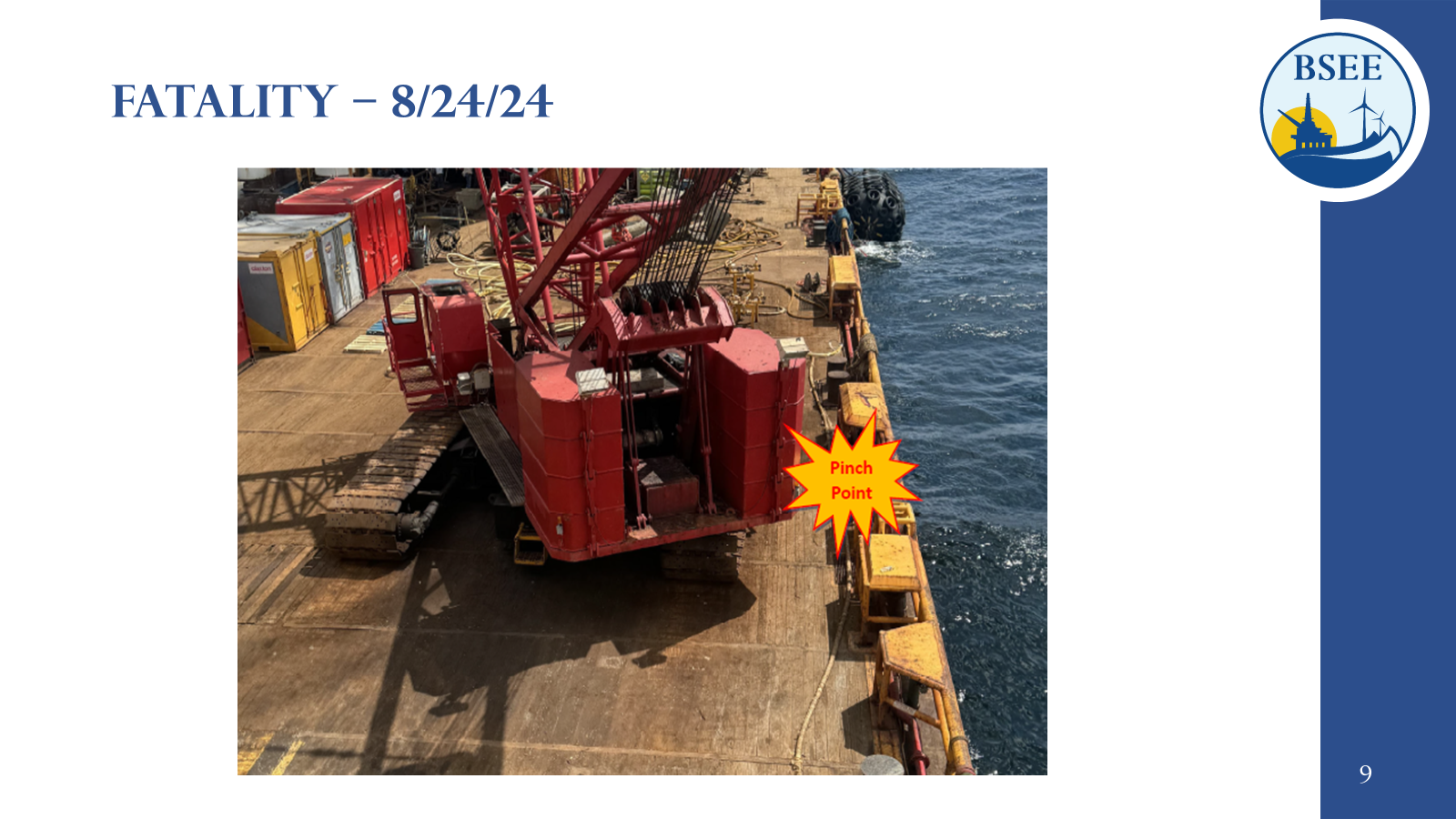
The fatality occurred during decommissioning operations on the Helix D/B EPIC HEDRON at Talos Energy’s Ship Shoal Block 225 “D” platform in the Gulf. The platform was to be reefed in Eugene Island Block 276.

The victim, who worked for Triton Diving Services, was moving hoses on the port side of the barge and got caught between the bulwark and counterweight of the crawler crane (see picture below).

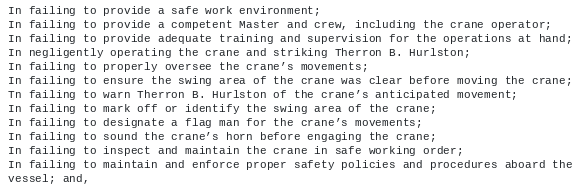
The victim’s family have filed a wrongful death lawsuit against Helix Energy Services and Triton Diving Services. The plaintiffs assert that prior to the crane movement the crane operator and crew had not undertaken measures to assure that the crane’s swing area was clear of other crew members. Per their filing, Triton and Helix were negligent as follows:

They further assert that:

The incident remains under investigation by BSEE.

Read Full Post »

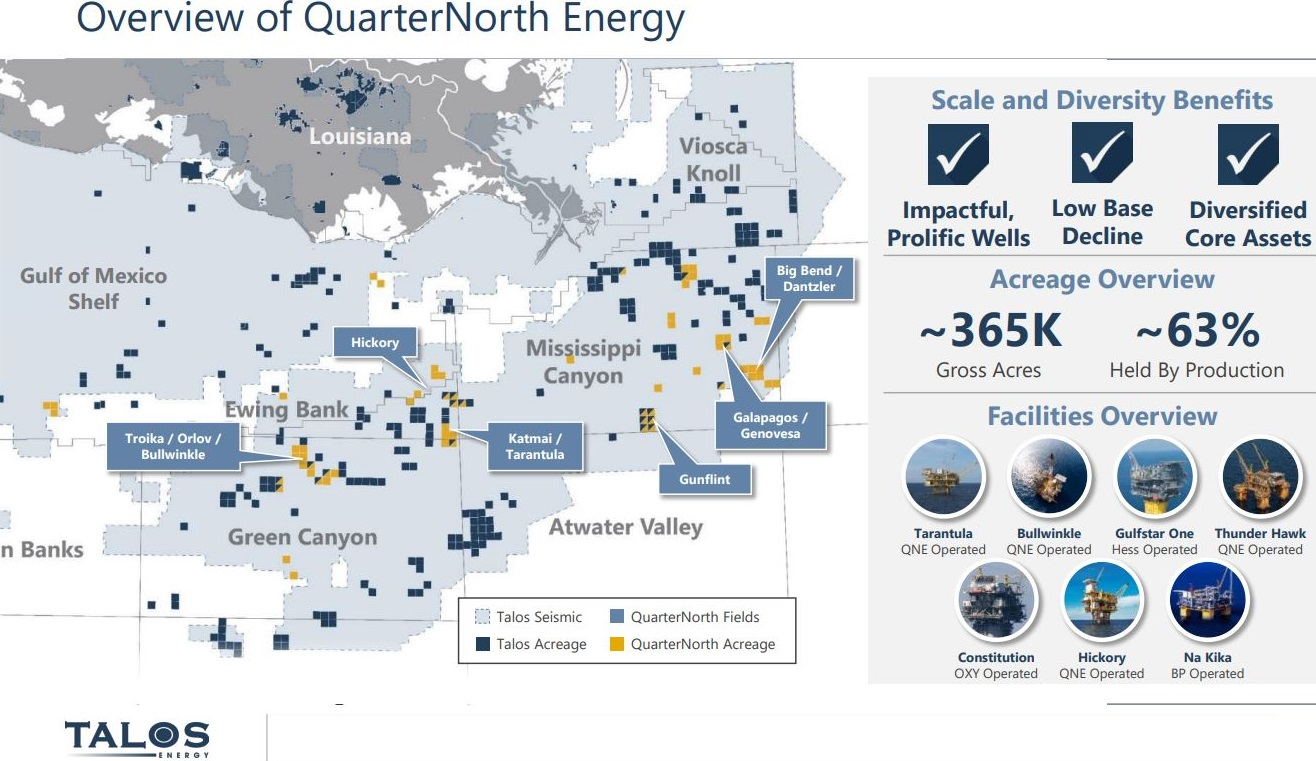
Safety first: As a descendant of troubled Fieldwood Energy, which had a very poor safety and compliance record, QuarterNorth Energy (QNE) had much to prove. That said, QNE has had a good compliance record in its brief 2 year history. During 76 facility inspections in 2022 and 2023, QNE was cited for only 15 Incidents of noncompliance, all but 2 of which were warnings. This is on par with the companies that had the best compliance records during that period.

BSEE’s incident statistics are hopelessly out-of-date, with the latest data being for 2021, so we have limited information on QNE safety incidents. However, BSEE’s District Investigation Reports, which document the more significant incidents, are relatively current and no QNE incidents were investigated in 2022 and 2023.

Platforms: Consistent with the general sense that QNE inherited the best of Fieldwood’s facilities, the company’s 15 platforms include Bullwinkle, the Thunder Hawk floating production unit in 6050′ of water, and prominent shelf platforms Tarantula and Hickory.

The acquisition reunites 2 iconic Shell platforms under the same ownership. QNE’s Bullwinkle, installed in 1988 in 1353′ of water, is the world’s tallest (non-compliant) steel tower platform. Talos’s Cognac, installed in 1978 in 1023′ of water, is the first platform in >1000′ of water.

Production and reserves: Per Talos, QNE adds 30,000 boe/d of production and 69 million boe of reserves.

Drilling: Per BSEE records, QNE was the operator for 2 deepwater exploration wells, both of which are classified as completed.

Active leases: The QNE acquisition will add 51 leases to the Talos’s 143 lease inventory.

Recent lease sale activity:

SaleQNETalos
2572/110/10
2596/45/4
2616/414/13
total/high bids for QuarterNorth (QNE) and Talos

Sales price and decommissioning: QNE was already on the market for “more than $2 billion,” shortly after the company was formed. Talos is paying $1.29 billion consisting of 24.8 million shares of Talos’s common stock and approximately $965 million in cash. A case study of the complex Fieldwood bankruptcy and the outcomes for the various parties would be most interesting. Also of interest would be a study of the decommissioning obligations of the former companies and the extent to which the sale proceeds are being applied.

Read Full Post »

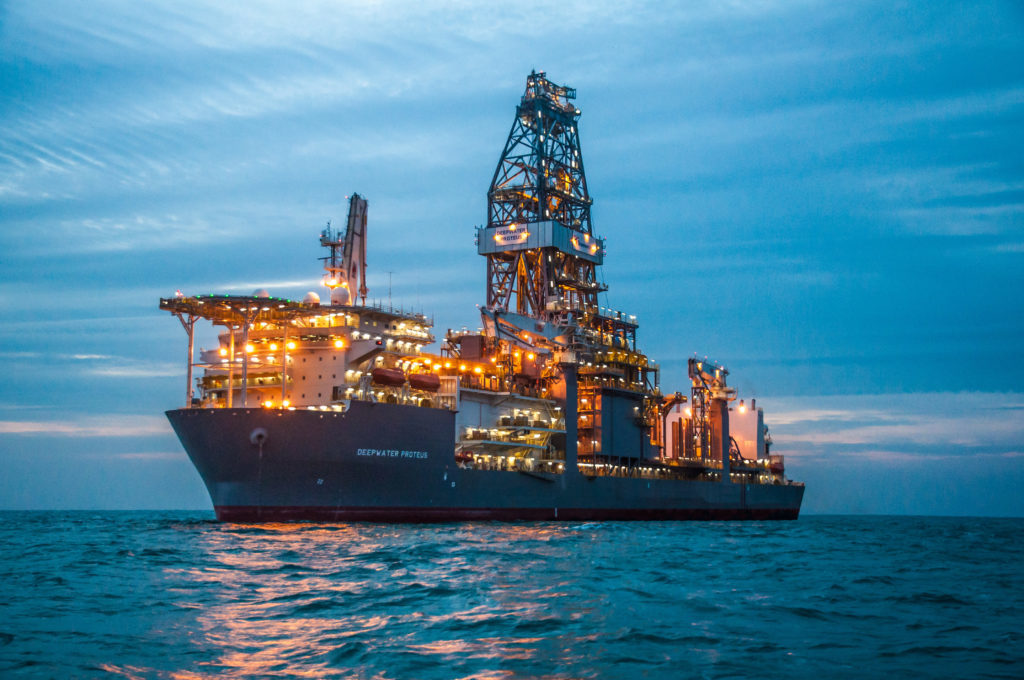
Pictured: Transocean’s Deepwater Proteus. T/O should name one of their drillships Deepwater Diligence 😉

Seven of the deepwater exploratory wells drilled in the Gulf of Mexico in 2023 (YTD) were spudded within 4.5 years of the effective date of their leases. Three of these wells were spudded within 3 years of their lease effective dates (see table below).

These are impressive achievements when you consider the time required for consultation with partners (if any) and contractors, site surveys, exploration plan development and approval, well planning, and drilling permit preparation and approval.

The subject wells accounted for 28% of the deepwater exploratory well starts in 2023 (25 net YTD wells after subtracting restarts at the same location).

date lease
effective
spud dateelapsed time
(months)
water
depth (ft)
operator
3/1/20218/27/2023306498Shell
8/1/20205/21/2023342211Talos
8/1/20203/15/2023313338Talos
12/1/20196/5/2023424228Chevron
11/1/20196/1/2023434603Hess
7/1/20197/11/2023487486Kosmos
12/1/20186/6/2023544127bp

Below are the exploration plan (EP) and permit (APD) approval timeframes for these 7 wells. With the exception of the Kosmos EP which required a number of modifications, the regulator actions appear to have been timely. For the bp, Shell, and Chevron wells, only 4-6 months elapsed between EP submittal and APD approval.

operatorblockdate EP
received
date EP
approved
APD
received
APD
approved
ShellWR 3653/1/20235/17/20235/11/20238/8/2023
TalosGC 781/19/20214/16/20213/8/20235/26/2023
TalosMC 1624/1/20227/13/20228/2/20223/2/2023
ChevronMC 93712/7/20225/19/20234/21/20235/21/2023
HessMC 7278/30/202211/3/202212/21/20224/24/2023
KosmosKC 9641/3/202010/12/20224/18/20237/3/2023
bpGC 4361/18/20234/14/20233/29/20236/5/2023
Notes: EP=Exploration Plan, APD=Application for Permit to Drill, WR=Walker Ridge, GC=Green Canyon, MC=Mississippi Canyon, KC=Keathley Canyon

Read Full Post »

BOEM published their Sale 257 Decision Matrix on Friday (2/24/2023), and my previous speculation regarding the rejected Sale 257 high bid has proven to be partially incorrect. The rejected high bid was submitted by BP and Talos and was for Green Canyon Block 777. BOEM’s analytics assigned a Mean of the Range-of-Value (MROV) of $4.4 million to that tract, which tied for the highest MROV for any tract receiving a bid. The BP/Talos bid was $1.8 million or just 40% of BOEM’s MROV. BOEM’s tract evaluation is interesting given that the other bid on this wildcat tract (by Chevron, $1.185 million) was considerably lower than the rejected BP/Talos bid.

The Sale 257 bid that I thought might have been rejected was for lease G37261. This lease was never issued per the lease inquiry data base and the final bid recap. BHP’s bid of $3.6 million for that tract (Green Canyon Block 79) was more than 5 times BOEM’s MROV of $576,000, and was accepted per the decision matrix. Why was the lease never issued?

Both Green Canyon 79 and 777 should again be for sale in legislatively mandated Sale 259, which will be held in just a few weeks on March 29, 2023, just 2 days prior to the deadline. It will be interesting to see what the bidding on those tracts looks like.

Meanwhile, Exxon and BOEM are still mum about the 94 Sale 257 oil and gas leases that Exxon acquired for carbon sequestration purposes. Note the large patches of blue just offshore Texas on the map above. These leases were all valued by BOEM at only $144,000 each, which is equivalent to the minimum bid of $25/acre. This valuation reflects the absence of perceived value for oil and gas production purposes. Exxon bid $158,400 for each tract, $27.50/acre or 10% higher than the minimum bid. Given that (1) the Notice of Sale only provided for lease acquisition for oil and gas exploration and production purposes, and (2) it was common knowledge that these tracts were acquired for carbon sequestration, should these bids have been rejected?

Read Full Post »

Ram Powell TLP
  • Talos has announced commercial discoveries at its Lime Rock and Venice prospects.
  • Both discoveries are near the company’s Ram Powell platform, where future production will flow via subsea tiebacks.
  • The Lime Rock prospect was acquired in Lease Sale 256 in November of 2020.
  • The new discoveries will help sustain production at Ram Powell, an early tension leg platform that has produced more than 250 million boe.
  • Ram Powell was the deepest production facility in the world (water depth of 3216′) when it was installed by Shell in 1997.
  • Access to nearby resources through regular lease sales facilitates continued production from existing platforms, reducing costs and environmental impacts.

Read Full Post »

Was 2021 the low point? Hopefully that is the case, but consistent leasing is essential.

Looks like Woodside is now officially the GoM operator of record (was BHP prior to merger). Kudos to them.

Shell continues to be the GoM bellwether. There is no OCS program without them.

What’s up with BP and Chevron? Big declines from both.

US super-majors Exxon and ConocoPhillips remain out of the picture, both in terms of lease acquisition and exploration. Disappointing.

Tip of the hat to Hess, LLOG, Murphy, and Talos – independents committed to deepwater production.

Read Full Post »

Sept 22 (Reuters) – Talos Energy Inc (TALO.N) said on Thursday it will buy EnVen Energy Corp, a private producer in the deepwater U.S. Gulf of Mexico, in a $1.1 billion deal including debt.

As the data below demonstrate, this is a significant merger from a regional perspective. In 2021, the combined company would have been the sixth largest GoM producer of both oil and gas. The two companies are operating 105 platforms, and their 8 deepwater (>1000′) platforms are 14% of the GoM total. Their compliance records, while not at Honor Roll levels, are better than the GoM average based on INCs/inspection. Some major decommissioning projects loom (see the second table below), and the extent to which the merged company is financially prepared for these obligations is unknown. Particularly noteworthy is the Cognac platform, which was the world’s first platform installed in >1000′ of water.

EnVenTalos
2021 Oil (MMbbls)9.617.5
GoM oil rank137
2022 Gas (Bcf)12.634.8
GoM gas rank169
2021/2022 well starts88
platforms: total1491
platforms >1000′44
BSEE inspections37176
2022 INCs (W, CSI, FSI)12/4/138/23/10
INCs/inspection0.460.40
INC=incident of noncompliance; W=warning; CSI=component shut-in; FSI=facility shut-in

Decommissioning obligations of note:

Platformownertypewater
depth
(ft)
installed
Amberjack Talosfixed11001991
VK 989Talosfixed12901994
Ram PowellTalosTLP32161997
GC 18Talosfixed7501986
CognacEnVenfixed10231978
LobsterEnVenfixed7751994
BrutusEnVenTLP29002001
PrinceEnVenTLP15002001
Cognac platform

Read Full Post »

Last month (12/2021), BSEE finally posted the 2020 incident statistics. Unfortunately, no details or incident summaries are provided for the 6 fatalities. The fatalities are simply classified as “occupational” (4) or “non-occupational” (2). As a result, we still know very little about these fatal incidents 13 – 24 months after they occurred.

The BSEE spreadsheet advises that 3 of the 4 “non-occupational” fatalities are being investigated, but the reports are still “pending.” Why the long delay? The National Commission, BOEMRE-CG, and NAE investigations of the Macondo tragedy were completed (and reports published) in less time.

No explanation is provided as to why the 4th occupational fatality is not being investigated.

Also, investigations of the preparedness and response aspects of the 2 non-occupational fatalities would have been beneficial. What was the cause of death? What medical screening procedures were in place? What treatment capabilities were available at the facility? How much time was required to transport the workers to hospitals? These are important considerations for the offshore community.

Below is a summary of the publicly available information for the 6 fatalities:

  • 1/14/2020: A worker died on a Diamond drillship on a lease (Mississippi Canyon 822) operated by BP. According to BSEE this was a non-occupational fatality. Per the listing of investigations, no investigation was conducted.
  • 5/16/2020: A worker died on a Fieldwood platform (Ewing Bank 826 A). Per BSEE, this was an occupational fatality and the investigation is still pending. There were no media reports or company announcements.
  • 6/2/2020: A worker died on the Valaris DS-18 drillship working for EnVen Energy at Green Canyon 767. Per BSEE, this was a non-occupational fatality and no investigation was conducted.
  • 6/20/2020: A worker died on at the Green Canyon 18 A platform operated by Talos. Per BSEE, this was an occupational fatality but no investigation is indicated for this incident. No media reports or company announcements could be found.
  • 8/23/2020: A worker died on the Pacific Khamsin drillship working for Total at Garden Banks 1003. A month later, at an Investors’ Day presentation, Total announced that the incident occurred while the crew was preparing to move the rig to avoid Tropical Storm Laura. Total’s statement included this defensive statement: “This is a routine operation that was executed with no time pressure as the rig disconnection had been decided well in advance.” Per Total, the findings of their investigation were shared with the regulators in Sept. 2020, but BSEE advises that their investigation is still pending.
  • 12/2/2020: A worker died on DCOR’s Platform Gilda in the Santa Barbara Channel offshore California. The BSEE investigations update provides no information on the status of the investigation. Per local media, 3 men fell from the platform and others jumped into the water to assist. No information is provided on the reason why the 3 men fell.

The number of US OCS fatalities remains unacceptably high, and timely data sharing and investigations are needed to better assess causes and trends. In that regard, this recommendation from the 2016 National Academies report entitled “Strengthening the Safety Culture of the Offshore Oil and Gas Industry” merits further industry/government attention and action:

Recommendation 4.2.2: Because accident, incident, and inspection data all are needed to identify and understand safety risks and corrective actions, the committee recommends full transparency such that regulators make all these data readily available to the public in a timely way, taking into consideration applicable confidentiality requirements.

Read Full Post »

Older Posts »