Feeds:
Posts
Comments

Posts Tagged ‘Lease Sale 257’

Big Beautiful Gulf of America

Will the oil and gas lease sale boldly named Big Beautiful Gulf 1 (BBG1) live up to its grand name? Given the more favorable lease terms and the 2 year gap since the last sale, BBG1 should surpass the previous 3 sales (table below). Questions:

  • Which majors will be the most active bidders? Chevron? Shell? BP? Oxy/Anadarko?
  • Will former Gulf of Mexico stalwarts Exxon and Conoco Phillips participate for the first time in years? Probably not, but US super-majors should participate in the US offshore program.
  • How many companies will submit bids? Would like that to be a number >35.
  • How many tracts will receive bids? A number >300 would be very encouraging.
  • Will the total high bids exceed $400 million?
  • Will we see an increase in shelf interest?
  • Which independents will be the most active?
  • After the not-so-clever carbon disposal acquisitions in the last 3 sales, will the number of carbon disposal bids be zero? For the first time ever, the Federal government felt compelled to stipulate the obvious (see the proposed notice for OCS Sale 262) – that an Oil and Gas Lease Sale is only for oil and gas exploration and development.

See the summary data below for the last 3 Gulf lease sales. We’ll fill in the blanks next week.

Sale No.257259261BBG1
date11/17/20213/29/202312/20/202312/10/2025
companies
participating
333226
total bids223328423161
tracts receiving bids214324422751
sum of all bids
$millions
198.5309.8441.9
sum of high bids
($millions)
101.7263.8382.2
highest bid
company
block
$10,001,252.00
Anadarko
AC 259
$15,911,947
Chevron
KC 96
$25,500,085
Anadarko
MC 389
most high bids
company
sum ($millions)
46
bp
29.0
75
Chevron
108.0
65
Shell
69.0
sum of high bids ($millions)
company
47.1
Chevron
108
Chevron
88.3
Hess
most high bids by independent14-DG Expl.13-Beacon
13-Red Willow
22-Red Willow
1excludes 36 leases improperly acquired for carbon disposal purposes; 2excludes 69 leases improperly acquired for carbon disposal purposes; 3excludes 94 leases improperly acquired for carbon disposal purposes

Read Full Post »

As previously posted, 14 of the 244 (not counting the 69 CCS bids) Sale 259 high bids were rejected. BOEM has published their bid evaluations for all of the tracts, and the 14 rejections are listed below.

lease #blockhigh bid ($)BOEM MROV ($)no. of bids
G37496DC 6222,101,8369,100,0001
G37515GC 173307,1071,300,0001
G37534GC 5471,783,49812,000,0001
G37538GC 5911,291,9935,200,0001
G37543GC 642605,5053,400,0001
G37548GC 777583,1034,200,0001
G37562AT 51,551,1304,700,0003
G37565AT 133607,1072,600,0001
G37616KC 745707,7773,600,0001
G37617KC 789707,7772,100,0001
G37647WR 750724,7443,500,0001
G37646WR 794724,7443,200,0001
G37648WR 795774,2425,000,0001
G37649WR 796774,2424,000,0001
MROV – Mean of the Range-of-Value

Observations:

  • Keathley Canyon (KC) Block 96, the tract receiving the highest bid in the entire sale ($15,911,947 by Chevron), had a BOEM MROV of only $576,000. Clearly, Chevron and the government have a very different view of the value of this tract. BP was the second bidder for KC 96, and their bid ($4,003,103) was also considerably higher than BOEM’s MROV. This one will very interesting to follow.
  • The only bid that was rejected in Sale 257 was the BP/Talos bid of $1.8 million for Green Canyon Block 777. BOEM’s MROV in the Sale 257 evaluations was $4.4 million. BP again bid on GC 777 in Sale 259, but their bid was only $583,000 (even though BOEM’s Sale 257 evaluation was public information). BOEM’s MROV was reduced only slightly to $4.2 million, and they again rejected BP’s bid. We’ll see what happens in the next sale.
  • 51 of the 230 accepted bids were >$1 million, all for deepwater tracts. All of the rejected bids were for deepwater tracts, and a higher percentage (4/14) were >$1 million. This makes sense given that the higher potential prospects are in deepwater.
  • These results demonstrate again that resource evaluation is far from an exact science. BOEM is not selling barrels of oil and cubic feet of gas. BOEM is evaluating prospects, and companies are bidding on the opportunity to explore these prospects.
  • Bidding strategies differ; the more companies participating, the better the long-term prospects for the OCS program.

Read Full Post »

ENERGYWIRE has reported that the Department of the Interior will publish the legislatively mandated carbon sequestration rule later this year. Given that even close followers of the OCS program were completely unaware of the enabling legislative provisions prior to their enactment, the proposed DOI rule will provide the first opportunity to formally comment.

Within the oil and gas industry and the environmental community, there are considerable differences of opinion about carbon sequestration in general, and more specifically, offshore sequestration. All interested parties are encouraged to submit comments on these important regulations.

Some background information on the sequestration legislation and subsequent actions:

Exxon and other companies intend to commercialize carbon sequestration, and Exxon projects an astounding $4 trillion CCS market by 2050. Such a market will of course be dependent on mandates and subsidies, and the costs will ultimately be borne by taxpayers and consumers.

Is it not a bit unsavory and hypocritical for hydrocarbon producers to capitalize on the capture and disposal of emissions associated with the consumption of their products? Perhaps companies that believe oil and gas production is harmful to society should exit the industry, rather than engage in enterprises that sustain it.

More:

Read Full Post »

That would appear to be the case now that the US Court of Appeals for DC dismissed litigation challenging the sale.

Meanwhile, challenges to Cook Inlet Sale 258 (humble as it was with only one bid) and GoM Sale 259 continue. It’s a great country (if you like endless litigation)!

In addition to Lease Sale 257, the IRA also required Interior to offer three other lease sales in Alaska and the Gulf that it previously declined to hold. Lease Sale 258, in Alaska’s Cook Inlet, was held in December but received only one bid. Earthjustice is challenging that sale. Earthjustice is also challenging Lease Sale 259, in the Gulf of Mexico, which was held in March. Lease Sale 261, also in the Gulf, will be held by September of this year. 

EarthJustice

Read Full Post »

Read Full Post »

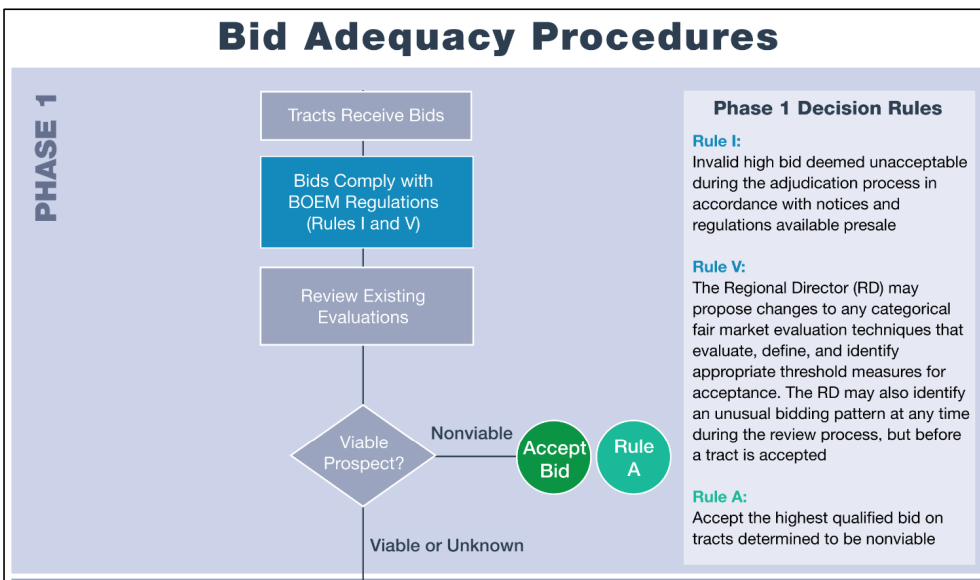
BOEM’s new procedures, which have been published for public comment, seem reasonable. However, it would be helpful to learn more about the testing of the new methodology. (See the quote below). Further, would the rejected Sale 257 bid have been accepted? What was the LBCI for that tract? Would any accepted Sale 257 bids have been rejected? Would the outcome of other sales have been affected?

After a 2-year comprehensive technical review of the delayed valuation methodology, BOEM intends to replace the delayed valuation methodology with a statistical lower bound confidence interval (LBCI) at a 90 percent confidence level as a decision criterion for accepting or rejecting qualified high bids on tracts offered in OCS oil and gas lease sales. Following extensive testing of the alternative approaches using both historical and current lease sale tract data and existing BOEM cash flow simulation models, BOEM determined that the LBCI approach would be the most appropriate substitute for the delayed valuation methodology. The LBCI is a statistical concept that captures the lower bound of a range of values encompassing the true unknown mean of the risked present worth of the resources at the time of the lease sale. The LBCI incorporates the uncertainty of parameters unique to the valuation of each OCS oil and gas lease sale tract. These parameters may include, but are not limited to, subsurface characterization of reservoir properties, cost and timing of the development, and projected revenues. Unlike the delayed valuation methodology, the LBCI approach would not require that BOEM estimate the time delay period between the current OCS oil and gas lease sale and the projected next lease sale. As such, BOEM finds the LBCI to be a better approach going forward.

Federal Register

Below is the flow chart for the new procedures. It’s interesting that high bids on nonviable tracts are automatically (and gratefully) accepted! 😉

Read Full Post »

BOEM published their Sale 257 Decision Matrix on Friday (2/24/2023), and my previous speculation regarding the rejected Sale 257 high bid has proven to be partially incorrect. The rejected high bid was submitted by BP and Talos and was for Green Canyon Block 777. BOEM’s analytics assigned a Mean of the Range-of-Value (MROV) of $4.4 million to that tract, which tied for the highest MROV for any tract receiving a bid. The BP/Talos bid was $1.8 million or just 40% of BOEM’s MROV. BOEM’s tract evaluation is interesting given that the other bid on this wildcat tract (by Chevron, $1.185 million) was considerably lower than the rejected BP/Talos bid.

The Sale 257 bid that I thought might have been rejected was for lease G37261. This lease was never issued per the lease inquiry data base and the final bid recap. BHP’s bid of $3.6 million for that tract (Green Canyon Block 79) was more than 5 times BOEM’s MROV of $576,000, and was accepted per the decision matrix. Why was the lease never issued?

Both Green Canyon 79 and 777 should again be for sale in legislatively mandated Sale 259, which will be held in just a few weeks on March 29, 2023, just 2 days prior to the deadline. It will be interesting to see what the bidding on those tracts looks like.

Meanwhile, Exxon and BOEM are still mum about the 94 Sale 257 oil and gas leases that Exxon acquired for carbon sequestration purposes. Note the large patches of blue just offshore Texas on the map above. These leases were all valued by BOEM at only $144,000 each, which is equivalent to the minimum bid of $25/acre. This valuation reflects the absence of perceived value for oil and gas production purposes. Exxon bid $158,400 for each tract, $27.50/acre or 10% higher than the minimum bid. Given that (1) the Notice of Sale only provided for lease acquisition for oil and gas exploration and production purposes, and (2) it was common knowledge that these tracts were acquired for carbon sequestration, should these bids have been rejected?

Read Full Post »

On September 14, 2022, BOEM announced that 307 high bids from Lease Sale 257 in the Gulf of Mexico were accepted. BOEM also announced that one high bid was rejected for not providing the public with fair market value. BOEM has not identified the rejected bid.

Per BOEM’s Lease Area Block Online Query file, 306 Sale 257 leases were effective on Oct. 1, 2022. A comparison of these data with the sale results identified 2 Sale 257 leases that have not been awarded:

leaseblockhigh bidder(s)bidcomments
G37261GC 70BHP$3.6 millionlone bid; 7th highest
bid in sale
G37294GC 777BP (75%),
Talos (25%)
$1.8 million2 bids; next highest
$1.185 million

So one of these 2 bids was rejected and the other has lease not yet been awarded for some reason (or perhaps there has been a clerical/IT issue).

Which bid was rejected? I would guess it was the BHP bid even though that bid was the 7th highest bid in the entire sale. The fact that this bid was $2.5 to $3 million higher than the other 7 BHP bids (all of which were accepted) tells us that the company valued this tract highly. Perhaps BOEM, which has all of the geologic data, thought the value was even higher, which is why the bid may have been rejected.

There was another bidder (Chevron) for the BP/Talos tract, so the competition makes it less likely that the bid would have been rejected.

Ironically, the 94 carbon sequestration bids, which made something of a mockery of the lease sale, could not be rejected on fair market grounds. The bids exceeded the minimum required, and the tracts have little or no value from an oil and gas production standpoint. A competitive process would be require to repurpose these leases for carbon sequestration.

Read Full Post »

Which bid was rejected? BOEM announced that 307 of the 308 high bids were accepted. One bid was rejected on fair market value grounds. The unsuccessful bid is not specified on the Sale 257 web page.

When can we expect a statement from Exxon on their intentions for the 94 blocks they acquired? Those 94 blocks (31% of the entire sale) are the elephant in the room, yet we have heard nothing from the company. Given Exxon’s apparent interest in using these leases for CCS purposes, and the tax credits and Federal funding associated with CCS projects (as per the Infrastructure Bill and Inflation Reduction Act), clarification regarding Exxon’s intentions would seem to be appropriate.

Read Full Post »

Pursuant to section 50264(b) of the Inflation Reduction Act of 2022 (Pub. L. No. 117-169), Congress has directed BOEM to award leases to the highest valid bidders in Lease Sale 257, which was held on November 17, 2021. Consistent with this direction, BOEM has accepted 307 of the highest valid bids, totaling $189,888,271.

A total of 33 companies participated in the lease sale, generating $191,688,984 in high bids for 308 tracts covering 1.7 million acres in federal waters in the Gulf of Mexico. One bid was rejected for not providing the public with fair market value.

BOEM

Bottom line:

Read Full Post »

Older Posts »