Feeds:
Posts
Comments

Posts Tagged ‘GAO’

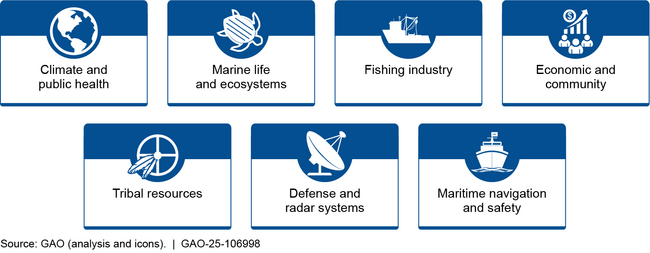
The Government Accountability Office report on Offshore Wind Energy (full report attached) does a good job of summarizing the potential impacts from offshore wind development. They are categorized in the report as follows:

  • Marine Life and Ecosystems (see table pasted below)
  • Fishing Industry and Fisheries Management
  • Economic Development and Community Impacts
  • Tribal Resources, Including Sacred Sites and Established Fishing Grounds
  • Defense and Radar Systems
  • Maritime Navigation and Safety

Unfortunately, GAO’s recommendations, which focus on consultation and staffing (perennial favorites), are rather meaningless. Does GAO really think more consultation will resolve the fundamental concerns of the tribes and fishing industry? Does GAO really think increasing BOEM/BSEE staff is a solution? Wind was the signature offshore energy program of the previous Administration, and it was well resourced.

When the legislation authorizing offshore wind energy development was drafted, we envisioned energy alternatives that could complement thermal energy sources like gas, coal, and nuclear plants. Natural gas plants are particularly important to intermittent energy sources, because their power can be readily dispatched on demand.

Never did we expect attempts to ban the dispatchable energy sources on which renewable energy goals were dependent. Policies that limit gas production, transportation, and consumption don’t boost offshore wind development, they doom it.

In a rush to achieve the Administration’s energy goals, the wind leasing program brushed aside important economic, safety, national security, and environmental issues. Coastal residents, tribes, fishing interests, power customers, and other affected parties have rebelled. Their concerns won’t be smoothed over by increasing consultation.

So now the wind program is in a dark and windless place (a regulatory dunkelflaute?). Five projects are under construction or in the early stages of operation. Construction has been authorized for 6 other projects. Five more projects are in various stages of permitting. What next?

Meanwhile, we still haven’t seen a report on the ugly and embarrassing Vineyard Wind blade failure offshore Nantucket last July. Shouldn’t that report be a precursor to further offshore wind development in the US Atlantic? Also of note, that same turbine was struck by lightning 2 months ago.

Should directed suspension orders be issued pending a complete review of the wind program? If so, for which leases and for how long? Suspension of projects still in the permitting phase would be relatively painless and maybe even attractive given the current state of the wind industry. However, financial impacts for projects in the construction phase would be significant. These important next-step decisions need to be made soon. Muddling along is not a strategy.

Table 2: Examples of Potential Impacts of Offshore Wind Development to Marine Life and Ecosystems

ImpactDescription
Acoustic disturbanceConstruction and survey activities produce underwater noise that can disturb sensitive marine species. Offshore wind projects take measures to mitigate underwater noise, including the use of bubble curtains to dampen pile driving sound and pausing operations if protected species are sighted.
Changes to marine habitatInstallation of infrastructure, such as turbine foundations and transmission cables, introduces new structures and causes changes to the ocean floor that can alter marine habitat and affect the distribution, abundance, and composition of marine life in the area. These new structures can create artificial habitat that may benefit some species while displacing others and could affect bottom-dwelling species through disturbing the seabed. Artificial habitat effects of wind turbines are well documented, but research is ongoing to monitor and understand impacts on marine life.
Hydrodynamic effectsOperation of wind turbines can affect hydrodynamics and ocean processes such as currents and wind wakes, but little is known about regional effects of widescale deployment on ecosystems.
Vessel disturbanceVessels can disturb some species and pose strike risks to large marine animals, but the increase in offshore wind vessels is projected to be small compared to the total volume of vessel traffic. Offshore wind vessels are required to take measures such as following speed restrictions and employing protected species observers.
Entanglement riskStructures, such as mooring cables from floating wind turbines, could snag fishing gear and other marine debris and create entanglement risk to marine animals. Wind projects employ measures to minimize entanglement (e.g., mooring systems designed to detect entanglement), but there is uncertainty about the extent of the risk from floating turbines because of limited deployment.a
Collision risk to birds and batsTurbine blades pose a collision risk to some sea birds, but little is known about offshore collision risk to bats. Research on collision risks and mitigation measures (e.g., lighting and curtailment) is ongoing.

Read Full Post »

Decommissioning financial assurance issues are complex!

This blog has raised significant concerns about BOEM’s decommissioning financial assurance rule, and will continue to comment on decommissioning policy. That said, decommissioning issues are complex and have challenged industry and government in the US and internationally for decades. Add well plugging practices, corrosion, storm risks, reefing vs. total removal, alternative uses for old platforms, and pipeline and seafloor equipment abandonment to the myriad of financial issues and you get a sense of the breadth and complexity of decommissioning issues.

Decommissioning is unique in that the issues divide sectors of the offshore industry that are typically aligned (majors vs. smaller producers). The environmental community is also divided with the reefing and fishing advocates opposing those who insist on complete removal.

Given these divisions, and decommissioning’s operational, environmental, and political complexities, highly partisan assertions are common. A recent article about the financial assurance rule includes a number of such assertions, and provides a framework for discussing some of the more prominent issues. Excerpts from the article and my comments follow.

This costly rule became final on April 15, 2024, but in the 10 months since its initial proposal, BOEM did nothing to alleviate concerns for smaller companies that comprise of 76 percent of oil and gas operators in the Gulf.

Comments:

  • While I concur that shelf operations and the independent companies that conduct them are important, 94% of OCS oil production and 80% of the gas (2023 data) were from deepwater facilities (>1000′ WD) which are largely the domain of the majors (although the participation of independents in the deepwater sector is increasing).
  • In 2023, four majors – Shell, bp, Oxy (Anadarko) and Chevron – accounted for 2/3 of the Gulf’s total oil production.
  • 1467 of the remaining 1527 GoM platforms are in <1000 feet of water and are almost exclusively operated by small producers. So 96% of the platforms are producing only 6% of the oil and 20% of the gas.
  • This dichotomy presents a major challenge for BOEM which must protect the public from decommissioning liabilities without unfairly penalizing small producers.
  • Having worked for respected political appointees from both parties, my experience has been that the smaller producers (somewhat surprisingly) have more political influence than the majors. For this reason, along with the general lack of attention to financial assurance issues in the early years of the offshore program, the standard bond requirement was ridiculously low for much of the program’s history, and supplemental financial assurance assessments were typically inadequate (and still are which is why the new rule was promulgated).
  • Attention to decommissioning issues grew exponentially in the early 1990s. Prior to that time, platform removal, like well plugging, was classified as “abandonment,” a term that was considered too harsh when bankruptcy issues and the Brent Spar controversy in the North Sea attracted worldwide attention.

Records obtained via the Freedom of Information Act show private meetings between Interior officials and representatives of the major oil companies as they cooperated on this rule.

Comments:

  • The linked FOIA records are not at all problematic. They pertain to meetings prior to the publication of the draft rule, which are appropriate and desirable.
  • Some of these meetings were in response to BOEM’s request for input regarding their review of the OCS oil and gas program. Such meetings are particularly helpful when a new administration is trying to assess the direction of the program.
  • Indeed 42 of the 71 pages in the FOIA were official industry comments in response to the BOEM request.
  • Per the Regulations.gov docket on the financial assurance rule, BOEM also met with stakeholders after the proposed rule was published. Those meetings are allowed as long as the regulator simply receives input and does not signal decisions regarding the content of the final rule.
  • The docket shows that BOEM had 8 listening sessions with advocates for independent producers. These included 2 sessions with the Gulf Energy Alliance and 6 sessions with individual independent producers.
  • BOEM also had 2 listening sessions with Oceana, a prominent environmental organization, and multiple sessions with tribal organizations.
  • The only sessions with representatives from major producers were a single session with API and a single session with Shell, the Gulf’s largest producer.
  • These meetings (after the proposed rule was published) are noted in the docket as required.
  • I am concerned that many listening session documents (from all sides of the decommissioning financial assurance issue) were removed from the docket at the direction of OIRA/OMB, purportedly because they included privileged information. This is rather troubling given the number of deletions and the complete absence of information about those meetings. What types of privileged information were these organizations providing and why is there no information whatsoever on these meetings? At a minimum, a list of attendees and general summary for each meeting should have been posted, as was our practice in the past.

Big Oil must think it won’t miss the small competitors the rule will drive from the market.

Comments:

  • There is important synergy between the major producers and independents, and no reason for driving smaller companies from the market.
  • The independents are critical to sustaining the shelf infrastructure and the associated service companies, which helps to facilitate deepwater development. Majors also benefit from partnering with independents on lease acquisitions, development projects, and lease assignments.
  • Financial assurance for decommissioning of transferred assets is the one area of significant conflict, particularly when there have been multiple ownership changes since the facilities were initially transferred.

“Historically, joint and several liability protected these small businesses from the financial demands of surety bonds.”

Comments:

  • Surety bonds, or other forms of financial assurance, have always been required. As previously noted, the amounts were often inadequate.
  • Joint and several liability was not established in the regulations until May 22,1997. Whether companies are liable for facilities transferred prior to that date has yet to be considered in court.
  • 1130 of the 1527 remaining GoM platforms were installed prior to May 22,1997. Many of these platforms were no doubt transferred prior to that date, which means the liability of the initial owner is uncertain.
  • Predecessor liability does not apply to new wells and platforms constructed by the current lessees.
  • Joint and several liability was never intended to relieve current lessees from their financial assurance responsibility, which is why assignors were required to provide such assurance. BOEM is correct in strengthening their enforcement of this requirement.

“The new rule is largely silent on joint and several liability, causing some uncertainty.”

Comment: The joint and several liability provision remains in place at 30 CFR 250.1701(a) BOEM has added language to part 556.704, to clarify, correctly in my opinion, that they may withhold approval of any transfer or assignment of any lease interest if the financial assurance requirements have not been satisfied.

Companies may not be able to acquire the needed financial assurances because the market likely will not even exist.

Comment: The history of small producer failures is no doubt a concern to financial institutions. BOEM offers multiple financial assurance options, some of which have been questioned on this blog. If a company can’t qualify, it’s not the responsibility of the public to assume their decommissioning risks.

What makes matters worse is that all this cost covers a risk that is effectively a rounding error historically and in the context of the royalties flowing from the offshore oil and gas industry. According to BOEM, taxpayers have borne decommissioning liability totaling $58 million – from a single company that lacked predecessor owners of the platform to call on to cover unfunded cleanup costs.

Comments:

  • The $58 million “rounding error” is more like the tip of the iceberg. It’s also a dangerous precedent and major embarrassment for the OCS program.
  • Those who seek to minimize the Federal government’s risk exposure should consider the findings in the 2024 GAO report. Per that report, “BOEM held about $3.5 billion in supplemental bonds to cover between $40 billion and $70 billion in total estimated decommissioning costs as of June 2023.”
  • At the time of the recent Cox bankruptcy, BSEE estimated that decommissioning costs for the Cox platforms would exceed $4.5 billion. The extent to which prior owners can be held accountable for those costs is uncertain.
  • When will we find out who will be paying the hundreds of millions needed to decommission long-idled Platforms Hogan and Houchin in the Santa Barbara Channel?
  • Decommissioning financial assurance is a responsibility of lessees, not the taxpayer.

Read Full Post »

John Smith, a decommissioning specialist who retired from BOEM, has published numerous professional papers on the topic. He has kindly shared his comments (below) on the new GAO report.

The Appeal Process is Broken – The GAO should have emphasized this point.  Companies routinely appeal orders to decommission platforms to forestall having to spend money on plugging wells and removing platforms, pipelines and other facilities. The appeal process commonly takes 5 or more years to reolove (e.g., DCOR appeal of BSEE order to decommission Platform Habitat).

Well P&A – BSEE has been negligent in requiring operators to plug and abandon wells no longer useful for operations. I’m shocked BSEE has curtailed or stopped issuing Inc’s for the failure of operators to P&A wells.  That’s a major failure on the part of BSEE management. That may explain why operator performance criteria was proposed to be eliminated for financial assurance.

Failure to Issue Civil Penalties for Well P&A – From GAO Report “BSEE officials explained that their reluctance to pursue civil penalties stems in part from concerns about whether inducing financial harm against an operator is an effective approach to compel decommissioning. They expressed reservations about taking actions—such as issuing civil penalties—that might strain the financial resources of operators to the point of pushing them into bankruptcy.”   This attitude underscores a real problem – an abrogation of regulatory and enforcement responsibility by BSEE. 

POCS Well P&A –  More than 700 wells have been drilled from the 23 California OCS platforms. The GAO report notes that approximately 200 are in the process of being plugged and abandoned – about 50% of those are probably associated with Gail, Grace, Harvest, Hermosa, Hidalgo, where P&A work has largely been completed by Chevron and Freeport McMoRan.  The vast majority of the remaining 500 wells are no longer useful for operations and have been idle for several decades.  Note POCS was never part of the Idle Well and Idle Iron Program, which was exclusive to the GOM. GAO gave POCS BSEE a pass by not highlighting that problem in POCS. It would have been interesting to know how many of the remaining 500 POCS wells are considered no longer useful for operations, and how many of those have been temporarily plugged and abandoned pursuant to regulations.  The GAO report broke that down for the GOM.

Footnote 46 of GAO Report – “Two of the eight platforms due for decommissioning in the Pacific—platforms Hogan and Houchin—have posed serious safety, environmental, and financial risks, including poor safety compliance records, severe corrosion, and ongoing disputes about who will assume decommissioning liabilities for the platforms and their associated wells, according to BSEE officials and documentation. According to BSEE, these platforms are currently being attended, monitored, and maintained as part of an agreement between BSEE, BOEM, Interior’s Office of the Solicitor, and the three predecessor operators pending a decision from the Interior Board of Land Appeals on the predecessors’ appeal. BSEE estimates that approximately $5 million of the estimated costs to decommission 21 orphaned sidetrack wells associated with these platforms are uncovered by financial assurances.”    $5 million divide 21 = $238,000 per well  – extremely conservative cost estimate given age of wells, likely collapsed casing, and downwhole equipment that needs to be removed.  The cost could easily be 3-4 times higher and there is no bonding so the federal government and taxpayers are on the hook for those costs.

Platform Hogan and Houchin Wells – approximately 75 wells were drilled from the platforms.  It would be interesting to know the status of those wells.  How many have been properly temporarily plugged and abandoned with long-term barriers installed to prevent leaks before decommissioning pursuant to OCS regulations?  Are the 21 orphaned wells mentioned above the Signal wells?  What about the other 54 wells?  Have the predecessor lessees agreed they are responsible for plugging and abandoning those wells?  

Platform Habitat – GAO could have noted this is another example of the broken appeal process. It would be interesting to know whether the 21 wells (primarily if not all gas wells) on Habitat have been temporarily abandoned. There are likely to be significant fugitive emission levels at the platform.  Hopefully the APCD is on top of that.  Note – the platform is unmanned and as I previously mentioned a potential catastrophe was avoided several years ago when a fire broke out on the platform.

Read Full Post »

Offshore facility decommissioning is a frequent target of Federal auditors given the complex financial and regulatory challenges. Unfortunately, the reviews have done little to better protect the public interest. As have previous inquiries, the new GAO report (attached for your convenience) calls for improved regulations and enforcement practices. That, of course, has been the objective for decades, but the problems have only worsened.

While the GAO recommendations are unsurprising, the body of the report is informative. Most notably, GAO (p. 29) raises a significant inconsistency on a key provision in the proposed decommissioning financial assurance regulations published last year:

One of the five criteria BOEM would no longer use under the proposed rule is demonstrated reliability, as shown by record of compliance with laws, regulations, and lease terms, among other factors. BOEM’s June 2023 regulatory analysis concluded this criterion is not a good predictive indicator of default on decommissioning obligations. However, BOEM and BSEE officials we spoke with told us that poor compliance records—such as safety and maintenance issues or delayed decommissioning obligations—can be an indicator of potential decommissioning noncompliance or financial stress.

Why was there such a disconnect between the opinions of BOEM and BSEE officials (who are directly involved with decommissioning) and BOEM’s decision not to include a company’s compliance record among the factors to be considered in determining the need for supplemental financial assurance? As pointed out here and here, safety performance is arguably the most important predictor of financial failure and decommissioning noncompliance.

The GAO report correctly acknowledges the difficulties in disqualifying operating companies. However, the regulations at 30 CFR § 250.135 specifically provide for disqualification for poor performance. While the regulations could be tighter, enforcing disqualifications regulations is dependent on persistence and strong support from management and DOI attorneys. Given the political risks associated with disqualifying operators, that support is often lacking.

Disqualification difficulties make it imperative that BOEM carefully consider past performance before approving lease assignments or determining financial assurance amounts. Provisions in 30 CFR §585.408 and §585.107 could have been used to disapprove assignments to Signal Hill, Fieldwood, Cox, and other problem operators. The failure to do so has significantly delayed decommissioning and increased public exposure to financial risks.

In some cases, lease assignments to unqualified companies have not only been approved but they have been facilitated by BOEM/MMS. The case of Platforms Hogan and Houchin, in the Santa Barbara Channel, is a particularly good example. (Did GAO inquire about the Inspector General report on this matter or ask why that report has still not been released?)

Most operating companies are responsible about planning for and fulfilling their decommissioning obligations. The problem is the exceptions, and they are not difficult to identify if you look at compliance data and obtain input from BSEE inspection personnel.

Other important decommissioning questions that need to be considered:

Additional comments on the GAO report from decommissioning specialist John Smith will be posted tomorrow.

Read Full Post »

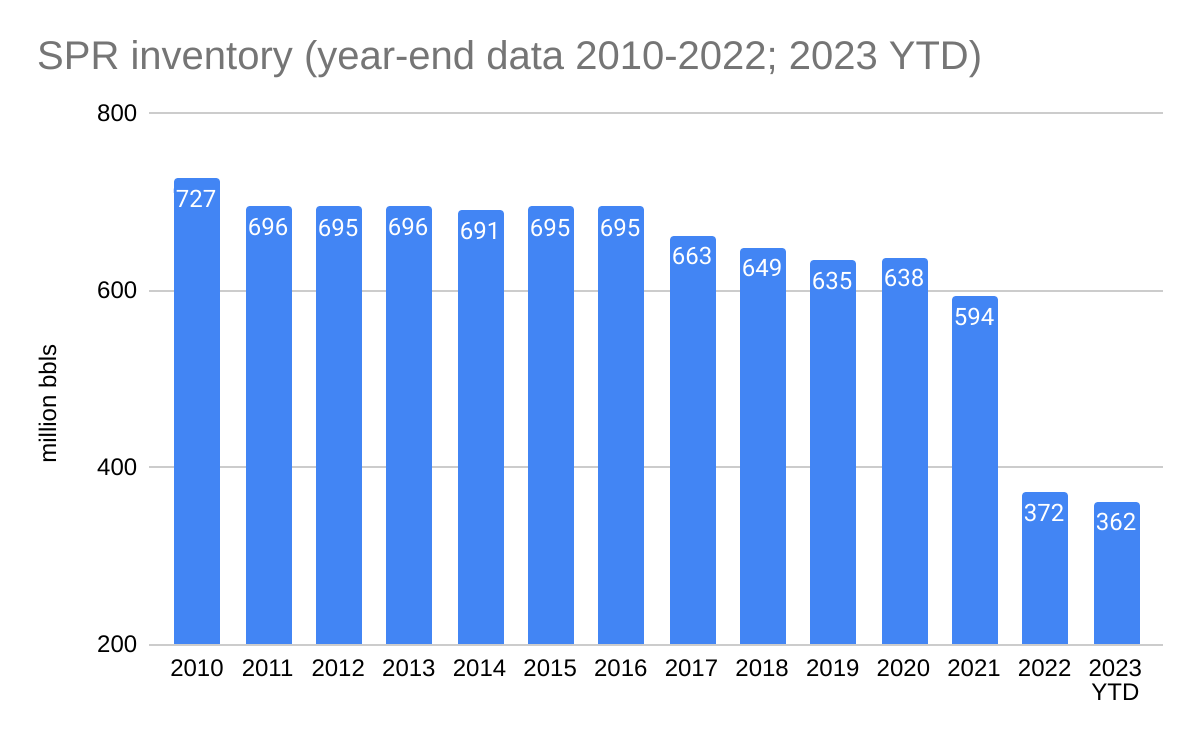
Per Bloomberg, DOE says they could begin refilling the reserve this fall “if the price is right.” What if it isn’t?

Keep in mind that the maximum refill rate is 685,000 bopd. A complete refill at the maximum rate would thus require 533 days, not counting acquisition, operational, and maintenance delays. Filling the reserve to its 727 million barrel capacity was a 28 year process.

Lastly, when will DOE conduct the strategic SPR review called for by the General Accountability Office (GAO) in 2018, well before DOE began rashly withdrawing oil to moderate prices? DOE concurred with GAO’s priority recommendation for periodic strategic reviews of the SPR that would be submitted to Congress. DOE told GAO that they “would complete a SPR Long-Term Strategic Review by the end of fiscal year 2021–5 years from the last review in 2016.” That review has still not been completed.

Update: Yesterday, members of Congress asked GAO to evaluate DOE’s management of the SPR and conduct an audit of the SPR modernization program.

Read Full Post »

Quite a bit per the GAO, and their report only deals with DOE management of demonstration projects. The Infrastructure Bill authorizes $2.5 billion for commercial projects (and much more for other CCS purposes).

DOE provided nearly $684 million to eight coal projects, resulting in one operational facility. Three projects were withdrawn—two prior to receiving funding—and one was built and entered operations, but halted operations in 2020 due to changing economic conditions. DOE terminated funding agreements with the other four projects prior to construction.

DOE provided approximately $438 million to three projects designed to capture and store carbon from industrial facilities, two of which were constructed and entered operations. The third project was withdrawn when the facility onto which the project was to be incorporated was canceled.

GAO

So DOE’s actual success ratio was 0.182 (2 for 11) – not very compelling.

With regard to proposals for offshore carbon sequestration, who will be liable for future cost overruns, operating losses, infrastructure failures including pipeline and well leaks, and decommissioning costs? Who ensures that there will never be any leakage from CO2 disposal reservoirs? Does all of this fall on the Federal government?

Corporations that want to engage in carbon sequestration for commercial or other purposes should fund the projects with their own revenues or fees charged to the companies whose emissions they are collecting. The Outer Continental Shelf is publicly owned and those wishing to dispose of substances should pay a usage fee, be responsible for all costs, and be liable for pollution and damages.

Read Full Post »

A recent Washington Post (WP) article, based in part on a March 2021 General Accountability Office (GAO) report, raises interesting pipeline decommissioning issues, but might benefit from some additional context, which I have attempted to provide below:

  • Decommissioning liability issues are not simply a matter of “companies trying to get out of that obligation.” Much of the complexity is associated with decades-long chains of lease ownership and the respective responsibilities of prior lessees. Pertinent questions include the following:
    • If a company sold a lease decades ago and there have since been multiple owners, to what extent is the original owner still liable for decommissioning lease facilities? (Note that guidance from the Federal government has not been entirely consistent over the decades.)
    • If current leaseholders fail to fulfill their obligations, who is next in line and why?
    • To what extent are prior lessees liable for wells and structures constructed subsequent to their ownership?
    • Knowing that decommissioning costs can vary significantly, what amounts of security should be required? How should these funds be protected or managed? Should an assigning company also collect funds to protect their interest?
    • How do inconsistent Federal policies and financial assurance requirements, and improper practices by subsequent owners, affect the liability of prior lessees? In that regard, the case of Platforms Hogan and Houchin in the Pacific OCS Region is interesting and pertinent.
  • Per the WP, “Federal regulations require the removal of offshore pipelines once they are decommissioned, but the rules are rarely enforced.” This statement is doubly incorrect.
    • 30 CFR § 250.1750 provides for decommissioning pipelines in place when the Regional Supervisor (BSEE) determines that the pipeline does not constitute a hazard (obstruction) to navigation and commercial fishing operations, unduly interfere with other uses of the OCS, or have adverse environmental effects. The consensus opinion of the regulators’ engineers and scientists has been that the safety and environmental risks associated with pipeline removal were significantly greater than those for decommissioning in place in accordance with the procedures specified in 250.1751.
    • The comment about enforcement is unfounded. BSEE and its predecessors have strictly enforced decommissioning requirements despite the challenges related to inconsistent policy direction, industry downturns, and hurricane damage. BSEE has an effective program to ensure that idle wells are plugged and platforms are removed in a timely manner. For this reason, 3315 platforms have been removed since 2001; 1933 since 2010. Only about 1800 platforms remain. This very significant loss of habitat is a concern to fishing organizations, another factor that complicates decommissioning policy.
  • In situ decommissioning of buried or trenched offshore pipelines is the standard throughout the world. The seafloor disturbance and safety risks associated with the removal of such pipelines are universally viewed as unwarranted. The pipeline decommissioning procedures followed elsewhere are similar to those described in 30 CFR 250.1751. In the Gulf of Mexico, pipelines installed in less that 200′ of water are typically buried (30 CFR 250.1003) to minimize interference with commercial fishing and other activities.
  • The decommissioning of wind turbines, which are typically more densely located and closer to shore, and their attendant power cables and substructures, will also be challenging. In their 9/16/2019 Congressional testimony, the Responsible Offshore Development Alliance expressed concern about the practice of leaving structural foundations when turbines are abandoned.

In remarks to the WP, Syed Khalil, a coastal restoration geologist for the State of Louisiana, commented that they have enough sand to meet their short term needs, but future needs were a major concern. The Gulf of Mexico Offshore Sand Management Working Group would seem to be the best mechanism for timely action and a workable, long-term action plan. The minutes of their meetings are quite instructive. Rulemaking is not a solution unless the parties want to tie their fate to both the 25 year pipeline rule rewrite (draft published in 2007, another draft coming? final?) and the contentious and similarly interminable financial assurance rule.

Read Full Post »

GAO’s report entitled “Opportunities to Reduce Potential Duplication in Government Programs, Save Tax Dollars, and Enhance Revenue” has just been released. The report identifies $billions in potential savings that could be realized by reducing program duplication.

Comments:

  1. Not only could taxpayer dollars be saved by reducing overlap and duplication, but greater efficiencies and safety benefits would be achieved.  As BOE has frequently noted, a single agency should be responsible and accountable for safety and pollution prevention at offshore facilities. For regulators, “overlap means underlap.” Important issues are sure to be overlooked, misunderstood, or confused. Jurisdictional redundancy inevitably results in unnecessary complexity, and regulatory and industry personnel are required to spend too much time resolving and coordinating administrative and procedural matters.  This time would be better spent focusing on mission critical safety issues.
  2. Much of the duplication among agencies is the result of the overlapping responsibilities of congressional committees, complex and poorly crafted legislation, and insufficient emphasis on function-based management.
  3. Program savings achieved by one government unit are immediately absorbed by another, discouraging cost-effective management practices. Senior and mid-level Federal managers should be able to transfer savings directly to a debt reduction fund that cannot be used for any other purpose. Federal managers should receive positive recognition for savings and efficiency, not criticism or immediate budget reductions.

Read Full Post »