This follows the directive from Energy Secretary Chris Wright on Friday.
However, quoting Nick Welsh of the Santa Barbara Independent: “With Sable Offshore, one thing’s for certain; there’s always more to come.”
This follows the directive from Energy Secretary Chris Wright on Friday.
However, quoting Nick Welsh of the Santa Barbara Independent: “With Sable Offshore, one thing’s for certain; there’s always more to come.”
Posted in California, energy policy, Offshore Energy - General, pipelines, Regulation, Uncategorized | Tagged Chris Wright, resumes production, Sable Offshore, Santa Ynez Unit | Leave a Comment »
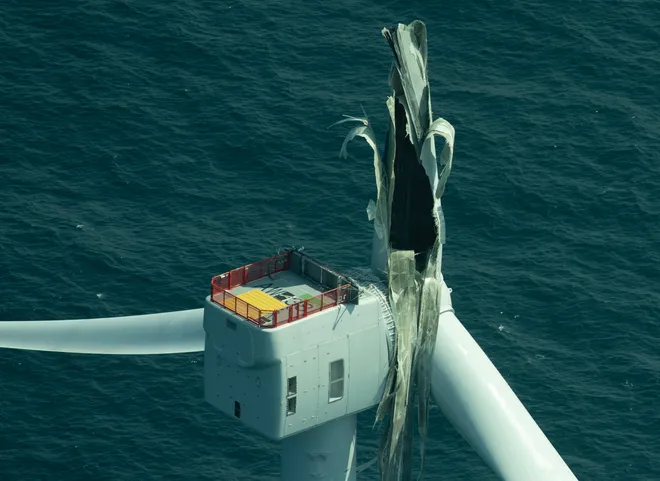
Vineyard Wind has finished installing turbine blades at their 62 turbine (186 blades) project. Yet the Federal investigation report on the July 2024 blade failure has still not been published. How is this acceptable?
The primary purpose of the independent investigation is to prevent recurrences at this or other projects in the US and worldwide. Available data suggest that blade failures are far too common.
Nearly two years have now elapsed since the Vineyard Wind blade failure. Important questions remain about the failure mechanisms, the manufacturing, testing, and quality control, a fabrication report waiver, the role of the CVA, debris recovery, and environmental impacts. Where is the investigation report?
Posted in accidents, energy policy, Offshore Wind, Regulation | Tagged blade failure, CVA, debris, installation, investigation report, last blade, quality control, Vineyard Wind | Leave a Comment »
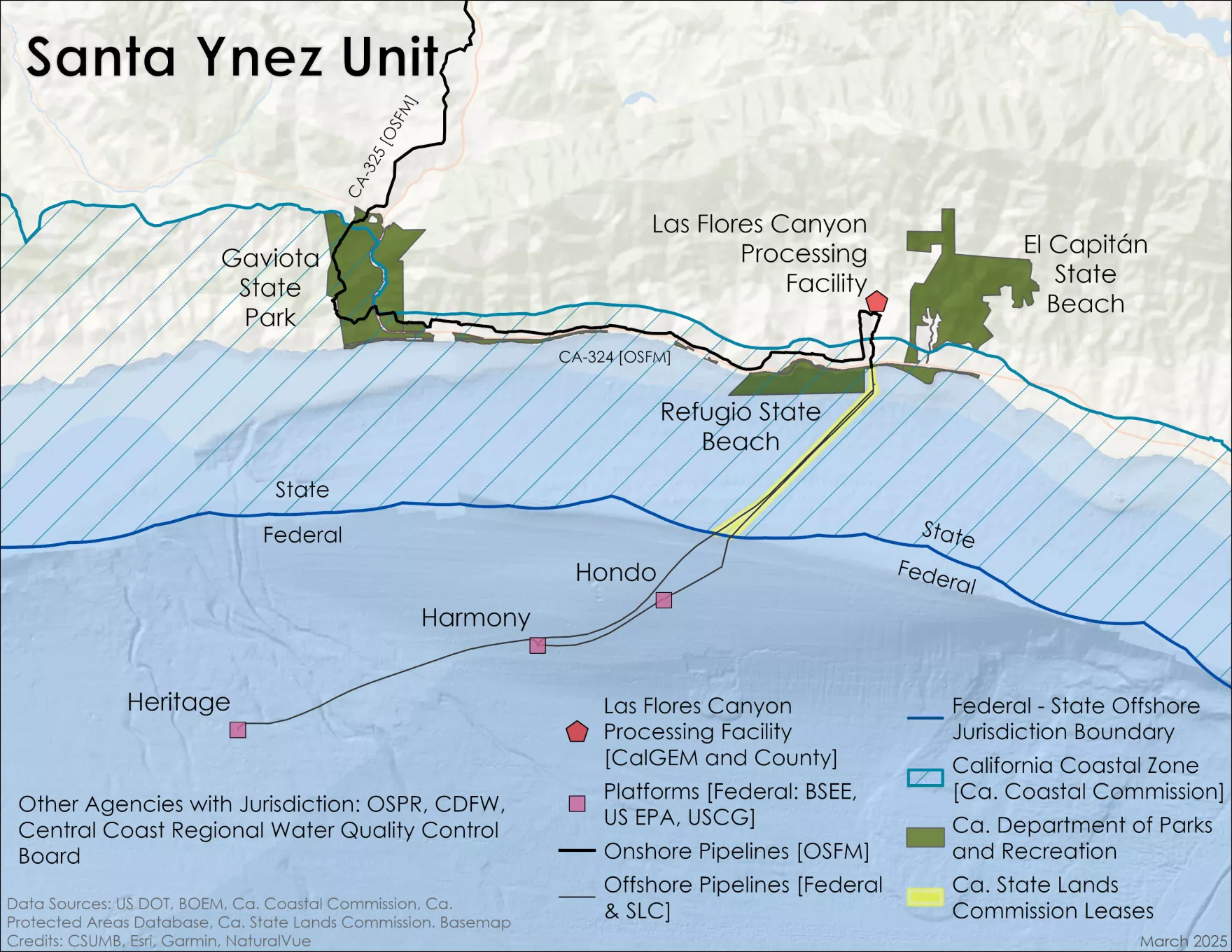
(Bloomberg) — The Trump administration on Friday took action to clear the way for oil production off the California coast in a bid to ease the global fuel pressures created by the war with Iran.
The announcement by Energy Secretary Chris Wright follows an executive order signed by President Donald Trump on Friday and directs Sable Offshore Corp., a Houston-based company, to begin restoring operations for the Santa Ynez Unit and Santa Ynez Pipeline System in California.
What about Judge Geck’s injunction and the case before the 9th Circuit? How are they affected by the EO and DOJ opinion?
Perhaps Four World Capital Management wasn’t crazy after all.
Posted in California, energy policy, Offshore Energy - General, pipelines, Regulation | Tagged Chris Wright, Executive Order, Judge Geck, NInth Circuit, restart production, Sable Offshore, Santa Ynez Unit | Leave a Comment »
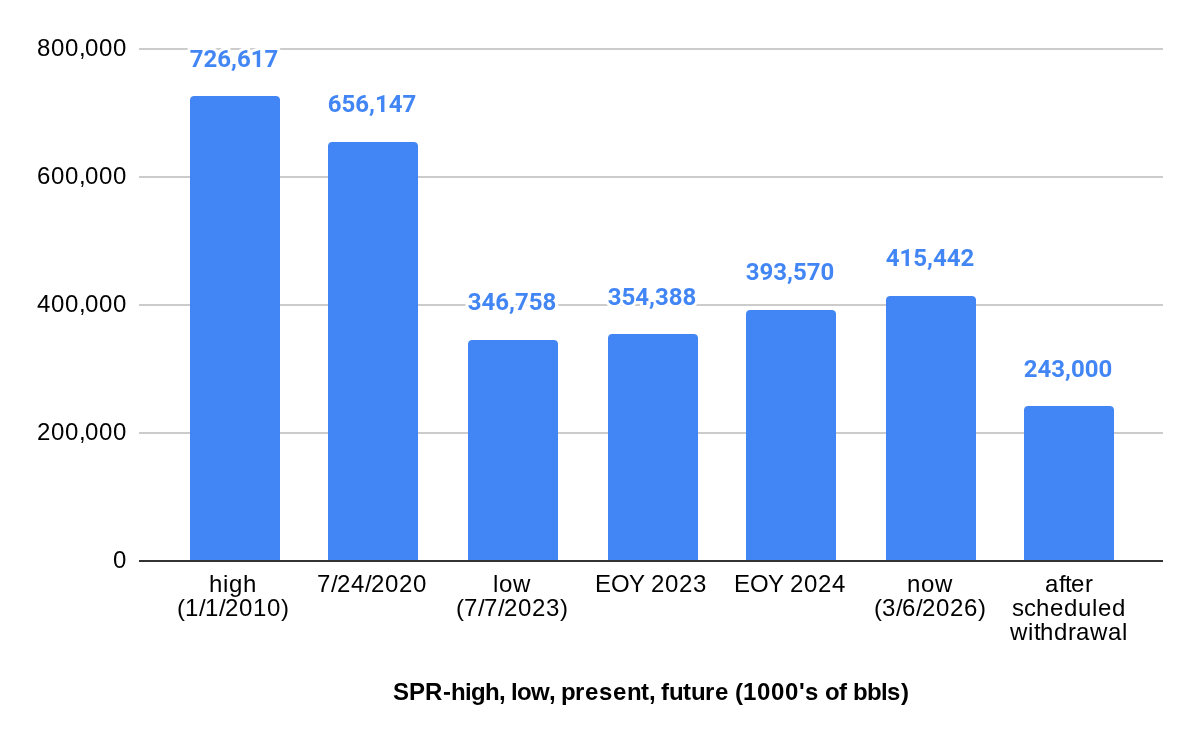
DOE (3/11/2026): “Earlier today, 32 member nations of the International Energy Agency unanimously agreed to President Trump’s request to lower energy prices with a coordinated release of 400 million barrels of oil and refined products from their respective reserves.
“As part of this effort, President Trump authorized the Department of Energy to release 172 million barrels from the Strategic Petroleum Reserve, beginning next week. This will take approximately 120 days to deliver based on planned discharge rates.
This will reduce the SPR to ~ 243 million bbls, 1/3 of capacity and the lowest level since it was initially filled in 2010. Market disturbances and national elections are too frequent to have confidence that the SPR will be refilled, even to the 500 million bbl level.
Meanwhile, the oil markets didn’t seem to be impressed by the announcement.

Posted in energy policy | Tagged 172 million barrel withdrawal, IEA, SPR, Strategic Petroleum Reserve | Leave a Comment »
Only 13 companies participated in the lease sale:
The No-Shows:
US supermajors once active in the Gulf that have become perennial No-Shows:
International majors with a Gulf presence:
Typically active independents
Why was the participation so poor?
It would be helpful to hear from some of the companies that chose not to participate.
Posted in energy policy, Gulf of Mexico, Offshore Energy - General | Tagged BBG2, low participants, no-shows, OCS lease sale, poor results | Leave a Comment »

Although no one was expecting a barnburner only 3 months after the previous sale, BBG2 was historically weak for a Gulf-wide sale. The table below compares BBG2 with the previous 4 Gulf sales, none of which were particularly impressive.
However, the sale was not without highlights. There was some spirited bidding for tracts in the Green Canyon area. BP’s bid was the highest of 5 for GC Block 404. BP bid $21 million for the block, 45% of the high bids sum for the entire sale. The BP bid was also $20 million higher than the next highest bid for that tract (ouch!).
Also interesting was Chevron edging Shell $5,887,188.00 to $5,501,240.00 to acquire GC Block 492.
| Sale No. | 257 | 259 | 261 | BBG1 | BBG2 |
| date | 11/17/2021 | 3/29/2023 | 12/20/2023 | 12/10/2025 | 3/11/2026 |
| companies participating | 33 | 32 | 26 | 30 | 13 |
| total bids | 2233 | 2842 | 3161 | 219 | 38 |
| tracts receiving bids | 2143 | 2442 | 2751 | 181 | 25 |
| sum of all bids $millions | 198.5 | 309.8 | 441.9 | 371.9 | 69.9 |
| sum of high bids ($millions) | 101.7 | 263.8 | 382.2 | 279.4 | 47.0 |
| highest bid company block | $10,001,252 Anadarko AC 259 | $15,911,947 Chevron KC 96 | $25,500,085 Anadarko MC 389 | $18,592,086 Chevron KC 25 | $21,009,990 bp GC 404 |
| most high bids company sum ($millions) | 46 bp 29.0 | 75 Chevron 108.0 | 65 Shell 69.0 | 50 bp 61.0 | 6 Anadarko (Oxy) 4.0 |
| sum of high bids ($millions) company | 47.1 Chevron | 108 Chevron | 88.3 Hess | 61.0 bp | 22.6 bp |
| most high bids by independent | 14-DG Expl. | 13-Beacon 13-Red Willow | 22-Red Willow | 14-Murphy | 5-LLOG |
For historical comparison purposes, Gulf Sale 206 drew $3.7 billion ($5.6 billion in today’s dollars) in 2008. Twenty-siz sales between 1972 and 2013 garnered more than $1 billion in high bids.
Posted in energy policy, Gulf of Mexico, Offshore Energy - General | Tagged BBG2, bp, Chevron, Gulf of America, historically weak, lease sale, Shell | Leave a Comment »
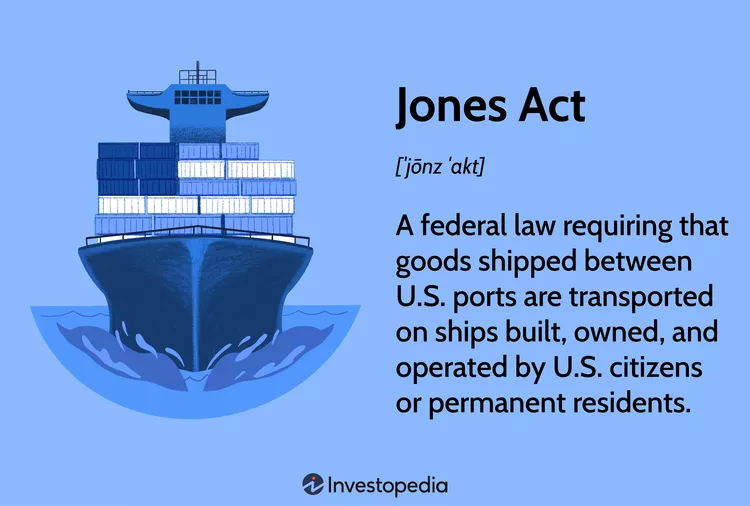
Sen. Mike Lee has introduced legislation to repeal the Jones Act, which is drawing additional scrutiny for the increased cost of transporting US oil production and LNG to US ports.
Because facilities on the Outer Continental Shelf are US ports under the Jones Act, the Act has been problematic for both the offshore oil and wind industries. The attached Customs and Border Patrol document delves into the nuances of Jones Act compliance for lifting operations (p.14-15) and “points” on the OCS (p.17).
EXAMPLE: CBP interprets the OCSLA to extend the Jones Act to artificial islands and similar structures, as well as to mobile oil drilling rigs, drilling platforms, and other devices attached to the seabed of the OCS for the purpose of resource extraction and/or exploration operations. Such objects located on the OCS are considered points or places in the United States for purposes of the Jones Act. Similarly, floating warehouse vessels, when anchored on the OCS to supply drilling rigs on the OCS, are also coastwise points.
Check out this complex CBP ruling on the transportation of well fluids from one location in a subsea well cluster to another. See if you understand and agree with their conclusion (below).
The transportation of fluids as described in the FACTS section above, by a dynamically-positioned, foreign-flagged drill ship between wells located within an IF (integrated facility), which subsequently, transships the fluids to a coastwise qualified barge for transportation to a coastwise point, violates 46 U.S.C. § 55102.
On a related matter, it’s still unclear to me whether the attachment of the lower marine riser package to a subsea wellhead makes a floating, dynamically positioned drillship a US port under the Jones Act.
Posted in energy policy, Offshore Energy - General, Regulation | Tagged CBP, Jones Act, OCS facilities, offshore drilling, Offshore Wind, oil production, repeal, Senator Mike Lee | Leave a Comment »
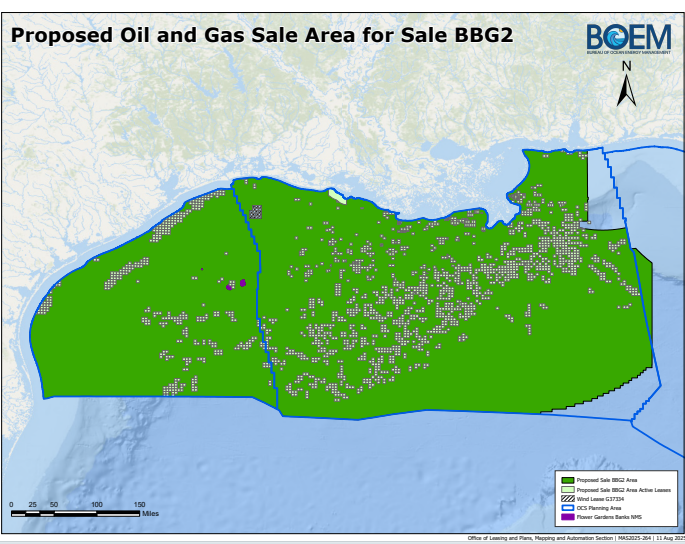
Gulf of America oil and gas lease sale BBG2 will be held tomorrow. The Notice of Sale is attached.
Although Big Beautiful Gulf 1 (BBG1) was rather lackluster, BBG 2 is unlikely to match it in terms of the number of bids and their sum. Prior to BBG1, there had been no lease sale for two years. BBG 2 is being held only 3 months later.
Given the short duration between sales, the bid evaluations for BBG1 are not yet completed. However, the sale notice advises that any block which received a bid in BBG1 is excluded from BBG2.
Will the recent increase in oil prices influence bidding? Probably not given the longer term nature of offshore development and expectations that the current price spike will be of short duration. Onshore shale oil production is more responsive to price fluctuations.
Posted in energy policy, Gulf of Mexico, Offshore Energy - General | Tagged BBG1, BBG2, bids, expectations, lease sale, oil and gas | Leave a Comment »



On February 27, 2026, we lost a long-time pillar of the OCS safety program, the foremost authority on California offshore oil and gas operations, and a wonderful friend and colleague.
Glenn Shackell grew up in Hawthorne, California, where he lived most of his life. He attended Hawthorne High with the Beach Boys!
Glenn served as a helicopter door gunner during the Vietnam War, an extremely hazardous assignment. According to historical accounts, the average life expectancy of a door gunner was two weeks. Think about that! (See the door gunner video embedded below.)
Glenn discussed his Vietnam experience with Minerals Management Service (MMS) colleague Andrew Konczvald:
“Glenn told me about encounters when the bullets were hitting the bottom of his Huey helicopter, and he was sitting on his personal armored jacket as the only protection against the bullets! He told me how he prayed every night and miraculously escaped wounds and returned home safely.”
Thankfully, Glenn survived and returned to earn a Petroleum Engineering degree from the Univ. of Southern California. He was a proud USC Trojan.
Glenn had an outstanding career in our Pacific Region office, starting in the early days when the OCS regulatory program was part of the US Geological Survey. He assessed and monitored drilling and production operations in the region, which once produced 120,000 bopd from 23 platforms, and had up to 9 mobile drilling units operating concurrently. Floating drilling operations were pioneered offshore California with the CUSS 1, and production was extended to 1200 feet of water at Platform Harmony.
Glenn had an encyclopedic knowledge of the California offshore sector, and was an expert on the history of the applicable regulations, orders, and standards. We had countless discussions about topics like OCS Order No. 2 (Drilling) and the evolution of API RP 14C (Production Safety Systems).
Glenn served on numerous MMS teams that evaluated the latest technical innovations of the offshore industry, established research priorities, and assessed safety and environmental performance. He was an authority on drilling safety and was called on to evaluate and accredit well control training programs.
Glenn respected everyone, and everyone admired and respected him. He was a man of faith, but didn’t impose his beliefs on others. Fittingly, his favorite Bible passage was John 11:25-26: Jesus tells Martha, “I am the resurrection and the life. The one who believes in me will live, even though they die; and whoever lives by believing in me will never die.”
RIP Glenn, you continue to inspire your friends, and your important contributions to society live on. We love you man!
The HORRORS of Door Gunners in Vietnam:
Posted in California, Offshore Energy - General, Regulation, Uncategorized | Tagged California, Glenn Shackell, Minerals Management Service, offshore safety, RIP, USGS | 2 Comments »
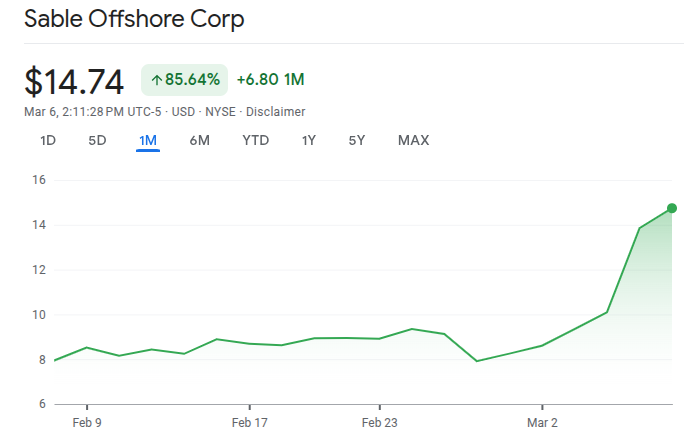
Big move by SOC following the issuance of the DOJ opinion. Justified optimism or irrational exuberance?
Posted in California, energy policy, Offshore Energy - General, pipelines, Regulation, Uncategorized | Tagged Dept. of Justice, irrational exuberance, legal opinion, Sable Offshore, Santa Ynez Unit | Leave a Comment »

