Feeds:
Posts
Comments

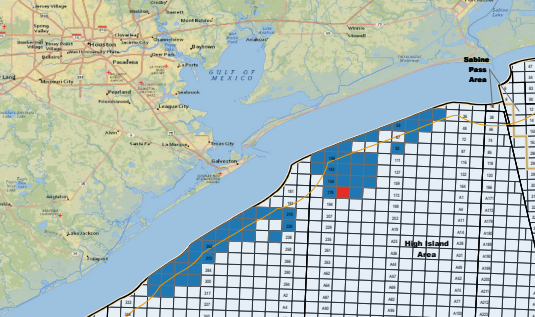
In addition to the 94 nearshore Texas leases Exxon acquired in Sale 257, the company was the sole Sale 259 bidder for all but one of 69 nearshore Texas blocks. The exception was High Island 177 (in red above). So who gets that lease?

  • the company (Exxon) that was the sole participant in a de facto CCS sale (bid of $182,750)
  • the company (Focus Exploration) that was participating in the announced oil and gas lease sale (bid of $145,177)

If Exxon is just acquiring these leases for evaluation purposes in preparation for a possible CCS sale in the future, their lease acquisitions may be okay. If they are planning on retaining these leases for actual sequestration operations, that is not okay, at least not until a competitive process has been established for awarding or reclassifying such leases. To date, no lease terms or bid evaluation procedures have been proposed for carbon sequestration leases; nor has an environmental review been conducted pursuant to NEPA.

Questions about Gulf of Mexico carbon sequestration

Jennifer Granholm

Energy Secretary Jennifer Granholm last month said it would be difficult for the U.S. to take advantage of low oil prices to replenish the Strategic Petroleum Reserve because of maintenance at two of the four sites.

The Financial Times reported, citing people familiar with Saudi Arabia’s thinking, that Riyadh was “irritated” by that comment. In any case, it came on top of stress in the financial sector that had dragged oil prices as low as $64 in March.

Market Watch

As previously posted, the SPR is easier to drain than fill. The reserve is still flat-lined at 371.6 million barrels or about half full.

In the past 2 years, at least 12 workers died suddenly at Gulf of Mexico facilities from “natural causes.” BSEE’s recent medical evacuation presentation provided information on 6 non-operational fatalities that occurred in 2022:

7/28: Employee (galley hand) was found in the bathroom non‐responsive with minimal electrical activity indicated on the EKG.

8/2 Advised of person down in the galley/T.V. area. Upon arrival in the area observed person on the floor being held by his supervisor. A white foam was coming out of his mouth and nose. Placed him on his side in order for the foam to drain. He was breathing and had a faint pulse. It was observed that he then appeared to stop breathing. Unable to find a radial or carotid pulse. CPR was started and AED was retrieved. AED instructions were followed. A shock was administered and CPR continued for approximately 50 minutes with no pulse or response.

8/18: Contract Personnel (CP) complained of not feeling well and went to his assigned room. It was noticed that CP did not come down for lunch and other personnel went to check on CP and CP was unresponsive.

9/7: CI was in galley of the M/V GO Triumph, waiting on weather, with co‐workers, when he made an exclamation and collapsed to the floor. Co‐workers and contract safety technician immediately ran to his aid. Breathing was sporadic for a minute then ceased and he was unresponsive.

9/23: At approximately 8:20 AM on September 23rd, platform personnel discovered an unresponsive employee (IP) face down on the deck. IP was rolled onto his back, evaluated, and CPR began. Other personnel were dispatched to retrieve AED and medical supplies, while one went to make notifications. Shortly after, personnel arrived with the AED, and it was applied to the IP. Personnel continued CPR while waiting for medical evacuation helicopter. At approximately 12:00 PM, IP was removed from facility by medical evacuation helicopter and subsequently, formally, pronounced dead.

10/21: Employee was assisting production personnel fueling the crane when he suddenly collapsed onto the platform deck and became unresponsive. Personnel on the platform quickly responded and immediately applied an AED to the Employee and began CPR. A medivac aircraft was dispatched for medical support assistance while platform personnel continued to resuscitate the
employee. Medivac personnel arrived on location and relieved personnel working on employee. Following an unsuccessful attempt to revive the employee, he was transported to Houma, La. and released to the Terrebonne Parish Coroner’s Office. Workers on the platform stated the employee was acting normal during breakfast time and during the morning safety meeting. The employee did not complain of any type of illness during the morning time prior to the event occurring.

Why are screened and presumably healthy offshore workers dying suddenly at what seems to be a historically high rate? Is this happening elsewhere in the offshore world? Is anyone investigating this disturbing trend? if not, why not?

As suggested in a previous post, further investigation should be a high priority for the Coast Guard and BSEE with appropriate medical assistance.

Rigs-to-Radar!

A new addition to our Rigs-to-Reefs+++ page courtesy of MaritimePhoto.

“Blue Marlin” – sea based X-Band radar on board a heavy lift and transport vessel
Photo: U.S. Navy / Journalist 2nd Class Ryan C. McGinley

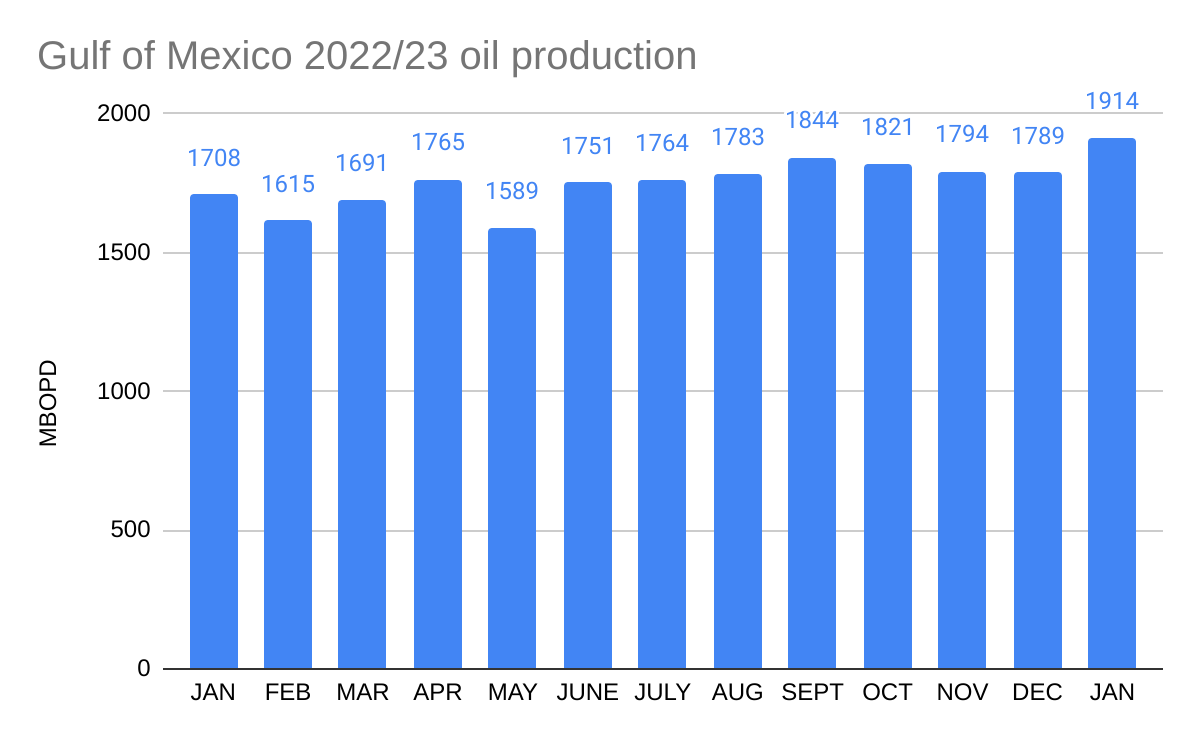
The encouraging start to 2023 GoM production is likely due, at least in part, to Shell’s Vito and Murphy’s King’s Quay ramping up production. Other deepwater startups should boost production later this year.

EIA data

companyno. of Sale 259 high bids
(Sale 257 in parentheses)
total Sale 259 high bids
($ millions)
Chevron75 (34)108
BP37 (46)46.7
Shell21 (20)20.1
Equinor16 (1)18.3
Beacon13 (4)9.0
Anadarko (Oxy)13 (30)8.6
Red Willow13 (5)3.8
Hess12 (2)8.3
Woodside12 (8)6.3
Houston Energy8 (5)11.6
from BOEM data

As anticipated, the increase in royalty and rental rates appears to have further weakened interest in leases in the shallow waters of the Gulf of Mexico continental shelf. Note the sharp declines in both the number of blocks receiving bids and the bid amounts.

lease saleblocks with bids
(excluding CCS bids)
sum of high bids
($million, excluding CCS bids)
25746$8.1
25929$4.1
  • 313 blocks receiving bids
  • 353 bids
  • 32 companies submitting bids
  • High bids totaled $263.8 million

Exxon doubled down on their strategic CCS bidding; their only bids (69 in total) again appeared to be solely for carbon sequestration purposes. As previously noted, acquiring tracts for CCS purposes is not authorized in an oil and gas sale. Arguably, these bids should be rejected.

The other super-majors, BP, Chevron, and Shell, were active participants as were many independents.

It was good to see BOEM Director Liz Klein announcing bids. This shows respect for the OCS oil and gas program.

It was also good to hear that Red Willow, a native American corporation, was again an active participant.

More to follow.

15 years ago the Minerals Management Service pushed hard for better offshore medevac capabilities. Harlan King, the father of an offshore worker whose injuries were exacerbated by the delayed medical response, was the main impetus behind this effort. The industry responded favorably and Mr. King, BP, and Petroleum Helicopters Inc received Offshore Leadership Awards in 2009 for their initiatives. This 2009 article describes PHI’s dedicated medevac capabilities at the time.

The number of “non-occupational” fatalities (at least 6) at US OCS facilities in 2021 suggests that medical care and evacuation capabilities are once again a concern. BSEE is therefore applauded for their medical evacuation assessment initiative. Their recent presentation is attached.

BSEE’s presentation describes 6 more “non-operational” fatalities in 2022, and raises concerns about CPR training deficiencies, evacuation challenges posed by stairways, and the absence of medics at some facilities. BSEE’s findings (pages 14-21 of the presentation) are eye-opening and merit the attention of all operators, contractors, and others interested in offshore facility safety.

While historical data on health-related OCS fatalities are not readily available, 12 such fatalities over the past 2 years seems high relative to past experience, particularly given that the total number of hours worked has declined by more than 50% since 2011. As suggested in our 2 February post, further investigation into this disturbing trend is warranted. Given the sensitivity of the topic, it would seem best for the Coast Guard and BSEE, with appropriate medical assistance, to conduct this review.