Feeds:
Posts
Comments

Archive for the ‘Regulation’ Category

This excerpt from a University of Michigan article describes the engineer’s paradox:

For engineers, failure and risk have a special relationship. If they don’t take risks they never do anything new. But if they do take risks, their probability of failing increases. So engineers must welcome risk and the opportunity to learn from failure, but they must make every effort to succeed. This leaves engineers in the odd predicament of becoming less informed as they become more successful. In that light, bad judgment could be an invaluable but potentially lethal experience. Conversely, evidence shows that experience fosters good judgment – the longer people do something, the more likely they are to make decisions, and in making them they’ll acquire not just an appreciation for the difficulty of rendering good judgments but the skill to do it well.

Comments:

  1. Society is dependent on engineers taking risks. These risks can be managed, but not totally eliminated.
  2. The oil and gas that are produced offshore support economic development and technological advances that make our lives safer and cleaner.
  3. Importing energy transfers some risk to other locations, but does not reduce (and may actually increase) the overall risk associated with energy consumption.
  4. Experience matters. Optimal corporate and governmental risk management regimes emphasize the role of experts in making project-specific and programmatic decisions, and promote industry-government communication among specialists. Experience is not a conflict of interest!
Read Full Post »

Like the National Commission on the BP Deepwater Horizon Oil Spill and Offshore Drilling, the Montara Commission of Inquiry, the Norwegian government, and leading safety and regulatory authorities around the world, the IADC recognizes the risks associated with complex, multi-agency regulatory regimes. A single authority should be responsible and accountable for safety and pollution prevention at offshore facilities, and should draw on the expertise of other agencies and organizations as necessary to achieve performance objectives. 

The safety and environmental  risks associated with fragmented or compartmentalized regulation include gaps, overlap, confusion, inconsistencies, and conflicting standards. Industry and governmental personnel spend too much time coordinating with multiple parties and not enough time managing safety and environmental risks.

Link to IADC comments.  Key quotes:

IADC continues to be concerned by seemingly duplicative regulatory requirements imposed by the Coast Guard and BOEMRE, particularly where the agencies appear to have divergent views regarding the placement of regulatory responsibility.

One cannot holistically address safety when faced with the unyielding and overlapping demands of multiple narrowly-focused regulatory agencies.

Read Full Post »

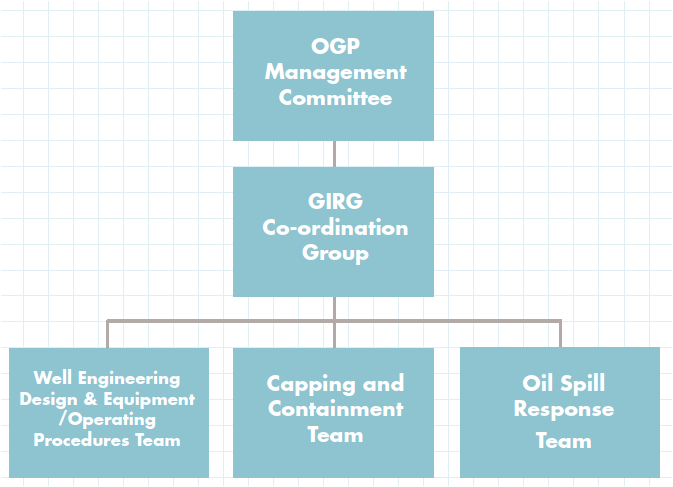
Today, the International Oil and Gas Producers (OGP) released the Global Industry Response Group (GIRG) reports.  GIRG was formed last July with the goal of better managing offshore safety risks. The organizational structure is illustrated below.

Deepwater Wells: Lessons and Recommendations focuses on the critical prevention programs, and is perhaps the most important of the GIRG reports. Since Macondo, the GIRG team and other industry committees have worked diligently on well planning and integrity issues, and are commended for their outstanding efforts. However, the recommendations presented in the GIRG report are surprisingly modest, and do not reflect the technological and management innovation that industry has demonstrated in pioneering offshore development.  The recommendations fail to break new ground, lack specifics, and, in some cases, appear to be a step backward. In short, the oil and gas industry is capable of much more.  Initial comments follow:

  • Incident data (problem): The absence of comprehensive and verified incident data is one of the “systemic” industry weaknesses identified by the National Commission. OGP has tried to address this problem for years, but has not had the industry-wide support needed to develop a credible program. GIRG has wisely recommended a Wells Expert Committee (WEC) to review selected incident data. However, the recommended program suffers from the same weaknesses that constrain existing OGP reporting programs. OGP must rely on “encouraging” its members to participate voluntarily, and non-members are not included. This type of voluntary program was not good enough before Macondo/Montara, and is certainly not good enough now.
  • Incident data (solution): Industry and regulators need an ironclad commitment that all operating companies will submit incident data in accordance with defined protocols. Contractor data must be included. Companies should execute binding agreements with OGP, or some other entity, to provide this information. The data must be managed by a completely independent entity that cannot, in any way, be directed by an industry advocacy group. Regulators and other independent representatives should be included on the management committee. Regulators should prohibit companies that don’t agree to submit these data from from operating within their jurisdictions. A comprehensive incident reporting and data management system is long overdue, and continued delays are not acceptable.
  • Montara: While GIRG is supposedly in response to both Macondo and Montara, the latter seems to have been largely ignored. The deepwater theme does not apply to the Montara platform, which was in only 80m of water. Despite the post-Macondo focus on water depth, shallow water was arguably a more significant contributing factor to the Montara blowout (batched completions using a cantilevered jackup, mudline suspensions, and two-stage platform installation) than deep water was at Macondo. Also, well capping, which was feasible and ultimately successful at Macondo, could not even be attempted at Macondo because of the manner in which these platform wells were suspended. Finally, GIRG  ignores the special gas migration and kick detection issues associated with horizontal completions like Montara, and the relief well rig availability and release issues that were never fully addressed during the Montara inquiry.
  • Emergency worldwide notification system: In conjunction with the incident reporting system, industry needs an emergency notification procedure that goes beyond safety alerts and requires the immediate attention of every operator and wells contractor. During the Montara inquiry, worldwide attention should have been drawn to the inability of the Montara operator to identify a hydrocarbons influx through the shoe track and into the production casing. Could an effective notification system have prevented Macondo? No one can say for sure, but the probability of a blowout at Macondo would have been greatly reduced if key BP and Transocean personnel had participated in discussions about Montara and the importance of proper negative pressure tests.
  • Dependence on regulator: On page 21 of the report, GIRG recommends that a company “carry out a more extensive programme of self-audit” when there is a lack of competent regulatory oversight. An operator should never depend on the regulator to verify its well or management programs, and should never relax its programs regardless of the level of regulation. Detailed regulatory reviews of specific drilling or management programs are never a substitute for operator diligence. Did the operators at Montara and Macondo rely on the regulator to protect them from themselves? Read the official investigation reports and make your own judgement.
  • Best practices: GIRG recommends “refraining from using the term ‘best industry practice’ until this definition is clarified; we prefer ‘good oilfield practice’ for the time being.”  Isn’t the clarification of best practices the role of groups such as this and industry standards committees? This attitude explains some of the technical recommendations in this report which may be “good oilfield practices,” but fail to raise the bar for safety achievement. Would you be satisfied with “good” if  family members were working on rigs or if operations were conducted off your coast? While “best practices” vary depending on the conditions and circumstances, it’s industry’s responsibility to identify those practices, and industry and regulators must set the bar high and keep raising it.
  • GIRG recommends established practices: Some of the GIRG recommendations, such as the “two-barrier” policy have been standard practice for most operators for years.
  • API RP 75: There are numerous endorsements of RP 75 as an important reference for management systems covering the design of wells and other activities.  RP 75 was a reaction to an MMS regulatory initiative 20-years ago to impose safety management requirements on offshore operators. BP, Transocean, and PTTEP had management systems that were generally consistent with the guidance in RP 75. GIRG needs to go beyond RP 75 and focus on improvements that will make safety management systems more effective.
  • API Bulletin 97, Well Construction Interface Document (WCID): Despite the complete absence of public attention, this is perhaps the most important post-Macondo initiative. It’s thus particularly disappointing that this document is now five months late. How does GIRG recommend the use of a document that is not complete and has not yet (to the best of my knowledge) even entered the balloting process? Another recommended and highly important document, updated RP 96 – Deepwater Well Design, has also yet to be finalized.
  • BOP recommendations: Nothing new or innovative is offered by GIRG. The report calls for 2 shear rams, but only one need have sealing capability, which means that the Deepwater Horizon stack met the GIRG specification. While many BOP advances require additional study, some (such as real-time function and pressure monitoring systems) already exist. Other GIRG technology recommendations are rather timid and generally in the form of suggestions for future study (e.g. study cement bond log technology).
  • Training: This section of the report is good, but doesn’t address deficiencies identified in the Montara inquiry and reviews of historical blowout data. Montara and other accidents have demonstrated that senior rig personnel may have limited understanding about well planning and construction practices. These topics are not covered in well control training programs. How does industry plan to address this major deficiency? While well planning is the responsibility of the operator (often a separate group than is represented on the rig), well control decisionmaking requires a fundamental understanding of well construction practices.  Also evident in the Montara testimony was the total absence of understanding on the part of operator, drilling contractor, and cementing personnel about the historical causes of blowouts. The cementers at Montara were unaware that gas migration/influxes during cementing operations were a leading cause of blowouts. Training programs need to be expanded to provide for the discussion of past accidents and how they could have been prevented.


Read Full Post »

The U.S. House of Representatives has voted to impose deadlines on the Obama administration to issue offshore drilling permits, as Republicans renew calls for greater amounts of domestic oil production amid rising gasoline prices. Dow Jones

Don’t you have to decide how you are going to regulate before setting deadlines? Now that the House has spoken and the bill is likely to die in the Senate, can we engage in a substantive discussion about how to regulate most effectively and efficiently? Congressional hearings?

Read Full Post »

U.S. District Judge Martin Feldman in New Orleans today ordered offshore energy regulators to act within 30 days on six pending permit applications filed by companies that have contracts with Ensco Offshore Co., the Louisiana drilling company leading the legal challenge to the government’s offshore drilling bans. Bloomberg

Read Full Post »

The HSE has told Shell to submit a revised safety case for the Brent Charlie platform after gas was detected on its topsides following leaks on 12 January this year and 27 September 2010, Upstream can reveal.

Shell, which took the decision itself to close the platform after the January incident, has been battling for some time to resolve technically complex issues related to the venting of gas from inside one the platform’s huge concrete legs — Column 1 (C1) — and dispersing it effectively away from the platform.

The operator now expects the ageing Brent field to remain shut down for several more months.

Read Full Post »

Surprisingly, the post-Macondo discussion about regulatory approaches has been largely devoid of value and cost-benefit assessments. While PSA has been praised for Norway’s outstanding offshore safety record, little attention has been paid to their relatively low regulatory costs.

According to data in the 2010 Annual Report, PSA has 161 employees, and had total operating expenses of NOK 202,762,689  ($US 38.1 million) for 2010. These modest cost and staffing numbers are particularly impressive when the magnitude and complexity of Norwegian offshore operations are considered. In March 2011, Norwegian oil production averaged 2.017 million barrels per day (no. 2 offshore oil producer slightly behind Brazil) and gas production averaged 11.6 billion cubic feet per day (world offshore leader). PSA is also responsible for onshore processing facilities.

PSA’s costs are relatively modest for the same reason that their regulatory program is successful. They hold companies responsible for managing their operations and conducting inspections. They don’t approve every detail of every operation, but focus on ensuring that the company management systems are effectively implemented.  They identify risks and insist that industry address them. As Magne Ognedal said in his interview with BOE: 

Our regulatory philosophy is indeed firmly based on the legislated expectation that those who conduct petroleum activities are responsible for complying with the requirements of our acts and regulations. Furthermore, our regulations require that they employ a management system that systematically probes and ensures such compliance at any time.  The approach to achieving this should be risk-based.  So, ensuring compliance with rules and regulations is the operator’s job – not ours.

Read Full Post »

Jan de Jong, Inspector General, State Supervision of Mines, the Netherlands

I want to thank Jan de Jong, Inspector General, State Supervision of Mines (SSM), the Netherlands, for the support he expressed for the former Minerals Management Service at yesterday’s Ministerial Forum in Washington. Jan spoke favorably about his experiences with MMS personnel and questioned the public criticism.

Last year, SSM celebrated its 200th anniversary. I encourage you to view an excellent anniversary video about this very effective regulator. Pay special attention to the description of their regulatory philosophy, which begins at about the 6 minute mark.

Read Full Post »

When an investigation has been completed and corrective action is necessary, the PSA (Norway) approach is to make the operator take ownership of the problem. The operator is directed to develop solutions and implementation schedules that are acceptable to the regulator. See the PSA directive to Statoil below following the investigation of the Gullfaks B gas release.

In contrast, there is a tendency in the US for the regulator to take ownership of the problem and thus assume responsibility for developing solutions. The regulator dictates these solutions to the operator (and perhaps the entire industry), sometimes without sufficient discussion or analysis. Of course, US regulators may not have a choice in the matter as the political system often demands that the regulator take action, perhaps before the investigation is even completed (or started!).

Which approach presents the greater opportunity for success? Most regulators would say the former, and that was the consensus view at the International Regulators’ Offshore Safety Conference in Vancouver.


Read Full Post »

Rep. Tim Murphy’s (R-Pa.) bill states that companies with drilling permits approved before early May 2010 can proceed with exploration or production “without further review” by the Interior Department, and “without further review or delay” under various environmental laws. The Hill.com

Read Full Post »

« Newer Posts - Older Posts »