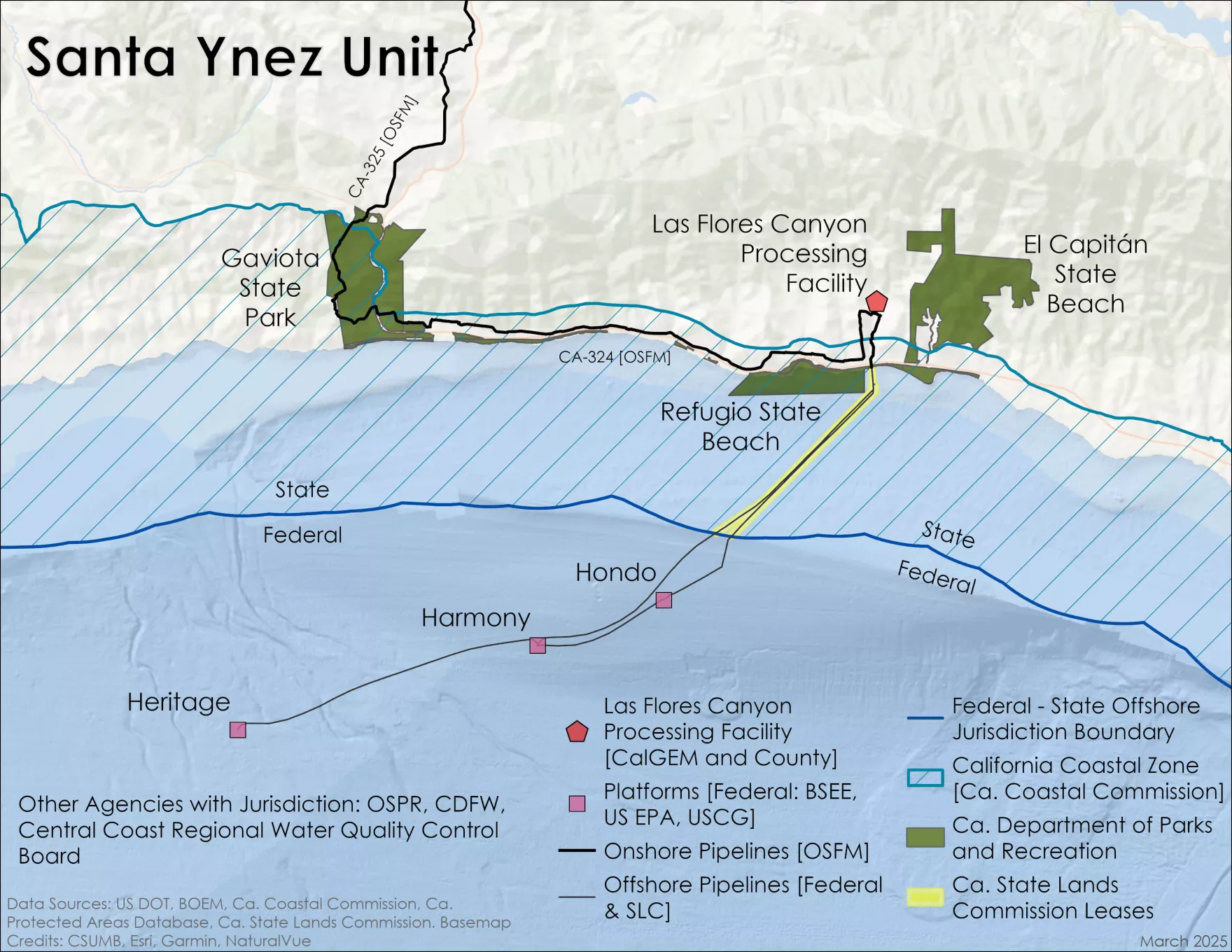
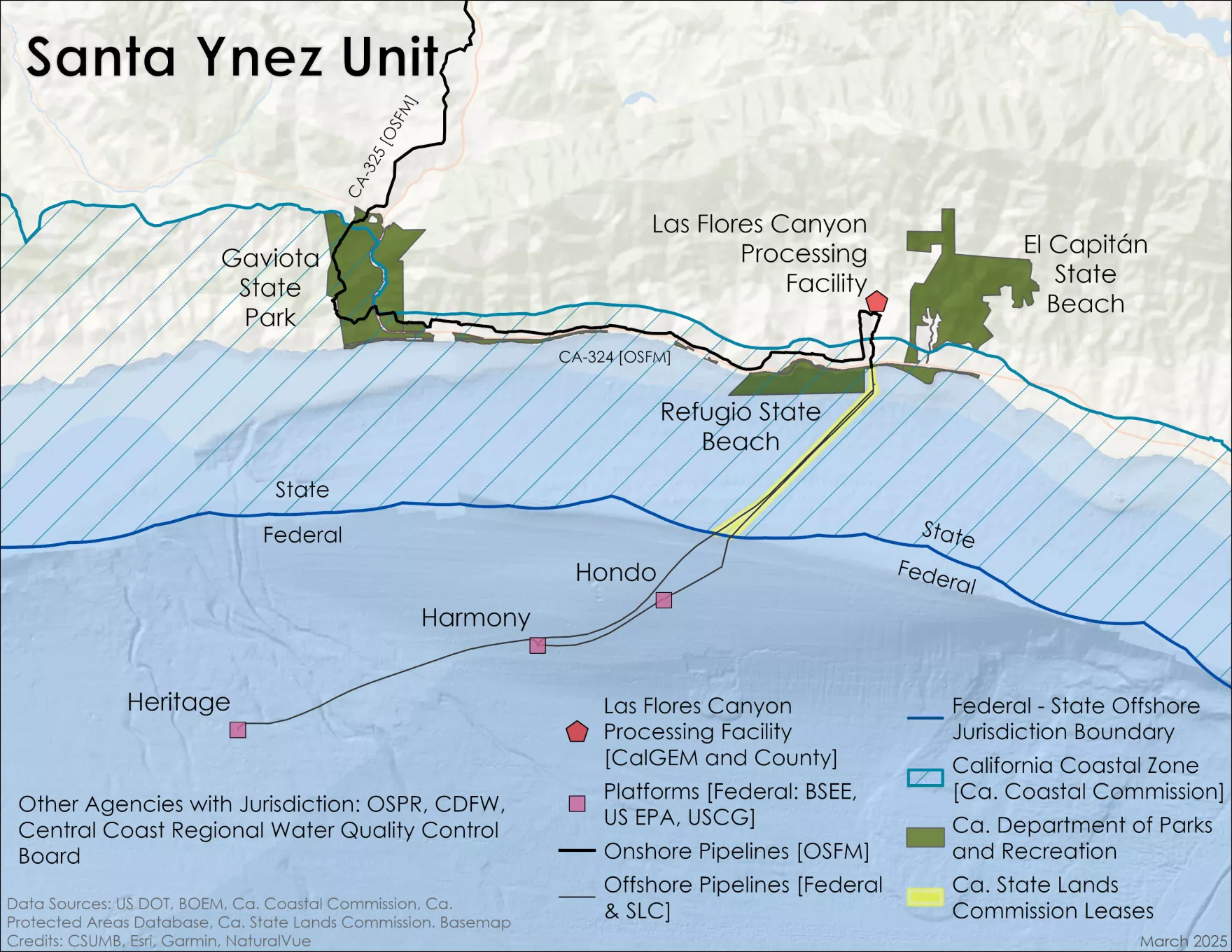
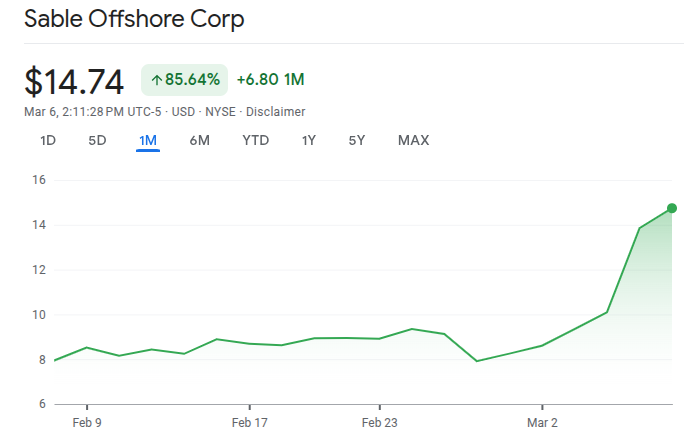
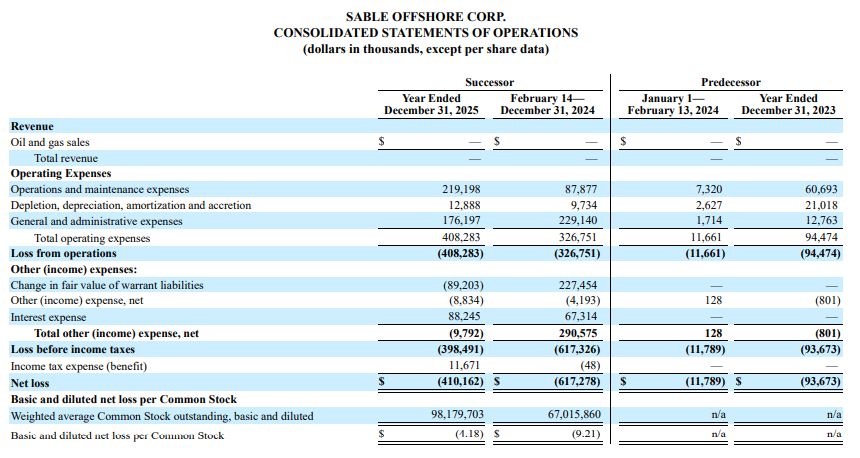
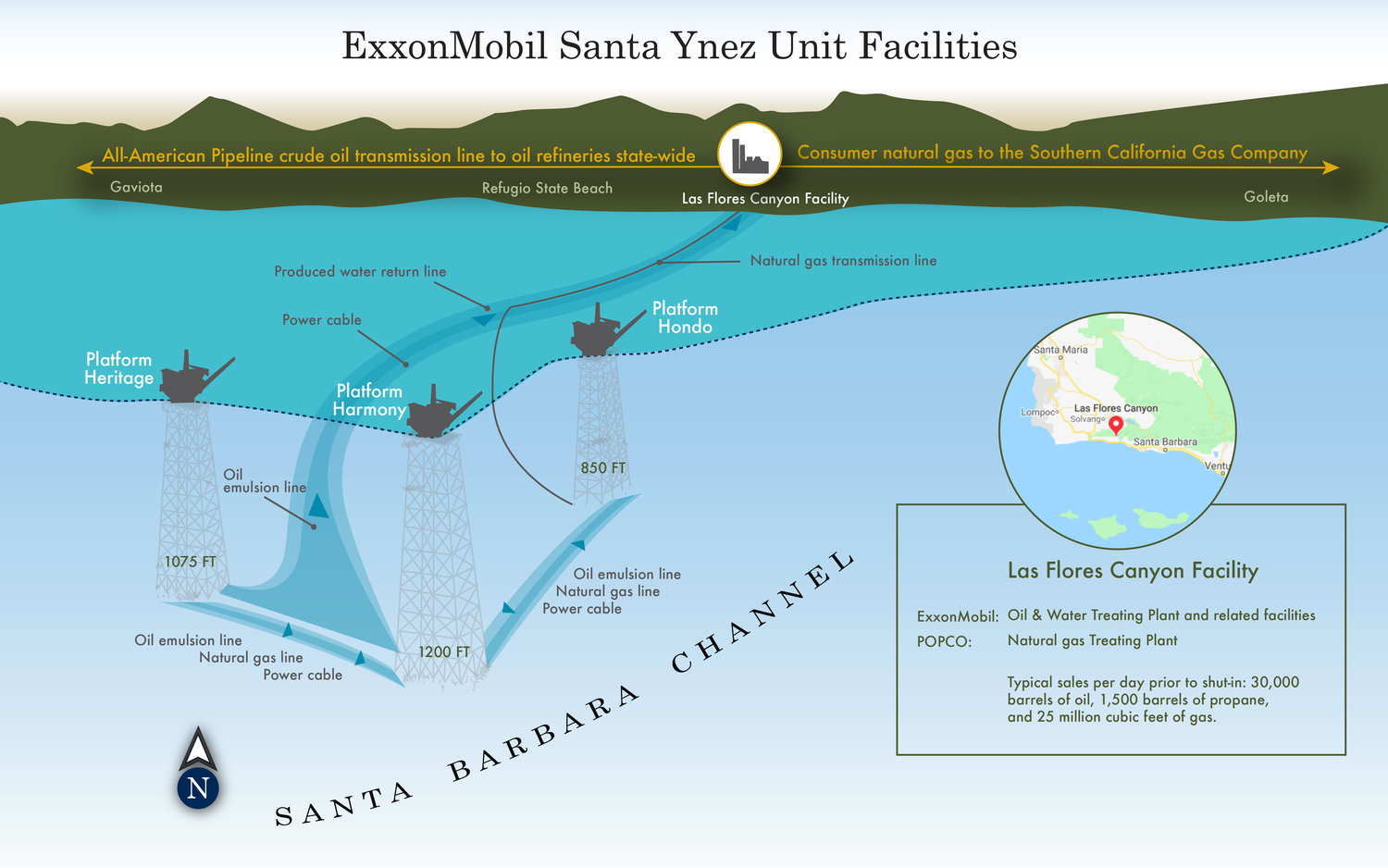
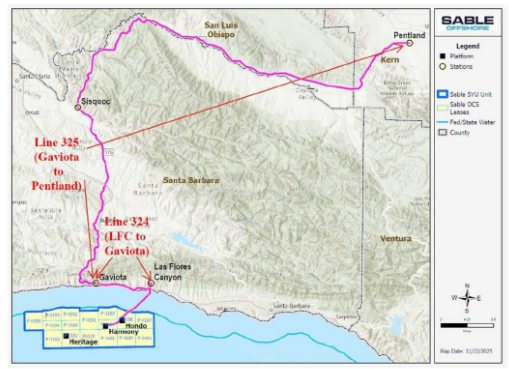
The anticipated State-Federal jurisdictional battle over Sable’s Las Flores Canyon Pipeline is on! See the attached letter from the Pipeline and Hazardous Materials Safety Administration (PHMSA) declaring that the pipeline is under Federal jurisdiction.
The major hurdle for PHMSA/Sable is thecourt approved Consent Decree that was executed following the 2015 Refugio pipeline spill. The Decree, which designates the California Fire Marshal as the sole regulator for the pipeline, is not mentioned in the PHMSA letter. Needless to say, another major legal battle looms.
Excerpt from the PHMSA letter:
PHMSA’s evaluation of the Las Flores Pipeline confirms that it transports crude oil from the OCS to an onshore processing facility at Las Flores Canyon and continues the transportation of crude oil from Las Flores Canyon to Pentland, California. Consistent with Appendix A, the Las Flores Pipeline is an interstate pipeline. As portions of the Las Flores Pipeline were previously considered to be intrastate and regulated by OSFM, PHMSA is notifying OSFM that the Las Flores Pipeline is subject to the regulatory oversight of PHMSA.
The pipeline spill just north of Refugio State Beach on May 19, 2015, coated miles of shoreline and marine habitat, and dolphins, elephant seals, sea lions, pelicans and other birds. | Santa Barbara Independent
We can scream all we want (with some justification) about the California Coastal Commission, Santa Barbara County, and intractable environmental organizations, but the Santa Ynez Unit would still be producing today were it not for an ugly, preventable pipeline spill.
At approximately 10:55 a.m. Pacific Daylight Time (PDT) on May 19, 2015, the Plains Pipeline, LP (Plains), Line 901 pipeline in Santa Barbara County, CA, ruptured, resulting in the release of approximately 2,934 barrels (bbl) of heavy crude oil. An estimated 500 bbl of crude oil entered the Pacific Ocean.
1) Ineffective protection against external corrosion of the pipeline The condition of the pipeline’s coating and insulation system fostered an environment that led to the external corrosion. The pipeline’s cathodic protection (CP) system was not effective in preventing corrosion from occurring beneath the pipeline’s coating/insulation system. 2) Failure by Plains to detect and mitigate the corrosion The in-line inspection (ILI) tool and subsequent analysis of ILI data did not characterize the extent and depth of the external corrosion accurately. 3) Lack of timely detection of and response to the rupture The pipeline supervisory control and data acquisition (SCADA) system did not have safety-related alarms established at values sufficient to alert the control room staff to the release at this location. Control room staff did not detect the abnormal conditions in regards to the release as they occurred. This resulted in a delayed shutdown of the pipeline. The pipeline controller restarted the Line 901 pipeline after the release occurred. The pipeline’s leak detection system lacked instrumentation and associated calculations to monitor line pack (the total volume of liquid present in a pipeline section) along all portions of the pipeline when it was operating or shut down. Control room staff training lacked formalized and succinct requirements, including emergency shutdown and leak detection system functions such as alarms.
Plains Pipeline was the responsible party, but that doesn’t absolve the companies that were dependent on Plains to transport their production. Given the organized opposition that emerged following the Santa Barbara blowout in 1969 (the result of a reckless well plan), the integrity of that pipeline was critical to their business strategy and they should have exercised some oversight.
Offshore disasters have had enormous consequences for the oil and gas industry in terms of lost opportunities. Think about this: prior to the Macondo blowout, the Obama administration had proposed an oil and gas lease sale in the Atlantic and the Florida Senate was holding hearings about leasing in Florida State waters. Such lease sales are now completely out of the question.
Regulations and standards are not enough. We need open discussion about incidents, large and small, and a willingness to be critical of the responsible parties.
Attached is John Smith’s comprehensive summary of lawsuits related to Sable Offshore’s attempts to restart Santa Ynez Unit production.
If you are keeping score, there are 10 separate cases including a class action lawsuit filed by investors. New legal battles are sure to follow given Sable’s OS&T strategy. Per John:
“The combined legal challenges, injunctions, and restraining orders have significantly delayed Sable’s restart plans and prompted the company to pursue an Offshore Storage and Treatment Vessel (OS&T) strategy, which was utilized to process SYU production in federal waters from 1981 – 1994, and transport oil to markets using tankers.“
In essence, the 3 Supervisors from South County (Districts 1-3) voted to euthanize an industry that is largely in North County (Districts 4 and 5). Those 3 supervisors, not the marketplace, are terminating a historically important industry. See the maps below.
District BoundariesOil Wells
Supervisors Laura Capps of the Second District, Joan Hartmann of the Third District and Roy Lee of the First District voted for the ordinance.
Ah, but it’s the industry’s fault according to Supervisor Hartmann. She asserted that companies have known since the 1950s about the dangers of climate change, and could have led the way to be part of the solution. How dare they respond to market forces instead of climate ideologues!
Of course, this is the same three vote coalition that is aligned with the Coastal Commission in opposition to the restart of the Santa Ynez Unit, which would benefit the County significantly.
Finally, note that the three supervisors voting for the ordinance represent the districts with the highest income levels and lowest poverty rates. Those opposing the ordinance represent the districts that will be most affected, and have the lowest income levels and highest poverty rates. (See the table below; Information courtesy of Grok AI.)
District
Approx. Median Household Income (2022)
Key Areas Included
Notes
1
$120,000–$140,000
Carpinteria, Summerland, Montecito, parts of Santa Barbara
Affluent coastal communities; high home values (~$1.5M+ median)
2
$95,000–$115,000
Santa Barbara city, Goleta, Isla Vista
Mix of urban professionals, students, and tech; university influence lowers median slightly.
3
$80,000-$95,000
Santa Ynez Valley, Buellton, Solvang, Lompoc
Rural/agricultural with tourism; moderate incomes from wine industry and military base
4
$70,000–$85,000
Lompoc, Vandenberg area, parts of Santa Maria
industrial and defense-related; higher poverty rates (~15–20%).
5
$60,000–$75,000
Santa Maria, Guadalupe
Agricultural North County; majority Latino population; lowest incomes due to farm labor.
Poverty rates: ~8–10% in Districts 1–2 vs. 18–25% in Districts 4–5
The carbon disposal industry, which overplayed its hand on the OCS, has managed to alienate traditional oil and gas industry supporters, sparking grassroots opposition in conservative areas of Louisiana. Carbon Capture and Sequestration (CCS) is also opposed by climate activists and the environmental justice movement.
The Advocate has nicely summarized opponents concerns: “land rights; the impact on underground aquifers if CO2 leaks; skepticism of climate change; skepticism of its effectiveness in fully capturing CO2; and opposition to the use of federal money and tax credits to finance the effort.”
Gov. Landry issued an executive order on Oct. 15 in an apparent attempt to calm the opposition. Following 34 “whereas” clauses intended to justify carbon disposal in Louisiana, the EO directs a pause in the review of new Class VI CO2 disposal wells. As evidenced by the attached press release, Save My Louisiana and other opposition groups are far from satisfied.
Sławomir Cenckiewicz, who leads Poland’s national security bureau and is a key adviser to President Karol Nawrocki, told the Financial Times in an interview that Germany should not continue the prosecutions if it wanted to align Russia policy with Poland and other Nato allies.
“From our point of view, this investigation doesn’t make sense, not only in terms of the interests of Poland but also the whole [Nato] alliance,” Cenckiewicz said, adding that prosecuting Nord Stream saboteurs might serve German justice, but also “Russian injustice.”
Whether or not the sabotage was justified, finding out who directed and executed the destruction of economically important energy infrastructure should have been a high priority for Sweden, Denmark, and Germany. Sweden and Denmark conveniently opted out after lengthy investigations, leaving only Germany to pursue what many believe to be a half-hearted inquiry.
As a result, on Sept. 29 Sable Offshore filed a declaratory judgement action against the State of California in Kern County. Sable is asking the court to confirm that the objectionable permitting provisions of SB 237 do not apply to their Las Flores Pipeline System.
Also, on Oct. 6 Sable filed a motion increasing the monetary damages in its ongoing case against the California Coastal Commission to $347 million. Sable asserts that their pipeline repair program was authorized by existing permits issued by the County of Santa Barbara under its Local Coastal Program and delegated Coastal Act authority.
These seem like good tactical moves on the part of Sable.
Meanwhile, two new floating production units, Beacon’s Shenandoah and LLOG’s Salamanca are now on line. More on this and bp’s Tiber announcement in an upcoming post.
Those of us who were involved with OCS oil and gas operations in the 1970s remember the heated battles between Exxon and Santa Barbara County that led to the installation of the infamous Offshore Storage & Treatment (OS&T) facility in Federal waters. This was the first floating production, storage, and offloading facility (FPSO) in US waters by 3 decades!
In light of Sable’s difficult (bordering on impossible) onshore permitting challenges, the company resurrected the OS&T option in a recent presentation to investors (pertinent slide pasted above). The extent to which this is purely a tactical maneuver remains to be seen, but this option would be very difficult to execute, even with a supportive Federal regulatory environment.
Updatedincident tables for OCS oil and gas operations. The most recent data are nearly 2 years old. The public has a right to timely information on the type of incidents that are occurring, the operating companies, and the resulting casualties, pollution, and property damage.
A summary of incidents associated with the OCS wind program. From press reports, we know about the fatality during Empire Wind construction. What other incidents have occurred to date?