Feeds:
Posts
Comments

Archive for the ‘Offshore Energy – General’ Category

Here is a good article, endorsed by Elon Musk among others, about the foreseeable problems NASA is facing with the Space Launch System rockets. SLS rockets use hydrogen which, at super-chilled temperatures and high pressures, easily oozes out of any available opening. Space X Raptor engines are fueled with methane (imagine that) which Musk and his engineers think is the best combination of high efficiency and ease of operation. Methane is also easier to produce on Mars where Musk hopes to develop a self-sustaining city.

In light of their respective frontier exploration accomplishments, space exploration and deepwater production are sometimes compared. In that spirit, NASA’s inspector general estimates the Artemis campaign will cost $93 billion between 2012 and 2025, $4.1 billion for a single launch. Each Artemis launch will thus cost approximately as much as developing and producing a 100 million barrel deepwater oil field in the Gulf of Mexico. And, of course, the Artemis program is fully funded by the government, while deepwater oil and gas development is not only privately funded but is an important source of government revenue.

Read Full Post »

An important figure in the history of the US offshore program passed away last week. Gerry Rhodes was a petroleum engineer with an attorney’s gift for understanding laws and regulations. Among other leadership roles in the offshore regulatory program, Gerry was Chief of the Minerals Management Service’s Branch of Rules, Orders, and Standards in the 1990’s.

Gerry was among the first in the Federal government to fully understand the financial responsibility risks associated with the decommissioning of offshore facilities and the urgent need to update requirements for the plugging of wells and removal of platforms. The enormity of this challenge is described in the 1991 Forbes article pasted below. Despite sharp divisions within the offshore industry and the resulting political pressure, Gerry succeeded in finalizing regulations (including this 1995 rule) that are the basis for the current financial responsibility programs in BOEM and BSEE. Without Gerry’s resolve, subsequent financial assurance challenges and government outlays would have been far greater.

RIP Gerry. You were a true gentleman, a dedicated father and grandfather, and a diligent and highly accomplished colleague.

Read Full Post »

The U.S. Court of Appeals for the D.C. Circuit ruled that BOEM “unreasonably refused to consider possible deficiencies in environmental enforcement” in their Supplemental EIS for Sales 250 and 251. The court found that BOEM did not adequately consider a 2016 Government Accountability Office (GAO) report that was critical of BSEE’s oversight of offshore activities.

More positively, the court chose not to vacate the sales or the EIS:

Moreover, vacatur would be highly disruptive for the lessees. They have paid millions of dollars to obtain their leases and have acted for some four years in reliance on themβ€”including by investing substantial additional sums and by executing contracts with third parties. Moreover, any redo of the lease sales β€œwould be tainted by prior publication of [the] lessees’ proprietary valuation of the leases” following the original sales.

Comments:

  1. How many GAO reports on BSEE or MMS have not been critical of some processes or procedures? None that I can recall.
  2. It’s unreasonable to expect BOEM to consider every GAO or other external criticism of the regulatory program in their EIS’s.
  3. All of the GAO recommendations in the subject report were process related and were closed (implemented) several years ago.
  4. The court exercised good judgement in declining to vacate the sale. Per the decision, the case will be remanded to BOEM for further consideration of the GAO report.


Read Full Post »

GoM oil production for June increased (see chart below) with King’s Quay and Spruance contributing to the uptick. Other anticipated 2022 startups are not yet producing.

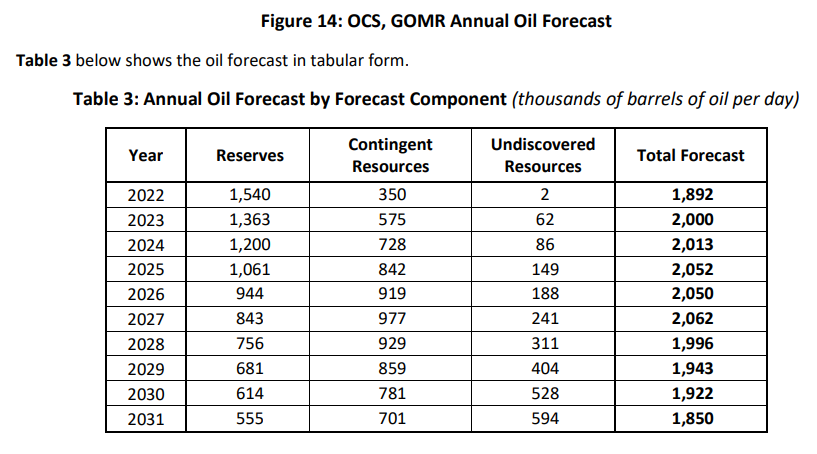
The EIA production forecast for 2022 is proving to be pretty accurate. Kudos to them. However, BOEM’s 2022 forecast of 1.9 million bopd is not achievable and concerns about the intermediate and longer term persist. Unfortunately, BOEM’s highly optimistic forecast for 2022 and beyond, along with unrealistic expectations regarding the energy transition, have significant policy implications. This stunning quote from the 5 year leasing plan explains why so few lease sales were proposed:

β€œBOEM’s short-term (20-year) production forecast for existing leases shows steady growth from 2022 through 2024 and declining thereafter (see Section 5.2.1). The long-term nature of OCS oil and gas development, such that production on a lease can continue for decades makes consideration of future climate pathways relevant to the Secretary’s determinations with respect to how the OCS leasing program best meets the Nation’s energy needs.β€œ

5 Year Leasing Program, p.3

Read Full Post »

Per legislation signed by the President on Aug. 16, 2022:

(b) LEASE SALE 257 REINSTATEMENT.β€”
(1) ACCEPTANCE OF BIDS.β€”Not later 30 days after the date of enactment of this Act, the Secretary shall, without modification or delayβ€”
(A) accept the highest valid bid for each tract or bidding unit of Lease Sale 257 for which a valid bid was received on November 17, 2021; and
(B) provide the appropriate lease form to the winning bidder to execute and return.

The Department of the Interior has been silent on their implementation of this provision. We are particularly interested in:

  1. how the 94 carbon sequestration bids will be handled
  2. whether any bids will be rejected on fair market value grounds

Read Full Post »

GUILDFORD, UKΒ β€” Alpha Petroleum Resources, Energean UK and Orsted Hornsea Project Four will consider repurposing the Wenlock gas platform in the UK southern North Sea, which is nearing the end of its productive life.

One possibility is to reuse the facility as an artificial nesting site to offset the impact on certain bird species of offshore wind developments in the area.

Black-legged kittiwakes have set up nests on various North Sea platforms, according to Orsted’s recent surveys. Repurposing an existing platform as an artificial nesting structure is seen as an alternative to building a new artificial nesting structure to support the local development of the Hornsea Four offshore wind farm.

Offshore Magazine

See our Rigs-to-Reefs+++ page!

Read Full Post »

Martyn Willsher, Amplify’s President and Chief Executive Officer, commented, β€œWe are pleased to have reached an agreement in principle regarding the civil litigation resulting from the Southern California Pipeline Incident last October. Although we are unable to provide additional detail at this time, we negotiated in good faith and believe we have come to a reasonable and fair resolution. We will continue to vigorously pursue our substantial claims for damages against the ships that struck our pipeline, and the Marine Exchange of Southern California that failed to notify us of the anchor strikes.”

Amplify Energy
Vehled

Read Full Post »

After devastating South Florida during August 25, 1992, Hurricane Andrew struck Gulf of Mexico facilities the following day. Sustained winds were 140 mph with gusts to 160 mph, and significant wave heights were 35-40 feet. About 700 platforms were exposed to hurricane force winds. 241 platforms and 83 pipeline segments incurred substantial damage.

All workers had been evacuated from the offshore facilities without incident. Surface and subsurface safety systems performed as intended, and there were no uncontrolled flows from production wells. According to respondents to a JP Kenny survey for MMS, 2698 valves were closed during the storm as follows:

valve typeactivatedfailed
subsurface safety valves7160
master surface safety valves7295
wing surface safety valves4600
pipeline shutdown valve4150
pipeline check valve3780

The five MSSV failures were at facilities directly in the path of the eye in an area where the storm damage was most severe.

The valve performance reporting was associated with a research project and was thus voluntary. It’s therefore important to give credit to the companies that participated (a number of which no longer exist): Amoco, Aquila Energy, BP, Chevron, Four Star O&G, Gulfstream, Houston Expl., Kerr-McGee, Mobil, Pennzoil, Samedan, Shell, Sonat, Stone, Tennessee Gas PL, Texaco, and Unocal.

Also, in reviewing the survey responses it’s clear that there was some confusion about what to report. Most facilities were completely shut-in well ahead of the storm’s arrival and the survey requests information on valves that were shut-in (presumably automatically) during the hurricane. Reporting was therefore inconsistent, and the total number of shut-in valves was under-reported.

Read Full Post »

It was revealed on Friday that Warren Buffett’s Berkshire Hathaway (NYSE: BRK-A) has received Federal Energy Regulatory Commission approval to acquire up to 50% of Occidental Petroleum’s (NYSE: OXY) common stock.

StreetInsider.com

Oxy (Andarko) fared very well in BOE’s mid-year review and apparently the “Oracle of Omaha” noticed. πŸ˜‰

Read Full Post »

Eni announces another deepwater gas discovery:

  • Offshore Cyprus
  • Cronos-1 well; Block 6 on map
  • 2287m water depth
  • >2.5 tcf

The challenge is getting the 100+ trillion cubic feet of gas to European markets. The East Med Poseidon Gas Pipeline (map below) makes the most sense, but the current US administration inexplicably opposes this project. Other options include LNG via Egypt, a pipeline to Turkey, and a floating LNG facility.

Read Full Post »

« Newer Posts - Older Posts »