Feeds:
Posts
Comments

Archive for the ‘Offshore Energy – General’ Category

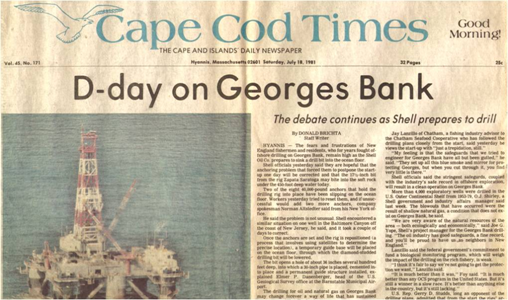
40 years ago today, drilling began on the first two exploratory wells on Georges Bank, a large seafloor feature that separates the Gulf of Maine from the Atlantic Ocean. The Cape Cod Times headline (below) attests to the drama that was unfolding 155 miles southeast of Nantucket. After years of debate, oil embargoes, gas lines, and the threat of future supply disruptions had tipped the political balance in favor of offshore leasing, and OCS Sale No. 42 (North Atlantic) was held one week before Christmas in 1979. Looking back, I find it remarkable that only 19 months elapsed between the lease sale and the initiation of drilling. During that time, bids were evaluated, exploration and spill response plans were drafted by the operating companies and reviewed by the Federal regulators and six coastal states, fisheries issues were addressed, and a comprehensive monitoring program was developed and initiated. Perhaps most impressive was the manner in which government (Federal and State), industry, and academic professionals with very different personal opinions about offshore drilling collaborated to assess and monitor impacts and mitigate risks.
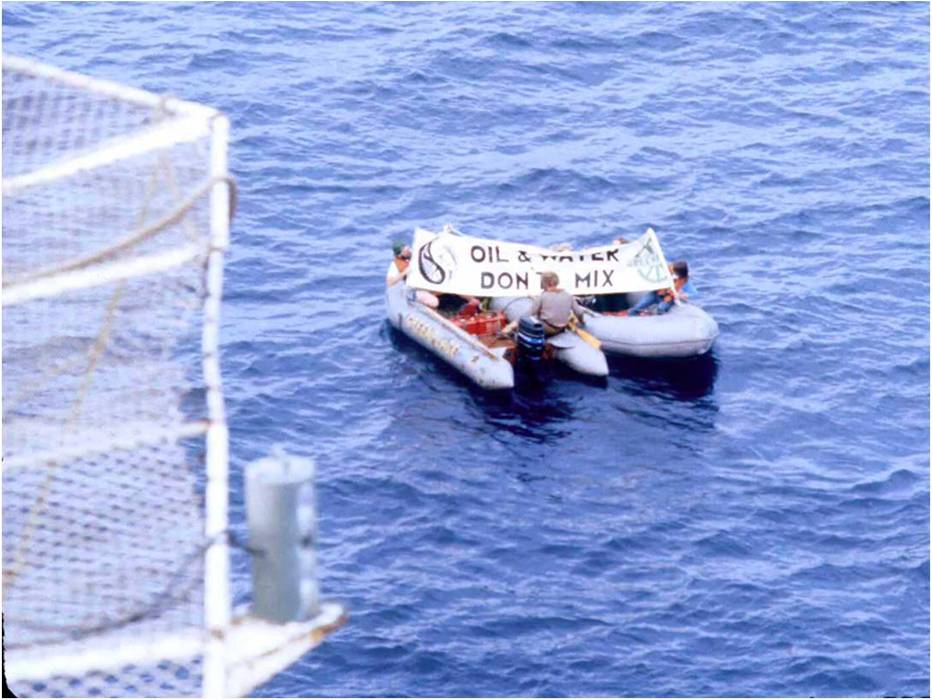
The protesters pictured above were dispatched to the Zapata Saratoga drilling rig from the Greenpeace vessel Rainbow Warrior. Given the remote location, the protest was unexpected. However, the drilling operation was not disrupted and no action was taken against the protesters. Four years later, the Rainbow Warrior was bombed by French commandos while in port in Auckland, NZ prior to planned protests against French nuclear testing in the South Pacific. Sadly, one crew member was killed during this incident.

Below is a list of the exploratory wells that were drilled on Georges Bank. In addition, two off-structure geologic test wells were drilled in 1976 and 1977. None of the wells discovered commercially significant oil and gas resources. However, gas shows led to erroneous press reports such as the article below. In 2000, the Minerals Management Service (MMS) published a summary of the geologic findings.


Operator
Lease No.
Block/Well
Rig

___________

Water
Depth
(ft.)


_________


Lat/Long
Miles SE
Nantucket

____________


Onsite


__________


Spud

________


Offsite


_________


Well
Depth
(ft. )

________

Exxon
0170
133/1
Alaskan Star
22540°49’05”
67°56’03”
112
7/22/817/24/81 11/24/81 13,808

Shell
0218
410/1
410/1R
Saratoga
45240°34’24”
67°12’32”
155
7/10/81
8/8/81
7/24/81
8/10/81
8/8/81
3/31/82
875
15,043

Mobil
0200
312/1
Midland
26040°39’27”
67°45’55”
125
11/21/8112/8/816/27/8219,652

Exxon
0153
975/1
Alaskan Star
20941°00’24”
67°37’19”
125
11/24/8111/25/813/10/8214,313

Tenneco
0182
187/1
Alaskan Star
30040°46’15”
67°23’19”
140
3/10/823/12/828/22/8217,744

Shell
0210
357/1
Saratoga
26540°36’51”
67°44’41″1
128
4/2/824/14/829/27/8219,090

Conoco
0179
145/1
Aleutian Key
30040°49’59”
67°17’06”
145
5/9/825/13/828/25/8214,115

Mobil
0196
273/1
Midland
30240°41’04”
67°30’12”
140
6/28/826/30/829/13/8215,190
Excerpted from “Georges Bank Exploratory Drilling, 1981-1982” by EP Danenberger

Regulatory policy lessons from the Georges Bank experience:

  • Regulators with overlapping responsibilities function best as a joint authority, particularly at the field level.  While MOUs/MOAs tend to be primarily for the purpose of protecting regulatory turf, joint authorities focus on the specific mission and how the performance objectives they can best be achieved. Capt. Barry Eldridge had the foresight to co-locate a USCG Marine Safety Detachment, headed by Bob Pond, adjacent to the USGS office at Barnstable Municipal Airport.  This facilitated cooperative reviews, coordinated inspections, and joint exercises.  This collaboration led to the first ever unannounced offshore response drills.    Similar USCG/DOI organizational arrangements have proven effective in the Pacific and in the Gulf of Mexico, particularly for monitoring hurricane preparations and responses.
  • Strive to conduct regulatory functions at a single field office.  USGS had the foresight to assign exploration plan review, environmental assessment, and coordination with State government responsibilities to our district office.  As a result, our environmental specialists, geologists, engineers, and inspectors worked together, along with our State and Federal partners, from the initial planning to the decommissioning stages.  Positive working relations were developed and everyone was informed and involved.  A subsequent reorganization changed the structure of our office and led to greater control from Washington, which (unsurprisingly) was not helpful.  
  • Transparency may be a bit of a buzzword, but it’s critical to regulatory success.  Other than proprietary geologic information and well reports, we fully informed our regulatory partners about the status of activities, all incidents and near-misses, and any operational issues. Conveying news that is not-so-good, like the mooring failures that were experienced by 2 Georges Bank rigs, is part of the mission.
  • Those regulating the operations should be informed about and a part of the environmental monitoring programs. Our office worked closely with the Woods Hole and other scientist conducting the comprehensive Georges Bank Monitoring Program.  In support of Mike Bothner, USGS Woods Hole scientist, we tracked every drilling fluid additive, and verified the materials that were available on each rig.  Mike conducted a material balance on the barite and looked for chromium and other metals in sediments near the well sites. His outstanding work is summarized in this paper.  

Read Full Post »

After a brief pause (only 10 years 😀), the BOE blog is set to return on 7/22/2021. In the meantime, I am sharing this outstanding painting by Jean-Louis Daeschler, a pioneering offshore engineer and a very accomplished artist. Click on the image to enlarge.

Painting by JL Daeschler. Sharing with his permission.

Read Full Post »

Much ado about nothing courtesy of the Associated Press:

Copies of the forms submitted by more than 100 inspectors, engineers and permit reviewers in five Gulf coast offices were obtained by the AP under the Freedom of Information Act. Personal information, such as the names of the employees, their friends and their family members, was blacked out to protect privacy. But the companies with ties to government workers were disclosed, and they represent a who’s who of the offshore oil and gas industry, from majors like Chevron, Shell and BP to smaller companies such as W&T Offshore Inc., Ankor Energy LLC and Hilcorp Energy Co.

So yesterday we linked an article about proposed legislation that would, among other things, require that offshore inspectors have “at least three years experience in the oil and natural gas field.” Today, we read contradictory (and silly) comments like the one below in the AP piece that criticize such experience. How would you like to be an oil and gas inspector or prospective offshore regulator?

“It’s nearly impossible to determine where the oil industry ends and the government’s regulatory agency begins,” said Scott Amey of the Project on Government Oversight, after reviewing AP’s data. “These new instances indicate that BOEMRE staff are connected to individuals and oil companies, which raises concerns about lax oversight and the integrity of the agency. Without enhanced enforcement authority and independent oversight of these potential conflicts, I’m uncertain that BOEMRE can assure the public that it is truly watchdogging the offshore oil industry.”

Give these people a break. I have seen absolutely no evidence that improper government-industry relationships or compromised inspections had anything to do with the Macondo blowout or any other recent incident. Inspection and engineering personnel are under continuous scrutiny well beyond what most employees would accept, and recuse themselves from assignments if there could be even a perception of a conflict of interest.

The US offshore program, and every other safety regulator, needs people who understand the operations and technology that they regulate. These regulators need to communicate regularly with industry personnel on operational and regulatory issues. Too little interaction with their professional peers is a greater danger than too much. You don’t advance safety technology and procedures, and resolve concerns, without communication.

DOI offshore personnel have had and will continue to have more than enough oversight; time to move on to another cause.

Read Full Post »

The Commonwealth of Virginia, home of BOE headquarters, continues to provide national leadership on energy issues, most notably offshore oil and gas exploration.  The Governor (Republican), both US Senators (Democrats), and both candidates for the US Senate support offshore leasing.

“Opening up and expanding Virginia’s offshore resources to responsible natural gas and oil exploration holds significant promise for boosting needed domestic energy production while bolstering the commonwealth’s economy.” Quote from Senator Jim Webb in the Richmond Times Dispatch


Read Full Post »

On Independence Day, four keys to realizing our offshore energy potential:

  1. A national offshore oil and gas program as required by the OCS Lands Act.
  2. Industry safety and pollution prevention leadership including comprehensive data analyses, research, standards development, management programs, and internal auditing. All operators, contractors, and service companies must participate.
  3. An efficient, risk-based regulatory program that scrutinizes performance, indentifies weaknesses, and demands excellence.
  4. Cooperative programs to develop cost-effective, reliable, and safe wind and hydrokinetic energy systems.

Read Full Post »

From Platts Oilgram News:

Shares of McMoRan Exploration jumped more than 12% June 29 after the company announced that additional drilling has confirmed its geological theories about the high potential of drilling ultra-deep natural gas prospects in the shallow waters of the Gulf of Mexico.

Hype, reality, or something in-between? One has to weigh the resource promise against the operational challenges, high costs, and gas market uncertainties.

Read Full Post »

Like the National Commission on the BP Deepwater Horizon Oil Spill and Offshore Drilling, the Montara Commission of Inquiry, the Norwegian government, and leading safety and regulatory authorities around the world, the IADC recognizes the risks associated with complex, multi-agency regulatory regimes. A single authority should be responsible and accountable for safety and pollution prevention at offshore facilities, and should draw on the expertise of other agencies and organizations as necessary to achieve performance objectives. 

The safety and environmental  risks associated with fragmented or compartmentalized regulation include gaps, overlap, confusion, inconsistencies, and conflicting standards. Industry and governmental personnel spend too much time coordinating with multiple parties and not enough time managing safety and environmental risks.

Link to IADC comments.  Key quotes:

IADC continues to be concerned by seemingly duplicative regulatory requirements imposed by the Coast Guard and BOEMRE, particularly where the agencies appear to have divergent views regarding the placement of regulatory responsibility.

One cannot holistically address safety when faced with the unyielding and overlapping demands of multiple narrowly-focused regulatory agencies.

Read Full Post »

News: BOEMRE releases report on the September 2010 Mariner Fire in the Gulf of Mexico.
BOE Comments:

  • Good report and relatively timely. Nice job by the team.
  • Good discussion of the heater-treater and production safety issues.
  • This was a very serious incident and lives were jeopardized. Sadly, no oil spill means no public attention.
  • Why didn’t the Coast Guard participate in the investigation? Will they be reporting on the haphazard evacuation?
  • Age old question: Is the rather extensive discussion of violations appropriate for an accident report? Should violations and enforcement actions be managed independently from accident investigations?
BOE: Floating liquefaction facilities open interesting possibilities for producing natural gas in remote offshore locations, possibly including the arctic.  The first FLNG facility will be 488 m from bow to stern! Offshore to the future!
BOE: Lots of posturing and not much in the way of meaningful proposals from either party. Unlike Australia, the US has not responded to its blowout with necessary legislative action, most notably the establishment of a single offshore safety and pollution prevention regulator.
BOE: Engineers solve problems when given the opportunity and encouragement. JL Daeschler is busy at the drawing board!
News: Greenland rolls on. despite Greenpeace protests. Cairn Energy has begun a second summer of drilling.
Views: Last summer’s results must have been sufficiently encouraging to justify further exploration. 
News: Hurricane season officially begins tomorrow.
BOE: There has been surprisingly little public discussion about the offshore industry’s preparations. Hopefully, everyone is ready.
BOE: Where is the worldwide commitment from industry and government? This problem can and must be fixed!

Read Full Post »

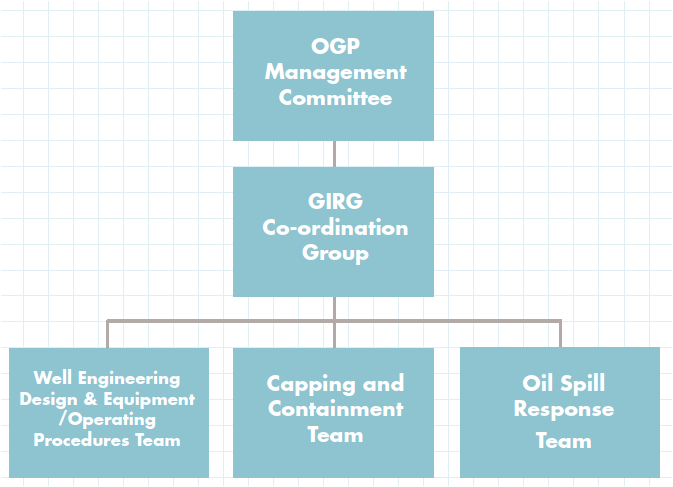
Today, the International Oil and Gas Producers (OGP) released the Global Industry Response Group (GIRG) reports.  GIRG was formed last July with the goal of better managing offshore safety risks. The organizational structure is illustrated below.

Deepwater Wells: Lessons and Recommendations focuses on the critical prevention programs, and is perhaps the most important of the GIRG reports. Since Macondo, the GIRG team and other industry committees have worked diligently on well planning and integrity issues, and are commended for their outstanding efforts. However, the recommendations presented in the GIRG report are surprisingly modest, and do not reflect the technological and management innovation that industry has demonstrated in pioneering offshore development.  The recommendations fail to break new ground, lack specifics, and, in some cases, appear to be a step backward. In short, the oil and gas industry is capable of much more.  Initial comments follow:

  • Incident data (problem): The absence of comprehensive and verified incident data is one of the “systemic” industry weaknesses identified by the National Commission. OGP has tried to address this problem for years, but has not had the industry-wide support needed to develop a credible program. GIRG has wisely recommended a Wells Expert Committee (WEC) to review selected incident data. However, the recommended program suffers from the same weaknesses that constrain existing OGP reporting programs. OGP must rely on “encouraging” its members to participate voluntarily, and non-members are not included. This type of voluntary program was not good enough before Macondo/Montara, and is certainly not good enough now.
  • Incident data (solution): Industry and regulators need an ironclad commitment that all operating companies will submit incident data in accordance with defined protocols. Contractor data must be included. Companies should execute binding agreements with OGP, or some other entity, to provide this information. The data must be managed by a completely independent entity that cannot, in any way, be directed by an industry advocacy group. Regulators and other independent representatives should be included on the management committee. Regulators should prohibit companies that don’t agree to submit these data from from operating within their jurisdictions. A comprehensive incident reporting and data management system is long overdue, and continued delays are not acceptable.
  • Montara: While GIRG is supposedly in response to both Macondo and Montara, the latter seems to have been largely ignored. The deepwater theme does not apply to the Montara platform, which was in only 80m of water. Despite the post-Macondo focus on water depth, shallow water was arguably a more significant contributing factor to the Montara blowout (batched completions using a cantilevered jackup, mudline suspensions, and two-stage platform installation) than deep water was at Macondo. Also, well capping, which was feasible and ultimately successful at Macondo, could not even be attempted at Macondo because of the manner in which these platform wells were suspended. Finally, GIRG  ignores the special gas migration and kick detection issues associated with horizontal completions like Montara, and the relief well rig availability and release issues that were never fully addressed during the Montara inquiry.
  • Emergency worldwide notification system: In conjunction with the incident reporting system, industry needs an emergency notification procedure that goes beyond safety alerts and requires the immediate attention of every operator and wells contractor. During the Montara inquiry, worldwide attention should have been drawn to the inability of the Montara operator to identify a hydrocarbons influx through the shoe track and into the production casing. Could an effective notification system have prevented Macondo? No one can say for sure, but the probability of a blowout at Macondo would have been greatly reduced if key BP and Transocean personnel had participated in discussions about Montara and the importance of proper negative pressure tests.
  • Dependence on regulator: On page 21 of the report, GIRG recommends that a company “carry out a more extensive programme of self-audit” when there is a lack of competent regulatory oversight. An operator should never depend on the regulator to verify its well or management programs, and should never relax its programs regardless of the level of regulation. Detailed regulatory reviews of specific drilling or management programs are never a substitute for operator diligence. Did the operators at Montara and Macondo rely on the regulator to protect them from themselves? Read the official investigation reports and make your own judgement.
  • Best practices: GIRG recommends “refraining from using the term ‘best industry practice’ until this definition is clarified; we prefer ‘good oilfield practice’ for the time being.”  Isn’t the clarification of best practices the role of groups such as this and industry standards committees? This attitude explains some of the technical recommendations in this report which may be “good oilfield practices,” but fail to raise the bar for safety achievement. Would you be satisfied with “good” if  family members were working on rigs or if operations were conducted off your coast? While “best practices” vary depending on the conditions and circumstances, it’s industry’s responsibility to identify those practices, and industry and regulators must set the bar high and keep raising it.
  • GIRG recommends established practices: Some of the GIRG recommendations, such as the “two-barrier” policy have been standard practice for most operators for years.
  • API RP 75: There are numerous endorsements of RP 75 as an important reference for management systems covering the design of wells and other activities.  RP 75 was a reaction to an MMS regulatory initiative 20-years ago to impose safety management requirements on offshore operators. BP, Transocean, and PTTEP had management systems that were generally consistent with the guidance in RP 75. GIRG needs to go beyond RP 75 and focus on improvements that will make safety management systems more effective.
  • API Bulletin 97, Well Construction Interface Document (WCID): Despite the complete absence of public attention, this is perhaps the most important post-Macondo initiative. It’s thus particularly disappointing that this document is now five months late. How does GIRG recommend the use of a document that is not complete and has not yet (to the best of my knowledge) even entered the balloting process? Another recommended and highly important document, updated RP 96 – Deepwater Well Design, has also yet to be finalized.
  • BOP recommendations: Nothing new or innovative is offered by GIRG. The report calls for 2 shear rams, but only one need have sealing capability, which means that the Deepwater Horizon stack met the GIRG specification. While many BOP advances require additional study, some (such as real-time function and pressure monitoring systems) already exist. Other GIRG technology recommendations are rather timid and generally in the form of suggestions for future study (e.g. study cement bond log technology).
  • Training: This section of the report is good, but doesn’t address deficiencies identified in the Montara inquiry and reviews of historical blowout data. Montara and other accidents have demonstrated that senior rig personnel may have limited understanding about well planning and construction practices. These topics are not covered in well control training programs. How does industry plan to address this major deficiency? While well planning is the responsibility of the operator (often a separate group than is represented on the rig), well control decisionmaking requires a fundamental understanding of well construction practices.  Also evident in the Montara testimony was the total absence of understanding on the part of operator, drilling contractor, and cementing personnel about the historical causes of blowouts. The cementers at Montara were unaware that gas migration/influxes during cementing operations were a leading cause of blowouts. Training programs need to be expanded to provide for the discussion of past accidents and how they could have been prevented.


Read Full Post »

Positive measures announced by President Obama during today’s radio address:

  1. Hold a Gulf of Mexico lease sale this year and two next year
  2. Extend Gulf of Mexico and Alaska leases where drilling activity was suspended after the blowout
  3. Accelerate pre-sale seismic surveys in the Mid- and South Atlantic
  4. Conduct annual lease sales in Alaska’s National Petroleum Reserve

Read Full Post »

« Newer Posts - Older Posts »