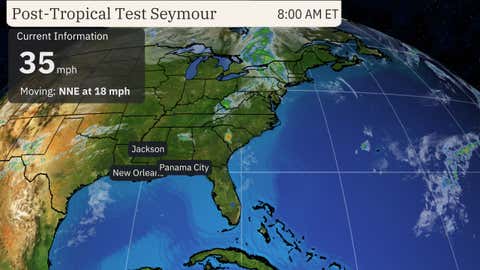
In light of the projected storm track for Ida, forecasting uncertainty, and the need to err on the side of caution in making evacuation and shut-in decisions, particularly for deepwater facilities, look for at least 75% of Gulf of Mexico oil production (approximately 1.3 million BOPD) to be shut-in temporarily.
This graphic update gives a better sense of the horrific tragedy that unfolded:
MEXICO CITY (AP) — Mexico’s state-owned oil company said Tuesday the possible remains of two missing subcontractors had been found on one of its oil platforms in the Gulf of Mexico following a weekend fire.
Pemex Director Octavio Romero said the apparent remains were found in a control room on the platform where temperatures reached around 1,800 degrees (1,000 degrees Celsius). Such heat would have burned the bodies beyond recognition.
Given the magnitude of the event, the restart schedule seems pretty aggressive. Hopefully, the risks have been fully assessed and the resumption of production is not being rushed.
Pemex said that by Aug. 30 it hoped to restore all of the 421,000 barrels per day in production knocked out by the blaze.
Mexico’s energy ministry has designated Petroleos Mexicanos as the operator of the country’s largest oil discovery by private companies, in the latest sign of the government’s nationalist approach to the energy industry.
Talos said it was “very disappointed” with the decision and will explore “legal and strategic options” regarding Zama. The company added that the energy ministry had informed Talos of its “sudden” decision only three days after the driller received a letter directly from Pemex arguing for operatorship.
The Mexican government’s decision is indicative of the Lopez Obrador administration’s commitment to rolling back the reforms that had encouraged private sector participation in Mexican offshore exploration and development.
Questions had already been raised about Pemex’s ability to fund Zama development and operate the field safely. This week’s deadly incident and a July pipeline fire add to those concerns. In light of the background political and financial issues, will it be possible to for Pemex and the Mexican regulators to conduct a fully independent investigation of the tragic fire that just occurred?
Comprehensive and timely incident data are critical for risk assessments, preventing recurrences, training and safety management programs, assessing the performance of the industry and individual companies, and driving safety culture. The National Academies 2021 review of BSEE’s inspection program included a number of recommendations related to data management including this one:
Recommendation 2. To further its goal of increasing data transparency and facilitating its internal and external use, BSEE should invest in more advanced and creative data collection, analytic and visualization tools, and infrastructure; corresponding data management, analysis, and evaluation capabilities among its personnel; and an outward-facing, online data system that can be navigated with ease and kept current across all fields for the purpose of encouraging and facilitating safety analyses.
Unfortunately, BSEE’s incident data are not updated and posted in a timely manner. As we approach September 2021, the 2020 incident statistics are still not publicly available. These incidents include at least one rig fatality that neither BSEE nor the Coast Guard announced at the time of occurrence one year ago today (8/23/2020) or subsequently. The only public information about this fatality is the following self-serving statement by the operator:
“This is a routine operation that was executed with no time pressure as the rig disconnection had been decided well in advance,” Total said.
A 37-year old man died, but according to the operator there is nothing to see here. This is not the type of statement you would expect from a company with a leading safety culture.
The keystone of BSEE’s primary mission, protecting workers and the environment, is timely incident information that is regularly reviewed and updated. Continuous improvements in safety are dependent on continuous improvements in data management and analysis. BSEE can do much better, as can other regulators, the offshore industry, and those of us who are interested and concerned observers.
A Coast Guard MH-65 Dolphin helicopter crew from Air Station Houston, Texas, medevacs an oil rig crew member experiencing a cardiac event on the Hoover-Diana oil platform, 150 miles east of Corpus Christi, Texas, Aug. 19, 2021. The helicopter crew successfully transported the man to the University of Texas Medical Branch in Galveston, Texas, in stable condition. (U.S. Coast Guard video, courtesy Sector/Air Station Corpus Christi)
For the better part of two months now, four of the five wind turbines at America’s first offshore wind farm haven’t been spinning.
Workers at the Merkur wind farm in the German North Sea found signs of stress fatigue on the support structures of the “helihoist” platforms on some of the project’s GE Haliade turbines.
Ørsted was prudent to shutdown the turbines to conduct precautionary inspections.
Press reports imply that Ørsted was slow to advise the public about the reasons for the shutdown.
The shutdown raises questions about the reliability of wind-centric regional power grids.
Given the questions that have arisen regarding the regulation of offshore wind projects (this wind farm is in Rhode Island State waters), the absence of any comments from State and local officials was noteworthy. It’s unclear what, if any, role the State had in the shutdown decision.
Hurricane Henri may give the wind farm a bit of a test this weekend.
The Department of the Interior (Interior) confirmed today that the Department of Justice (DOJ) has appealed the preliminary injunction entered by the district court in Louisiana v. Biden, which enjoined Interior from implementing the pause in new federal oil and gas leasing …
DOI argues that greenhouse gas (GHG) emissions must be curtailed, but reductions in domestic production would increase the demand for imports with higher GHG intensity. Reductions in deepwater Gulf of Mexico production, which has low GHG intensity and other environmental advantages (few dispersed facilities distant from shore), would be particularly detrimental. Of course, any public policies that discourage natural gas production would also have distinct air emissions costs.
If supply restrictions increase the price of oil, net reductions in oil consumption and GHGs could be achieved. However, as evidenced by the recent appeal for increased OPEC production, higher oil prices are not consistent with Administration policy.
Decommissioning liability issues are not simply a matter of “companies trying to get out of that obligation.” Much of the complexity is associated with decades-long chains of lease ownership and the respective responsibilities of prior lessees. Pertinent questions include the following:
If a company sold a lease decades ago and there have since been multiple owners, to what extent is the original owner still liable for decommissioning lease facilities? (Note that guidance from the Federal government has not been entirely consistent over the decades.)
If current leaseholders fail to fulfill their obligations, who is next in line and why?
To what extent are prior lessees liable for wells and structures constructed subsequent to their ownership?
Knowing that decommissioning costs can vary significantly, what amounts of security should be required? How should these funds be protected or managed? Should an assigning company also collect funds to protect their interest?
How do inconsistent Federal policies and financial assurance requirements, and improper practices by subsequent owners, affect the liability of prior lessees? In that regard, the case of Platforms Hogan and Houchin in the Pacific OCS Region is interesting and pertinent.
Per the WP, “Federal regulations require the removal of offshore pipelines once they are decommissioned, but the rules are rarely enforced.” This statement is doubly incorrect.
30 CFR § 250.1750 provides for decommissioning pipelines in place when the Regional Supervisor (BSEE) determines that the pipeline does not constitute a hazard (obstruction) to navigation and commercial fishing operations, unduly interfere with other uses of the OCS, or have adverse environmental effects. The consensus opinion of the regulators’ engineers and scientists has been that the safety and environmental risks associated with pipeline removal were significantly greater than those for decommissioning in place in accordance with the procedures specified in 250.1751.
The comment about enforcement is unfounded. BSEE and its predecessors have strictly enforced decommissioning requirements despite the challenges related to inconsistent policy direction, industry downturns, and hurricane damage. BSEE has an effective program to ensure that idle wells are plugged and platforms are removed in a timely manner. For this reason, 3315 platforms have been removed since 2001; 1933 since 2010. Only about 1800 platforms remain. This very significant loss of habitat is a concern to fishing organizations, another factor that complicates decommissioning policy.
In situ decommissioning of buried or trenched offshore pipelines is the standard throughout the world. The seafloor disturbance and safety risks associated with the removal of such pipelines are universally viewed as unwarranted. The pipeline decommissioning procedures followed elsewhere are similar to those described in 30 CFR 250.1751. In the Gulf of Mexico, pipelines installed in less that 200′ of water are typically buried (30 CFR 250.1003) to minimize interference with commercial fishing and other activities.
The decommissioning of wind turbines, which are typically more densely located and closer to shore, and their attendant power cables and substructures, will also be challenging. In their 9/16/2019 Congressional testimony, the Responsible Offshore Development Alliance expressed concern about the practice of leaving structural foundations when turbines are abandoned.
In remarks to the WP, Syed Khalil, a coastal restoration geologist for the State of Louisiana, commented that they have enough sand to meet their short term needs, but future needs were a major concern. The Gulf of Mexico Offshore Sand Management Working Group would seem to be the best mechanism for timely action and a workable, long-term action plan. The minutes of their meetings are quite instructive. Rulemaking is not a solution unless the parties want to tie their fate to both the 25 year pipeline rule rewrite (draft published in 2007, another draft coming? final?) and the contentious and similarly interminable financial assurance rule.
In the early 1990’s, Department of the Interior (DOI) and Department of Energy (DOE) leadership dabbled at re-branding the OCS Oil and Gas Program by reversing the order of the words. Clever? Perhaps by Washington public relations standards. One senior manager even changed his license plate from “OCS OIL” to “MMS GAS” (not much competition for those tags 😃). Technical staff were less enthused about this simplistic marketing gimmick that misrepresented the historical and scientific facts about oil and gas production. For many years, natural gas was a byproduct of oil production that was commonly flared. (This practice continues in some regions of the world, although to a lesser extent than in the past.)
Understandably, the Oil and Gas Journal wasn’t very impressed by the change. I saved a copy of their 1/24/1994 editorial (attached) on the subject. Per the OGJ:
We at the Journal love natural gas. But that doesn’t warrant an attempt to repeal the laws of nature and ignore the weight of tradition by renaming everything “gas and oil” this and that.
John L. Kennedy, Editor, Oil and Gas Journal, 1/24/1994)
To their credit, BOEM and BSEE web pages and announcements during recent administrations (both parties) indicate a preference for the more traditional “oil and gas.” (The DOE website largely ignores the existence of either oil or natural gas.) Surprisingly, the American Petroleum Institute (API), an industry trade organization with more than 100 years of history, is now consistently using “natural gas and oil.” This rearrangement of words is not entirely consistent with the interest of API’s members. In the offshore sector, the primary interest of API members is in finding and producing oil. if you think otherwise, look at the EIA GoM gas production data. Most of the Gulf’s declining gas production is now associated with deepwater oil production, and BSEE rightfully requires that this gas be used for fuel or transported for sale. Similarly, gas is a secondary consideration for API members exploring in Alaska given that 35 trillion cu ft of North Slope gas still awaits a pipeline.
Oil companies, and those who represent them, should be proud of their current and historical role in producing oil (and gas) for our economy, security, and way of life; and of the men and women who have toiled to locate and produce petroleum resources for the benefit of society. Are there better energy alternatives? Perhaps, but issues with these alternatives remain to be resolved, and oil and gas will continue to be important. Let’s focus on producing these resources as safely, cleanly, and reliably as possible.
In light of energy security and price considerations, rebounding oil demand, uncertainty about the long-term viability of non-conventional onshore production, and the elimination of most other offshore options, sustaining deepwater GoM production should be a high-priority U.S. policy objective. The deepwater GoM also offers significant environmental advantages in that approximately 1.6 million BOPD are produced from only 58 widely dispersed surface facilities that are well maintained, closely monitored and inspected, and distant from shore. Another advantage of US deepwater production is the low carbon intensity relative to other sources of petroleum (more on this in a later post).
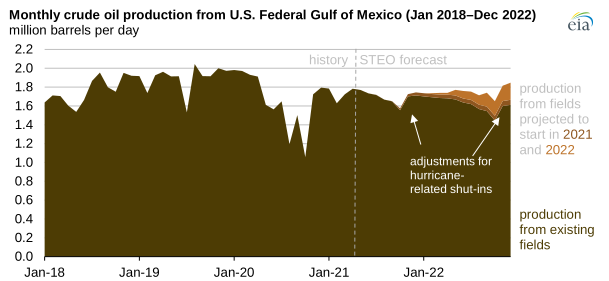
EIA (Chart 1) projects relatively stable GoM production over the next 2 years. Platt’s (Chart 2) is forecasting a slight decline in 2021 production primarily because of COVID-related delays in the initiation of production at Shell’s VIto and PowerNap and BP’s Mad Dog 2 and Thunder Horse South 2 facilities. Based on the latest available EIA data, current stabilized GoM oil production appears to be in the 1.7-1.8 million BOPD range.
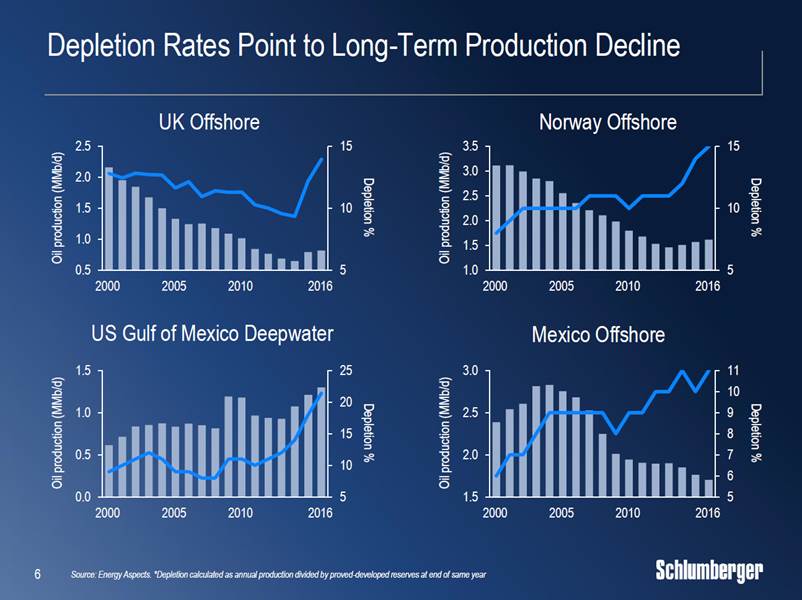
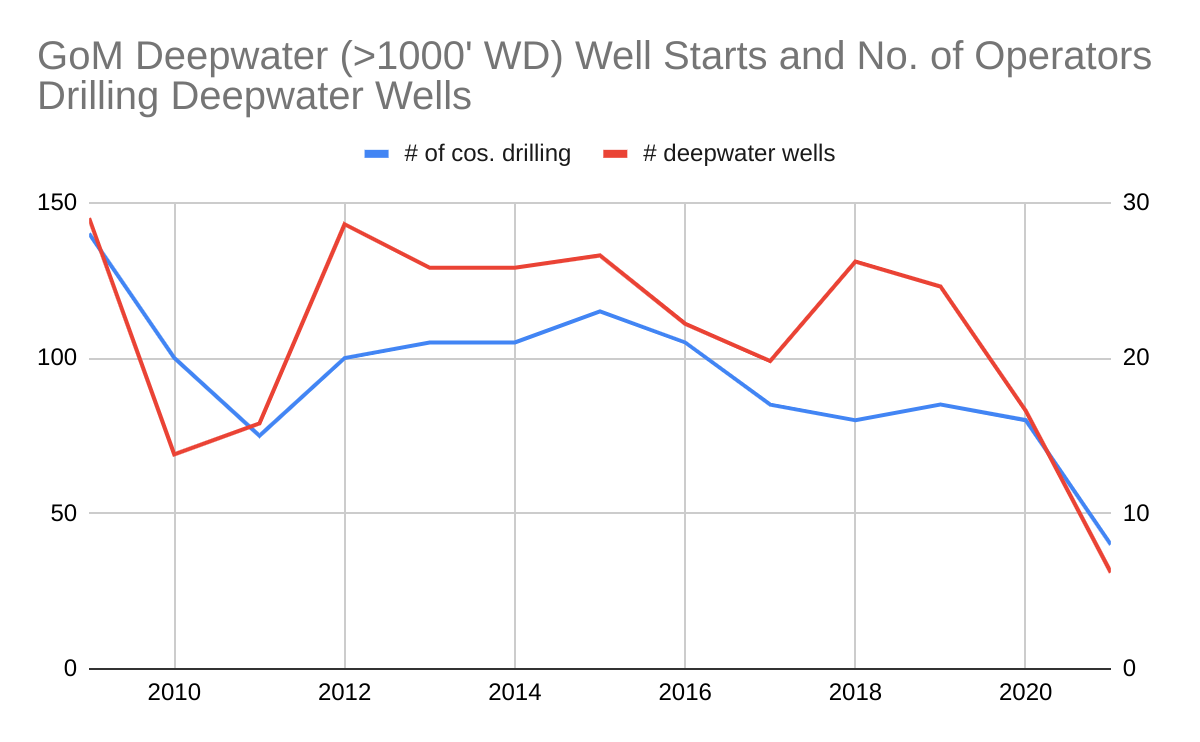
Going forward, the concern is the high rate of reserve depletion and the absence of drilling activity needed to replace reserves. Schlumberger data through 2016 (Chart 3) show depletion rates rising to above 20%, the highest (by far) of the offshore regions analyzed. I was unable to find more recent data, but unless this trend line has made a sharp turn, production declines are likely in the next 3-5 years. Further, drilling trends do not suggest the likelihood of significant reserve growth. Data from BSEE’s Borehole File (Chart 4) indicate deepwater well start activity that is comparable to the moratorium years of 2010 and 2011. Even more concerning is the absence of exploratory drilling (chart 5) and the very few operating companies that are drilling deepwater wells. Only five operators have spudded deepwater exploratory wells in 2021 YTD. One US supermajor hasn’t started a well since 2019, and another US major has essentially exited the Gulf.
Deepwater production trends are not easily reversed, so dialogue is urgently needed to assess the implications of declines in drilling, reserves, and industry interest. As the resource manager on behalf of the public, BOEM is the logical choice for initiating these discussions. BOEM’s Norwegian equivalent, the Norwegian Petroleum Directorate (NPD) demonstrates the importance of pro-active land management. The NPD has done an outstanding job of sustaining exploration activity and production consistent with Norwegian safety and environmental values, which are among the highest in the world. On their website, NPD provides ongoing updates on exploration, production, and reserve depletion parameters. Their competency and commitment to sustaining production on the Norwegian shelf is underscored in this news release, an excerpt from which is pasted below:
Exploration is of great importance for the long-term value creation on the shelf. The supply of oil and gas resources from new discoveries, as we have seen so far this year, is necessary so that activity in the petroleum industry does not fall sharply after 2030. Without new discoveries, production can fall by more than 70 percent in 2040 compared to 2020, says Torgeir Stordal, director of Technology and coexistence in the Norwegian Petroleum Directorate.


 Bud's Offshore Energy (BOE)