Feeds:
Posts
Comments

Archive for the ‘Gulf of Mexico’ Category

Maersk Drilling awarded contract extension to drill world record well in Angola

The Ondjaba-1 well will be drilled at a new world record water depth of 3,628 m. The current world record is 3,400 m, set by Maersk Voyager’s sister drillship Maersk Venturer when it drilled the Raya-1 well for TotalEnergies offshore Uruguay in 2016.

Maersk

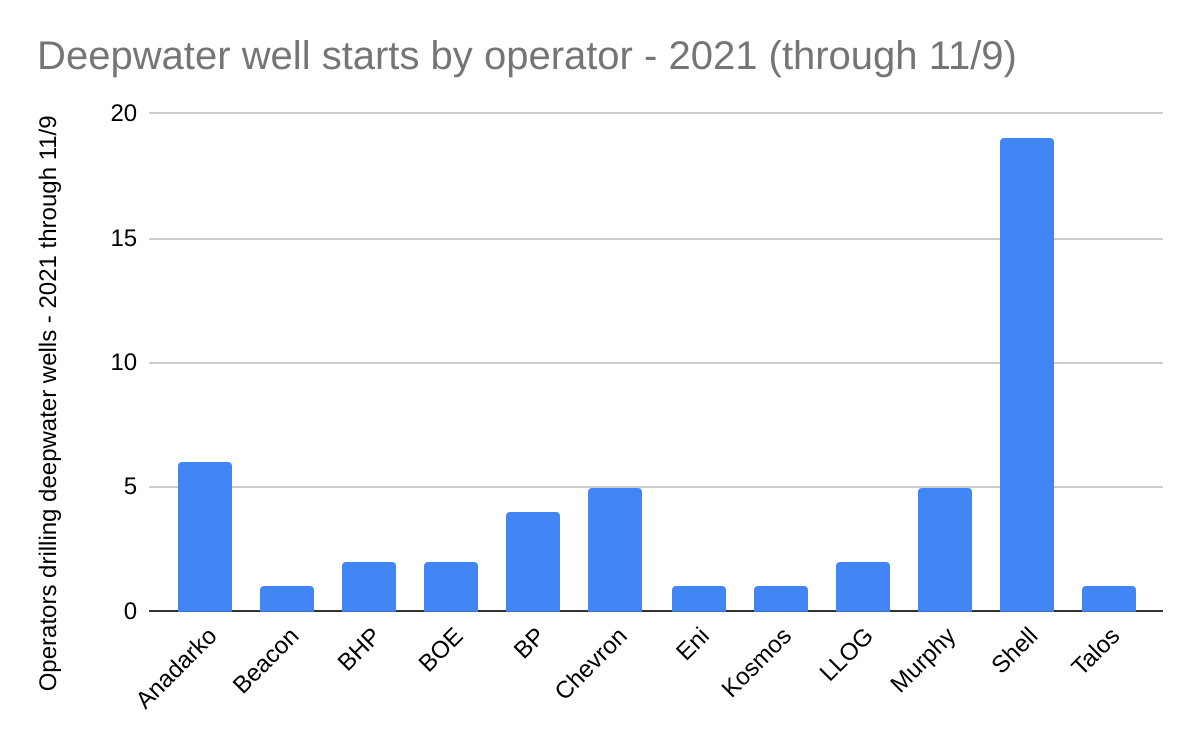
The record US water depth well (3051m/10,011′) was drilled in 2003 by Transocean for Chevron in Alaminos Canyon Block 951 the Gulf of Mexico. The deepest well drilled in US GoM in 2021 YTD was for Shell in 9352′ of water in Alalminos Canyon Block 815.

While brief celebrity space flights are major news stories, these economically important and technical challenging accomplishments by the offshore industry receive very little attention even as oil prices pierce the $82/bbl mark.

Read Full Post »

Establishing an OSHA rule takes an average of 7 years, and the process has ranged from 15 months to 19 years between 1981 and 2010, the Government Accountability Office (GAO) reported to Congress in 2012

EHS Daily Advisor

OSHA’s long rule promulgation timeframes are actually quite typical for US regulatory agencies. In some cases, employees work on a single rule for most of their careers! On the plus side, the rigorous internal and public review processes help prevent arbitrary and capricious actions by regulators. However, the long promulgation process often results in regulations that are outdated before they are published. As a result, the entire process repeats and you have a regulatory “do loop.”

To avoid the daunting rulemaking process, regulators often resort to issuing notices, letters, or conditions of approval that accomplish some of their objectives. However, these actions are not always consistent with the rule promulgation requirements of the Administrative Procedures Act and other directives, and are less likely to survive legal challenges.

The optimal approach is for the regulator to establish clear objectives for the operating companies and a schedule for achieving those objectives. This approach was demonstrated following the 2005 hurricane season (Katrina and Rita) when numerous mooring system and other stationkeeping issues were identified. In a face-to-face meeting, Department of the Interior Secretary Gale Norton outlined her concerns and informed offshore operators that there would be no drilling from moored MODUs or jackups during hurricane season until the issues identified during Hurricanes Katrina and Rita were addressed.

The collaborative effort that followed was a resounding success. In addition to addressing station keeping concerns, a comprehensive list of hurricane issues was developed. Industry and government then worked together to assess mitigations and develop new standards and procedures. The essential MODU standards were completed before the 2006 hurricane season, and all of the related concerns were effectively addressed prior to the 2009 hurricane season. Had the government elected to promulgate regulations to address all of these issues, much of this work would have never been completed.


Read Full Post »

IRVING, Texas – ExxonMobil increased its estimate of the discovered recoverable resource for the Stabroek Block offshore Guyana to approximately 10 billion oil-equivalent barrels

ExxonMobil
null

Where would you drill?

Read Full Post »

EIA just released the July data, and GoM oil production averaged 1.845 million BOPD, which was consistent with expectations. 2021 production through July was relatively stable averaging from 1.762 to 1.845 million BOPD. This will, of course, change dramatically when the August data are released, and even more so for September. Most production was shut-in for Ida beginning on 8/28 and some production has not yet been restored. Per BSEE’s final update (9/23), about 300,000 BOPD remained shut-in.

The EIA data are plotted below:

Read Full Post »

This comment by the late John Borne, an outstanding USGS and MMS engineer/philosopher, reflects on the persistent vessel allision incidents over the years. The reporting of these incidents was spotty, but some could not be denied. Pictured below is the State Command arriving in Morgan City (~1973?) topped by a platform deck. Fortunately, the platform was unmanned and there were no injuries to vessel personnel. You could say this was the first floating production platform 😃

Read Full Post »

While the official BOEMRE-USCG and National Commission/Chief Counsel investigation reports were quite good and there are countless court documents and ad hoc reviews of the blowout, some important Macondo issues have not been fully addressed. BOE will touch on these issues periodically starting with the decision to terminate the top kill operation on 5/28/2010.

The top kill operation (see diagram above) was intended to overcome and halt the flow of oil by pumping heavy mud into the well bore.  The operation was not successful because the pumping rate and mud weight did not generate sufficient pressure.  Per an excellent paper by Dr. Mayank Tyagi and colleagues at LSU  (Analysis of Well Containment and Control Attempts in the Aftermath of the Deepwater Blowout in MC252):

It is very likely that if the top kill had been designed to deliver more than 109 bpm of 16.4 ppg drilling fluid below the BOP stack for a sustained period, the Macondo blowout could have been stopped between May 26-28, 2010. Given that the well was successfully shut-in with the capping stack in July, and that the subsequent bullhead (static) kill was successful, certainly a higher rate top kill would have been successful at that time.

The American Thinker, citing the New York Times, reports that Energy Secretary Chu stopped the top kill operation over the objections of some BP engineers. While it was reasonable to be concerned about possible casing leaks and the fracturing of subsurface formations, the subsequent (7/15/2010) closure of the capping stack demonstrated that the well had sufficient integrity to support the top kill operation. Questions regarding why a higher rate top kill effort was not attempted and how that decision was made are therefore important and merit discussion. Did the Macondo well flow unnecessarily into the Gulf for an additional 48 days (5/28-7/15)? Did the National Incident Command facilitate or delay source control?

Keep in mind that the NIC almost made a similar mistake in July. Even after the capping stack successfully shut-in the well on 7/15, Incident Commander Thad Allen (USCG) continued to call the closure of the capping stack a temporary test and threatened to require BP to resume flow from the well. Fortunately, informed input from experienced engineers prevailed. The well remained shut-in and the static well-kill operation was successful.

Read Full Post »

For illustration only - One of Shell's platforms in the U.S. Gulf of Mexico / Image by Stuart Conway - Photographic Services, Shell International Limited.

Attached is an outstanding presentation by Jason Mathews that reviews the latest Gulf of Mexico incident data and trends. The collection and analysis of incident data are critical to safety achievement and continuous improvement, and are among an offshore energy regulator’s most important functions. Kudos to BSEE’s Gulf of Mexico Region for their timely and comprehensive reviews and alerts.

Read Full Post »

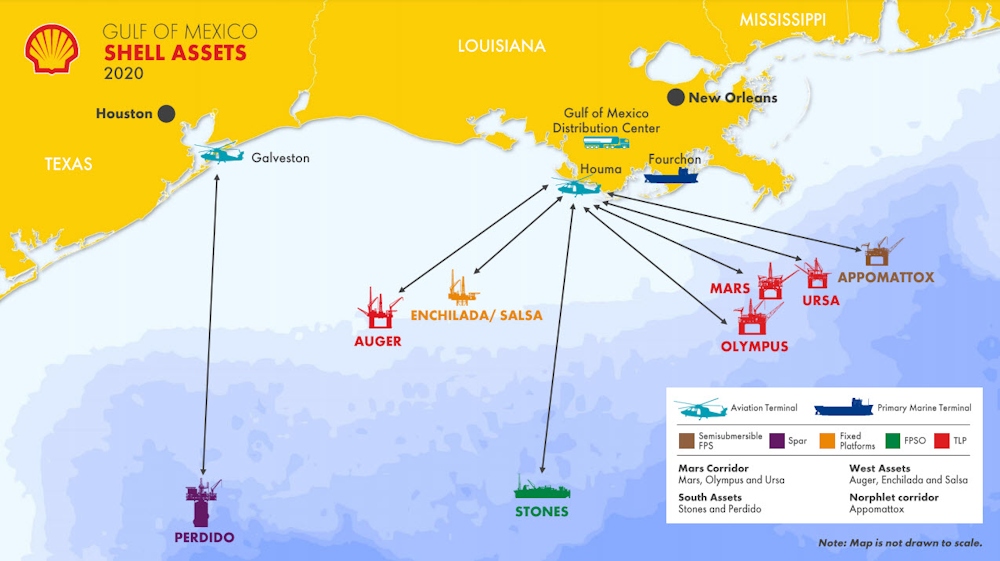
Shell’s damage assessment of the West Delta 143 (WD 143) platforms revealed significant structural damage. Shell estimates that that the WD-143 “A” platform facilities will be off line for repairs until the end of 2021, and that the facilities on our WD-143 “C” platform will be operational in Q4 2021. Shell expects to resume production from their Olympus platform, which flows across the WD-143 “C” platform, in Q4 2021, and from their Mars and Ursa facilities, which flow across the WD-143 “A” platform, in Q1 2022.

Mars, Olympus, and Ursa account for most of the GoM production that remains shut-in as a result of Hurricane Ida.

Read Full Post »

BSEE data

Read Full Post »

BSEE Data

Read Full Post »

« Newer Posts - Older Posts »