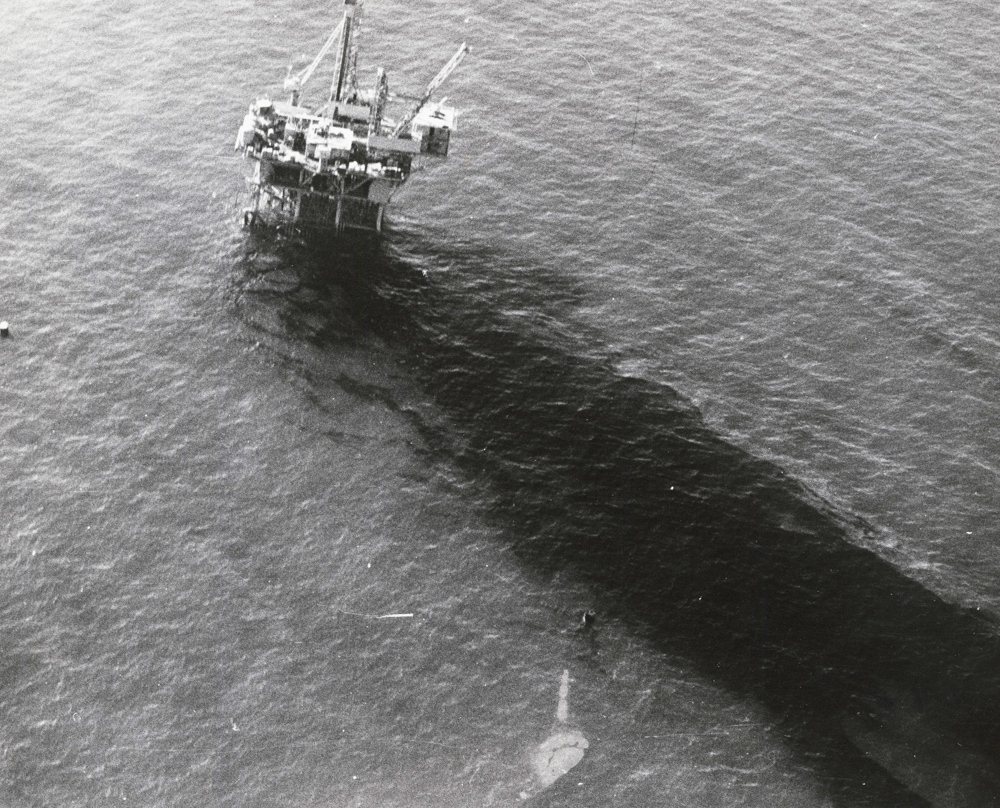
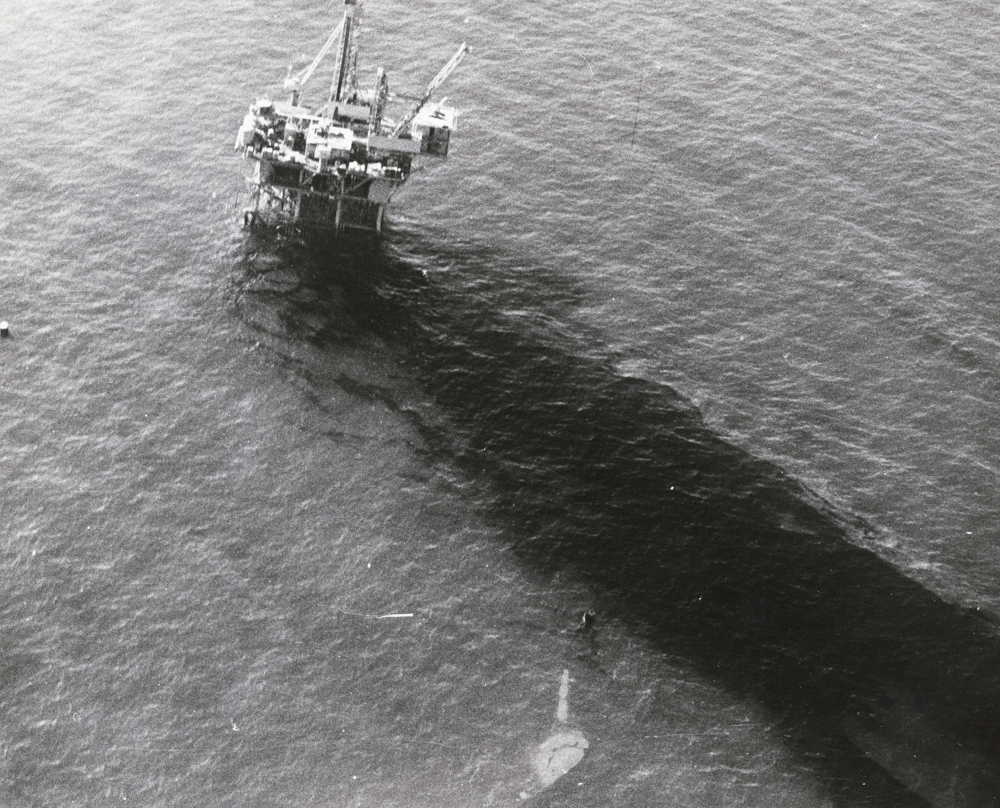
On January 28, 1969, well A-21, the 5th well to be drilled from Union Oil Company’s “A” platform began flowing uncontrollably through fractures into the Santa Barbara Channel.
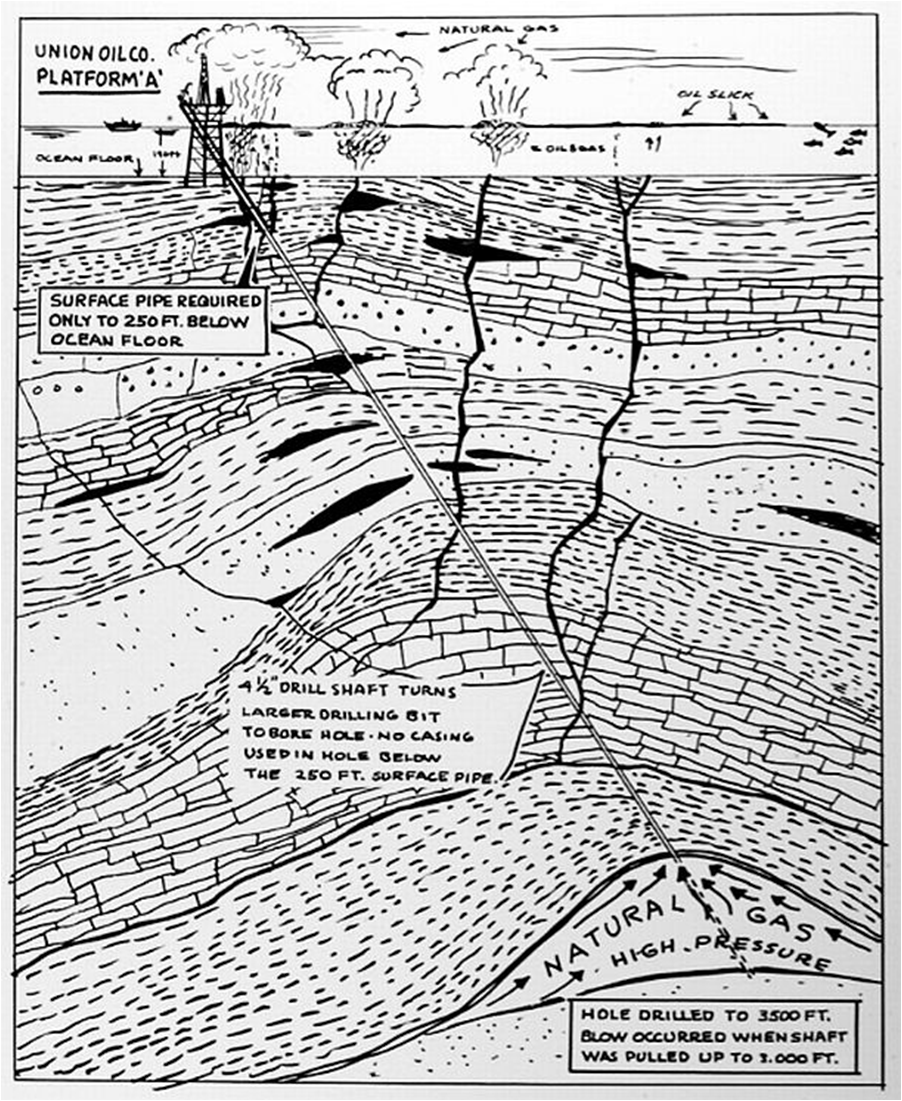
The absence of any well casing to protect the permeable, fractured cap rock meant that the operator couldn’t safely shut-in a sudden influx of hydrocarbons into the well bore (i.e. a “kick”). Shutting-in the well at the surface would create well bore fractures through which oil and gas could migrate to shallow strata and the sea floor. The probability of an oil blowout was thus essentially the same as the probability of a kick (>10-2). Compare this with the historical US offshore oil blowout probability (<10-4) and the probability of <10-5 for wells with optimal barrier management.
Here, in brief, is the well A-21 story:
Well drilled to total depth of 3203′ below the ocean floor (BOF).
13 3/8″ casing had been set at 238′ BOF. The well was unprotected from the base of this casing string to total depth.
Evidence of natural seeps near the site suggested the presence of fracture channels
The well was drilled through permeable cap rock and a small high pressured gas reservoir before penetrating the target oil sands.
When the well reached total depth, the crew started pulling drill pipe out of hole to in preparation for well logging.
The first 5 stands of drill pipe pulled tight; the next 3 pulled free suggesting the swabbing of fluids into the well bore..
The well started flowing through the drill pipe. The crew attempted to stab an inside preventer into the drill pipe, but the well was blowing too hard. The crew then attempted unsuccessfully to stab the kelly into the drill pipe and halt the flow.
The crew dropped the drill pipe into the well bore and closed the blind ram to shut-in the well.
Boils of gas began to appear on the water surface. Oil flowed to the surface through numerous fracture channels. The above sketch by former colleague Jerry Daniels (RIP) depicts the fracturing, which greatly complicated mitigation of the flow.
We need to continue studying these historically important incidents, not just the technical details but also the human and organizational factors that allowed such safety and environmental disasters to occur. The idea is not to shame, but to remember and better understand.
As we approach the 55th anniversary of the Santa Barbara blowout (more to follow), pioneering subsea engineer JL Daeschler reminds us of a lesser known, but very serious, drilling blowout that occurred the same year offshore Northern Australia.
As is the case with most historic incidents, the lessons learned are still pertinent today and should be studied by those involved with well operations. Training sessions should consider what went wrong then, how technology and practices have changed since, how similar incidents could still occur, and innovations and improved practices that could further mitigate well control risks.
While well control technology and procedures are much improved, the fundamental issues discussed in the attached video remain the same. Well control must always be considered a work in progress with continuous improvement being the objective.
(The Sedco 135G semisubmersible that drilled this well is of the same design as the Sedco 135B rig that sank offshore Borneo in 1965.)
Firstly, taking 2.5 years to publish an investigation report is unacceptable for an organization with BSEE’s talent, resources, and safety mandate. Unfortunately, such delays now seem to be the rule as the summary table (below) for the last 4 panel reports demonstrates. The most recent report implies that the actual investigation was completed in 2-3 months. Why were another 2+ years needed to publish the report? (Note that the lengthy and complex National Commission, BOEMRE, Chief Counsel, and NAE reports on the Macondo blowout were published 6 to to 17 months after the well was shut-in.)
incident date
report date
elapsed time (months)
incident type
5/15/2021
10/31/2023
29.5
fatality
1/24/2021
7/24/2023
30
fatality
8/23/2020
2/15/2023
30
fatality
7/25/2020
2/15/2023
31
spill
Four most recent BSEE panel reports
The subject (May 2021) fatality occurred during a casing integrity pressure test, and some of the risk factors were familiar:
The platform was installed 52 years prior to the incident, and had been shut-in for more than a year.
The well of concern (#27) was drilled in 1970, sidetracked in 1995, and last produced in February 2013.
Diagnostic tests clearly demonstrated communication between the tubing, production casing, and surface casing.
In light of the known well integrity issues and the absence of production for more than 8 years, the prudent action would have been to plug and abandon the well in a timely manner. However, under 30 CFR 250.526 as interpreted at the time, Fieldwood had another option – submit a casing pressure request to BSEE to confirm the integrity of the outermost 16″ casing and (per p. 10 of the report) “continue to operate the well in its existing condition.” Given that the well had not produced for 8 years and that the platform had been shut-in for more than a year, the option to continue operating the well should not have been applicable.
The only issue for Fieldwood to resolve with the regulator should have been the timing of the plugging operation. Additional well diagnostics would only serve to create new risks and further delay the well’s abandonment.
The resulting pressure test of the outermost (16″) casing was solely for the purpose of confirming a second well bore barrier. Per the report (p.10), there is a “known frequency of outermost casings in the GOM experiencing a loss of integrity as a result of corrosion.” Whether or not the 16″ casing passed the test, the inactive well had clear integrity issues and should have been plugged.
Fieldwood proceeded with the pressure test rather than correcting the problem. The regulations, as interpreted, thus facilitated the unsafe actions that followed. These factors heightened the operational risks:
Extensive scaffolding and a standby boat were needed for the test.
Process gas via temporary test equipment was used to conduct the test.
The Field-Person In Charge (PIC) heard about the test for the first time on the morning of the incident.
The PIC and victim had no procedures to follow, and had to figure out how to conduct the test on the fly.
A high pressure hose was connected without a pressure regulator or pressure safety valve.
The digital pressure gauge had two measurement modes, one to display pressure in psi and the other in bars. (One bar is equivalent to 14.5 psi. Assuming that the readings were in psi rather than bars would thus result in serious overpressure of the casing.)
Seconds after the victim told the field-PIC the pressure was 175 psi (presumably 175 bar and 2538 psi), the casing ruptured. The force of the explosion propelled the victim into the handrail approximately 4 feet away, which bent from the impact. The victim’s hardhat was projected 60 to 80 feet upwards, lodging into the piping.
The investigation report fails to address the wisdom of conducting the pressure test and the regulatory weaknesses that enabled Fieldwood to defer safety critical well plugging operations. The pressure test option in 30 CFR § 250.526, was not intended for long out-of-service wells with demonstrated well integrity issues. The only acceptable option was corrective action (plugging the well) without further delay. The pressure test option added risks without addressing the fundamental problem and helped enable the operator to further delay decommissioning obligations.
Postscript: According to BOEM data, the lease where the fatal incident occurred expired on 7/31/2021. Per the BSEE Borehole and structures files, neither the platform (#14) nor any of the other 4 structures remaining on the lease have been removed, and the well (#27) has yet to be plugged.
Per the DOI regulatory agenda published on 7/27/2023 (excerpt below), the final BSEE well control rule was published in June. Of course, that did not happen, but the update tells us that the final rule should be published soon. The delay is probably in the internal review process which moves at the pace of continental drift 😉.
BOE comments on the proposed rule are attached here.
12. Oil and Gas and Sulfur Operations in the Outer Continental Shelf-Blowout Preventer Systems and Well Control Revisions [1014–AA52]
Legal Authority: Not Yet Determined [BOE note: This is rather comical since the OCSLA authority was specified in the preamble to the proposed rule and you would never publicly imply that you didn’t know the authority for a final rule. 😉]
Abstract: This rulemaking revises the Bureau of Safety and Environmental Enforcement (BSEE) regulations published in the 2019 final rule entitled “Oil and Gas and Sulfur Operations in the Outer Continental Shelf-Blowout Preventer Systems and Well Control Revisions,” 84 FR 21908 (May 15, 2019), for drilling, workover, completion and decommissioning operations. In accordance with Executive Order (E.O.) 13990 (Protecting Public Health and the Environment and Restoring Science to Tackle the Climate Crisis) and the E.O.’s accompanying “President’s Fact Sheet: List of Agency Actions for Review,” BSEE reviewed the 2019 final rule and is updating to subpart G of 30 CFR part 250 to ensure operations are conducted safely and in an environmentally responsible manner.
There are a number of recent articles related to the Guyana Supreme Court ruling on Exxon’s financial assurance obligations. An Oil Now piece (quoted below) is the most informative. It seems that the Supreme Court decision is based on a provision of Exxon’s EPA permit and that EPA is siding with Exxon in this dispute.
The Guyana government and the Environmental Protection Agency (EPA) are set to appeal a recent Guyana Supreme Court ruling that determined that the EPA and ExxonMobil affiliate, Esso Exploration and Production Guyana Limited (EEPGL), breached the terms of the Liza 1 environmental permit. The permit was revised and granted to EEPGL last year for operations in the Stabroek Block, offshore Guyana.
Justice Sandil Kissoon granted several declarations, including that the EPA failed to enforce compliance by EEPGL of its Financial Assurance obligations to provide an unlimited Parent Company Guarantee Agreement and/or Affiliate Company Guarantee Agreement to indemnify and keep indemnified the EPA and the Government of Guyana against all environmental obligations of the Permit Holder (EEPGL) and Co-Venturers (Hess and CNOOC) within the Stabroek Block.
While acknowledging the court’s ruling, the Government of Guyana, as a major stakeholder, maintained in a statement that the Environmental Permit imposes no obligation on the Permit Holder to provide an unlimited Parent Company Guarantee Agreement and/or Affiliate Company Guarantee Agreement. The government believes that Justice Kissoon erred in his findings and that the ruling could have significant economic and other impacts on the public interest and national development.
Unlimited liability is a rather daunting and open-ended obligation that would trouble permittees in any industry.
In the US, the liability for oil spill cleanup costs is unlimited for offshore facilities, but there is a liability cap for the resulting damages. That cap is currently $167.8 million after a recent inflation adjustment. BP, of course, paid far more than that for damages associated with the Macondo blowout. BP’s costs, which amounted to an astounding $61.6 billion, were both voluntary and compulsory as a result of agreements and settlements. Keep in mind that the damage liability limit was only $75 million at the time. One can imagine what would have happened if a company with less financial strength or more inclination to fight had been responsible for the spill.
Sharing this touching tribute to the 11 men who died on the Deepwater Horizon on April 20, 2010. These American heroes gave their lives exploring for energy to power our economy. The video is introduced by singer Trace Atkins, a former Gulf of Mexico rig worker. Please take a moment to watch.
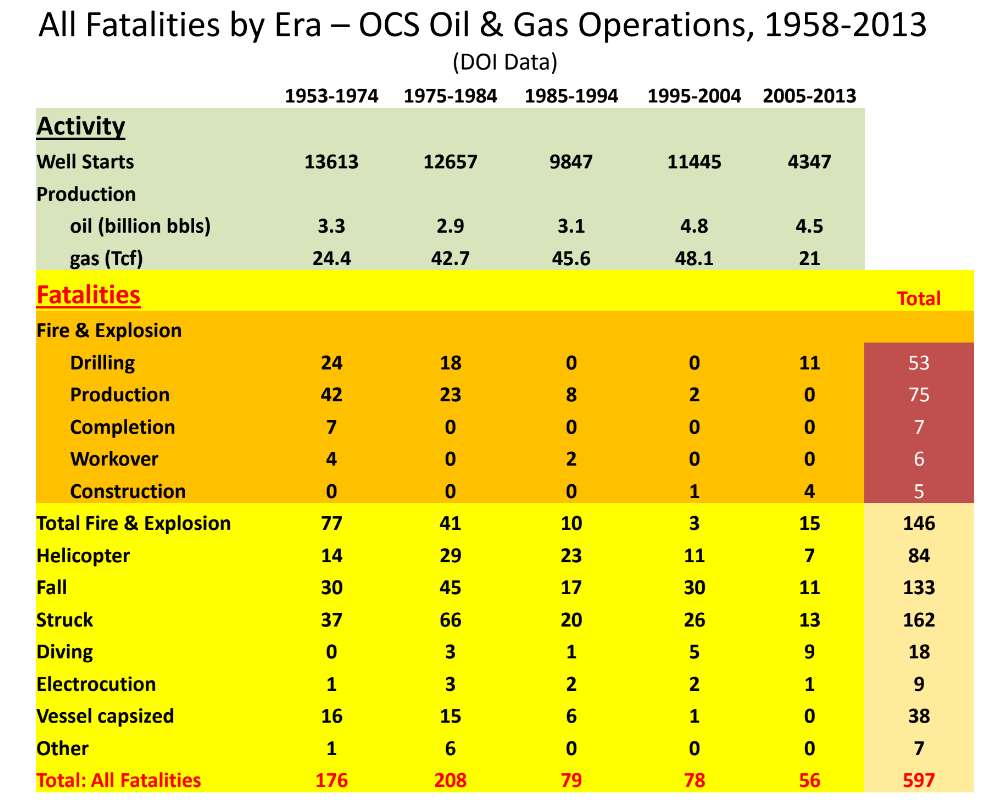
Per yesterday’s post, below are US OCS fatality data from a 2014 presentation. Ten year intervals were selected for 1975-2004. The longer 1953-1974 era was selected so the activity indicators (well starts and production) would be comparable with the next 3 intervals. The last interval (2005-2013) was limited because the presentation was prepared in 2014.
Fire/explosion fatalities exceeded fall/struck fatalities only in the first interval (1953-1974). As one would expect, the fire/explosion deaths were associated with a limited number of better known incidents (e.g. Main Pass 41, Bay Marchand, Macondo). While the overall trend is favorable, fall/struck incidents and helicopter fatalities at offshore platforms have proven to be more chronic.
I hope to update these data in the not too distant future.
Now that the 2021 US OCS incident spreadsheet has been posted and I have commented on the fatalities, I’ll be looking at some incidents by category starting with losses of well control (LWCs). Incident summaries and links to investigation reports follow the bullet points.
4 LWCs incidents in 2021
None posed a significant threat to worker safety or the environment
All were deepwater wells
3 were during exploratory drilling and 1 was during completion operations
All 3 drilling incidents involved water flows after setting 22″ surface casing.
At least one resulted in the loss of the well; unclear regarding the other 2.
All 3 were exploration wells
Per the Lars Herbst review, there were 29 new deepwater exploration well spuds in 2021, so >10% of these experienced losses of well control due to water flows. Much work has been done on preventing top-hole water flows while drilling deepwater wells, but it appears there is more work to do.
The completion LWC was the result of the inadvertent opening of fluid control devices. The report on this incident provides important information for well completion risk assessments.
Incident summaries
Spreadsheet incident 19: Well completion operation. Inadvertent shearing and opening of the fluid loss control devices were not adequately assessed during the planning and review phases of the completion. While displacing the wellbore from 14.8 ZnBr to 14.8 packer fluid, the downhole equivalent circulating density sheared the upper and lower fluid loss control devices. The rig immediately began to experience fluid losses of 600 bph. A 50 bbl fluid loss pill was spotted and losses slowed to 345 bph. A second fluid loss pill was pumped which significantly decreased the losses eventually resulting in zero losses. After losses stopped, the rig experienced approximately a 14 bbl gain on the trip tank. The well was shut in on the annular and circulated out using the driller’s method. Oil was observed in the returns. While waiting on additional fluids and materials, wellhead pressure was managed by bullheading 14.8 brine when required. The well was killed via bullheading down the annulus followed by bullheading down the workstring with 3 CaCo3 pills. investigation report
BOE comment: While the cause of this incident is classified as “human error,” the failure to properly assess and plan for risks associated with the inadvertent shearing and opening of the fluid loss control devices is an organizational/management issue.
Incident 186: Shallow water flow during exploration drilling. Lost well. A shallow water flow was observed from one of the ports in the 38″ wellhead housing following cementation of the 22″ riserless casing string at Caramel Keg (GB 962 #1). Additional wireline logging (casing bond log and temperature log) runs were performed to gain additional insights into the potential source/location of the flow, as well as the quality and presence of cement behind the 22″ casing string. Approval from BSEE Lafayette district was received on April 1st to proceed with running the riser/BOP and continue with subsequent planned operations. Flow from the wellhead was monitored and a general reduction trend in flow from wellhead port was observed. Approval was received from BSEE on April 19th to install and close ball valves on two wellhead ports to isolate flow from wellbore. On April 20th, the ball valves were closed and flow from the wellbore ceased approximately 23 days after initial observation. Approval to temporarily abandon the well was received from BSEE on April 25, along with a monitoring plan of the wellbore and the surrounding area. TA operations concluded on April 27th. The ongoing monitoring program has since identified no indications of flow/broaching at or near the GB 962 #1 wellbore as of May 7th. No personnel were injured or evacuated as a result of this subsurface shallow water flow. report
Comment: The BSEE incident investigation team determined that salt contamination probably caused the cement to go under-balanced triggering flow and channeling behind the 22-in casing.
Incident 478: Exploration well – 7188′ WD; exploration. The 22″ casing cement job went as planned with positive cement returns to the mudline from dye and pH meter. The rig observed post cementing flow. Flow was predominantly gas. The flow started with a single source from the seabed, about 20 ft away from the wellhead. Within the next 2-3 hours, two other flow sources developed, one immediately adjacent to the jetpipe while another flow source surfaced about 10ft away from the wellhead. The rig continued to monitor the post cementing flow and completed multiple ROV wagon wheel surveys. No new seafloor anomalies or active flow points were identified away from the wellhead. Minor flow of water and gas continued at the wellhead. No investigation report.
Incident 507: Post Cement Flow Summary: The 22″ casing was cemented in place at 2:30 AM on August 18, 2021. At approximately 5:45 AM, a minor post cementing flow was observed by the ROV. The flow was only observed from 1 cement port/ball valve connected to the 28″x22″ annulus. The flow composition was predominately cement and absent hydrocarbons. The ROV continued to monitor the flow. No investigation report.