Feeds:
Posts
Comments

Archive for the ‘accidents’ Category

Continuous improvement has to be the primary objective of offshore safety leaders, and this independent blog is committed to recognizing initiatives that further reduce safety and environmental risks. Australia’s collaborative mental survey project is an interesting such initiative in its early stages. Two other important initiatives are noted below.

BSEE’s Dropped Object Risk-Based Inspection initiative: As has been the case for 50 years, most offshore fatalities and serious injuries are associated with falls or falling and moving objects/equipment. BSEE’s Dropped Objects initiative, as described in a presentation by Jason Mathews during a recent Center for Offshore Safety (COS) webinar is intended to draw further attention to and better manage these risks. In addition to BSEE’s focused inspections, the “Good Practices” being followed by some operators and contractors, as described on pages 40-50 of the presentation, are encouraging. These types of initiatives are necessary if we are to achieve the elusive “zero fatality” year on the US OCS.

IOGP process safety guidance, Report 456 v.2 : Contrary to some post-Macondo narratives, process safety and well control were always the primary focus of the US OCS regulatory program. In 1974, my boss Richard Krahl (known as “Mr. OCS” for his commitment to offshore safety) dropped a copy of the first edition of API RP 14C (Analysis, Design, Installation, and Testing of Safety Systems for Offshore Production Facilities) on my desk and told me it was an excellent document that I should read. RP 14 C and other process safety standards were incorporated into the USGS OCS Orders (regulations) in the 1970’s. For decades, the USGS and MMS were leaders in well control and production safety research and training. That said, better indicators and improved approaches to offshore facility process safety were needed, and the International Association of Oil and Gas Producers report has provided an excellent framework. Report 456 is comprehensive and technically sound, and provides excellent guidance and examples. Very well done!

Read Full Post »

Following the Piper Alpha tragedy (1988) and the Exxon Valdez spill (1989), the Minerals Management Service, under the direction of Dr. Charles Smith, embarked on new research to address the human and organizational factors that are fundamental to offshore safety. An important 1993 report, MMS project 167, Management of Human Error in Operation of Marine Systems by Robert Bea and William Moore, observed that:

High consequence accidents resulted from a multiplicity of compounding sequences of breakdowns in the human, organization, and system; often there are precursors or early-warning indications of the breakdowns that are not recognized or are ignored.” The human element is complex and “states” such as “fatigue, negligence, ignorance, greed, folly, wishful thinking, mischief, laziness, excessive use of drugs, bad judgement, carelessness, physical limitations, boredom, and inadequate.” Environmental factors such as weather conditions, time of day, smoke, and noise further complicate human performance.

Bea and Moore, 1993

COVID 19 has further complicated human performance and facility management. In an effort to better understand human factors during COVID, NOPSEMA (the Australian offshore safety regulator) has partnered with industry, and labor organizations, and universities to survey offshore workers.

Per the survey announcement:

Your unique insight on the impacts of the COVID-19 pandemic on members of the offshore workforce are vital to informing industry and the development of strategies that best support employee mental health and well-being.

BOE is looking forward to learning about the results of this survey and other efforts to better assess and understand mental health challenges facing offshore workers. The effective integration of mental health considerations into management systems is critical to safety achievement.

Read Full Post »

Phil Rae piece in Fuel Fix

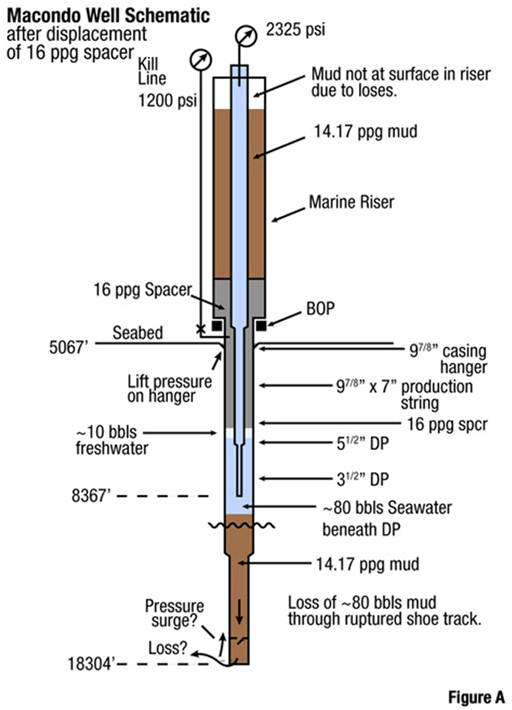
  1. The well clearly had losses through the shoe during the initial displacement of the heavy spacer with seawater, immediately prior to the negative test.
  2. Allowing for, and accepting, losses of ~80 bbls during spacer displacement, explains ALL pressure and flow anomalies without the need to create or invoke undocumented and unsubstantiated valve closures or manipulations that contradict witness testimony of events. It also eliminates the need to adopt unrealistically-low pump efficiencies for the rig pumps, hypothetical washed-out tubing and ridiculously high viscosities for the drilling mud, in an effort to fit questionable computer models.
  3. Despite extensive examination by investigators and the publication of several reports, the fact that the well experienced losses, making it even more severely underbalanced than was planned, has been given little credence or has received little or no attention, despite several clear indications that this was the case. While this statement regarding losses may be self-evident, its significance on the outcome at Macondo merits closer examination since it explains many previous, apparently-contradictory aspects of the disaster.
  4. Under-displacement of heavyweight spacer, as a result of losses during displacement, caused U-tubing and partial evacuation of the kill line, the lower end of which was later refilled with heavyweight spacer, driven by pressure and flow from the formation. The vacuum, initially, and subsequent invasion of heavy fluid rendered the kill line useless for monitoring the well since the line was effectively blind to pressure changes in the well.
  5. While initial flow into the well was through the shoe, pressure above the casing hanger seal during the negative test was reduced to levels that could have allowed the casing to lift, compromising the seal and possibly also allowing flow from the external annulus.
  6. The well encountered further losses during the second displacement (to displace the riser), after completion of the negative test. These losses, which were perhaps as much as 200 bbls, effectively replaced heavy mud with sea water in the casing below the drill pipe. This further underbalanced the well to the point that it was being kept under control only by pumping friction pressure. As the pump rate was reduced prior to shut down for the sheen test, effectively reducing system backpressure, the now severely underbalanced well began to flow.

Read Full Post »


oil-eating bacteria

Woods Hole Oceanographic Institute scientists have published important new findings on the rapid bacterial degradation of the Macondo spill.

They found that bacterial microbes inside the slick degraded the oil at a rate five times faster than microbes outside the slick—accounting in large part for the disappearance of the slick some three weeks after Deepwater Horizon’s Macondo well was shut off.


Read Full Post »

Dauphin Island tarballs, May 2011

Cheryl’s update after reviewing the latest reports:

  • There is a USCG unified command specific to BP spill residue after storms.
  • The tarballs are not considered toxic, just an unattractive nuisance.
  • Tarball cleanup on Dauphin Island was halted on May 1 to protect nesting birds.
  • BP estimates a total Macondo spill volume of about 4 million bbl as opposed to the government estimate of 4.9 million bbl.
  • BP estimates that 850,000 barrels were captured, burned or skimmed off the water.
  • 1,260 people remain employed in spill cleanup as of [July 14, 2011], down from a peak of 48,200 a year ago

Articles of interest:

Alabama.com

WALA New Orleans

Bloomberg Business Week 

Read Full Post »

Very interesting findings for those interested in the fate of spilled oil:

The deep sea entrainment of water-soluble hydrocarbons has far-reaching implications for deep water oil spills. Our results demonstrate that most of the C1-C3 hydrocarbons and a significant fraction of water-soluble aromatic compounds were retained in the deep water column, whereas relatively insoluble petroleum components were predominantly transported to the sea surface or deposited on the seafloor, although the relative proportions are not known.

The resulting apportionments of hydrocarbon transfers to the water column and atmosphere are therefore very different for a deep water oil spill versus a sea-surface oil spill. During seasurface oil spills, highly water-soluble components such as BTEX, C3-benzenes, and naphthalene quickly volatilize and are rapidly lost to the atmosphere within hours to days, thereby limiting the extent of aqueous dissolution into the water column. In the case of the Deepwater Horizon oil spill, however, gas and oil experienced a significant residence time in the water column with no opportunity for the release of volatile species to the atmosphere. Hence, water-soluble petroleum compounds dissolved into the water column to a much greater extent than is typically observed for surface spills.

Read Full Post »

In light of the 2009 helicopter crash that killed 17 workers offshore Newfoundland and the rash of other helicopter incidents around the world, helicopter safety is a major concern for the offshore industry and regulators. This FAA decision (link courtesy of Cheryl Anderson) is sure to be controversial in Atlantic Canada and elsewhere.

The U.S. aviation regulator says it won’t require the retrofit of a gearbox blamed in a fatal helicopter crash off Newfoundland because it would be too expensive for the industry.

 The decision by the Federal Aviation Administration rejects a call by the Transportation Safety Board of Canada to phase-in a requirement that all Sikorsky S-92A gearboxes be capable of operating at least 30 minutes after losing oil.

The March 2009 crash of Cougar Flight 491 resulted in 17 deaths during a flight to an offshore oil platform, and has brought demands from the families of the victims that regulators in the United States, Canada and Europe change the rules governing the gearbox.

The FAA memo on the decision, obtained by The Canadian Press under U.S. freedom of information legislation, says the service record of the helicopter no longer supports the certification’s basic premise that the chances of an oil leak are “extremely remote.”

Read Full Post »

Encouraging report from Steve Walker and his HSE colleagues.

Figures from the Health and Safety Executive (HSE) show that there were 73 major or significant hydrocarbon releases associated with offshore installations in 2010/11, compared with 85 the previous year. There were 61 recorded in 2008/09 – the lowest since HSE began regulating the industry. Overall, there continues to be a downward trend in the total of all reported hydrocarbon releases offshore.

For the fourth year running, no workers were killed during offshore activities regulated by HSE and 2010/11 also saw a fall in the number of major injuries. There were 42 reported compared with 50 the previous year, bringing the total in line with the average of the previous five years.

Read Full Post »

You be the judge.

Read Full Post »

14.07.2011 | On Wednesday 13 July, a fire broke out in the compressor area of Valhall PCP. Today the Petroleum Safety Authority Norway (PSA) will send two representatives to Valhall to investigate the incident.

The fire, which was reported to the authorities yesterday afternoon, started at around 4.40 p.m. A standby vessel was deployed to put out the fire and at 6.45 p.m. it was confirmed that the fire had been extinguished. All personnel were evacuated and there were no injuries.

link

Read Full Post »

« Newer Posts - Older Posts »