Venus is very impressive in the pre-dawn September sky and will peak in brightness over the next week days. Worth checking out!
Venus will be brightest in the morning sky around September 19, 2023, and will reach 44 degrees elongation from the sun by the end of the month. Venus will brighten from magnitude -4.6 to -4.8 during the month.
The reason that the planet Venus is so dazzlingly bright is because it is completely enshrouded in thick clouds that reflect sunlight at us.
In ancient times, mariners looked up to the night sky for guidance, and one celestial body held a special role in their navigation: Venus. With its bright and consistent appearance, Venus served as a reliable reference point for sailors venturing across vast oceans. This article explores the significant role that Venus played in early navigation, guiding mariners safely to their destinations and paving the way for future advancements in seafaring.
Cantium’s record is especially impressive given that most of their platforms were installed more than 40 years ago and some date back to the 1950s. They have also been a very active development well driller.
While Kosmos and Beacon have somewhat lower violation and penalty exposure because their production is via subsea wells tied back to surface facilities operated by other companies, they are demonstrating that entrepreneurial deepwater independents can also be safety leaders.
“The Pickerel-1 prospect was our first (exploration well on the Mississippi Canyon 727) and we are delighted that it was an oil discovery. Black Pearl will be the next and that will hopefully be a tieback (to Tubular Bells with first oil expected mid-2024).
“Then we have a wildcat opportunity (the Vancouver exploration prospect) later in the year in the Green Canyon. With the other 80 exploratory blocks that we have in the Gulf, we will be actively drilling for the next several years,” Hess said.
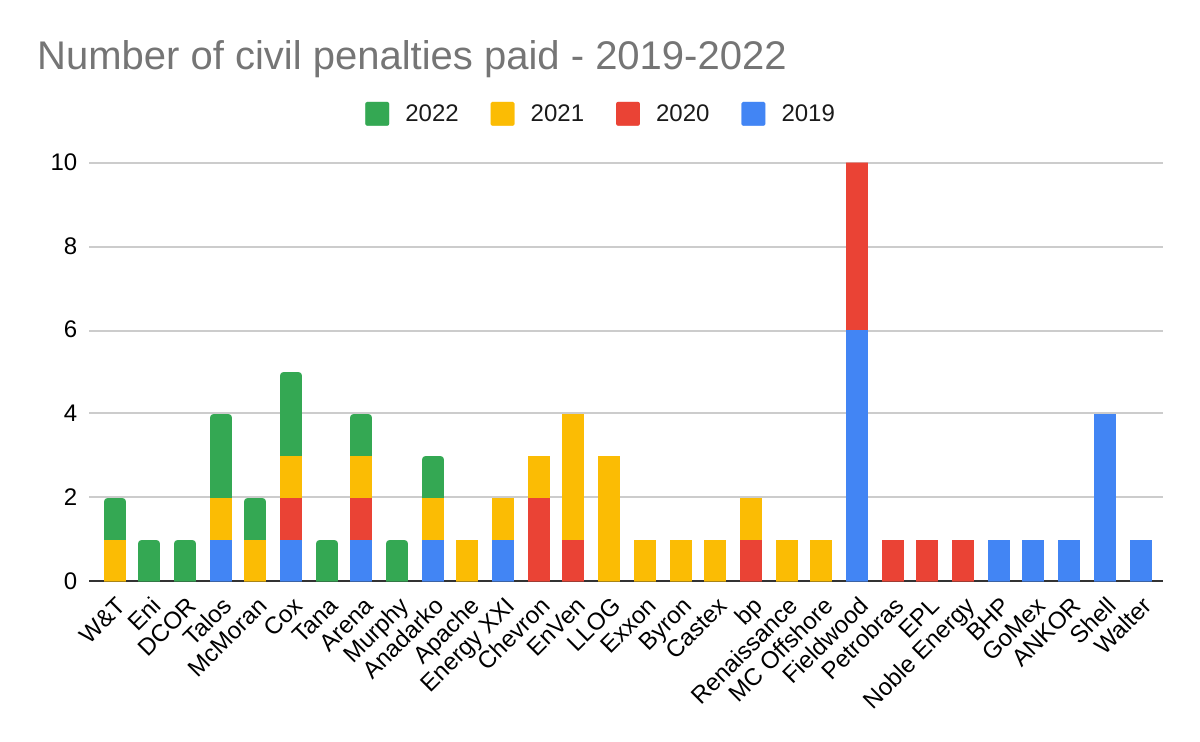
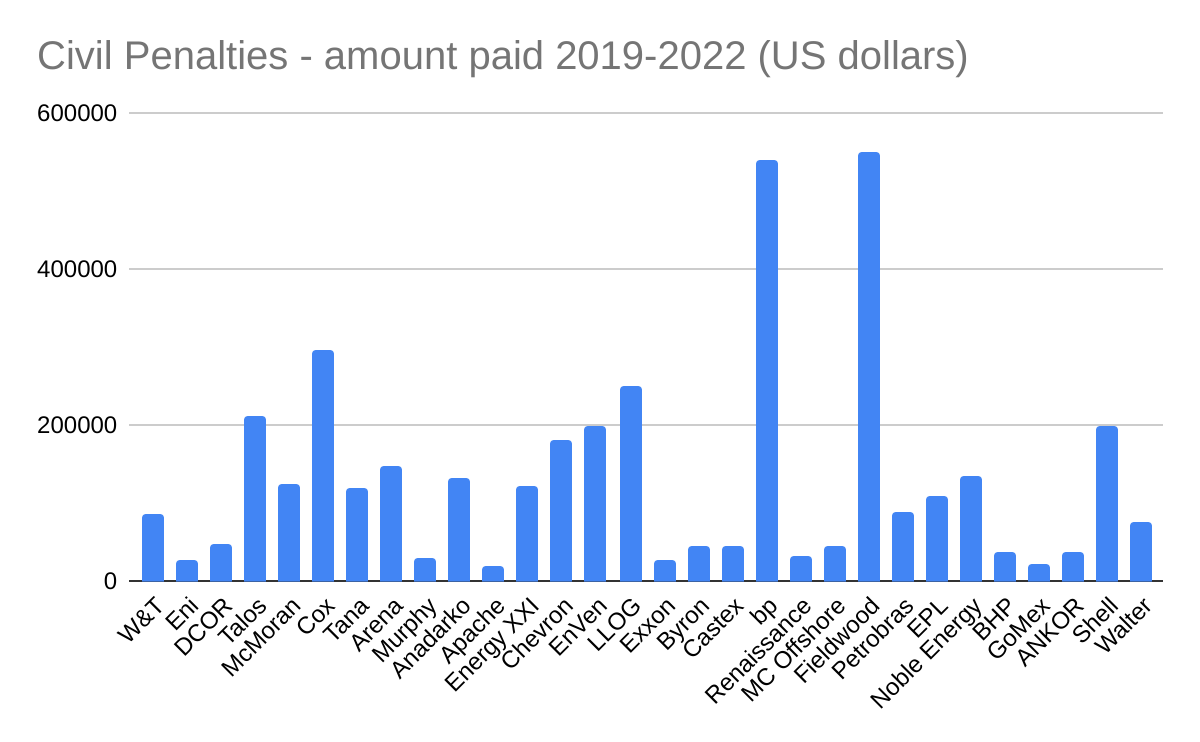
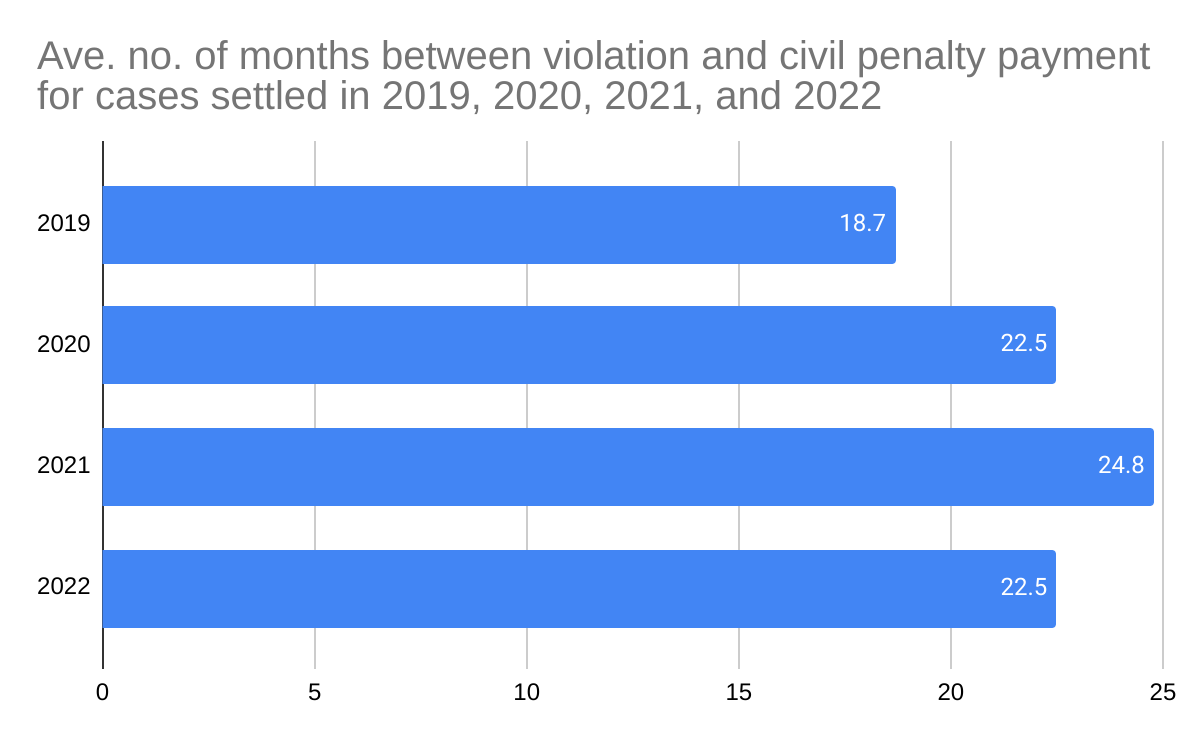
Data are on a fiscal year basis (i.e. 2022 started on 10/1/2021 and ended on 9/30/2022)
These data are only for civil penalties paid in that year. Data for civil penalties referrals are not publicly available.
Nothing terribly surprising in the data. Fieldwood’s issues have been discussed at length.
Note (last chart) the lag between the date violations were observed and the date penalties were paid. This lag is significant but understandable given due process considerations.
Fastest payment: 6 months by Shell for an open hole that was not properly barricaded ($26,750 penalty, 2018).
Slowest payment: 54 months by LLOG for failing to install and maintain equipment properly (three 2016 violations)
Largest civil penalty paid: $512,900 by bp for a high-pressure gas release caused by the use of improper seals (May 8, 2018 violation).
Smallest civil penalty paid: $16,300 by Arena for the release of 1000 psi gas on October 16, 2018
Water depth: 2500 m (Mexico’s first ultra-deepwater project)
Distance from US maritime border: 30 km
Distance offshore: 180 km
Reserves: 324.7 million BOE proved, 478.7 million BOE probable
Production: Floating Production Unit with an oil production capacity of 100,000 B/D connected to an FSO vessel with a capacity of 950,000 bbl. Gas not used to power FPU will be reinjected
The civil penalties provision in the 1978 OCS Lands Act (OCSLA) Amendments was flawed in that it stipulated that operators must be given time to take corrective action before a civil penalty could be assessed. The “time to take corrective action” requirement was confirmed by a 1983 Federal Court decision in Louisiana:
The Court agrees with Chevron’s construction of Section 24(b) and holds that civil penalties may only be imposed under Section 24(b) for violations which continue after the violator has been notified of the breach and has failed to correct it within a reasonable period allowed. This conclusion is based primarily upon a careful review of the pertinent statute. The first sentence sets forth the conditions of liability:
If any person fails to comply with any [provision of the Act] after notice of such failure and expiration of any reasonable period allowed for corrective action, such person shall be liable for a civil penalty of not more than $10,000 for each day of the continuance of such failure.
The court decision gutted the Minerals Management Service (MMS) civil penalties program. Civil penalties could no longer be assessed until the operators had been given time to correct their violations, even those that endangered workers and the environment.
Ironically, Congressman George Miller (D-CA), an ardent opponent of the offshore oil and gas program, proved to be an important MMS ally by adding language to the Oil Pollution Act of 1990 that amended the OCSLA civil penalties provision. The first draft of that language expanded the civil penalties authority to include violations that may constitute a threat of serious, irreparable, or immediate harm or damage to life, property, or the environment.
We were able to revise that draft by adding the words “or constituted” after “constitute” to cover situations where the threat was no longer present. For example, if an inspector found that a well had been drilled without required elements of the well control system in place, the threat may no longer be present at the time the violation was detected but it certainly was when the well was drilled.
The revived MMS civil penalties program was fair and effective, and BSEE seems to be administering the program in a similar manner. Civil penalties data for the past 4 years will be posted next week.
For those interested in safety and compliance data, a good BSEE update for the Gulf of Mexico is attached.
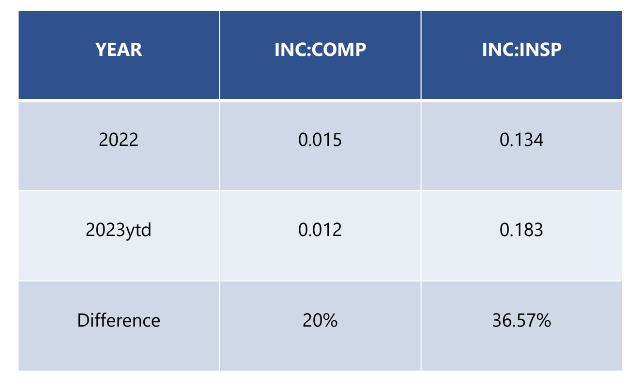
Interestingly, (slide pasted below), there were 20% fewer Incidents of Noncompliance (INCs) per component inspected but 37% more INCs/inspection. This would seem to imply high INC rates at less complex (typically older) facilities with relatively fewer components.
The plaintiffs assert “insufficient and arbitrary environmental analyses, in violation of the National Environmental Policy Act (NEPA) and the Administrative Procedure Act (APA).” The court filing is attached.
All of this will have to be resolved in the next 3 weeks, as the congressionally mandated sale, scheduled for 27 September, (presumably) cannot be postponed.
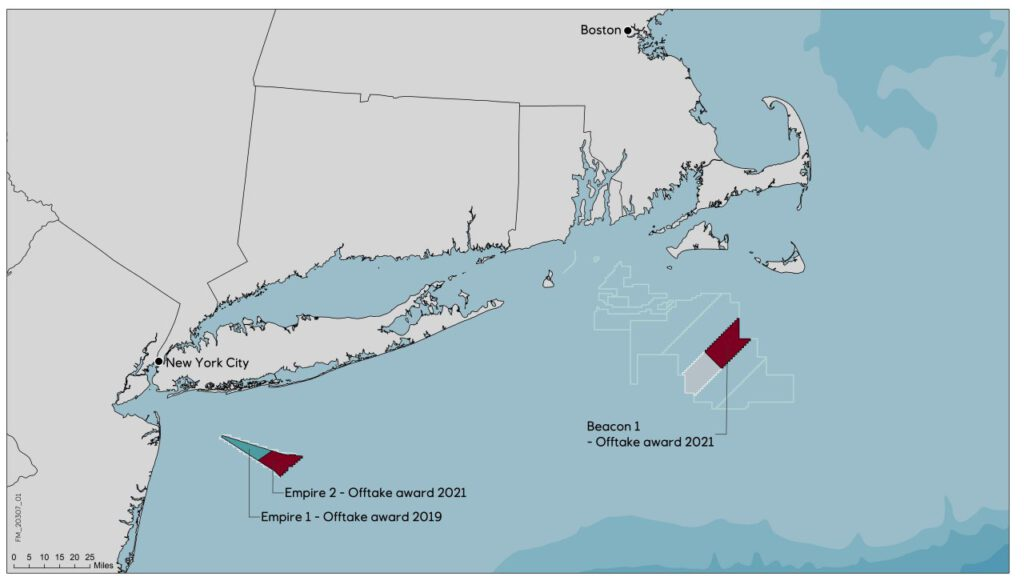
According to the New York State Energy Research and Development Authority, this would result in an average 54% price hike across their portfolio. The strike prices would rise from $118.38 to $159.64/MWh for Empire Wind 1, from $107.50 to $177.84/MWh for Empire Wind 2, and from $118.00 to $190.82/MWh for Beacon Wind.



 Bud's Offshore Energy (BOE)