Feeds:
Posts
Comments

Posts Tagged ‘Walter Oil and Gas’

This image has an empty alt attribute; its file name is image-3.png

The 2024 Gulf of America Safety Compliance Leaders are ranked below according to the number of incidents of non-compliance (INCs) per facility inspection. To be ranked, a company must:

  • operate at least 2 production platforms
  • have drilled at least 2 wells during the year
  • average <1 INC for every 3 facility inspections (0.33 INCs/facility inspection)
  • average <1 INC for every 10 inspections (0.1 INCs/inspection). Note that each facility inspection may include multiple types of inspections (e.g. production, pipeline, pollution, Coast Guard, site security, etc). In 2024, there were on average 3.4 inspections for every facility inspection.

This ranking is based solely on BSEE’s published compliance data. The absence of timely public information on safety incidents (e.g. injuries, fires, pollution, gas releases, property damage) precludes inclusion of these data.

District investigation reports are more timely and provide additional insights into safety performance. Impressively, Hess had no incidents warranting a District investigation, and was the only ranked operator with this distinction. I will comment more on the District reports in a future post

Chevron’s 2024 compliance record was among the best in the history of the US OCS oil and gas program. Was it the absolute best? Were it not for the FSI INC at a Unocal (Chevron) facility, one could unequivocally assert that it was. Further evaluation of that INC would be helpful. However, details on specific INCs are not publicly available, so the significance of that violation cannot be evaluated.

operatorWCSIFSItotal INCsfacility inspINCs/
fac insp
inspINCs/
insp
Chevron10121170.023110.006
BP2305930.052510.02
Anadarko891181430.133440.05
Hess2305260.19670.07
Walter64111500.221610.07
Shell23175451990.234950.09
Cantium2480321230.265370.06
Murphy89118700.261910.09
Arena29283601890.328030.07
Gulf-wide957398109146431330.47106640.14
Notes: Numbers are from published BSEE data; INC=incident of non-compliance; W=warning INC; CSI=component shut-in INC; FSI=facility shut-in INC; INCs/fac insp= INCs issued per facility inspection; each facility-inspection may include multiple types of inspections (e.g. production, pipeline, pollution, Coast Guard, site security, etc), in 2024, there were on average 3.4 inspections for every facility inspection

Not meeting the production facilities requirement to be ranked among the top performers, but nonetheless noteworthy, was the compliance record of BOE Exploration & Production (no relation to the BOE blog 😀). See their impressive inspection results below:

WCSIFSItotal INCsfacility inspINCs/
fac insp
inspINCs/
insp
BOE1102210.1480.04

Transparency on inspections and incidents is important for a program that is dependent on public confidence. For independent observers to better evaluate industry-wide and company-specific safety performance, publication of the following information should be considered:

  • quarterly updates of the incident tables, as was once common practice
  • posting of violation summaries for inspections resulting in the issuance of one or more INCs
  • more timely publication of panel reports for more serious incidents
  • real time list of ongoing investigations including the reason for each investigation
  • status summary for civil penalties that have been proposed, including the violations and responsible parties
Read Full Post »

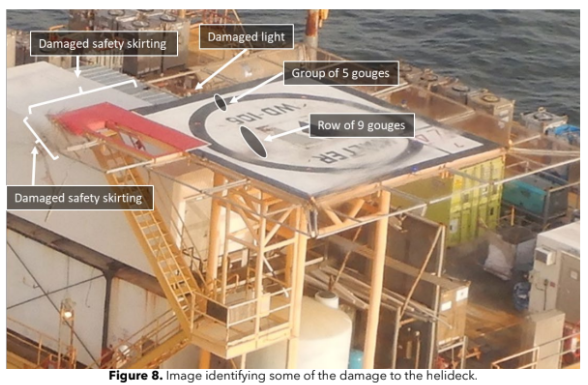
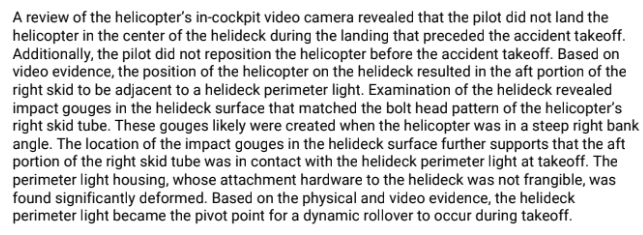
The NTSB has finally issued their report (attached) on the 12/29/2022 helicopter crash that resulted in 4 fatalities at Walter’s West Delta 106 A platform. The NTSB report on the Huntington Beach pipeline spill took a comparable amount of time (26 months) to complete. By comparison, the lengthy and complex National Commission, BOEMRE, Chief Counsel, and NAE reports on the Macondo blowout were published 6 to to 17 months after the well was shut-in.

The gist of the NTSB’s findings is pasted below.

The report summarizes operations standards, but does not consider the associated operator/contractor safety management systems that are intended to prevent such incidents. The report notes that:

Was the contractor/operator aware of these deviations from company policy? Should they have been?

The report implies that human (pilot) error was the cause of the dynamic rollover, but fails to assess the organizational controls that are intended to prevent such errors. How was a pilot with 1667.8 flight hours (1343.8 as the PIC), who had made 23 trips to this platform, repeatedly making fundamental positioning and takeoff errors?

The report also notes that:

This is interesting wording given that the perimeter light was identified as the pivot point, one of the 3 requirements for a dynamic rollover. Why wasn’t that violation observed by the operator/contractor and corrected? What helideck inspection procedures were in place? Did NTSB consider the fragmented regulatory regime for helicopter safety, particularly with regard to helidecks?

Read Full Post »

David Scarborough, Island Operating Co. employee who died in the crash.

The preliminary NTSB report was posted on 1/18/2023, but the final report has still not been published. Status update:

Will the investigators consider longstanding regulatory fragmentation issues? The most recent Coast Guard – BSEE MOA for fixed platforms added to helideck regulatory uncertainty by assigning decks and fuel handling to BSEE and railings and perimeter netting to the Coast Guard.  This is the antithesis of holistic, systems-based regulation.

Read Full Post »

4/17/2023 NTSB data base search results:

Preliminary report

Read Full Post »

Presentations from the January 2023 HSAC meeting have now been posted. None of the presentations addresses the tragic crash in the Gulf of Mexico on 29 December. This is understandable given the ongoing investigation.

Attached is an update from the Helideck Committee which also addresses wind farm issues.

Read Full Post »

The attached NTSB report includes details on the timing of the accident, observations from personnel remaining on the platform, condition of the helipad, nature and location of the debris, and the recovery of the fuselage and separated tail boom. The engine control unit (ECU) was recovered and sent to an NTSB lab for data extraction.

Link to previous posts on the crash.

Read Full Post »

Offshore gas has important environmental advantages, particularly nonassociated gas-well gas (GWG). While the GoM production chart (below) is not pretty, there are signs that gas production may have bottomed and is slowly rising. This is largely due to growth in oil-well gas (OWG) associated with deepwater oil production.

A successful offshore program requires a mix of strategies, and it is encouraging that companies are still pursuing natural gas on the GoM shelf. The second chart (below), based on BOEM data, shows 2022 YTD (probably through Oct.) GWG production for the 11 companies that (1) produced more GWG than OWG and (2) produced more than 1 BCF of GWG.

Interestingly, 100% of the gas produced by Contango, Samchully, and Helis in 2022 was from gas wells. Contrast this with bp, the third largest GoM gas producer. None of bp’s gas production was from gas wells.

One has to wonder about the extent to which deepwater gas reservoirs are being stranded due to the less favorable economics. Preventing such resource losses was once an important regulatory consideration given the conservation mandate in the OCS Lands Act and the importance of maximizing the public benefit. However, current policy, as expressed in the proposed 5 year leasing plan, is to phase out offshore production rather than sustain it. This is difficult to reconcile.

Read Full Post »

David Scarborough, Island Operating Co. employee who died in the crash.
  • The bodies of the 4 victims have been recovered.
  • The 3 offshore workers were employees of Island Operating Co., a production contractor. The pilot worked for Rotorcraft Leasing Company, the owner of the Bell 406 helicopter that crashed. The platform is owned by Walter Oil and Gas, the operating company.
  • A preliminary FAA report confirms that the helicopter crashed onto the helideck during takeoff, breaking apart and falling into the Gulf.
  • 4 passengers had been dropped off at the platform before the fatal takeoff. Presumably there were witnesses to the incident.
  • According to the FAA report, the platform was located at West Delta Block 106. Per the BOEM platform data base, the platform was installed in 1994, is in 252′ of water, and is continuously manned.
  • Per the BSEE INC data base, the platform had not been cited for any violations since 2016.

Lacy Scarborough, wife of victim David Scarborough, is pregnant. Tragically, the couple lost their first child in an accidental drowning in March. David was heading home for the holidays after completing his 2 week shift on the platform. He had worked offshore for 8 years. Per Lacy, David’s last message was that he was taking off and would be home soon.

The only other victim who has been identified is Tim Graham of Quitman, Mississippi.

I trust that the NTSB will conduct a timely and thorough investigation, and hope they consider offshore helideck oversight, both in terms of industry programs and government regulation. The most recent Coast Guard – BSEE MOA for fixed platforms added to helideck regulatory uncertainty by assigning decks and fuel handling to BSEE and railings and perimeter netting to the Coast Guard. This is the antithesis of holistic, systems-based regulation.

More on the crash: ominous message, update #3

Read Full Post »

ainonline:

  • This was the second crash for the operator (Rotorcraft) in two weeks, its second fatal for the year, and the third in the Gulf of Mexico since October.
  •  On December 15, a Rotorcraft Leasing Bell 206L-4 with three aboard crashed while taking off from a platform 35 miles south of Terrebonne Bay, Louisiana. In that accident, one of the helicopter’s skids caught under the helipad’s perimeter railing, and the aircraft fell into the water below. (We have concerns that yesterday’s incident may have had a similar cause.)
  • On October 26, a Westwind Helicopters Bell 407 with three aboard crashed into the Gulf 25 miles south of Morgan City, Louisiana after the pilot apparently experienced an in-flight medical emergency and told his front seat passenger he “was not going to make it” and then slumped over the controls. The front-seat passenger then attempted to gain control of the helicopter prior to the water impact. After several hours, both passengers were rescued with serious injuries, but the pilot died. (This is why I never liked single pilot aircraft.)
  •  Another of the company’s Bell 407s crashed on January 14 near Houma, Louisiana, killing both occupants. A witness to the accident said the helicopter appeared to dive nose-down into terrain. To date, investigators in that accident have not discovered any mechanical or structural failure that would account for that crash. 

Get to work HSAC, NTSB, BSEE, USCG, FAA, and all others who are involved with offshore helicopter safety.

Not a word about this tragedy on the Rotorcraft, Walter Oil & Gas, or BSEE websites, and no public statements can be found. At a minimum, one would have expected condolences to the families and a commitment to find out what happened and prevent recurrences.

Read Full Post »

From Lars Herbst:

  • Tragically, the pilot and 3 passengers are assumed dead.
  • Aircraft reported as Bell 407, a very common smaller aircraft used in the GOM
  • Crashed on departure; apparently hit the helideck before tumbling into the Gulf
  • Second Rotorcraft helicopter to go down in the Gulf in three months

The next Helicopter Safety Advisory Conference (HSAC) meeting, scheduled for January 18-19 in Houston, is now urgent.

Read Full Post »

Older Posts »