Feeds:
Posts
Comments

Posts Tagged ‘Shell’

The Board of Shell plc (“Shell”) today announced its intention to exit its joint ventures with Gazprom and related entities, including its 27.5 percent stake in the Sakhalin-II liquefied natural gas facility, its 50 percent stake in the Salym Petroleum Development and the Gydan energy venture. Shell also intends to end its involvement in the Nord Stream 2 pipeline project.

Shell.com

Read Full Post »

While the Fieldwood Energy violations drove up the number of Incidents of Non-Compliance (INCs) in the Gulf of Mexico in 2021, most operating companies appear to have had good compliance records. Among companies that were subjected to at least 10 facility inspection and drilled at least one well, BHP Billiton, Eni US, and Murphy (listed alphabetically) had the most impressive compliance records. These three operators were cited for 7 or fewer INCs, none of which required a facility to be shut-in. Other operators that exceeded those activity thresholds and had excellent compliance records were (listed alphabetically) Anadarko, ANKOR Energy, Chevron, EnVen, Shell, and Walter Oil and Gas.

In the Pacific Region, Beta Operating Co., Chevron (now overseeing the former Signal Hill properties), and Exxon had excellent compliance records, although none of these facilities produced for the full year. In Alaska, Hillcorp had an excellent record at the Northstar Unit. (This is a gravel island facility in the State waters of the Beaufort Sea, but some of the wells produce from portions of the reservoir that are in the Federal sector).

Unfortunately, only summary inspection data are posted online. Without knowing the specific violations and circumstances, it’s not possible to fully assess the risk exposure. These oil and gas operations are conducted on public lands and are monitored by Federal employees. Inspection data and reports should be publicly accessible without having to submit Freedom of Information Act requests.

As has previously been discussed, incident updates should also be posted in a timely manner. Reference is made to this important recommendation in the 2016 National Academies report entitled Strengthening the Safety Culture of the Offshore Oil and Gas Industry:

Recommendation 4.2.2: Because accident, incident, and inspection data all are needed to identify and understand safety risks and corrective actions, the committee recommends full transparency such that regulators make all these data readily available to the public in a timely way, taking into consideration applicable confidentiality requirements.

Read Full Post »
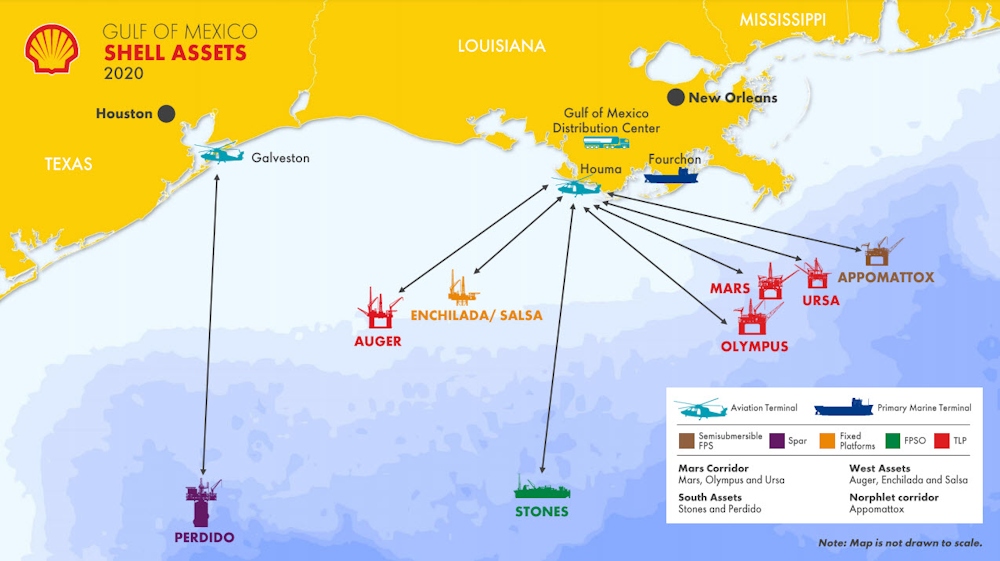
Per Shell, production at Mars and Ursa has restarted. Olympus was restarted on 10/1. The December production figures should give us a pretty good indication of stabilized GoM production post Ida.

210902 Shell Go M Asset Map

Read Full Post »

Maersk Drilling awarded contract extension to drill world record well in Angola

The Ondjaba-1 well will be drilled at a new world record water depth of 3,628 m. The current world record is 3,400 m, set by Maersk Voyager’s sister drillship Maersk Venturer when it drilled the Raya-1 well for TotalEnergies offshore Uruguay in 2016.

Maersk

The record US water depth well (3051m/10,011′) was drilled in 2003 by Transocean for Chevron in Alaminos Canyon Block 951 the Gulf of Mexico. The deepest well drilled in US GoM in 2021 YTD was for Shell in 9352′ of water in Alalminos Canyon Block 815.

While brief celebrity space flights are major news stories, these economically important and technical challenging accomplishments by the offshore industry receive very little attention even as oil prices pierce the $82/bbl mark.

Read Full Post »

Shell’s damage assessment of the West Delta 143 (WD 143) platforms revealed significant structural damage. Shell estimates that that the WD-143 “A” platform facilities will be off line for repairs until the end of 2021, and that the facilities on our WD-143 “C” platform will be operational in Q4 2021. Shell expects to resume production from their Olympus platform, which flows across the WD-143 “C” platform, in Q4 2021, and from their Mars and Ursa facilities, which flow across the WD-143 “A” platform, in Q1 2022.

Mars, Olympus, and Ursa account for most of the GoM production that remains shut-in as a result of Hurricane Ida.

Read Full Post »

Shell Offshore Inc. (Shell), a subsidiary of Royal Dutch Shell plc, conducted an initial flyover of our assets in the path of Hurricane Ida. During this initial flight, we observed damage to our West Delta-143 (WD-143) offshore facilities. When it is safe to do so, we will send personnel offshore to provide a closer inspection of these facilities to understand the full extent of the damage and the degree to which our production in the Gulf of Mexico will likely be impacted.

Shell news release

This is a very significant report given the importance of the WD 143 platform in transferring all production from Shell facilities in the “Mars corridor.” These facilities include the Mars, Olympus, and Ursa platforms.

Read Full Post »

News: BOEMRE releases report on the September 2010 Mariner Fire in the Gulf of Mexico.
BOE Comments:

  • Good report and relatively timely. Nice job by the team.
  • Good discussion of the heater-treater and production safety issues.
  • This was a very serious incident and lives were jeopardized. Sadly, no oil spill means no public attention.
  • Why didn’t the Coast Guard participate in the investigation? Will they be reporting on the haphazard evacuation?
  • Age old question: Is the rather extensive discussion of violations appropriate for an accident report? Should violations and enforcement actions be managed independently from accident investigations?
BOE: Floating liquefaction facilities open interesting possibilities for producing natural gas in remote offshore locations, possibly including the arctic.  The first FLNG facility will be 488 m from bow to stern! Offshore to the future!
BOE: Lots of posturing and not much in the way of meaningful proposals from either party. Unlike Australia, the US has not responded to its blowout with necessary legislative action, most notably the establishment of a single offshore safety and pollution prevention regulator.
BOE: Engineers solve problems when given the opportunity and encouragement. JL Daeschler is busy at the drawing board!
News: Greenland rolls on. despite Greenpeace protests. Cairn Energy has begun a second summer of drilling.
Views: Last summer’s results must have been sufficiently encouraging to justify further exploration. 
News: Hurricane season officially begins tomorrow.
BOE: There has been surprisingly little public discussion about the offshore industry’s preparations. Hopefully, everyone is ready.
BOE: Where is the worldwide commitment from industry and government? This problem can and must be fixed!

Read Full Post »

Anchorage Daily News:

The federal Environmental Appeals Board, which is part of the EPA, reviewed the permits. It found last week that the analysis of the impact of nitrogen dioxide emissions from the ships on Alaska Native communities was too limited, and remanded the permits so that problems cited by the board could be fixed by the agency.

The closest proposed drill site is 60 miles off shore and about 80 miles from Wainwright, an Inupiat Eskimo village 710 miles northwest of Anchorage.

Read Full Post »

Shell’s submission to the BOEMRE provides more details on discharge plans for their Beaufort Sea exploratory drilling, and confirms that all muds and cuttings generated in drilling below the 20″ casing will be transported out of the Beaufort for disposal.  Shell also plans to transport gray water and sanitary wastes, bilge, and ballast water to approved discharge sites. This is about as close as you can get to true “zero discharge” when conducting exploratory drilling from a floating drilling unit.


Read Full Post »

Shell has agreed to transport its used drilling fluids from Beaufort Sea exploration drilling out of the Arctic if the company finally gets government permission to drill a well next summer. Alaska Journal of Commerce

I assume this includes all drilling fluids and drilled solids (cuttings) except for the spud mud and cuttings generated prior to installing the riser?  If so, I believe this will be a first for an exploratory well drilled from a floating rig in US offshore waters.

Read Full Post »

« Newer Posts - Older Posts »