Feeds:
Posts
Comments

Posts Tagged ‘offshore oil’

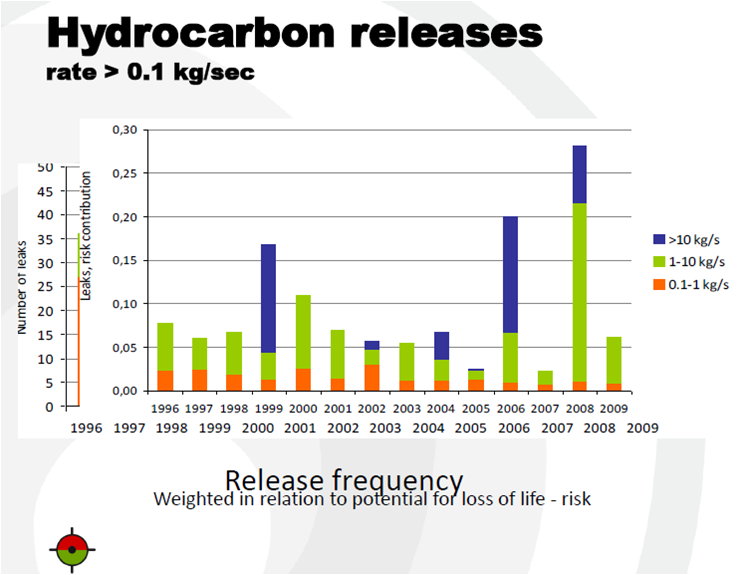
The above slide is excerpted from Torleif Husebo’s presentation at the Vancouver conference.  Since Piper Alpha in 1988, offshore safety leaders have been gathering and assessing hydrocarbon release data.  Norway, the UK, Australia, the Netherlands and other nations track these data because they are an important indicator of fire and explosion risks. The IRF reports these data as part of their performance measurement project.

Obviously, when hydrocarbons are unintentionally released at an offshore facility you have the potential for a very dangerous situation.   However, because of objections voiced when the MMS updated incident reporting requirements 5 years ago, the US government does not collect the detailed information needed to track the size and cause of these releases.  The US is thus unable to monitor trends and benchmark against other nations around the world.

Offshore companies have done well in responding to the drilling issues raised following the blowout.  However, the post-Macondo offshore industry needs to provide broad safety leadership.  A commitment to collecting performance data and assessing risk trends at OCS oil and gas facilities is absolutely essential.  A good place to start would be to initiate a cooperative hydrocarbon release data gathering program.

Read Full Post »


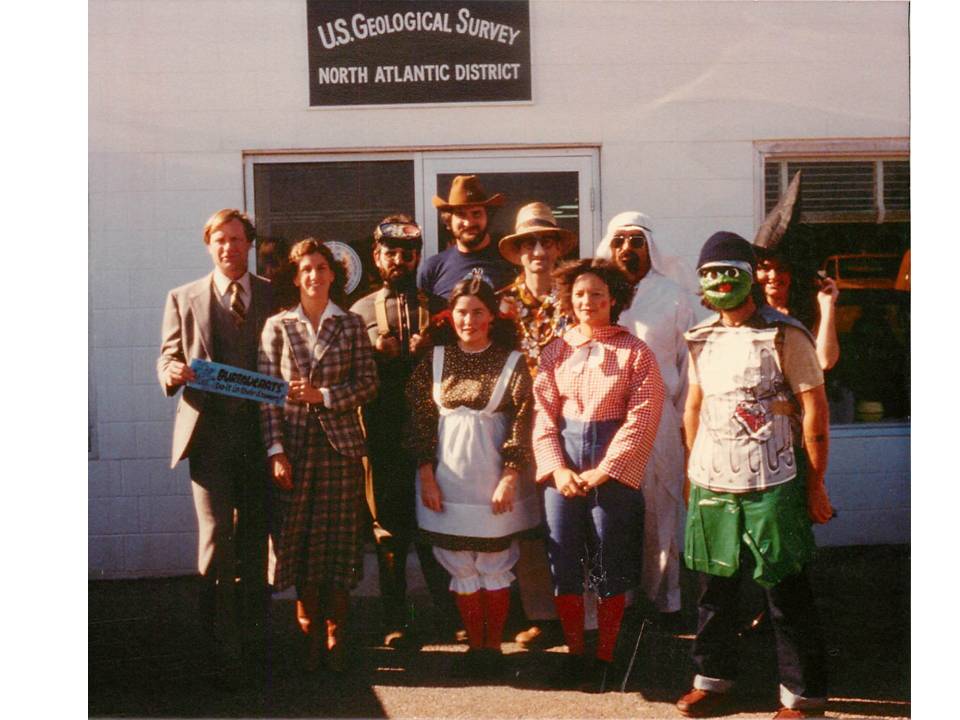
Hyannis Halloween - 1981


Note the sign (above) on our office at Barnstable Municipal Airport in Hyannis. Prior to 1982 when the Minerals Management Service was formed, the OCS regulatory program was part of the US Geological Survey (Conservation Division) and the leasing program was in the Bureau of Land Management. After a 28-year marriage, these functions are again being separated.

As one who worked in the OCS program for 10 years prior to the formation of MMS, I think the the pre-1982 framework is conceptually preferable. However, unless the separation is carefully executed, disruptive conflicts between the two organizations are guaranteed.  Such conflicts were common in the pre-MMS days, and the Department of the Interior had to set up a special office to coordinate activities and manage disputes.

In addition to being independent, the new regulatory authority must be fully responsible (without interference) for all regulatory actions from plan approval through abandonment.  Without such independence and authority, the separation will only add to the regulatory confusion that has handicapped the OCS program throughout its history.

Technical and scientific personnel in the OCS regulatory program must be freed from non-productive and time-consuming internal disputes and coordination responsibilities so they can concentrate on performance measurement, risk assessment, safety leadership, standards, and technical studies.

Read Full Post »

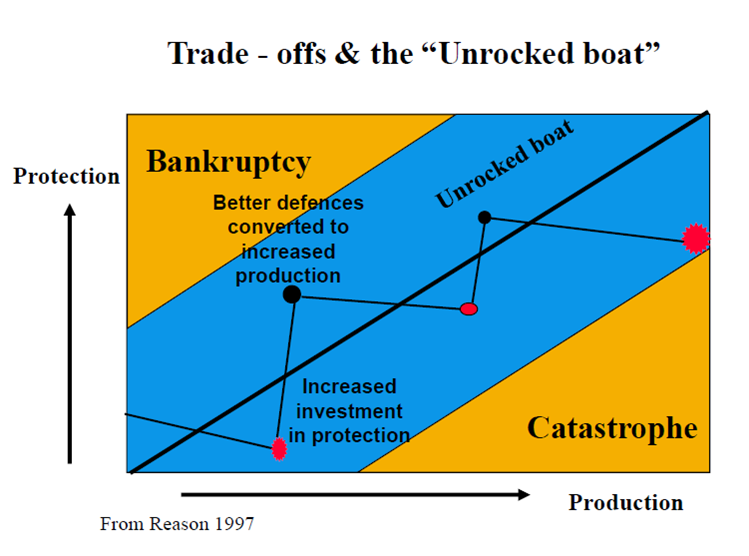
This slide presented by Dr. Mark Fleming during his excellent presentation in Vancouver piqued my interest, so I looked for a bit more information.  I found this interesting observation in a paper by Gonzales and Sawicka:

The role of risk perception is particularly interesting. First, performance in both safety and security settings is well characterized by the “unrocked boat” metaphor: Organizations become accustomed to their apparently safe state, thus misperceiving risk and allowing themselves to drift into regions of greater vulnerability, until (near) accidents temporarily induce greater risk awareness. The resulting pattern is oscillatory, with varying amplitude and typically leading to disaster.

The above quote seems to describe the situation on the Deepwater Horizon. Perhaps there was a sense of invulnerability among some employees (including managers) and finishing the job took precedence over safety.  As Mark Fleming remarked in his presentation, offshore workers know their employer is in business to produce barrels of oil, not barrels of safety.  Concerns about production (or in this case timely suspension of the well) can easily supersede concerns about safety.

A very important paper by James Reason, the person responsible for the “Unrocked Boat” diagram, had this to say:

The same cultural drivers-time pressure, cost-cutting, indifference to hazards and the blinkered pursuit of commercial advantage-act to propel different people down the same error-provoking pathways to suffer the same kinds of accidents. Each organization gets the repeated accidents it deserves. Unless these drivers are changed and the local traps removed, the same accidents will continue to happen.

Reason goes on to recommend a data collection program that is currently absent, at least on an industry-wide basis:

In the absence of sufficient accidents to steer by, the only way to sustain a level of intelligent and respectful wariness is by creating a safety information system that collects, analyzes, and disseminates the knowledge gained from accidents, near misses, and other sources of ‘free lessons.’

I would suggest that another way to sustain wariness is to present information on past accidents and why they can happen again. How many industry employees know what happened at Santa Barbara, Bay Marchand, Main Pass 41, Ixtoc, the Alexander Kielland, Ocean Ranger, Brent B, South Pass 60 B, and even Piper Alpha?

Finally, Reason reaches this critically important and completely relevant conclusion (keep in mind that this paper is 12-years old):

It need not be necessary to suffer a corporate near-death experience before acknowledging the threat of operational dangers-though that does appear to have been the norm in the past. If we understand what comprises an informed culture, we can socially engineer its development. Achieving a safe culture does not have to be akin to a religious conversion-as it is sometimes represented. There is nothing mystical about it. It can be acquired through the day-to-day application of practical down-to-earth measures. Nor is safety culture a single entity. It is made up of a number of interacting elements, or ways of doing, thinking and managing, that have enhanced resistance to operational dangers as their natural by-product.

Read Full Post »
Click here to view the presentations from the International Regulators’ Offshore Safety Conference in Vancouver.

Read Full Post »

Upstream was in attendance at today’s Arctic Oil & Gas Conference in Oslo and posted an interesting report. At the conference, Cairn Energy’s Engineering and Operations Director Phil Tracy wisely avoided the “can’t happen here, can’t happen again, can’t happen to me” traps.  Instead, he correctly noted that:

An uninformed public are looking for guarantees we cannot give.

Kudos to Mr. Tracy.  We are not politicians, and must be open and honest with the public.  Yes, a disaster can happen again, but we will do everything possible to prevent it.  While the professional opposition and their political leadership will never be satisfied, the public at large appreciates candid and honest responses.

I was personally required to give a point by point by point submission (covering HSE) to the Greenlandic authorities. Phil Tracy

I have to give high marks to Greenland.  They resisted the cry to prohibit drilling, but challenged the operator and insisted on a top-notch operation.  Well done!


Cairn operation offshore Greenland. Greenpeace provides moral support.


Read Full Post »

Now that Chile, with the help of the international community (including two companies from the Commonwealth of Pennsylvania where the drilling industry began), has rescued the 33 miners, can we drill into the Australian government and rescue the Montara and Varanus Island reports?

While we are at it, can we learn more about these accidents?

Let’s learn from past accidents, so we don’t need dramatic rescues in the future.

The offshore safety record will be suspect until industry and governments have credible, internationally accepted programs and policies for ensuring that accidents are independently investigated and that investigation updates and reports are released in a timely manner.

Read Full Post »

We are pleased that Mexico’s new regulatory agency CNH will be participating in the International Regulators Offshore Safety Conference in Vancouver. North American cooperation on offshore safety and regulatory issues is critical to the energy and economic futures of all countries in the region.

Read Full Post »

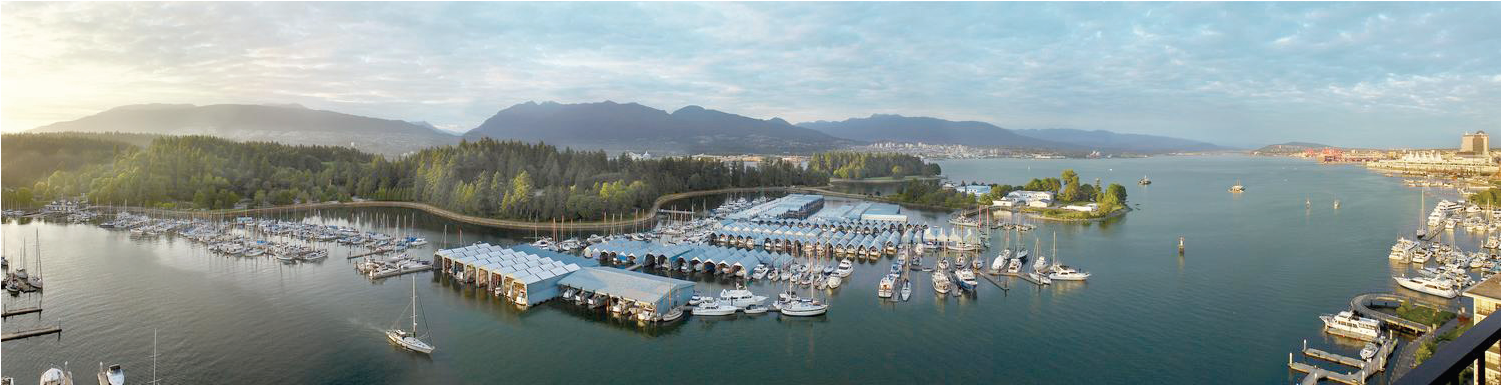
In less than 10 days, we kick off the International Regulators’ Offshore Safety Conference in Vancouver.  The venue is top-notch, the list of delegates is long and impressive, and the speakers are world leaders in offshore operations, safety, and regulatory practices.  Everything is in place for a productive conference; now it is up to us.  We must challenge the speakers, each other, and conventional wisdom if we want to make a difference.  We need to understand where we have been, and then focus on where we are going.  In that regard, the “Roundtable Discussions” will be an important part of the conference.  If you plan to attend the conference and would like to assist with the Roundtable Sessions, send a note to edanenberger@gmail.com.

Here are ten issues that I look forward to discussing with other delegates:

  1. How do we develop a comprehensive and verified international incident data base?   The IRF data and some of the industry efforts are good starts, but where do we go from there?
  2. What other performance data should be routinely collected?
  3. How do we assess emerging and hidden risks?  In that regard, I am looking forward to Torleif Husebø’s presentation: PSA’s Risk Level Measuring Scheme and how available data are collected and used.
  4. Looking beyond centralizers, long-strings, and corrosion caps, what are the management lessons from Macondo and Montara?
  5. Is there such a thing as a hybrid regulatory regime?  While a certain amount of prescription is necessary in any regulatory system, how can a regime have both  “command and control” and “safety case” elements?  Aren’t they contradictory?
  6. How do we develop and encourage safety leaders?  How do we measure their progress.  In that regard, I am really looking forward to Mark Fleming’s presentation: Know where you are going rather than where you have been! A Leaders’ guide to continuous safety performance measurement
  7. Can regulators inhibit industry safety achievement?  How do we encourage innovation and leadership?  How do we deal with those who have no interest in either?
  8. Should standards participation and safety research be a part of every operator’s safety management programs?
  9. Can the international community help provide stability and perspective during crises like Macondo?
  10. What are the next steps in international cooperation on offshore safety?


Read Full Post »

Safety and Environmental Management Systems

This rulemaking will incorporate in its entirety and make mandatory the AmericanPetroleum Institute’s Recommended Practice 75, Development of a Safety andEnvironmental Management Program for Offshore Operations and Facilities, with respectto operations and activities under the jurisdiction of BOEMRE. This final rule will applyto all OCS oil and gas and sulphur operations and the facilities under BOEMREjurisdiction including drilling, production, construction, well workover, well completion,well servicing, and DOI pipeline activities.

The rule will become effective on November 15, 2010.

Read Full Post »

The complete interim final Drilling Safety Rule is now posted on the Federal Register site.  This rule was announced on 30 September along with the Safety and Environmental Management System rule. The latter rule has not yet been posted by the Federal Register.

The Drilling Safety Rule is effective immediately.  With regard to comments:

While BOEMRE will not solicit comments before the effective date, BOEMRE will accept and consider public comments on this rule that are submitted within 60 days of its publication in the Federal Register. After reviewing the public comments, BOEMRE will publish a notice in the Federal Register that will respond to comments and will either:

1. confirm this rule as a final rule with no additional changes, or

2. issue a revised final rule with modifications, based on public comments.

Read Full Post »

« Newer Posts - Older Posts »