Updatedincident tables for OCS oil and gas operations. The most recent data are for 2023! Providing timely details on incidents is a fundamental responsibility of a safety regulator.
A summary of incidents associated with the OCS wind program. From press reports, we know about the fatality during Empire Wind construction. What other incidents have occurred to date?
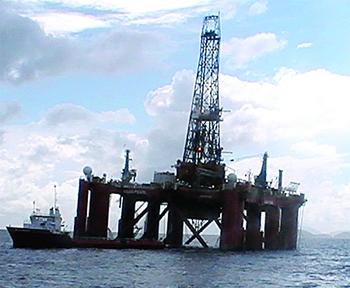
Information on the mysterious sinking of the Aban Pearl semi-submersiblein May 2010. An investigation was conducted, but the report was never shared. In the interest of offshore safety, the new regime in Venezuela should release this report.
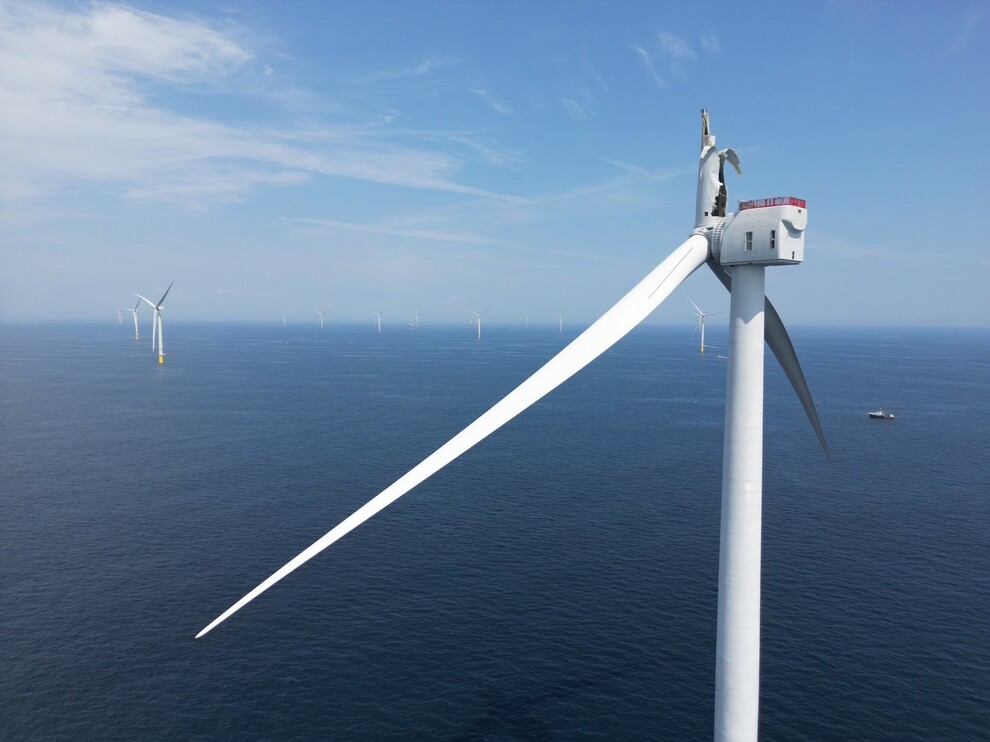
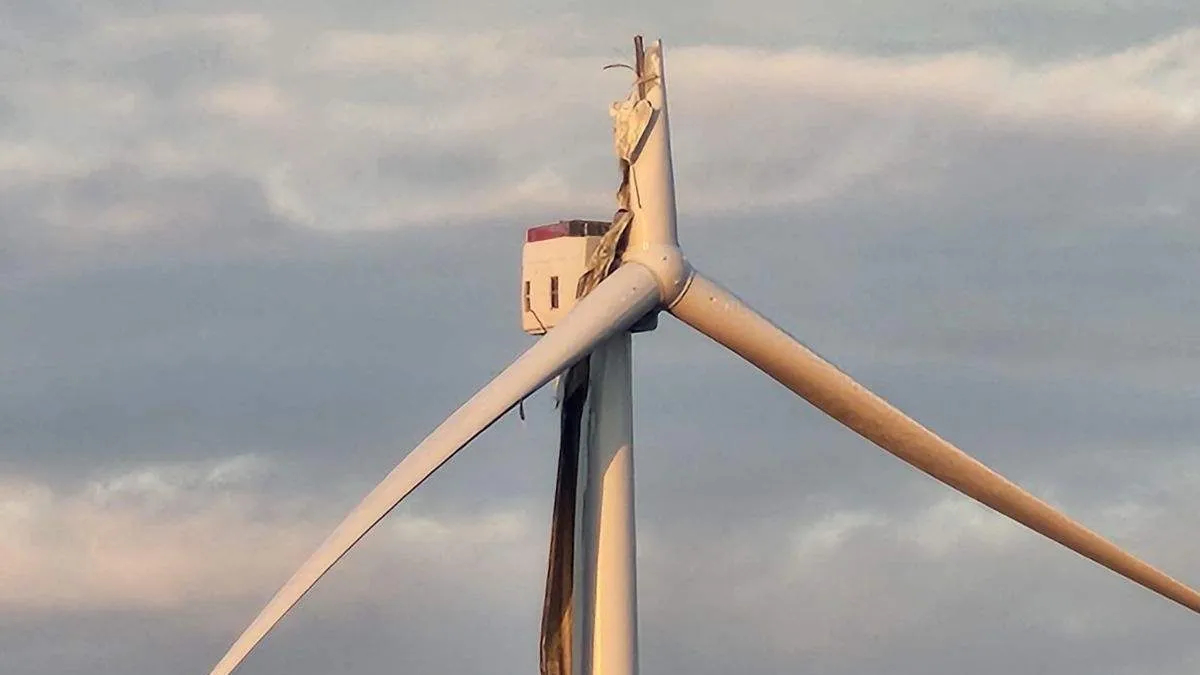
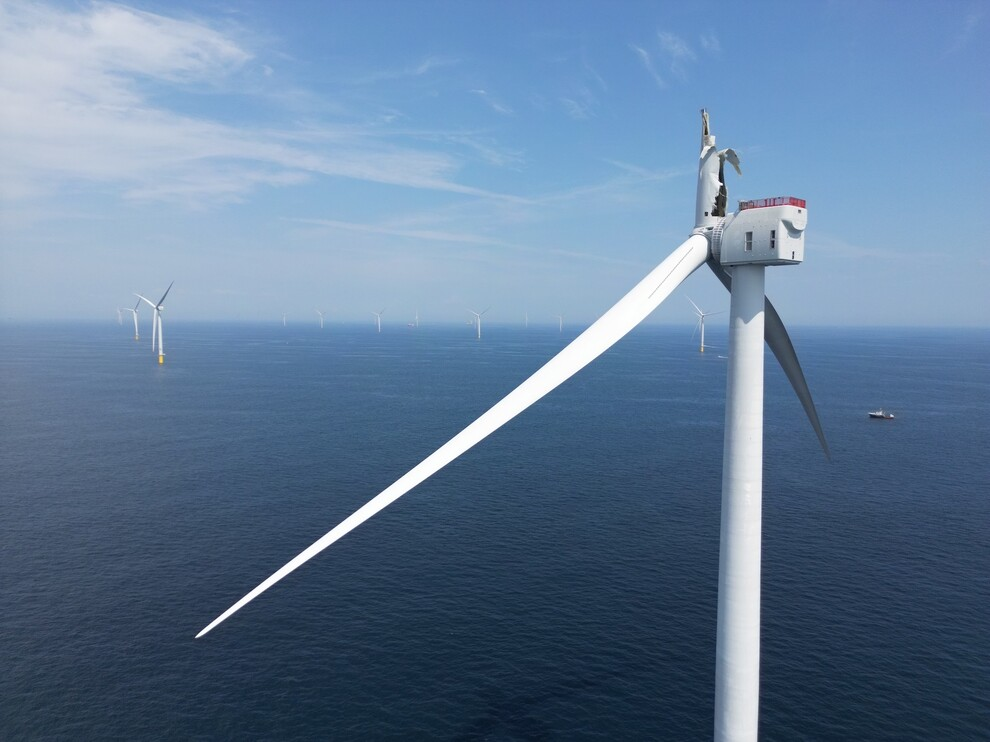
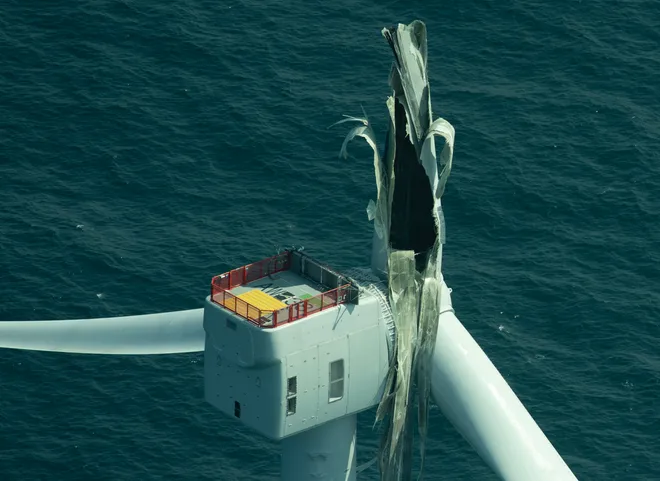
The Town of Nantucket’s attorney, Greg Werkheiser of Cultural Heritage Partners, told The Light last month that “it’s taken far too long” to get a final report on the blade failure.
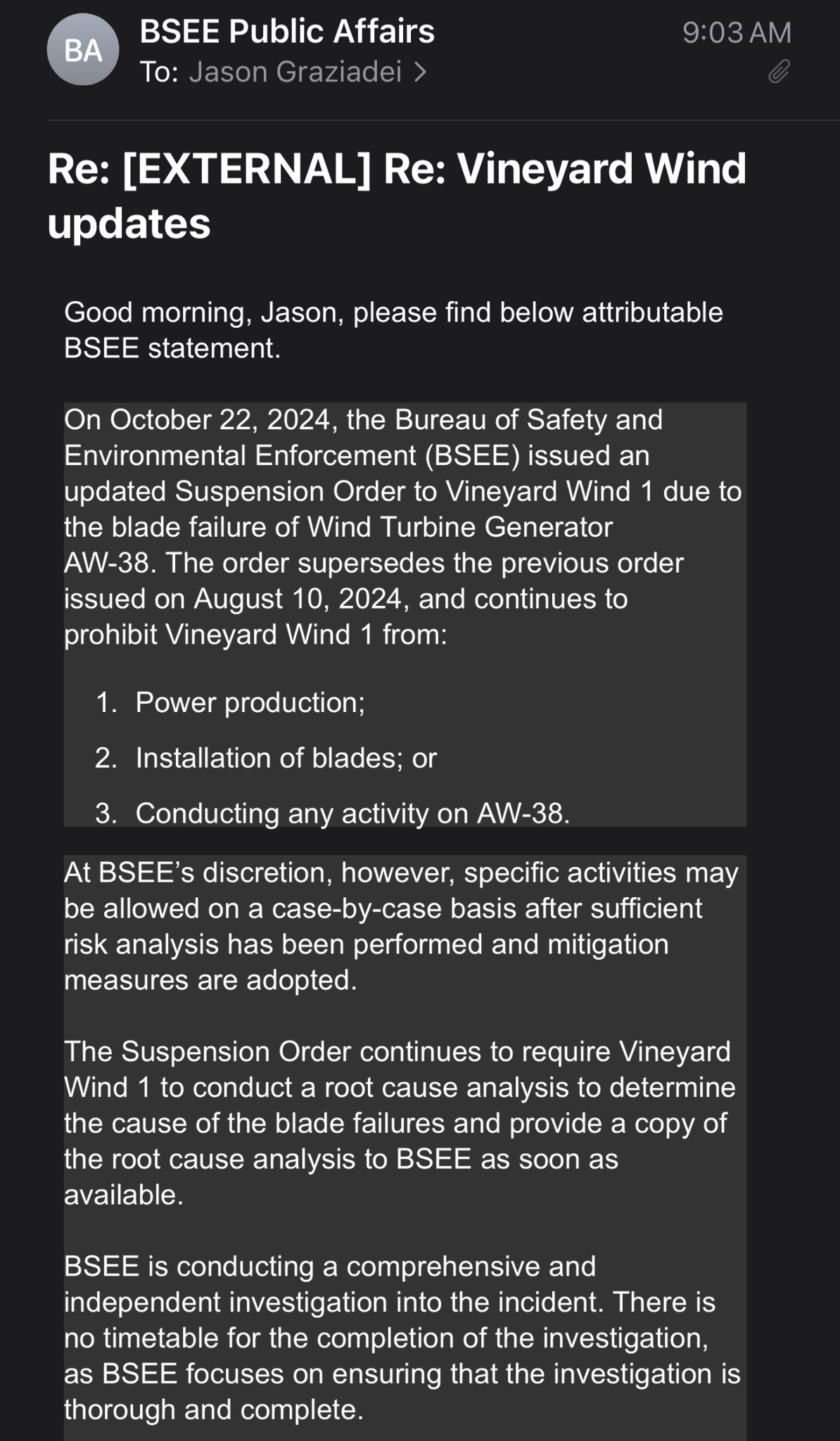
BSEE: Vineyard Wind is still prohibited from installing blades, producing power or conducting any activity on the damaged A-38 turbine.
GE: We are “really now getting to a point of shifting back to execution out at sea.” (Not at all what BSEE said.)
BSEE: BSEE may permit other specific activities after a risk analysis has been performed and mitigations adopted.
GE: We were “granted approval to return to installing new blades on turbines at the project once stringent safety and operational conditions are met.” (Positive spin of the BSEE statement implying that approval is assured.)
BSEE:Root cause analysis of the blade failure has not yet been provided to BSEE.
GE: “We have finalized root cause analysis and confirm the blade at issue at Vineyard Wind was caused by a manufacturing deviation from our factory in Canada.” (Then why doesn’t BSEE have the analysis? Is the Canadian plant being scapegoated?)
BSEE:No timetable for completion of BSEE investigation (This could present a dilemma for BSEE. How do you allow the resumption of blade installation and power generation before the investigation has been completed? Will the report be held until the Harris or Trump administration gives the go-ahead?)
Contrary to the regulations, Vineyard Wind was authorized to begin the fabrication of facilities beforeBOEM “received and offered no objections to the their Facility Design Report (FDR) and Fabrication and Installation Report (FIR).” The approval letter is attached, and excerpts (emphasis added) are pasted below. [Note: The requirement that was then at §585.700(b) is found at §585.632 in the current regulations.]
“Vineyard Wind requests a regulatory departure from §585.700(b) requiring that fabrication of approved facilities not begin until BOEM provides notification that it has received and has no objections to the submitted Facility Design Report (FDR) and Fabrication and Installation Report (FIR). Vineyard Wind proposes to fabricate, but not install the following project elements: 1) Monopile foundations; 2) Electrical service platform; 3) Export cable; 4) Inter-array cables; and 5) Wind turbine generator facilities.
….allowing these fabrication activities to take place earlier in time would allow Vineyard Wind to adhere to its construction schedule, maintain its qualification for the Federal Investment Tax Credit, and meet its contractual obligations under the Power Purchase Agreements with Massachusetts distribution companies.
30 cfr 585.103 requires that a departure provide safety and environmental protection equal to or greater than the provision in the regulations that is waived. BOEM’s letter fails to explain how allowing fabrication to begin before fundamental design and fabrication reports are submitted and reviewed meets this test.
Perhaps even more troubling is BOEM’s response to subsequent requests by other companies to waive the FDR and FIR requirement (example). In these responses, BOEM asserts that their “current interpretation” is that no departure is needed because “the regulation prohibits only fabrication and installation activities on the Outer Continental Shelf (OCS) itself.” How does that make sense given the important activities, including the fabrication of turbine blades and other turbine components, that take place onshore?
In their letters approving the Vineyard Wind and other departures, BOEM implies that their review of these reports is unnecessary because “the design and fabrication of these components would occur under the supervision of the approved CVA” (Certified Verification Agent). That assertion misconstrues the role of the CVA. These agents, nominated and funded by the operator, provide third party oversight that is complementary to, not a substitute for, BOEM/BSEE project reviews.
According to this memo, DNV was the CVA for Vineyard Wind. Their insights on the turbine blade failure will presumably be included in BSEE’s investigation report.
“The order comes as the bureau continues its oversight and investigation into the July 13, 2024, turbine generator blade failure. The order continues to prohibit Vineyard Wind 1 from generating electricity from any of the facilities or building any additional wind turbine generator towers, nacelles, or blades. This order also requires Vineyard Wind 1 to submit to BSEE an analysis of the risk to personnel and mitigation measures developed prior to personnel boarding any facility. Vineyard Wind 1 is not restricted from performing other activities besides those specifically directed for suspension or additional analysis. For example, Vineyard Wind 1 is still permitted to install inter-array cables and conduct surveys outside of the damaged turbine’s safety exclusion zone.”
BSEE also advises that they are conducting their own investigation, and promises to release the findings to the public.
“A team of BSEE experts is onsite to work closely with Vineyard Wind on an analysis of the cause of the incident and next steps,” the agency said in a statement.
Nord Stream AG has responded to their insurers’ “a goverment did it, so we don’t have to pay” defense. Nord Stream’s full response, courtesy of Swedish engineer Erik Andersson, a leader in seeking the truth about the the pipeline sabotage, is linked.
Key excerpts from the Nord Stream AG filing (p.5):
(a) On their proper construction, in the context of Exclusion 2.i as a whole, the words “destruction of or damage to property by or under the order of any government or public or local authority” relate only to destruction or damage that arises out of or is related to the confiscation, nationalisation or requisition of therelevant property (and/or attempts thereat). In the premises, those words do not apply to the Damage.
(b) Alternatively, in the event that the Defendants establish that the Damage does constitute destruction of or damage to property by or under the order of any government, then it is therefore covered by the Deliberate Damage clause because it would have been “loss, damage, liability, cost or expense caused or inflicted by order of any governmental or regulatory body or agency” and Exclusion 2(i) to Section I does not apply: paragraphs 8 and 9.2 above are repeated.
If the insurers contend that one or more governments were responsible, shouldn’t they have to identify the government(s)? That would be nice. However, Erik doesn’t think the Nord Stream AG response puts the insurers in that politically difficult position. I agree. This case is about getting the insurers to pay for the damages, not identifying the responsible parties, something that the Swedes, Danes, and Germans have shied away from.
The conclusion of the investigation is that Swedish jurisdiction does not apply and that the investigation therefore should be closed,” the Swedish Prosecution Authority said in a statement.
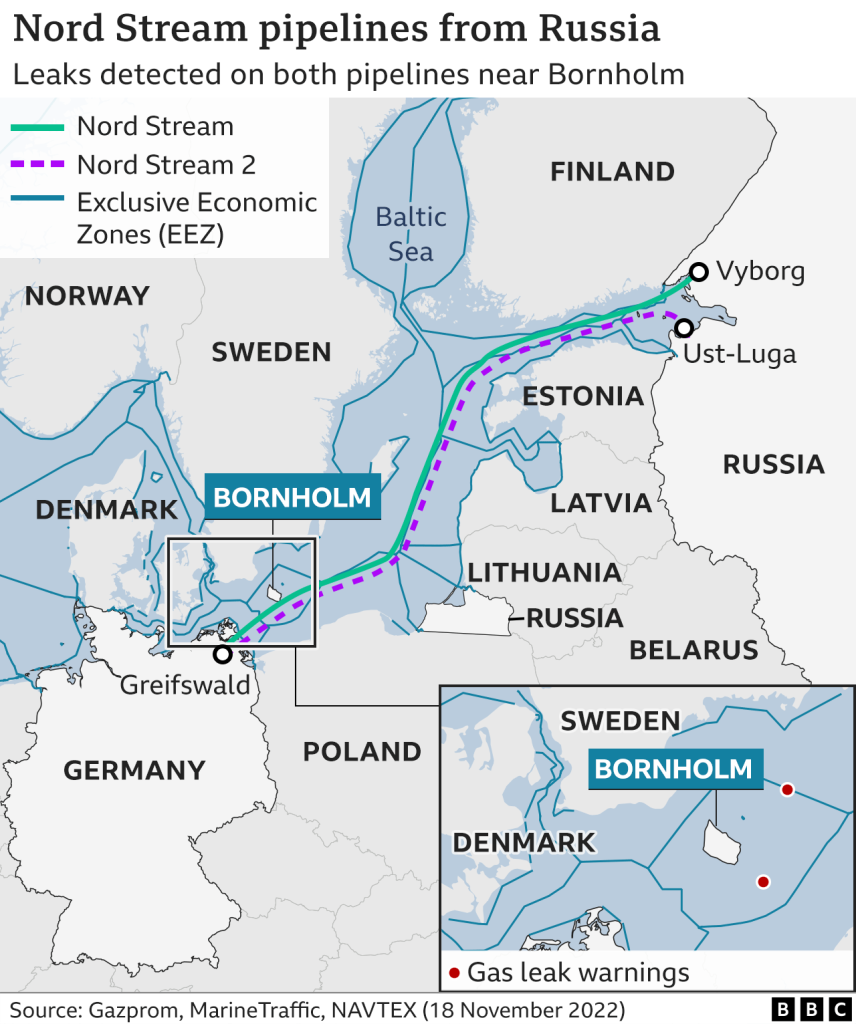
Nord Stream AG, or the operator of Nord Stream 1 pipeline, sent a specially equipped vessel on Thursday to investigate damage to the pipelines under the Baltic Sea.
Nord Stream AG, whose majority shareholder is Russia’s state energy giant Gazprom, said the chartered vessel arrived at the location of damage in Sweden’s exclusive economic zone.
The vessel, bearing the Russian flag, would have specialists aboard to assess the damage within a day and investigation would take three to five days, the company said.
Nord Stream AG said it didn’t have relevant permits to conduct an investigation until now.

 Bud's Offshore Energy (BOE)