Feeds:
Posts
Comments

Posts Tagged ‘Guyana’

OilNow, an informative and boldly named media outlet that covers the oil and gas sector in Guyana, reports that “the Guyana government expects crude oil exports this year to generate US$11.3326 billion in 2023, a 14% increase from the 2022 figure.“

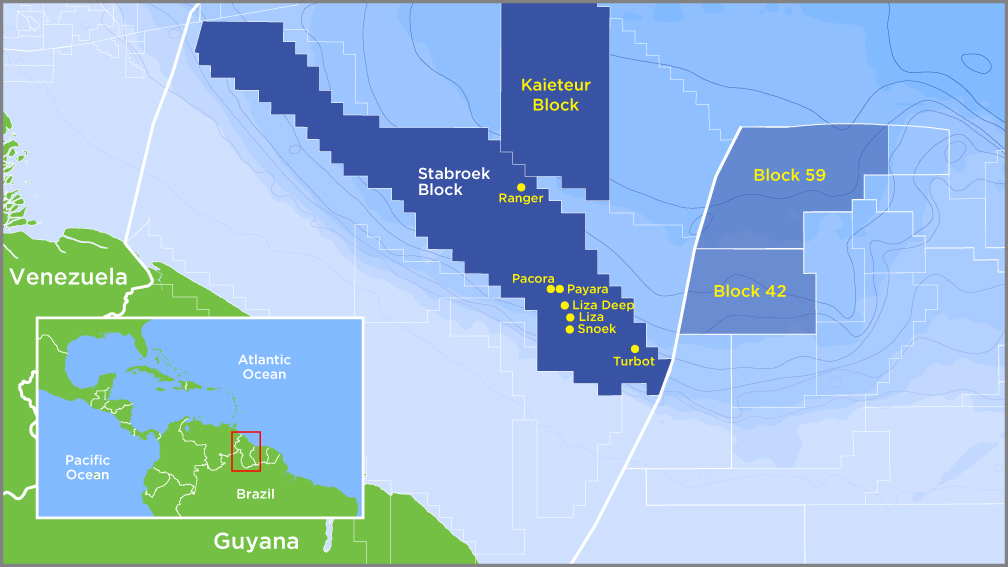
Of course, the 3 Stabroek Block partners who are responsible for this production – Exxon (45%), Hess (30%), and CNOOC (25%) – are also doing quite well. If you are wondering about this curious mix of companies – a US supermajor, a large US independent, and a state-owned Chinese mega-company – this OilNow post explains what happened.

Initially, Exxon and Shell were 50/50 partners in the Stabroek Block. Shell thought the chances for success were slim and opted out a year before the world class Liza discovery (ouch!). After Shell departed, Exxon sent “at least 35 letters” to prospective partners and only Hess and CNOOC responded favorably (actually, it was Nexen, not CNOOC that responded). The Liza discovery followed and the rest is history.

Will exploration offshore Jamaica and Barbados also prove successful? Stay tuned.

OilNow

Read Full Post »

There are a number of recent articles related to the Guyana Supreme Court ruling on Exxon’s financial assurance obligations. An Oil Now piece (quoted below) is the most informative. It seems that the Supreme Court decision is based on a provision of Exxon’s EPA permit and that EPA is siding with Exxon in this dispute.

The Guyana government and the Environmental Protection Agency (EPA) are set to appeal a recent Guyana Supreme Court ruling that determined that the EPA and ExxonMobil affiliate, Esso Exploration and Production Guyana Limited (EEPGL), breached the terms of the Liza 1 environmental permit. The permit was revised and granted to EEPGL last year for operations in the Stabroek Block, offshore Guyana.

Justice Sandil Kissoon granted several declarations, including that the EPA failed to enforce compliance by EEPGL of its Financial Assurance obligations to provide an unlimited Parent Company Guarantee Agreement and/or Affiliate Company Guarantee Agreement to indemnify and keep indemnified the EPA and the Government of Guyana against all environmental obligations of the Permit Holder (EEPGL) and Co-Venturers (Hess and CNOOC) within the Stabroek Block.

While acknowledging the court’s ruling, the Government of Guyana, as a major stakeholder, maintained in a statement that the Environmental Permit imposes no obligation on the Permit Holder to provide an unlimited Parent Company Guarantee Agreement and/or Affiliate Company Guarantee Agreement. The government believes that Justice Kissoon erred in his findings and that the ruling could have significant economic and other impacts on the public interest and national development.

OIlNow

Unlimited liability is a rather daunting and open-ended obligation that would trouble permittees in any industry.

In the US, the liability for oil spill cleanup costs is unlimited for offshore facilities, but there is a liability cap for the resulting damages. That cap is currently $167.8 million after a recent inflation adjustment. BP, of course, paid far more than that for damages associated with the Macondo blowout. BP’s costs, which amounted to an astounding $61.6 billion, were both voluntary and compulsory as a result of agreements and settlements. Keep in mind that the damage liability limit was only $75 million at the time. One can imagine what would have happened if a company with less financial strength or more inclination to fight had been responsible for the spill.

Read Full Post »

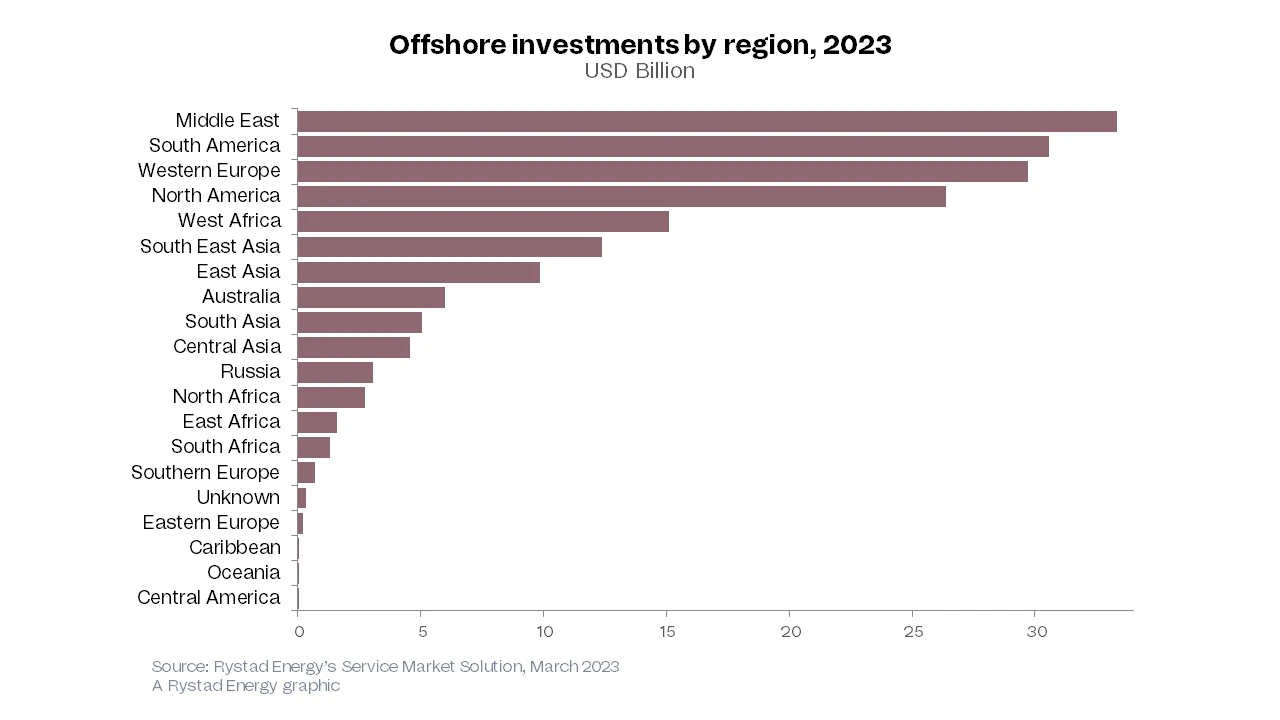
The offshore oil and gas (O&G) sector is set for the highest growth in a decade in the next two years, with $214 billion of new project investments lined up. Rystad Energy research shows that annual greenfield capital expenditure (capex) broke the $100 billion threshold in 2022 and will break it again in 2023 – the first breach for two straight years since 2012 and 2013.

Offshore activity is expected to account for 68% of all sanctioned conventional hydrocarbons in 2023 and 2024, up from 40% between 2015-2018.

Rystad

Comments:

  • Middle East investment continues to be strong
  • Good for South America thanks to Brazil (16 new FPSOs by the end of the decade) and the Guyana success story.
  • Strong forecast for Norway and the UK boosts Europe.
  • North America could do far better with less obstructive access policies.

Read Full Post »

Exxon is now producing >360,000 bopd from just two Guyana FPSOs. So these two FPSOs are producing about 20% as much oil as the Gulf of Mexico or Norway. A third FPSO will add 220,000 bopd in 2023.

Guyana’s oil output is expected to increase significantly in 2023, as both projects maintain steadier production at capacity throughout the year, and as the third project, Payara, comes on stream in the second half of the year. Payara will add another 220,000 bpd of production capacity to Stabroek Block output, taking it to 580,000 bpd.

Oil Now

Read Full Post »

Attorney General Anil Nandlall today said that Guyana is closer to securing a Council of Legal Education-recognised law school.

Stabroek Times

Read Full Post »

Federal Oil & Bas Corp. (FOGCO)

Guyana’s pending decision regarding the formation of a national oil company brings back memories of unsuccessful attempts to do the same in the US in the 1970s.

The most serious attempt at forming a national oil company in the US was a 1975 Senate bill to establish the Federal Oil and Gas Corporation or FOGCO. (Oddly, the bill’s sponsors weren’t troubled by that acronym.) FOGCO was proposed at a time when natural gas supplies didn’t satisfy demand, and that was the primary impetus behind the legislation. (Supply issues went away when price controls were lifted.)

Concerns about a FOGCO then and now:

  • The political pressures under which a national oil company operates are not conducive to sound, expeditious decisionmaking. (Unfortunately, some current industry execs seem overly responsive to pressure from governments and activist organizations, which is not always in the best interest of the company and its shareholders).
  • Would limit competition and private investment.
  • Would delay or prevent innovation:
    • The shale revolution was driven by nimble private companies operating on private land in supportive states. Why is there Marcellus shale development in PA, WV, and OH, and none in NY? (Hint: It’s not the absence of resources.) Why could the US shale experience not be replicated in Europe?
    • Innovative deepwater development projects were driven by private companies and the supportive public policies of the 1990s.
  • A national oil company could be the first step in the process of nationalizing the petroleum industry.

Guyana is far different from the US and should do what is perceived to be in their best interest. Best wishes to the people of Guyana as they weight their options.

Read Full Post »

According to ExxonMobil Guyana, the Liza Unity FPSO is the world’s first FPSO to be awarded for its sustainable design, documentation and operational procedures. The vessel has been awarded the SUSTAIN-1 notation by the American Bureau of Shipping (ABS), which is the Classification Society for the unit.

Guyana Chronicle
Liza Unity FPSO

Here are the criteria for the ABS Sustainability Notation, This looks like a solid program.

Based on the schematic for the sister FPSO Liza Destiny (below), gas that is not used to power the vessel will be reinjected.

The quality of offshore facilities and the attention to safety and environmental details have improved dramatically over time. The offshore industry deserves recognition for their efforts in that regard.

Read Full Post »

IRVING, Texas – ExxonMobil increased its estimate of the discovered recoverable resource for the Stabroek Block offshore Guyana to approximately 10 billion oil-equivalent barrels. 

ExxonMobil
null

Where would you drill?

Read Full Post »

« Newer Posts