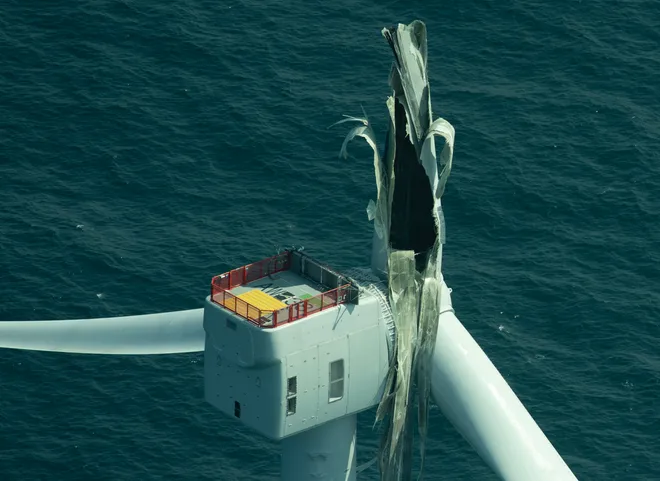
The offshore safety regulator (BSEE) has a very capable technical staff and should produce an informed report on the Vineyard Wind blade failure. The concern is with the internal review process that has seriously delayed the publication of accident investigation reports and safety alerts.
Presumably, DNV, the Vineyard Wind CVA, will provide input into the BSEE investigation. Perhaps the effectiveness of the CVA process and quality control procedures should be separately considered.
Will Equinor, a major oil and gas producer, Dogger Bank partner, and offshore wind advocate, be investigating the Dogger Bank failures?
A comprehensive International data base on turbine incidents and performance is needed.
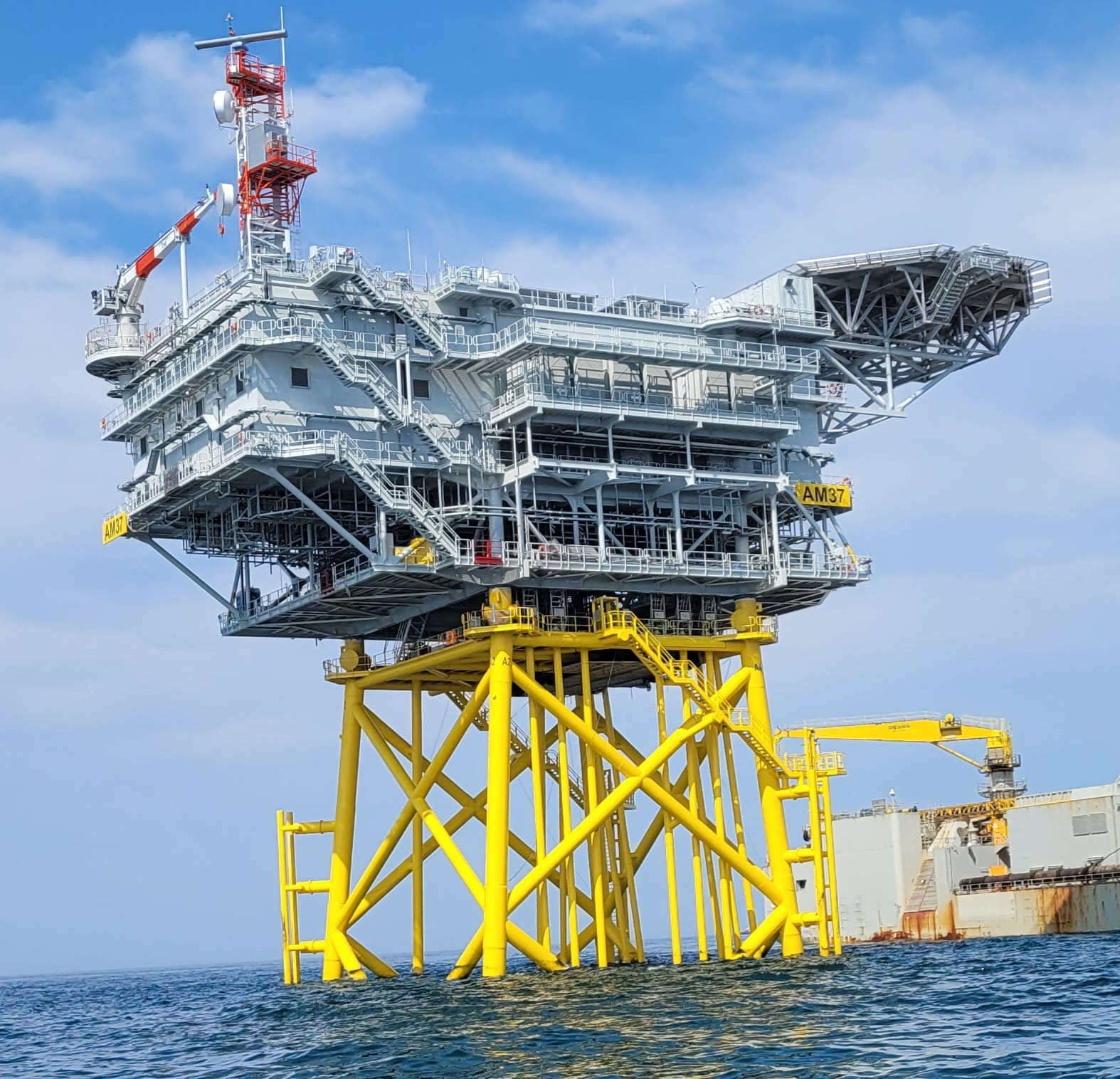
As previously noted, offshore substations are large structures. A closeup of the Vineyard Wind 1 substation is pasted below.
Contrary to the regulations, Vineyard Wind was authorized to begin the fabrication of facilities beforeBOEM “received and offered no objections to the their Facility Design Report (FDR) and Fabrication and Installation Report (FIR).” The approval letter is attached, and excerpts (emphasis added) are pasted below. [Note: The requirement that was then at §585.700(b) is found at §585.632 in the current regulations.]
“Vineyard Wind requests a regulatory departure from §585.700(b) requiring that fabrication of approved facilities not begin until BOEM provides notification that it has received and has no objections to the submitted Facility Design Report (FDR) and Fabrication and Installation Report (FIR). Vineyard Wind proposes to fabricate, but not install the following project elements: 1) Monopile foundations; 2) Electrical service platform; 3) Export cable; 4) Inter-array cables; and 5) Wind turbine generator facilities.
….allowing these fabrication activities to take place earlier in time would allow Vineyard Wind to adhere to its construction schedule, maintain its qualification for the Federal Investment Tax Credit, and meet its contractual obligations under the Power Purchase Agreements with Massachusetts distribution companies.
30 cfr 585.103 requires that a departure provide safety and environmental protection equal to or greater than the provision in the regulations that is waived. BOEM’s letter fails to explain how allowing fabrication to begin before fundamental design and fabrication reports are submitted and reviewed meets this test.
Perhaps even more troubling is BOEM’s response to subsequent requests by other companies to waive the FDR and FIR requirement (example). In these responses, BOEM asserts that their “current interpretation” is that no departure is needed because “the regulation prohibits only fabrication and installation activities on the Outer Continental Shelf (OCS) itself.” How does that make sense given the important activities, including the fabrication of turbine blades and other turbine components, that take place onshore?
In their letters approving the Vineyard Wind and other departures, BOEM implies that their review of these reports is unnecessary because “the design and fabrication of these components would occur under the supervision of the approved CVA” (Certified Verification Agent). That assertion misconstrues the role of the CVA. These agents, nominated and funded by the operator, provide third party oversight that is complementary to, not a substitute for, BOEM/BSEE project reviews.
According to this memo, DNV was the CVA for Vineyard Wind. Their insights on the turbine blade failure will presumably be included in BSEE’s investigation report.
Everyone agrees that a series of failures and mistakes leading to the use of containment systems is totally unacceptable. Capping stacks and containment devices, while necessary and important, should never have to be used in the post-Macondo offshore world.
The same cannot be said for blowout preventers. BOPs will be used and will have to work when needed. No matter how carefully drilling programs are planned and executed, there will be hydrocarbon influxes into well bores. While most of these influxes will be “routine kicks,” the equipment must work and the personnel must be trained to use it properly and to function effectively as a team.
I doubt that there will be any argument with the DNV recommendations. These include studies on elastic buckling, shear blade surfaces, the effectiveness of ROV intervention, and well control procedures (including the sequencing of annular preventer and pipe ram closures); revised testing procedures for backup control systems; improved capabilities for monitoring of the status of BOP functions; and requirements for backup control system performance.
BOP stacks with redundant blind shear rams are becoming more common, and would generally seem to be appropriate for subsea wells. However, attention must be paid to the entire stack with the goal of optimizing overall performance and most effectively managing risks for the type of well that is being drilled and the site-specific conditions.
A shortened and simplified summary from information provided in the DNV report:
The Upper Variable Bore Rams (VBRs) were closed prior to the Emergency Disconnect Sequence (EDS) activation at 21:56 on April 20, 2010.
A drill pipe tool joint was located between the Upper Annular Preventer (closed) and the Upper VBRs (also closed). Forces from the flow of the well pushed the tool joint into the Upper Annular element. Because the tool joint was trapped beneath the closed annular preventer (and could not move upward), forces from the flowing well caused the pipe to push upward and buckle.
The drill pipe deflected until it contacted the wellbore just above the Blind Shear Ram (BSR). The portion of the drill pipe located between the shearing blade surfaces of the BSR was off center and held in this position by buckling forces.
A portion of the pipe cross section was outside of the intended BSR shearing surfaces and did not shear as intended.
As the BSR closed, a portion of the drill pipe cross section became trapped between the ram block faces, preventing the blocks from fully closing and sealing.
Since the deflection of the drill pipe occurred from the moment the well began flowing, trapping of the drill pipe would have occurred regardless of which means initiated the closure of the BSR.
In the partially closed position, flow continued through the drill pipe trapped between the ram block faces and subsequently through the gaps between the ram blocks.
When the drill pipe was sheared on April 29, 2010, using the Casing Shear Ram (CSR), the flow expanded through the open drill pipe at the CSR and up the entire wellbore to the BSR and through the gaps along the entire length of the block faces and around the side packers. The CSR was designed to cut tubulars, not seal the well bore.
The DNV report will be discussed in the upcoming hearings:
The Bureau of Ocean Energy Management, Regulation and Enforcement (BOEMRE)/U.S. Coast Guard (USCG) Joint Investigation Team, which is examining the Deepwater Horizon explosion and resulting oil spill, today announced that it will hold a seventh session of public hearings the week of April 4, 2011. The hearings, which will focus specifically on the forensic examination of the Deepwater Horizon blowout preventer (BOP), are scheduled to take place at the Holiday Inn Metairie, New Orleans Airport, 2261 North Causeway Blvd., Metairie, La.



 Bud's Offshore Energy (BOE)