
Like offshore platforms, BOE readers are useful long after “retirement”😁
Posted in decommissioning, Offshore Energy - General, Uncategorized, tagged decommissioning, offshore platforms, retirement on July 8, 2022| Leave a Comment »
Posted in California, decommissioning, energy policy, rigs-to-reefs, tagged Bob Byrd, California platforms, decommissioning, Exxon, Hogan, Houchin, John Smith, OC Coastkeeper, rigs to reefs, Santa Ynez Unit on May 31, 2022| Leave a Comment »
Offshore California, the best that most facility operators and their predecessors (to the extent they continue to hold decommissioning liabilities) can hope for is a graceful exit with manageable financial losses. (The situation is a bit different for Exxon’s Santa Ynez Unit, which has been shut-in since 2015 while the company seeks to resolve oil transportation issues resulting from an onshore pipeline rupture. Here is the latest episode of that amazing saga.)
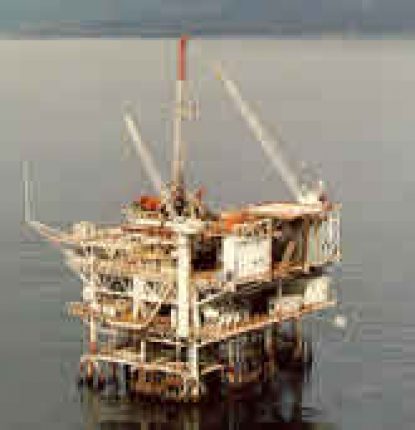
California’s Federal offshore, where 9 mobile drilling units (MODUs) were operating concurrently in the early 1980s, hasn’t seen a MODU in over 30 years. However, 23 production platforms, some of which are massive structures, remain (see the presentation below). At this point, these platforms are expensive monuments given that their combined production (per EIA) is only 7000 BOPD.
Regardless of their production status, the California offshore platforms continue to be ecologically significant. Dr. Jerry Schubel is among the many marine scientists who understand the importance of the life that has grown on and around these structures. The scientific community also sees other research, educational, and recreational uses for these platforms as per our Rigs-to-Reefs +++ page.
In the absence of workable State reefing/reuse legislation, not much is going to happen. Questionable Federal decisions on the management of decommissioning funds are another impediment to timely action. (See “The troubling case of Platforms Hogan and Houchin.”)
To their credit, State and Federal agencies, trade organizations, and interested third parties continue to discuss the issues and consider alternatives. A recent workshop was helpful in that regard. Attached is the excellent presentation by Bob Byrd and John Smith, who have been at the vanguard in addressing California decommissioning issues. Embedded below is the YouTube video of the presentations from their session. These are excellent updates for those who have an interest in decommissioning issues.
Posted in California, decommissioning, Offshore Energy - General, tagged California platforms, decommissioning, rigs-to-reefs on March 10, 2022| Leave a Comment »

Excerpts from a good OC Register article on the ecological significance of the 27 platforms in State and Federal waters offshore California:
“All the (California) platforms having booming ecosystems underwater,” marine scientist Amber Sparks said at an Aquarium of the Pacific lecture in Long Beach on Wednesday, March 2.
“There’s a lot of real estate; a lot of nooks and crannies for marine life,” she said. “Scientists at the National Academy for the Sciences have found California’s platforms are some of the most productive marine habitat in the world.”
The Gulf of Mexico is the poster child for rigs-to-reefs, with more than 500 decommissioned oil platforms turned into full-time artificial reefs over the past 30 years. It’s bold testament to the habitat potential of the rigs, transforming the relatively sterile, sandy bottom ecosystem there into one with hundreds of prime locations for marine life.
Posted in decommissioning, Gulf of Mexico, Offshore Energy - General, Offshore Wind, Wind Energy, tagged decommissioning, Gulf of Mexico, liability on March 3, 2022| Leave a Comment »
BSEE has posted the slides and presentation video announcing their draft Request For Proposals (RFP) to contract for the decommissioning of facilities on five Gulf of Mexico leases. Phase 1 involves the plugging of 15 wells. Per the presentation, this work would be paid for using “orphan well” funds appropriated in the 2021 Infrastucture bill.
Per BSEE’s online borehole file, the wells in question were drilled by Matagorda Island Gas Operations, Anglo-Suisse Offshore Partners, and Bennu Oil and Gas. Matagorda and Bennu declared bankruptcy and are no longer in business. The status of Anglo-Suisse is not entirely clear, but presumably they are no longer financially accountable.
Looking at BOEM online data, these leases had other owners including two US super-majors. However, the wells identified by BSEE were drilled after these and other financially strong companies had assigned their interest. They are thus not legally accountable, which is presumably why these wells were chosen for the RFP.
The unprecedented use of Federal funds for decommissioning reflects poorly on the offshore industry and Federal lease management practices. The financial risks associated with decommissioning have been apparent for more than 30 years (see the July 1991 Forbes article below). Why have these issues not been effectively addressed? Some thoughts:
In the past, the regulators, operating companies, and insurers have found ways to ensure that decommissioning costs did not fall on the taxpayer. BSEE continues to be resourceful in that regard. Private solutions should always be the objective. The proposed RFP opens the door to the potential for far greater Federal liabilities down the road, particularly given the uncertainty about predecessor liability in some important cases.

Posted in California, conferences, decommissioning, tagged California, decommissioning, Orange County Coastkeeper on January 25, 2022| Leave a Comment »
Per our post about old disputes preventing common sense decommissioning solutions for offshore California facilities, we were pleased to learn that an Orange County Coastkeeper’s workshop will address the flaws in the California’s unworkable rigs-to-reefs program with the objective of advancing decommissioning programs.
Coastkeeper’s upcoming Retiring Offshore Rigs Summit, or ROR, comes roughly ten years after Coastkeeper’s Rigs to Reef Conference in 2010. While that conference succeeded in passing new decommissioning and artificial reef enhancement laws, the language was not workable. In the decade since that legislation, known as AB 2503, or the “California Marine Resources Legacy Act” was signed into law, it was never implemented by the state.
Orange County Coastkeeper
Link for further information on the workshop.
Previous posts on California decommissioning:
Posted in California, decommissioning, energy policy, rigs-to-reefs, tagged California, decommissioning, rigs to reefs on November 30, 2021| Leave a Comment »
Despite scientific support, California’s “rigs to reefs” program has made little progress. Comments in yesterday’s LA Times article help explain why:
Fed by concerns from some environmental advocates and a skepticism about the motives of California’s billion-dollar oil industry, the Rigs to Reefs program that passed in 2010 was so complicated by political compromise that the permitting process became almost unworkable, (State Sen.) Hertzberg said.
Not a single oil company has applied in the history of the program, according to the State Lands Commission, which has jurisdiction over state waters.
LA Times
“Oil companies want a clear path to compliance,” he said. “They’re operating in many cases at a loss, but it’s cheaper to operate at a loss than it is to face millions for decommissioning.”
Gary Brown, Orange County Coastkeeper
Posted in California, decommissioning, energy policy, Offshore Energy - General, rigs-to-reefs, tagged California, decommissioning, Jerry Schubel, rigs-to-reefs on November 2, 2021| Leave a Comment »
Veteran marine science advocate Jerry Schubel, former president of Long Beach’s Aquarium of the Pacific, is among those pushing for offshore oil platforms to be transformed for new ocean uses. He points out that the underwater portion of the structures already are a boon to marine life.
“They have enormous value as ecosystems because of the life that has grown on and around them,” he said.
He points out that other states have rigs-to-reefs programs — and California does as well, though it needs funding before it can function. Once the ball gets rolling, oil companies could be tapped to cover costs with fees drawn from the money they would save by not having to haul dismantled rigs ashore. Schubel estimated that turning platforms into reefs could cut decommissioning costs in half.
But Schubel says artificial reefs should be just the beginning. How about fish farms? Research labs? Windmills? Hotels for divers?
“The uses,” he said, “are limited only by our imagination.”
Orange County Register
Well said Dr. Schubel! For a full list of alternative uses for offshore platforms see the official Rigs-to-Reefs+++ page.
Posted in decommissioning, energy policy, Offshore Energy - General, pipelines, Regulation, tagged decommissioning, pipelines, Regulation, Scandpower on October 19, 2021| Leave a Comment »
Scandpower study (2004) for MMS:
Overall Conclusion
Currently, there are no regulations that require removal of subsea pipelines if they are not an obstruction to navigation. Based on the high costs for removing the pipelines, the personnel risk involved in the removal operations, the negative effect on overall emissions to air and the very limited reduction in discharges to sea, the overall conclusion is that it is better to leave the pipelines in place. If possible, re-use of the pipelines is the optimal solution.
Environmental Impacts
The impacts on the environment and the marine environment from pipelines and cables left in place were found to be very minor. Conversely recovery operations will have a negative impact on the environment. The number of vessels required for removal operations and long operating hours will result in considerably more releases and emissions than leaving the pipelines in place. In addition the energy savings benefit from recycling the pipeline materials will be exceeded by the energy required to remove the pipelines and separate the materials.
Pipeline Decommissioning: Environmental Impact Metric (per Scandpower)
| Remove/ recycle | Remove/ landfill | Reuse or preserve | Bury | Abandon in place | |
| Energy | High | High | Low | Moderate | None |
| Emissions | High | High | Low | Low | Low |
| Discharges | Low | Low | Moderate | Low | Low |
| Habitat | Low | Low | Moderate | Low | Low |
| Aesthetics | Low | Moderate | None | None | None |
| Resource Utilization | High | None | High | None | None |
| Littering | Low | Low | Low | Low | Moderate |
The “Habitat” impacts row seems questionable. Pipeline removal certainly has a greater impact on habitat than abandonment in place, particularly for buried pipelines.
Posted in California, decommissioning, Offshore Energy - General, tagged California, decommissioning, John B Smith on September 24, 2021| Leave a Comment »

For those interested in California offshore decommissioning, attached is an excellent update presented at a 2020 forum by my former colleague John Smith.
Posted in California, Offshore Energy - General, Regulation, tagged BOEM, BSEE, decommissioning, Hogan, Houchin, OIG, Santa Barbara Channel on September 21, 2021| Leave a Comment »
Platforms Hogan and Houchin were installed 52 and 53 years ago respectively on Lease OCS P-0166 in the Santa Barbara Channel. The lease, which had initially been issued to Phillips Petroleum, Cities Service Oil Co., and Continental Oil Co., was assigned to Signal Hill Service effective 2/19/1991. The assignment was approved despite concerns within the Minerals Management Service (MMS) about the financial strength of Signal Hill and the technical competence of Pacific Operators Offshore Inc (POOI), the affiliate that would operate the facilities.
Three decades of frustration followed for MMS, BOEM, and BSEE regulators in the Pacific Region. Per the terms of the assignment, Signal Hill was required to establish an Abandonment Escrow Account, funded from oil production revenue, with a “target balance” equal to the abandonment cost, plus 25 percent. These payments were seldom made in a timely and consistent manner.
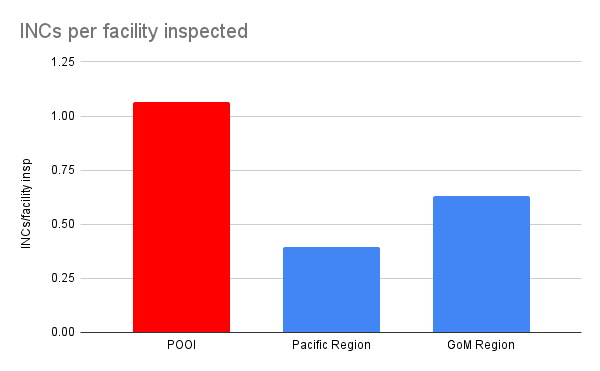
Compliance with safety regulations was also poor. In that regard, violations data are consistent with anecdotal reports from inspectors. POOI accounted for a high percentage of the regional Incidents of Noncompliance (INCs), and Platforms Hogan and Houchin had INC/inspection ratios that were far higher than Pacific or Gulf of Mexico platform averages (see inspection data below).
| INC’s | Warnings | Component Shut-ins | Facility Shut-ins |
| POOI | 485 | 562 | 46 |
| All companies (Pacific Region) | 1965 | 3103 | 281 |
| POOI % of total | 24.6 | 18.1 | 16.4 |
A 9/20/2020 Inspector General report found significant irregularities in the use of funds from an offshore production company’s escrow account. While the IG’s summary (pasted below in its entirety) doesn’t say so, the company is assumed to be Signal Hill.
The OIG investigated allegations that an offshore oil and gas production company improperly paid operational expenses with money from an escrow account dedicated to paying expenses related to decommissioning offshore platforms in Federal waters.
DOI OIG, 9/20/2020
We found that the company routinely used funds from its decommissioning account to pay what appeared to be various operating expenses. We also found instances where the company appeared to claim reimbursement for duplicate expenses.
Based on our findings, the company submitted credits and adjustments, totaling $1.9 million, to the decommissioning account to cover these expenses and other disbursements. In addition, we referred a number of unresolved expenses for non-decommissioning activities to the Bureau of Safety and Environmental Enforcement and the Bureau of Ocean Energy Management for resolution.
We referred this matter to the U.S. Department of Justice, which declined to pursue it.
Questions:
 Bud's Offshore Energy (BOE)