Are Exxon and Chinese partner (CNOOC) attempting to use Chevron’s acquisition of Hess to improve their already lucrative position in Guyana’s prolific Stabroek block?
The Stabroek operating agreement outlines terms for Hess, Exxon, and CNOOC to explore and develop the block.
This Stabroek agreement includes a right of first refusal (ROFR) provision which allows the parties to buy out the stake of one of them in the event of a ‘change of control’ transaction.
Chevron and Hess argue that the merger’s structure does not trigger the ROFR clause.
Exxon and CNOOC argue that the clause applies. This could force Hess to offer its stake in the Stabroek block to its partners first.
The Exxon/CNOOC position seems to be a stretch. Chevron did not buy the Stabroek share; they bought the company that holds that share. Hess is to be part of Chevron and there would be no change of control from the standpoint of the partnership.
As an offshore operator, Exxon has been highly responsible from a safety standpoint. However, the company has a shown tendency to stretch the envelope when it comes to contract rights. The most recent example was their acquisition of 163 GoM oil and gas leases for carbon disposal purposes, contrary to the terms of the sale notice and lease contracts.
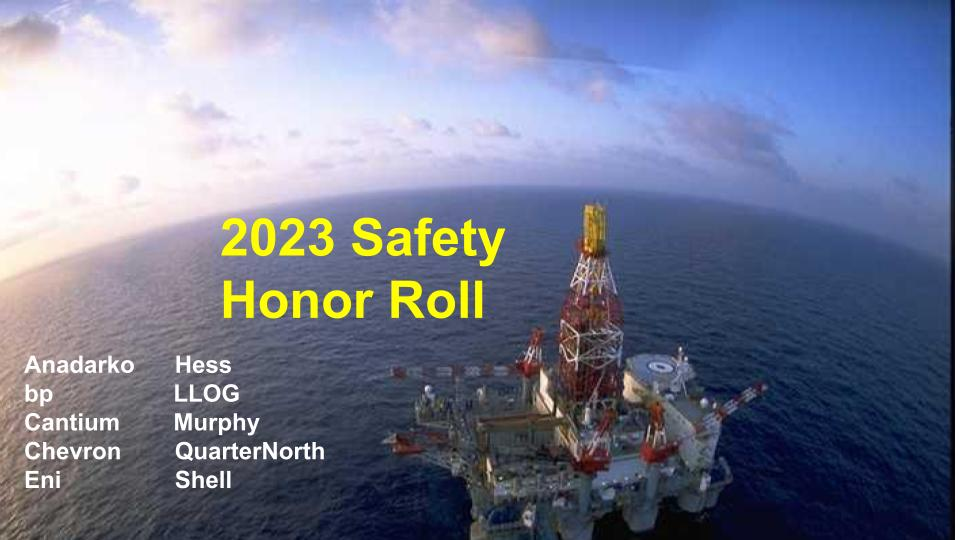
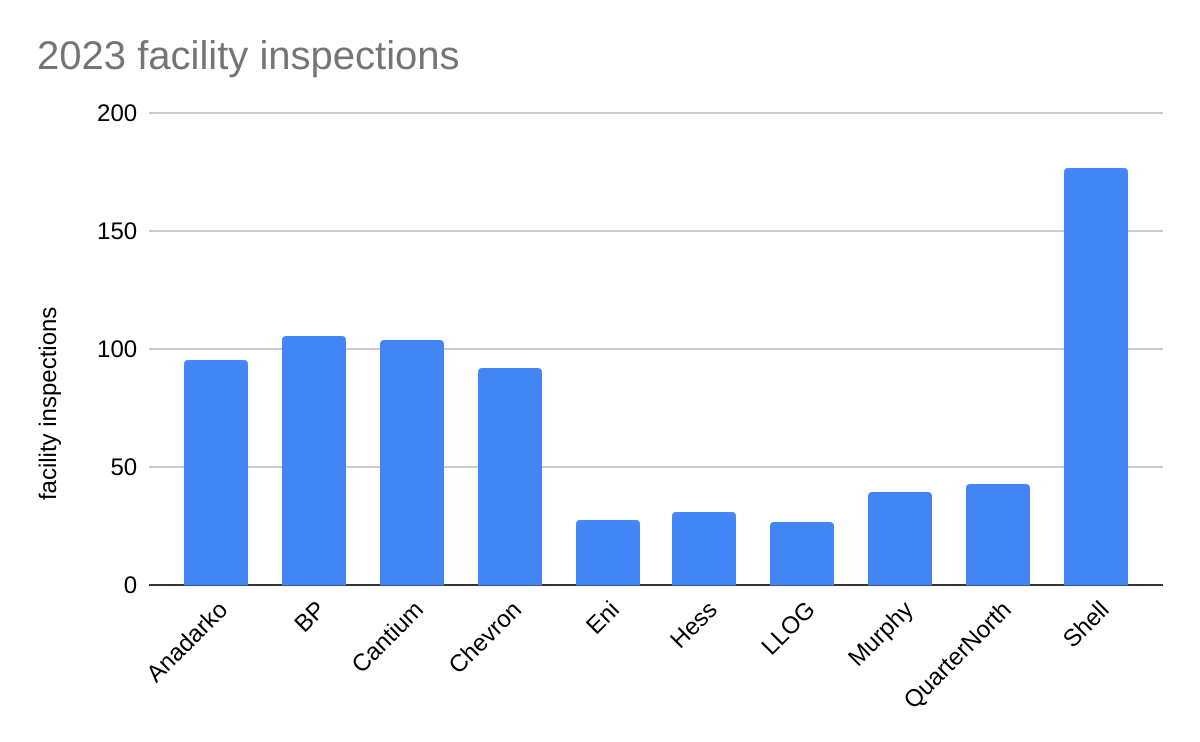
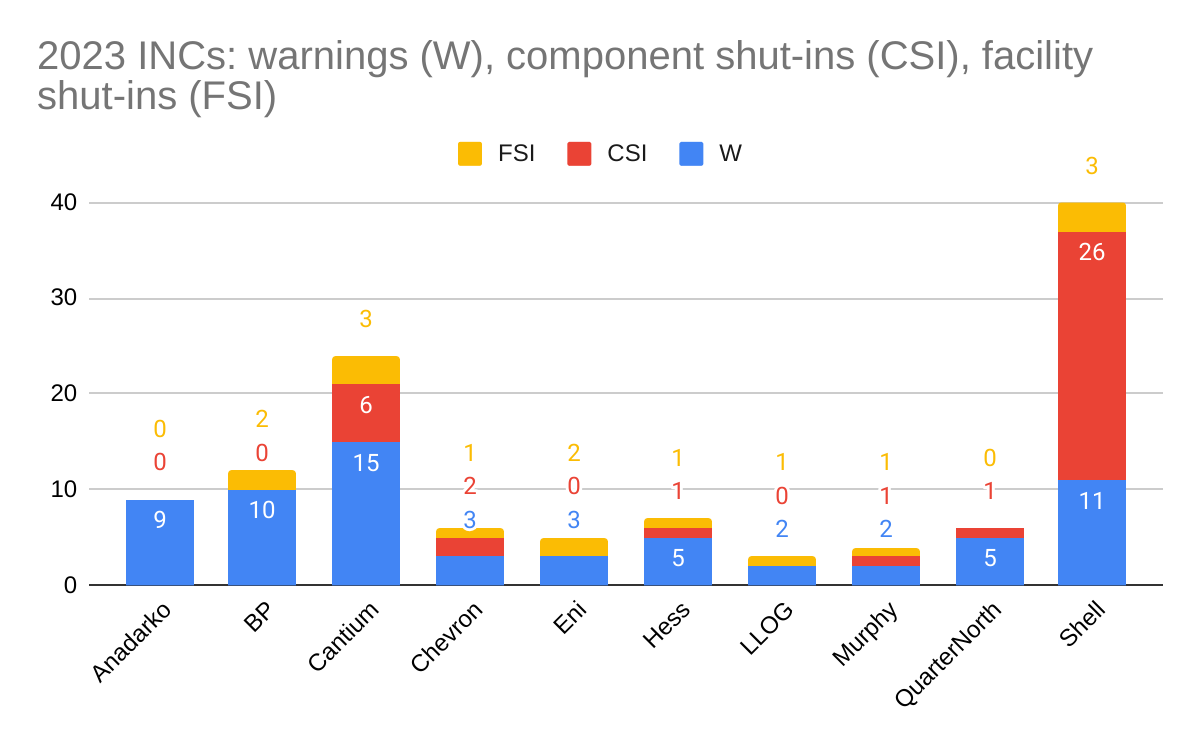
The Honor Roll companies for 2023 (listed alphabetically) are Anadarko, bp, Cantium, Chevron, Eni, Hess, LLOG, Murphy, QuarterNorth, and Shell.
BOE Honor Roll criteria:
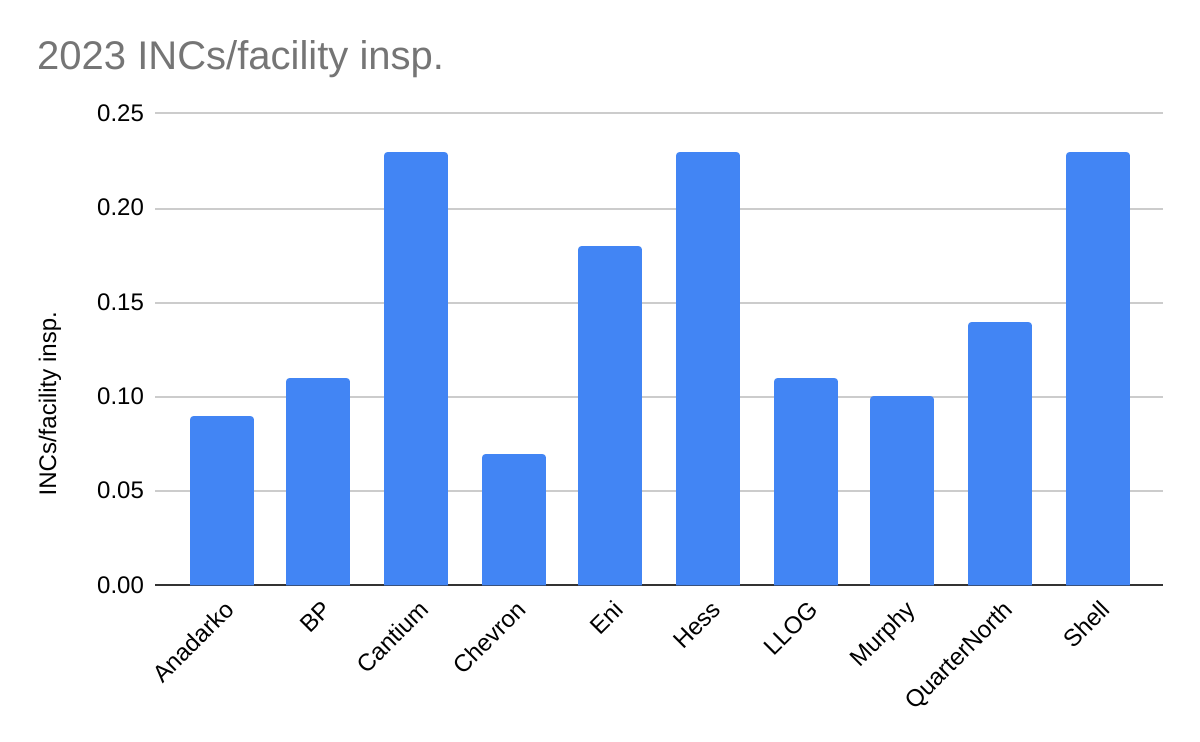
Must average <0.3 incidents of noncompliance (INCs) per facility-inspection.
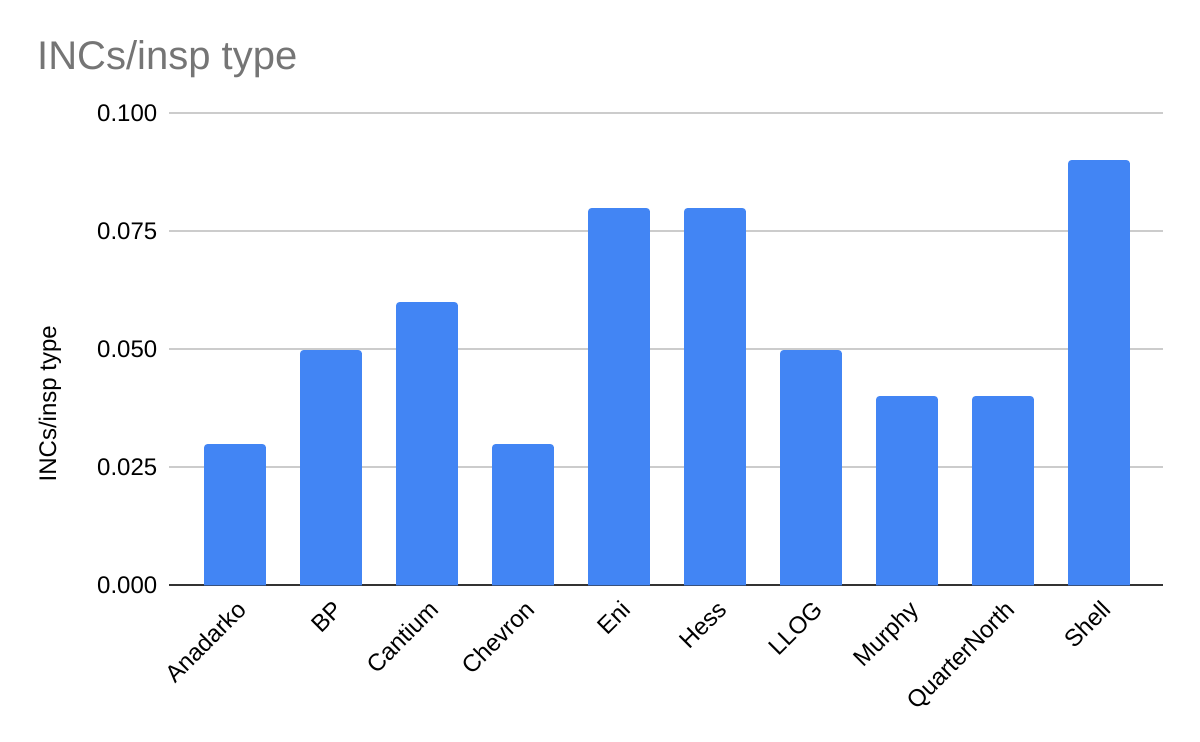
Must average <0.1 INCs per inspection-type. (Note that each facility-inspection may include multiple types of inspections (e.g. production, pipeline, pollution, Coast Guard, site security, etc). On average, each facility-inspection included 3.3 types of inspections in 2023. Here is a list of the types of inspections that may be performed.
Must operate at least 3 production platforms and have drilled at least one well (i.e. you need operational activity to demonstrate compliance and safety achievement).
May not have a disqualifying event (e.g. fatal or life-threatening incident, significant fire, major oil spill). Due to the extreme lag in updates to BSEE’s incident tables, district investigations and media reports are used to make this determination.
platforms
2023 well starts
2023 (10 mos.) oil prod. (million bbls)
2023 (10 mos.) gas prod. (bcf)
Anadarko
10
11
66
60
BP
7
11
105
65
Cantium
96
10
5
6
Chevron
8
10
67
39
Eni
3
1
6
13
Hess
3
3
18
36
LLOG
10
7
25
35
Murphy
7
4
42
57
QuarterNorth
9
1
13
23
Shell
20
20
141
140
Also noteworthy:
Zero shut-in violations for Anadarko in 2023
<1 INC for every 10 facility inspections for Anadarko, Chevron, and Murphy
<1 INC for every 20 inspections (all types) for Anadarko, bp, Chevron, LLOG, Murphy, and QuarterNorth
On January 2, 2024, Chevron Corporation announced that for fourth quarter 2023, the Company will be impairing a portion of its U.S. upstream assets, primarily in California, due to continuing regulatory challenges in the state that have resulted in lower anticipated future investment levels in its business plans. The Company expects to continue operating the impacted assets for many years to come. In addition, the Company will be recognizing a loss related to abandonment and decommissioning obligations from previously sold oil and gas production assets in the U.S. Gulf of Mexico, as companies that purchased these assets have filed for protection under Chapter 11 of the U.S. Bankruptcy Code, and we believe it is now probable and estimable that a portion of these obligations will revert to the Company. We expect to undertake the decommissioning activities on these assets over the next decade.
Biggest prize at the holiday party went to Anadarko: Mississippi Canyon 389 – 5 bids, $25.5 million high bid
Biggest holiday shopping spree: Shell’s 65 high bids accounted for 24% of the sale’s high bids (excluding CCS bids).
Big spender award: Hess – $88.3 million on only 20 high bids. Does Chevron approve? 😀
Aussie, Aussie, Aussie, Oi, Oi, Oi: Strong performance by Woodside. 18 high bids, $24.8 million
Heia Norge!: Equinor continues to shine in the GoM! 13 high bids, $20.6 million
Spirit of America award to Red Willow Offshore which is owned by the Southern Ute tribe. 22 high bids!
Deepwater independents for (energy) independence: Beacon, Murphy, LLOG, Kosmos, Talos, Houston Energy, Ridgewood, QuarterNorth, Alta Mar, CSL, CL&F, and Westlawn
Even pace wins the race: Another solid lease sale for bp – 24 high bids.
So happy together 😀: Chevron and Hess combined for 48 high bids, $114 million
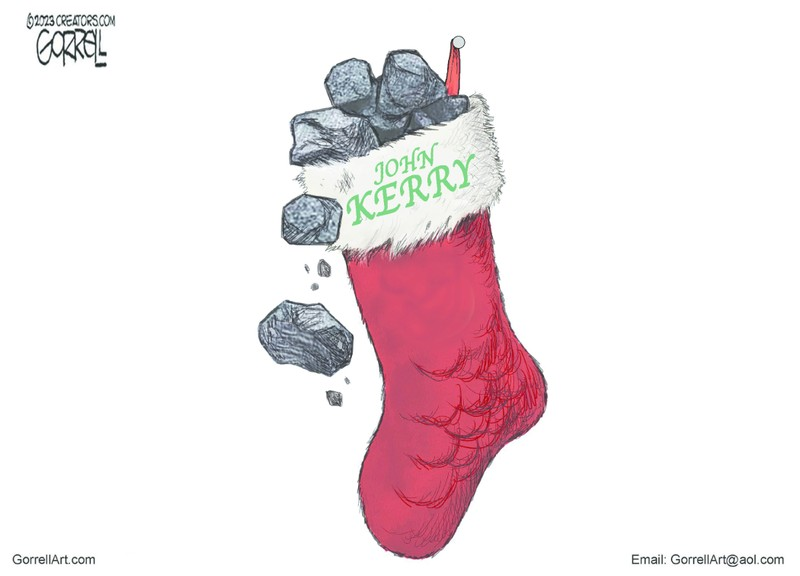
Coal in their stockings? Repsol (Sale 261) and Exxon (Sales 257 and 259) made up their own rules for acquiring carbon dumping leases. Perhaps some solid carbon in their Christmas stockings would be appropriate.
Christmas in July?: A lease sale in 2024 is needed. Sometime near the 4th of July holiday would be good. It’s up to you Congress!
Holiday greetings to our friends around the world!
It’s always interesting to compare the high bids with the “runner-up” bids on the same tracts. Usually the gap is large and, as indicated in the table below, that is the case with the Sale 261 “top 10.” This tells us that bidding is independent, that tract evaluation is far from an exact science, that information and expert opinions differ, and that companies have different business and bidding strategies.
Particularly interesting in this sale were the tracts that both Hess and Chevron, its future parent, sought to acquire. Chevron and Hess bid against each other on two of the “top 10” tracts, and Hess outbid Chevron by wide margins. Will this affect post-merger relationships? 😉
In a future post, we’ll look at the 14 rejected Sale 259 high bids and the bidding on these tracts in Sale 261.
The IEA’s assessments face criticism, particularly in terms of the agency’s optimistic outlook on the growth and impact of renewable energy worldwide. The report suggests that renewables will meet half of the world’s power demand by 2030, based on optimistic scenarios, including the proliferation of electric vehicles (EVs) and substantial investments in offshore wind, solar, green hydrogen, and ammonia. The IEA emphasizes the idea that consumers worldwide are enthusiastic about changing their heating systems to electricity or heat pumps.
Simultaneously, the ongoing contentious relationship between the IEA and OPEC is poised to reach new levels of disagreement. The release of the IEA’s report shortly after OPEC’s relatively optimistic oil market report gives the impression that Paris is attempting to alarm markets without substantial grounds. It’s worth noting that, despite its inherent bias, OPEC’s reports have historically demonstrated a higher level of accuracy compared to the IEA reports from the early 21st century. Even OPEC’s most optimistic scenarios regarding hydrocarbon demand growth have been realized sooner than expected. The current IEA report appears to resemble a modern-day version of “Crying Wolf.” It’s possible that the underlying strategy of Paris and its supporters is to induce significant fear among investors, including clients, in the hope that their biased outlook becomes a reality. However, at present, such a scenario appears unlikely. It’s essential to keep in mind that the IEA will need to present a doomsday scenario for hydrocarbons, as it faces a different audience in Dubai in the coming weeks.
WP: “Chevron is acquiring oil driller Hess in a $53 billion all-stock deal announced Monday, bringing the energy giant deeper into the fossil fuel business at a time when policymakers are pressing for a broader transition to renewables.”
Comment: Many who live and work outside of the Post’s policy bubble differ on the urgency and practicality of the transition. Their primary concerns are reliable, secure, and affordable energy. Many elected representatives agree, which is why there is little national support for legislation restricting fossil fuels and imposing rigid transition timelines. Administrative actions, like the 5 year leasing plan, that handicap US offshore production are also being questioned.
And what are we transitioning to? Wind and solar are intermittent energy sources that can complement fossil fuel power generation, but not replace it. Nuclear energy has strong proponents, but faces stiff opposition, much of which is from the same groups that oppose fossil fuels. Other energy alternatives like ultradeep geothermal are very promising but are still years away.
WP: “The investments run counter to U.S. and global climate policies, which aim to rapidly phase out the internal combustion engine and shift power grids to zero emissions energy. The International Energy Agency reported last month that demand for oil, gas and coal will peak by 2030 before going into a steady decline, leading its executive director, Fatih Birol, to warn oil company executives that decisions to double down on fossil fuel infrastructure could prove misguided.“
Comment: Fortunately, IEA does not dictate corporate investment decisions. Perhaps IEA should look more closely at their own forecasts which show essentially no decline in oil or gas demand through 2050. Their assertion that demand for all fossil fuels will peak by 2030 is based on their speculative forecast calling for a sharp decline in coal demand, even though coal consumption is currently at record levels. IEA’s forecasts are also dependent on questionable assumptions such as this: “50% of new US car registrations will be electric in 2030.”
WP: “Still, the massive acquisitions from both Chevron and Exxon indicate their executives believe fossil fuels will continue to drive their business well into the future. Emphasizing affordability, company executives have said they see oil and gas alongside renewables.”
Comment: Spot-on. The WP could have shortened their commentary to these 2 sentences.
WP: Alex Witt, senior adviser for oil and gas at the advocacy group Climate Power, said the Hess acquisition shows the company’s true priorities. “Today’s news proves what we already knew — Chevron executives only care about the short-term, putting potential profits over the lives of families and the future of our planet,” Witt said in a statement Monday.
Comment: Or perhaps both Chevron and the lives of families will benefit, as they have in the past.
“Stampede,” Gulf of Mexico: Hess 25% owner and operator, Chevron 25% owner
Most importantly, both companies have excellent safety and compliance records as evidenced by their Honor Roll achievements.
Hess is an attractive company with impressive assets. Were there other suitors?
Chevron is currently a partner on the Stampede, Esox, and Tubular Bells deepwater projects that are operated by Hess. There is thus an established deepwater development relationship.
The acquisition of Hess means that Exxon and Chevron will now be partners in Guyana. That should be interesting.
Chevron’s CEO Mike Wirth is quoted as saying “We’ve got too many CEOs per BOE, so consolidation is natural.” That comment seems a bit self-serving, but makes sense from the perspective of an acquiring CEO. Employees of the companies being acquired may have a somewhat different view.
In the Gulf of Mexico, will the combined company be greater than the sum of the parts in terms of lease acquisition, exploration, and development?
Will combining the companies limit the diversity of geological assessments and exploration strategies?
Consolidation affects participation in workshops and on committees engaged in assessing technology and developing standards. More limited participation in these activities, which are critical to offshore safety, was a justified concern of my former boss, the late Carolita Kallaur.
Add Hess to the list of important offshore operators that, for all intents and purposes, no longer exist. This list includes (among others): Amoco, Arco, Texaco, Getty, Gulf, Unocal, Sun, Anadarko, BHP, Mobil, Phillips (or Conoco), Noble Energy, Pennzoil, Kerr-McGee, and Newfield.
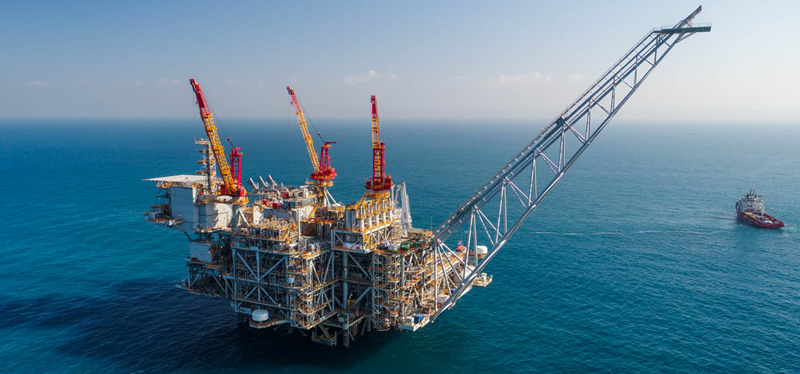
Production at Chevron’s Leviathan, a giant offshore gas field
This may come as a surprise to many, but Israel produced 752 billion cubic feet of gas in 2022, which is nearly equivalent to US offshore gas production (788 bcf in 2022).
Chevron is the main operator in Israel, having purchased Noble’s assets in 2020. Absent Noble’s bold and pioneering exploration in the Eastern Mediterranean, Israel would have continued to be an energy importer dependent on coal for power generation.
Presumably, the protection of these offshore assets is a high priority for the Israeli Navy.




 Bud's Offshore Energy (BOE)