Slide 13: “In 2022, the rate of occupational fatalities, reported for activities on facilities where BSEE has primary investigation authority, decreased to being near the historical national average of approximately 0.9 fatalities per 25,000 full time equivalent workers per year. However, considering all offshore risk factors, including helicopter transportation, diving, marine transfer, and COVID-19 exposures, the occupational fatality rate for all OCS activities has remained high since 2019.“
Slide 15: “In 2022, the TRIR for both production and construction operations increased to the highest levels recorded since 2010 and remained high even after discounting the impact of COVID-19 illnesses. The TRIR for drilling and well operations, however, remained near their historical lows.“
Comments:
These charts and tables are helpful for assessing trends.
The data raise concerns that merit further analysis. Absent the specific incident summaries, which have yet to be updated for 2022, it’s difficult to assess the nature and extent of the issues.
The parsing of fatality data according to regulatory jurisdiction adds to previously expressed concerns about regulatory fragmentation and its implications for offshore safety.
The latest International Regulators’ Forum country performance data are for 2020. The absence of regular, timely updates makes international comparisons difficult and limits the value of what is arguably the most important IRF workstream.
Per the DOI regulatory agenda published on 7/27/2023 (excerpt below), the final BSEE well control rule was published in June. Of course, that did not happen, but the update tells us that the final rule should be published soon. The delay is probably in the internal review process which moves at the pace of continental drift 😉.
BOE comments on the proposed rule are attached here.
12. Oil and Gas and Sulfur Operations in the Outer Continental Shelf-Blowout Preventer Systems and Well Control Revisions [1014–AA52]
Legal Authority: Not Yet Determined [BOE note: This is rather comical since the OCSLA authority was specified in the preamble to the proposed rule and you would never publicly imply that you didn’t know the authority for a final rule. 😉]
Abstract: This rulemaking revises the Bureau of Safety and Environmental Enforcement (BSEE) regulations published in the 2019 final rule entitled “Oil and Gas and Sulfur Operations in the Outer Continental Shelf-Blowout Preventer Systems and Well Control Revisions,” 84 FR 21908 (May 15, 2019), for drilling, workover, completion and decommissioning operations. In accordance with Executive Order (E.O.) 13990 (Protecting Public Health and the Environment and Restoring Science to Tackle the Climate Crisis) and the E.O.’s accompanying “President’s Fact Sheet: List of Agency Actions for Review,” BSEE reviewed the 2019 final rule and is updating to subpart G of 30 CFR part 250 to ensure operations are conducted safely and in an environmentally responsible manner.
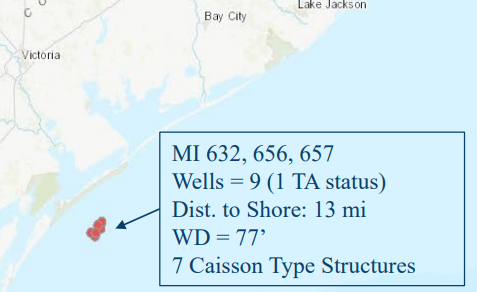
Per BSEE’s recent announcement, Federal funds will be used to plug wells in the Matagorda Island (MI) area of the Gulf of Mexico (see map below). Based on a BSEE presentation and BSEE borehole data, these wells were drilled by Matagorda Island Gas Operations LLC, a company that filed for bankruptcy in 2014.
Prior to the bankruptcy filing, Matagorda Island Gas was cited for 112 violations on 108 inspections. This INC/inspection rate is approximately double the Gulf of Mexico (all operators) rate in a typical year (0.52 in 2022), and is 4 to 25 times higher than the rate for the 2022 Honor Roll companies.
The preliminary NTSB report was posted on 1/18/2023, but the final report has still not been published. Status update:
Will the investigators consider longstanding regulatory fragmentation issues? The most recent Coast Guard – BSEE MOA for fixed platforms added to helideck regulatory uncertainty by assigning decks and fuel handling to BSEE and railings and perimeter netting to the Coast Guard. This is the antithesis of holistic, systems-based regulation.
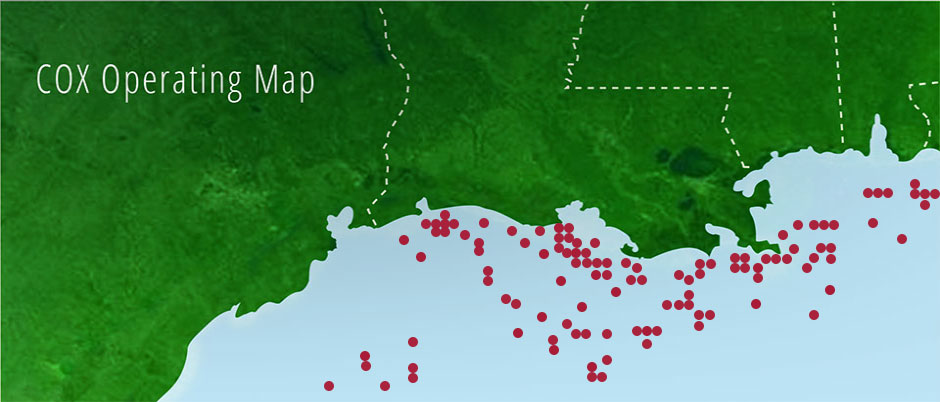
Along with Cox Operating, six affiliates also filed: MLCJR , M21K, EPL Oil & Gas, Cox Oil Offshore, Energy XXI Gulf Coast, and Energy XXI GOM.
The BOEM platform data base lists only Cox Operating (276 platforms), EPL (10 platforms), and Energy XXI GOM (26 platforms) as current operators of OCS platforms. However, according to the Cox Operating website, the company operates 600 producing wells on 500 structures. Presumably, ~200 of those structures are in State waters.
In 2020, the OPEC price war drove oil prices down, while stay-at-home orders and well shut-ins associated with the COVID-19 global pandemic sharply reduced production.
The debtors’ assets suffered significant damage from five named storms and hurricanes during 2020 and 2021, leading to further reductions in production. Comment: According to BSEE, 7 tropical systems affected GoM operations in 2021, so the number of storms is not in dispute. The extent to which maintenance or preparedness issues contributed to the damage is unknown.
In 2020, a foreign-flagged vessel struck a platform owned by one of the debtors resulting in major damage and substantial losses of production. Comment: Apparently, this is the incident being cited. According to the BSEE report, the operator (Cox) was not at fault. Per BSEE: (1) The navigational lights and foghorn on the platform were maintained and in operational order, (2) the allision was not due to any platform related error, and (3) the platform’s operator and safety system responded in accordance with the regulations.
At this time, the debtors’ production volume is half what it was in 2019. Comment: Comparing the 2019 and 2022 production data, OCS oil and gas production are down by about 30% and 40% respectively. However, the 50% reduction figure seems reasonable given the likelihood of further reductions in State water production and in 2023.
A recent fatal incident involving a person working on an offshore oil and gas facility has provided a tragic reminder of the risks of work involving the rigging, manipulation and movement of loads, including people and equipment.
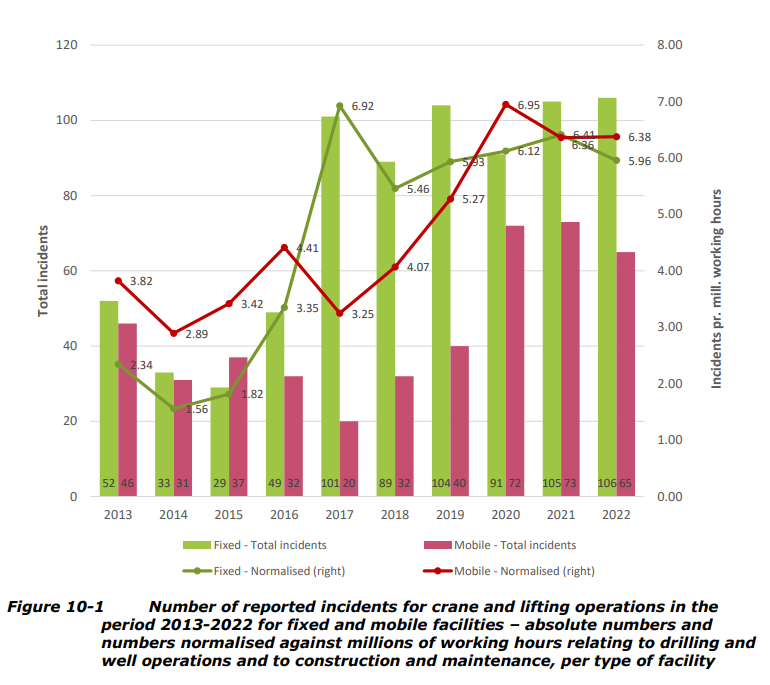
Despite the international focus on lifting operations over the past 30 years, Norwegian and US data do not suggest improved performance. PSA Norway’s “Trends in risk level on the Norwegian Continental Shelf” report shows an increase in lifting incident rates for both fixed and mobile facilities over the past 10 years (first chart below).
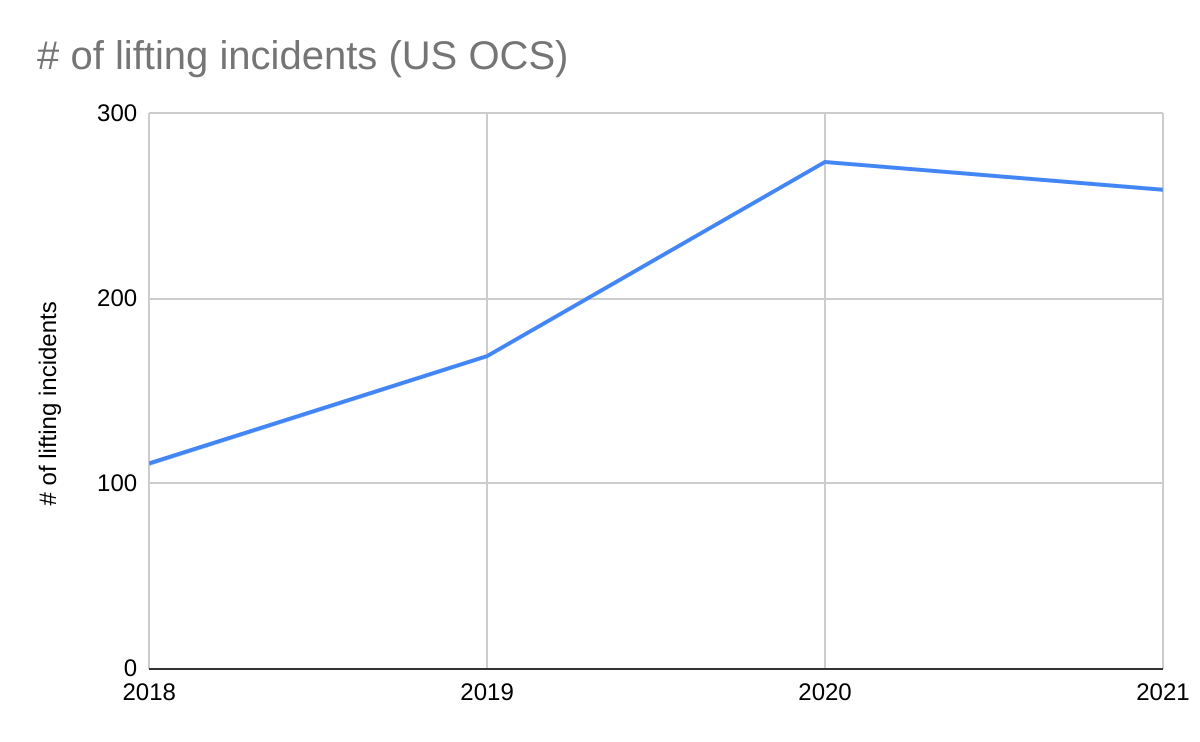
Similarly, recent lifting data from BSEE’s incident tables (summary below) and Jason Mathew’s June 2022 presentation (pages 48-63) suggest that lifting risks are not being effectively mitigated. Why are industy/regulator messages regarding hazard identification and controls not achieving the desired results? Perhaps a fresh look and renewed dialogue are needed.
Crane or personnel/material handling incident (as used in 30 CFR 250.188(a)(8)) refers to an incident involving damage to, or a failure of, the crane itself (e.g., the boom, cables, winches, ballring), other lifting apparatuses (e.g., air tuggers, chain pulls), the rigging hardware (e.g., slings, shackles, turnbuckles), or the load (e.g., striking personnel, dropping the load, damaging the load, damaging the facility) at any time during exploration, development, or production operations on the OCS. This includes all incidents of shock loading that, upon inspection, reveals damage to any part of the crane, lifting apparatus, rigging hardware, or load. Personnel handling incidents include events involving swing ropes, personnel baskets, and any other means to move personnel. Material handling incidents include any activities involving the loading and unloading of material and moving it on, off, or around an OCS facility.
Kudos to offshore-energy.biz for drawing attention to the recent Coast Guard medevacs from the pipelay vessel Solitaire. Three health-related medevacs from the same facility in <2 months would seem to warrant further scrutiny. Will the Coast Guard investigate?
The only timely information on medevacs is from Coast Guard news releases. Information on private medevacs is seldom provided, except as included in the BSEE incident tables, which are typically more than 1 year behind, and update presentations by BSEE’s Gulf of Mexico region.
Below is information on 2023 YTD Coast Guard medevacs associated with Gulf of Mexico oil and gas activities. As previously posted, at least 12 workers died at OCS facilities in 2021-22 of natural causes. Unfortunately, “natural cause” fatalities and illnesses receive little industry or regulator attention.
date
vessel or platform
description
condition report
5/18
OSV Brandon Bordelon
50-year-old male crewmember with an injury to his leg
stable
5/17
Allseas’ pipelay vessel Solitaire
65-year-old male crewmember was experiencing heart attack-like symptoms
stable
4/26
crew boat Mr. Fred
halted search for missing crewmember
presumed dead
4/23
Allseas’ pipelay vessel Solitaire
32-year-old male crewmember experiencing severe abdominal pain.
stable
3/22
Allseas’ pipelay vessel Solitaire
crewmember was experiencing seizure-like symptoms
stable
3/18
BP’s Atlantis platform
28 year old male, eye injury
stable
3/13
unidentified platform 40 miles south of Port Fourchon
Regulatory fragmentation occurs when multiple federal agencies oversee a single issue. Using the full text of the Federal Register, the government’s official daily publication, we provide the first systematic evidence on the extent and costs of regulatory fragmentation. We find that fragmentation increases the firm’s costs while lowering its productivity, profitability, and growth. Moreover, it deters entry into an industry. These effects arise from regulatory redundancy and, more prominently, regulatory inconsistency between agencies. Our results uncover a new source of regulatory burden: companies pay a substantial economic price when regulatory oversight is fragmented across multiple government agencies.
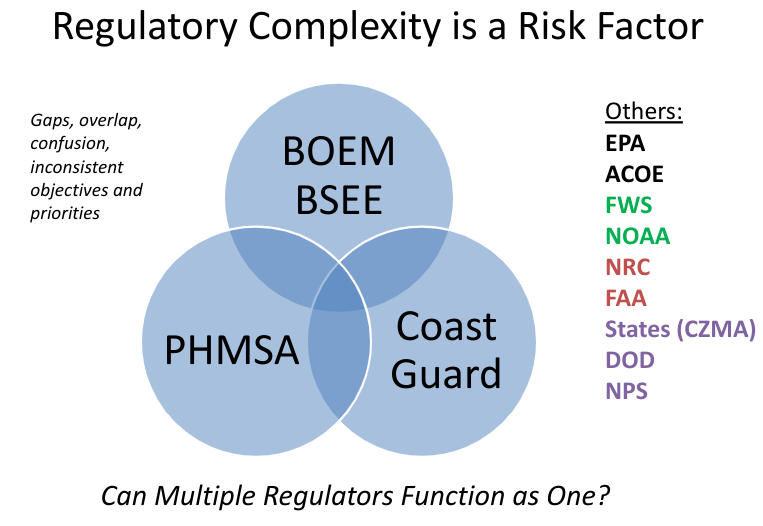
The US has a highly fragmented offshore regulatory regime that has become even more fragmented with the complex division of responsibilities between BOEM and BSEE. The slide below is from a presentation on this topic.
While the linked paper focuses on costs and productivity, fragmentation may also be a significant safety risk factor. A UK colleague once asseted that “overlap is underlap,” and I believe there is something to that. If multiple agencies have jurisdiction over a facility, system, or procedure, the resulting redundancy, inconsistency, and ambiguity may create significant gaps in industry and governmental oversight.
For example, regulatory fragmentation was arguably a significant factor in the most fatal US offshore fire/explosion incidents in the past 35 years – the South Pass B fire in 1989 and the Macondo blowout in 2010. More specifically:
South Pass 60 B: The investigation of the 1989 South Pass 60 B platform explosion that killed 7 workers noted the inconsistency in regulatory practices for the platform, regulated by DOI, and the pipeline regulated by DOT. Cutting into the 18-inch pipeline riser did not require an approved procedure, and the risks associated with hydrocarbon pockets in the undulating pipeline were not carefully assessed. Oversight by the pipeline operator was minimal, and the contractor began cutting into the riser without first determining its contents. A massive explosion occurred and 7 lives were lost.
One would hope that this major spill will lead to an independent review of the regulatory regime for offshore pipelines. Consideration should be given to designating a single regulator that is responsible and accountable for offshore pipeline safety (a joint authority approach might also merit consideration) and developing a single set of clear and consistent regulations.
Macondo: While the root causes of the Macondo blowout involved well planning and construction decisions regarding the casing point, cementing of the production casing, and well suspension procedure, the blowout would likely have been at least partially mitigated (and lives saved) if the gas detection system was fully operable, the emergency disconnect sequence was activated in a timely manner, flow was automatically diverted overboard, or engine overspeed devices functioned properly. Indeed, regulatory overlap led to underlap as summarized below:
Macondo contributing factor
jurisdiction
flow not automatically diverted overboard
DOI/USCG (also concerns about EPA discharge violations)
some gas detectors were inoperable
DOI/USCG
generators did not automatically shutdown when gas was detected
USCG/DOI
failure to activate emergency disconnect sequence in a timely manner (training deficiencies and chain-of-command complications)
USCG/DOI
engine overspeed devices did not function
USCG/DOI
hazardous area classification shortcomings
USCG/DOI
MOUs and MOAs are seldom effective regulatory solutions as they are often unclear or inconclusive, and tend to be more about the interests of the regulator and protecting turf. They also do nothing to ensure a consistent commitment among the regulators. In the case of the US OCS program, BOEM-BSEE have a greater stake in the safety and environmental outcomes given that offshore energy is the reason for their existence. That is not the case for any of the other regulators identified in the graphic above.



 Bud's Offshore Energy (BOE)