Feeds:
Posts
Comments

Posts Tagged ‘Brazil’

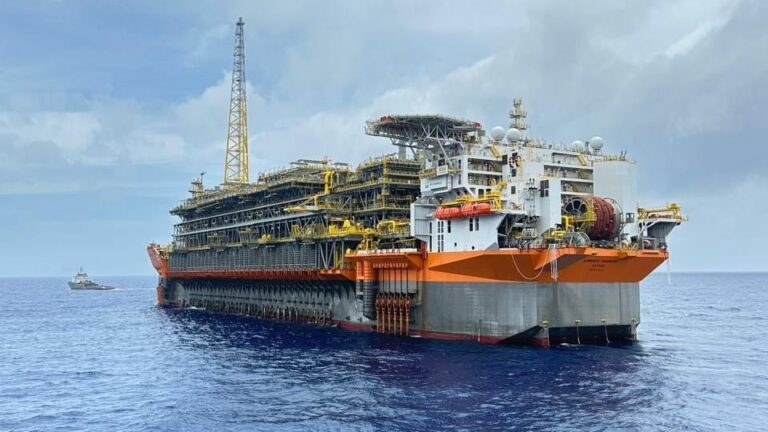
FPSO Almirante Tamandaré; Source: SBM Offshore

ANP (Agência Nacional do Petróleo, Gás Natural e Biocombustíveis) nicely organizes and presents Brazil’s production data. Their 30-page monthly bulletin includes field specific information. The US does not have an equivalent publication.

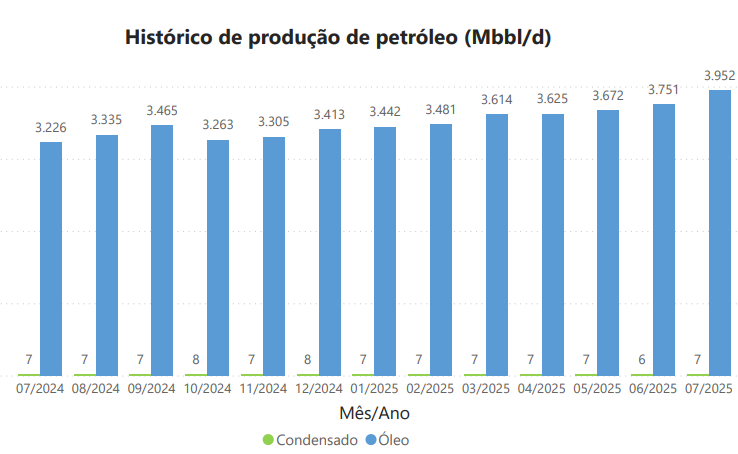
Brazil produced 5.16 million boe/day in July, 97.7% of which was from offshore fields. Oil production was 3.959 million bopd, making Brazil the no. 1 offshore producer. Brazil’s offshore oil production is approximately the equivalent of the combined offshore production of the US and Norway.

How important is Brazil’s offshore sector? Their offshore production is from 568 wells. Assuming all 568 wells were actively producing oil wells (no gas or service wells), the average production rate was ~7000 bopd plus associated gas. More than 10 times as many wells (6033) produced Brazil’s limited onshore production. So <10% of Brazil’s wells (all offshore) account for nearly 98% of their production.

How important is pre-salt exploration and production technology? Pre-salt production (only 169 wells) accounted for 79.1% of the national total of 5.16 million boe/d. This means that pre-salt wells averaged 24,000 boe/d.

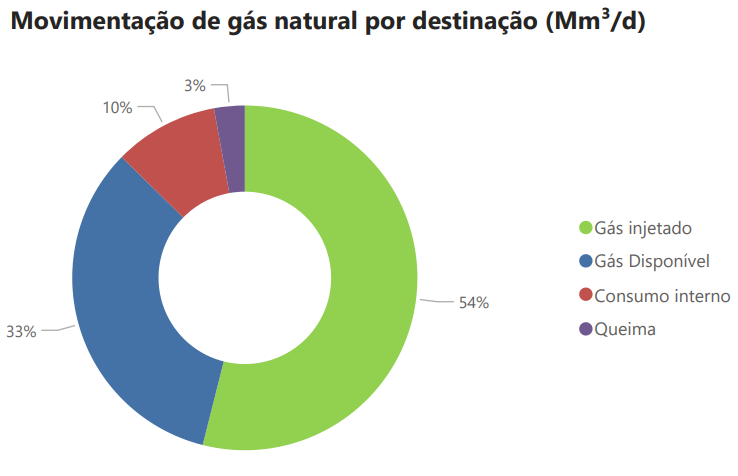
Room for improvement? 2.9% of the produced gas was flared (queima) in July (first chart). Over the past year, Brazil’s flaring volumes ranged from 2.2 to 3.9% of gas production. The fact that nearly all of their gas production is from oil wells, the growth in production (2nd chart), and the higher upset potential (perhaps) for FPSOs, may help explain the relatively high flaring numbers. 1.3% of Gulf of America gas production was flared or vented in 2024 (still too high). <1% flaring rates should be the target for all offshore producers.


Read Full Post »

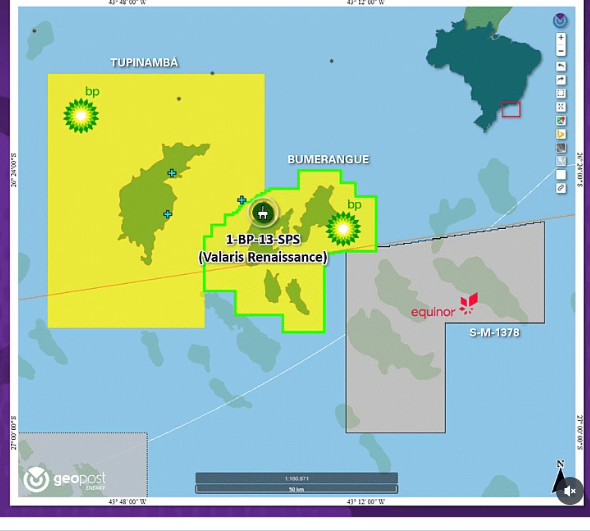
Per bp, the Bumerangue block well is located in the Santos Basin, 404 kilometres from Rio de Janeiro, in 2,372 metres of water. The well was drilled to a total depth of 5,855 metres.

Looks like the buzz may be warranted:

The well intersected the reservoir about 500 metres below the crest of the structure and penetrated an estimated 500 metre gross hydrocarbon column in high-quality pre-salt carbonate reservoir with an areal extent of greater than 300 square kilometres. 

Read Full Post »

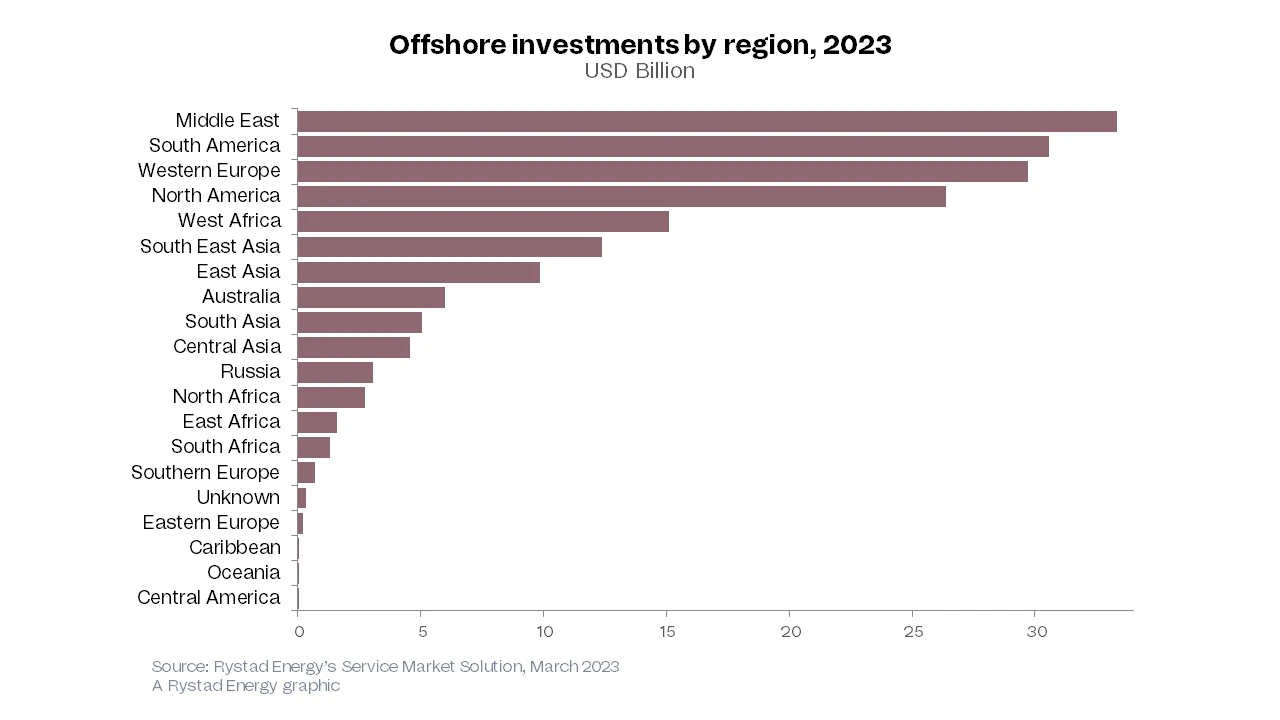
The offshore oil and gas (O&G) sector is set for the highest growth in a decade in the next two years, with $214 billion of new project investments lined up. Rystad Energy research shows that annual greenfield capital expenditure (capex) broke the $100 billion threshold in 2022 and will break it again in 2023 – the first breach for two straight years since 2012 and 2013.

Offshore activity is expected to account for 68% of all sanctioned conventional hydrocarbons in 2023 and 2024, up from 40% between 2015-2018.

Rystad

Comments:

  • Middle East investment continues to be strong
  • Good for South America thanks to Brazil (16 new FPSOs by the end of the decade) and the Guyana success story.
  • Strong forecast for Norway and the UK boosts Europe.
  • North America could do far better with less obstructive access policies.

Read Full Post »

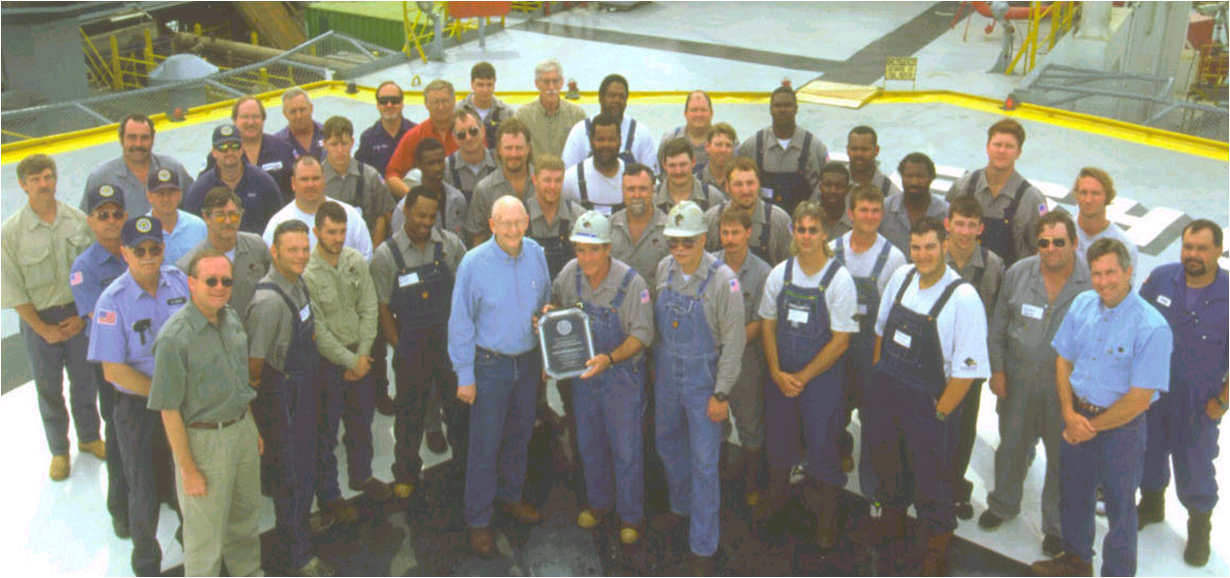
Proposal: Let’s make April 20th International Offshore Safety Day to honor those who have been killed or injured, to recognize the many workers who provide energy for our economies and way of life, and to encourage safety leadership by all offshore operators, contractors, and service companies.

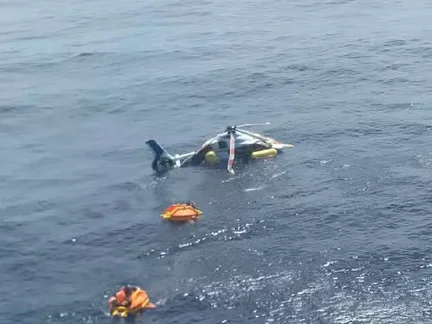
Discussion: April 20th is, of course, the anniversary of the Macondo tragedy in the Gulf of Mexico. Eleven men died on the Deepwater Horizon that day. Many other offshore workers have died or been injured exploring for and producing offshore energy.  167 workers were killed when Piper Alpha exploded in 1988, 84 died when the Ocean Ranger sank in 1982, 123 perished when the Alexander Kielland capsized in 1980, 17 died in a helicopter crash off Newfoundland in 2009, 11 died when the Petrobras 36 sank in the Roncador field in 2001, and many others have been killed working offshore. Some of these accidents, like last summer’s fatality on the Jack Ryan offshore Nigeria, receive no public notice. Others like the fall in the Gulf on Monday or the recent diver fatality in the North Sea receive just a brief mention.

In addition to honoring those killed or injured, Offshore Safety Day would draw attention to the importance of offshore workers, their dedication and commitment, progress that is being made in addressing offshore safety risks, and the outstanding safety management efforts of leading companies around the world.  It’s time for a day to honor offshore workers!

Read Full Post »

  1. The Petrobras Cascade-Chinook project, which includes the first Floating Production Storage and Offloading (FPSO) facility in the Gulf of Mexico, received final approval.
  2. The US will be a major purchaser of Brazilian (Petrobras) deepwater oil production. Will some of the tankers pass through US offshore areas that are closed to exploration and production?

Read Full Post »

The tragedy in Japan has added yet more uncertainty to nervous energy markets:
Japan will likely need more imported oil and natural gas due to closures of nuclear reactors caused by Friday’s earthquake and tsunami, but volumes can’t be calculated accurately as it is unclear how much industrial output has been affected by the disaster and how long power nuclear and thermal power plants will remain closed. Wall Street Journal
It’s much too early to gauge how the nuclear power industry, which some have touted as a model for safety achievement, will be affected.
    Standards news and discussion:
    Offshore Safety Institute?
    The CEOs of major oil and gascompanies will meet March 18 to decide how to proceed with the formation of a US offshore drilling safety institute, William Reilly, the co-chair of the National Oil Spill Commission, said March 8. Platts Oilgram News
    New twist in Cuban drilling drama – Petrobras relinquishes interest
    Marco Aurelio Garcia, foreign policy adviser to President Dilma Rousseff, told reporters in Havana exploratory work off Cuba’s northern coast had not shown good results and that Brazil wanted to concentrate on its own oil fields.
    Since BP’s disastrous Deepwater Horizon accident in the Gulf of Mexico last April, the risks of offshore oil drilling have been a hot topic. One place it isn’t questioned much is Brazil, whose oil production industry is one of the fastest-growing in the world because of vast new deepwater oil reservoirs discovered in the past five years.
    Mexican Deepwater Update (Platts Oilgram News)
    Pemex has just begun to explore in Mexico’s Gulf of Mexico waters deeper than 1,000 feet, but 28 billion undiscovered barrels of oilequivalent are thought to exist in that area, some of which borders US territorial waters. Pemex officials said the company is forging a development plan for its first deepwater field, Lakach, located northeast of the state of Veracruz in about 3,200 feet of water. First production is expected in 2015.
    Environmentalists are furious at a proposal by the petroleum company Shell to start exploration drilling off one of Western Australia’s most treasured reefs. Ningaloo Reef off the north-west coast, has been nominated for World Heritage listing.

Read Full Post »

BOE’s Chery Anderson has alerted us that the Petrobras P-33 platform, which had been shut-in at the direction of the Brazilian regulators, has resumed production. Unfortunately, as has been the case with many post-Macondo articles, the author felt compelled to link the Petrobras problem to deep water.

…the accident once again raised concerns about the safety of deep-water oil output in the wake of last year’s disaster in the U.S Gulf of Mexico.

Contrary to popular opinion, water depth was a relatively minor factor in the Macondo blowout, and had nothing to do with the maintenance issues at the P-33 and other Campos basin facilities. Shallow water was a more significant contributing factor to the Montara blowout (batched completions, mudline suspensions, and two-stage platform installation) than deep water was at Macondo.

Read Full Post »

Reposted from Platt’s Oilgram News (31 January 2011):

Brazil’s Petrobras said January 28 it was forced to shut output at its Cherne II production platform after a January 19 fire on the structure, one of the oldest working in the offshore Campos Basin. The fire in an oil transfer pump unit was brought under control without injuries to crew members, damage to the environment or major structural damage to the platform, Petrobras said in a statement. The platform was producing about 9,300 b/d of crude oil when output was shut, Petrobras said, adding the field should be ready to restart production on February 1. Brazilian oil regulators, the country’s navy and environmental officials, and Petrobras technicians are investigating the cause of the fire, Petrobras said. The platform is one of two in the Chernefield, which recorded output of about 22,000 b/d of crude in November. Brazil’s petroleum regulator had an on-site inspection of the platform scheduled for June.—Jeb Blount

Read Full Post »

Brazil and Angola share more than a common language. Both aspire to be presalt production leaders.  According to Platts Oilgram News (not available online):

BP, Total, Eni and other international majors have been awarded concessions to explore in Angola’s ultra deepwater presalt blocks, a ministry of energy official told Platts January 26, as companies hope to replicate in the southwest African country the successof the pre-salt plays offshore Brazil.

Per a separate Platts article:

According to the US Energy Information Administration website as of January 2010, Angola had proven oil reserves of 9.5 billion barrels while government statements in December 2009 put total reserve numbers as high as 13.1 billion barrels.

Read Full Post »

Unfortunately, this isn’t a Cajun joke.  According to Upstream, Noble’s Clyde Boudreaux, a deepwater semisubmersible, is being moved to Brazil to work for Shell.

We expect to see additional units leave the Gulf region, which may at some point impact the broader deepwater market. Roger Hunt, Noble

Read Full Post »

Older Posts »