Feeds:
Posts
Comments

Posts Tagged ‘BOEM’

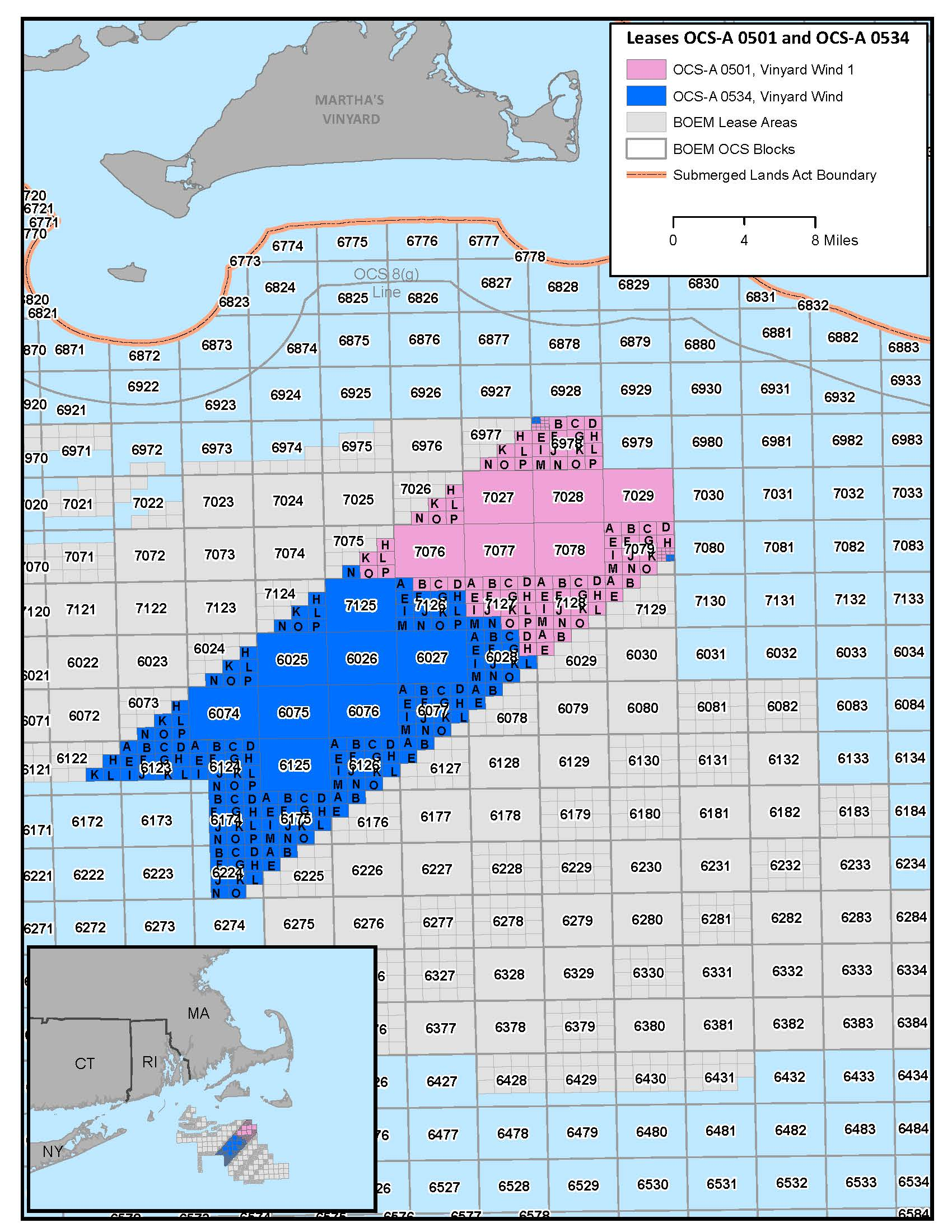
Vineyard Wind project

BOEM is charged with protecting the public from financial risks associated with the decommissioning of offshore facilities. Previous posts have addressed oil and gas facility decommissioning issues and proposed revisions to BOEM’s financial assurance regulations for those operations.

Recent disclosures indicate that BOEM, which very publicly promotes the offshore wind projects that it regulates, has waived a fundamental financial assurance requirement at the request of Vineyard Wind (approval letter attached). Given its broad applicability, this precedential waiver could have the effect of revising a significant provision of the offshore wind decommissioning regulations without public review and comment.

The issue is the “pay as you build” financial assurance requirement at 30 CFR § 585.516, which was waived by BOEM. This requirement, which is intended to project the public from decommissioning liability, is fair and reasonable given that wind developers must only provide financial assurance “in accordance with the number of facilities installed or being installed.” Companies that don’t have sufficient financial strength to comply with this requirement should not be installing and operating offshore wind turbines.

Vineyard Wind was either unable or unwilling to comply with the requirement. They instead requested to defer providing the full amount of the required financial assurance until year 15 of actual operations. The waiver changes “provide assurance when you install” to provide assurance 15 years after installation if everything goes as planned (hoped?).

After their waiver request was denied in 2017, Vineyard Wind resubmitted the request in 2021 seeking a favorable decision from an administration concerned that project cancellation or delay might tarnish the program that they were enthusiastically promoting.

BOEM (as directed from above?) granted the waiver, citing the general departure authority at 30 CFR § 585.103. However, that authority is intended for special situations, not for broadly applicable waivers that have the effect of revising the regulations without the public review required by the Administrative Procedures Act and Executive Orders 12866 and 13563.

There are no criteria in the Vineyard Wind waiver approval that could not apply to other wind developers. Vineyard Wind has simply committed to the same “risk-reduction factors” that apply to all offshore wind projects: damage insurance, the “use of proven turbine technology,” and long-term power purchase agreements. How could BOEM deny the same request from other companies?

It’s noteworthy that the regulations specific to financial assurance at 30 CFR § 585.516 provide no criteria for waiving the assurance requirements; nor do the regulations provide for the 15-year payment plan approved by BOEM. Given the precedential nature of the BOEM action and its enormous financial implications, a revision to the decommissioning regulations that provides criteria for such payment schemes should be promulgating before any similar departures are approved.

In light of the waiver, the public will likely incur substantial costs if Vineyard Wind fails, walks away, doesn’t fully fund their decommissioning account in a timely manner, or seeks new concessions after some or all of the 62 turbines have been installed.

Given the decommissioning obligations, what company would want to step in and assume responsibility for a failing project 10-15 years from now? What happens if Vineyard Wind’s project revenues don’t meet expectations and contributions to their decommissioning account are insufficient or used improperly? More concessions? We’ve seen this dance before.

Whether the project is for oil, gas, or wind energy, protecting the public from decommissioning liabilities should always be prioritized over facilitating development.

Read Full Post »

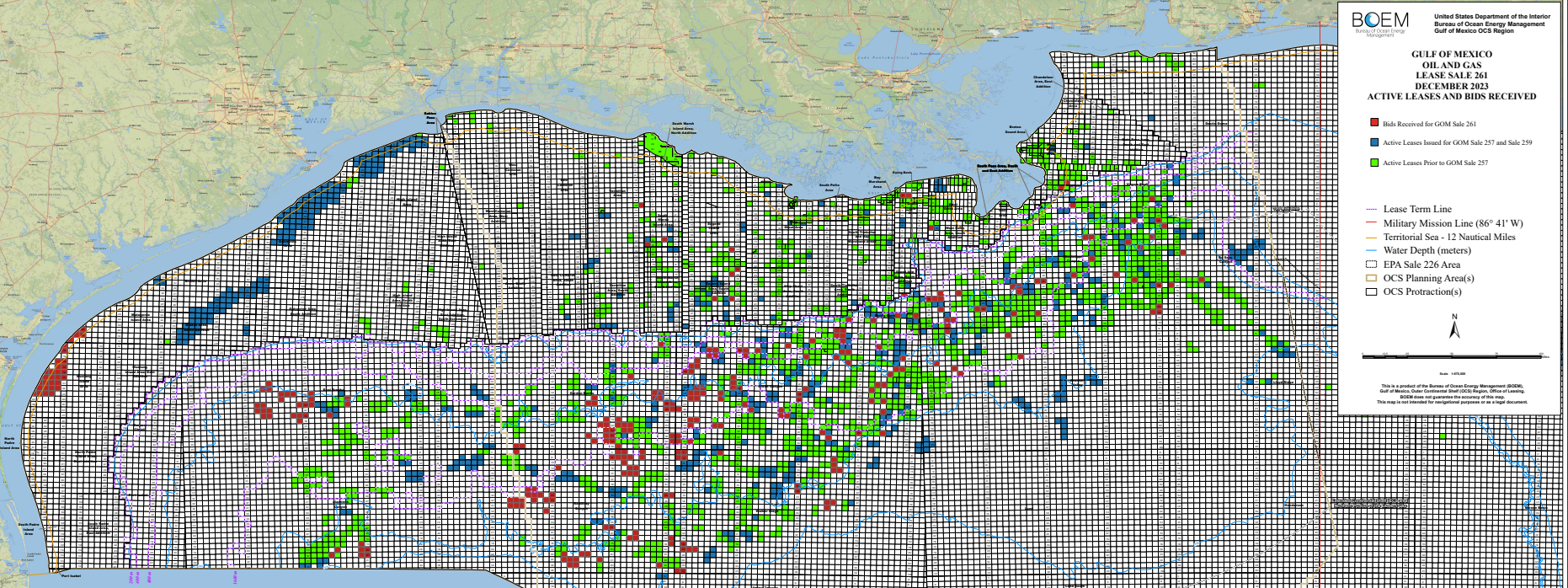
The above map shows the offshore carbon disposal leases acquired by Repsol from the Texas General Land Office (GLO) and the adjacent Federal tracts Repsol bid on at OCS Lease Sale 261. There should be absolutely no confusion regarding Repsol intentions at Sale 261. They plan to develop a large CO2 disposal hub offshore Corpus Christi and bid improperly at an OCS oil and gas lease sale to support that objective.

Perhaps blinded by visions of “a stream of U.S. government grants, followed by generous tax credits for every ton of carbon stored,” Repsol (Sale 261) and Exxon (Sales 257 and 259) have made a mockery of the OCS leasing process and the regulations that guide it. The Repsol bids should be promptly rejected.

So what about the Exxon nearshore Texas leases that have already been issued? Given that Exxon misled the Federal government and improperly acquired carbon disposal leases at an oil and gas lease sale, those bids should be cancelled pursuant to 30 CFR § 556.1102:

(c) BOEM may cancel your lease if it determines that the lease was obtained by fraud or misrepresentation. You will have notice and an opportunity to be heard before BOEM cancels your lease.

While Exxon’s oil production increases in the Permian Basin and offshore Guyana are impressive, is it not hypocritical for Exxon and other major producers to capitalize on the capture and disposal of emissions associated with the consumption of their products? Is it not just a bit unsavory for oil companies to cash in on (and virtue signal about) carbon collection and disposal at the public’s expense? Perhaps companies that believe oil and gas production is harmful to society should be reducing production rather than engaging in enterprises intended to sustain it.

Read Full Post »

  • Good prep by the BOEM leasing staff. On time. Quality live stream. Smooth bid reading by Jim Kendall and Bernadette Thomas.
  • Strong sale: $382.2 million in high bids vs. $263.8 for Sale 259. Anything over $300 million would have been considered a good sale.
  • 26 companies participated (updated from pre-sale stats)
  • Strong participation by the GoM stalwarts: Shell, Chevron, Oxy/Anadarko, BP, Woodside (BHP), Equinor, Talos, LLOG, Walter, Kosmos, Beacon
  • Kudos to Arena, Byron, Cantium, Focus for keeping the shelf alive
  • Contrary to the regulations, it looks like we once again have a company seeking to acquire oil and gas leases for carbon disposal purposes. This time it’s Repsol which was the sole bidder for 36 low-value nearshore tracts in the Mustang Island and Matagorda Island areas (red blocks at the western end of the map above). At least Repsol also bid legitimately on 5 deepwater tracts.
  • Exxon was a complete no show, as was ConocoPhillips.

Complete sale statistics will soon be available at BOEM.gov.

Read Full Post »

This should be an interesting sale. Below are some of the questions that may be answered:

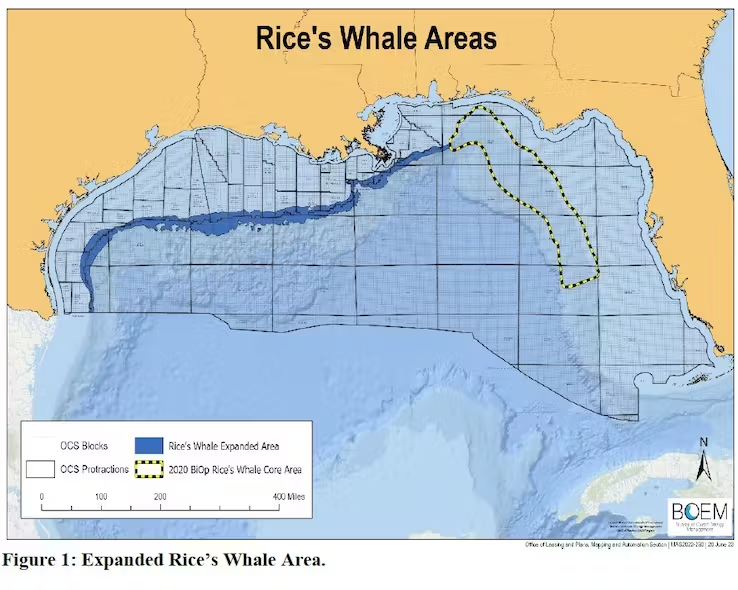
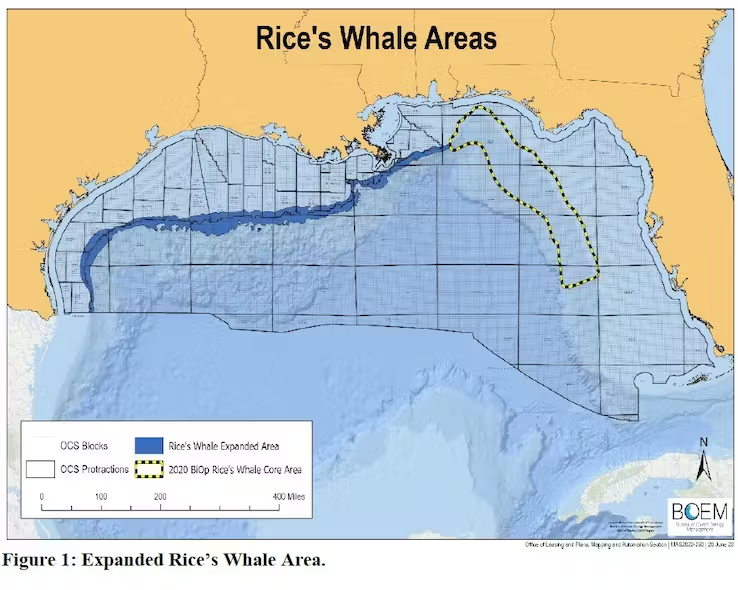
  • Will the Rice’s whale issues affect bidding for deepwater leases? The 5th Circuit’s ruling removes the Rice’s whale lease stipulation. However, BOEM’s Notice to Lessees and Operators (NTL) includes the same provisions and still stands pending further consultations with NOAA. Although the NTL is a “guidance document” (wink-wink), there are ways of making it stick through the plan approval process. Even without binding requirements, companies might choose to fully comply with the NTL to minimize legal risks.
  • Will the uncertainty about future sales spur or constrain bidding? Absent legislative action, no sale will be held in 2025.
  • Will the 14 blocks with rejected high bids at Sale 259 receive bids at Sale 261? If so, will the bids be higher or lower? Is it prudent to reject high bids without knowing when the next sale might be held?
  • Will bp, Chevron, Shell, Equinor, Oxy, and Woodside continue to be bullish on the GoM?
  • Will Red Willow Offshore, owned by the Southern Ute tribe, again be an active bidder?
  • Will Exxon again seek to acquire carbon sequestration leases at an oil and gas lease sale? After a long absence, it would be good to see the US super-major acquire leases for oil and gas purposes. Ditto for ConocoPhillips.
  • How many companies will participate in the sale? 30-35 would be a nice outcome.
  • What will be the sum of the high bids? >$300 million would be a solid result.

BOEM will live stream the opening of bids at 9 am CDT on Dec. 20, 2023

BOEM

Read Full Post »

BOEM diminishes the credibility of their important (and generally excellent) scientific, lease administration, and regulatory work with over-the-top wind energy promotion. The tweet below is a recent example.

This is not a good look for the bureau that is expected to objectively evaluate offshore wind projects. Leave the hype to the wind industry and its NGO supporters.

Read Full Post »

link: Investigation of May 15, 2021, Fatality, Eugene Island Area Block 158 #14 Platform

Firstly, taking 2.5 years to publish an investigation report is unacceptable for an organization with BSEE’s talent, resources, and safety mandate. Unfortunately, such delays now seem to be the rule as the summary table (below) for the last 4 panel reports demonstrates. The most recent report implies that the actual investigation was completed in 2-3 months. Why were another 2+ years needed to publish the report? (Note that the lengthy and complex National Commission, BOEMRE, Chief Counsel, and NAE reports on the Macondo blowout were published 6 to to 17 months after the well was shut-in.)

incident datereport dateelapsed time (months)incident type
5/15/202110/31/202329.5fatality
1/24/20217/24/202330fatality
8/23/20202/15/202330fatality
7/25/20202/15/202331spill
Four most recent BSEE panel reports

The subject (May 2021) fatality occurred during a casing integrity pressure test, and some of the risk factors were familiar:

  • The operator, Fieldwood Energy, was facing bankruptcy, and had a poor performance record.
  • The platform was installed 52 years prior to the incident, and had been shut-in for more than a year.
  • The well of concern (#27) was drilled in 1970, sidetracked in 1995, and last produced in February 2013.
  • Diagnostic tests clearly demonstrated communication between the tubing, production casing, and surface casing.

In light of the known well integrity issues and the absence of production for more than 8 years, the prudent action would have been to plug and abandon the well in a timely manner. However, under 30 CFR 250.526 as interpreted at the time, Fieldwood had another option – submit a casing pressure request to BSEE to confirm the integrity of the outermost 16″ casing and (per p. 10 of the report) “continue to operate the well in its existing condition.” Given that the well had not produced for 8 years and that the platform had been shut-in for more than a year, the option to continue operating the well should not have been applicable.

The only issue for Fieldwood to resolve with the regulator should have been the timing of the plugging operation. Additional well diagnostics would only serve to create new risks and further delay the well’s abandonment.

The resulting pressure test of the outermost (16″) casing was solely for the purpose of confirming a second well bore barrier. Per the report (p.10), there is a “known frequency of outermost casings in the GOM experiencing a loss of integrity as a result of corrosion.” Whether or not the 16″ casing passed the test, the inactive well had clear integrity issues and should have been plugged.

Fieldwood proceeded with the pressure test rather than correcting the problem. The regulations, as interpreted, thus facilitated the unsafe actions that followed. These factors heightened the operational risks:

  • Extensive scaffolding and a standby boat were needed for the test.
  • Process gas via temporary test equipment was used to conduct the test.
  • The Field-Person In Charge (PIC) heard about the test for the first time on the morning of the incident.
  • The PIC and victim had no procedures to follow, and had to figure out how to conduct the test on the fly.
  • A high pressure hose was connected without a pressure regulator or pressure safety valve.
  • The digital pressure gauge had two measurement modes, one to display pressure in psi and the other in bars. (One bar is equivalent to 14.5 psi. Assuming that the readings were in psi rather than bars would thus result in serious overpressure of the casing.)

Seconds after the victim told the field-PIC the pressure was 175 psi (presumably 175 bar and 2538 psi), the casing ruptured. The force of the explosion propelled the victim into the handrail approximately 4 feet away, which bent from the impact. The victim’s hardhat was projected 60 to 80 feet upwards, lodging into the piping.

The investigation report fails to address the wisdom of conducting the pressure test and the regulatory weaknesses that enabled Fieldwood to defer safety critical well plugging operations. The pressure test option in 30 CFR § 250.526, was not intended for long out-of-service wells with demonstrated well integrity issues. The only acceptable option was corrective action (plugging the well) without further delay. The pressure test option added risks without addressing the fundamental problem and helped enable the operator to further delay decommissioning obligations.

The report also fails to address the lease administration practices that enabled a problem operator to expand their lease holdings. Indeed, BOEM’s inexplicable proposal to eliminate a company’s performance record in determining the need for supplemental bonding would exacerbate the risk of more such incidents. (See these comments on the BOEM proposal).

Postscript: According to BOEM data, the lease where the fatal incident occurred expired on 7/31/2021. Per the BSEE Borehole and structures files, neither the platform (#14) nor any of the other 4 structures remaining on the lease have been removed, and the well (#27) has yet to be plugged.

Read Full Post »

As a result of the order issued by the United States Court of Appeals for the Fifth Circuit on Nov. 14, 2023, the Bureau of Ocean Energy Management (BOEM) has scheduled Lease Sale 261 for Dec. 20, 2023.

The Gulf of Mexico oil and gas lease sale was originally scheduled for Sept. 27, 2023, and later scheduled for Nov. 8, 2023, in response to judicial orders.

Pursuant to direction from the Court, BOEM will include lease blocks that were previously excluded due to concerns regarding potential impacts to the Rice’s whale population in the Gulf of Mexico. BOEM will also remove portions of a related stipulation meant to address those potential impacts from the lease terms for any leases that may result from Lease Sale 261.

A Final Notice of Sale will be published in the Federal Register on Nov. 20, 2023, and will be available for public inspection on Nov. 17, 2023. 

BOEM will live stream the opening of bids at 9 am CDT on Dec. 20, 2023. All terms and conditions of the lease sale are listed in the FNOS. For more information, go to: www.boem.gov/sale-261.  

BOEM

Read Full Post »

The sale could be held sooner. However, since BOEM asked for 37 days, I’m assuming that the sale will be on December 21.

In the 70 year history of the oil and gas leasing program, this will be the sale date that is closest to Christmas. Yet another major milestone for the offshore program! 😀

Read Full Post »

Order is pasted below and attached.

IT IS ORDERED and ADJUDGED that the Intervenors’ appeal is DISMISSED. As for BOEM’s limited appeal as to the timing of the sale, we hereby AMEND the district court’s preliminary injunction only to the extent that the deadline for conducting Lease Sale 261 shall now be thirtyseven days from the date of the issuance of the mandate in this appeal.
IT IS FURTHER ORDERED that each party bear its own costs on appeal.

Background information and related posts.

Read Full Post »

Study: Potential Hydrodynamic Impacts of Offshore Wind Energy on Nantucket Shoals Regional Ecology: An Evaluation from Wind to Whales, National Academies of Sciences, Engineering, and Medicine.

Comments:

  • Kudos to BOEM for sponsoring this important study which identifies the potential ecological effects of offshore wind farms on the endangered North Atlantic Right Whale.
  • BOEM must now consider, and presumably implement, the committee’s recommendations. This could prove to be especially challenging given BOEM’s prominent wind advocacy role.
  • All 9 of the study committee members are scientists with appropriate backgrounds and specialties (see Appendix A of the report).
  • As a rule, the NAS notes potential conflicts of interest in the biographical statements. Two possible conflicts were identified: one committee member was a “compensated member of a review panel for Ortsted’s Offshore Wind Research Plan in 2021,” and another works for a firm that “has been partially funded by offshore wind development companies.”
  • The panel recommends robust monitoring during all phases of wind development and operations in the North Atlantic region. Is that sufficient given that hundreds of turbines could be installed before the data have been acquired and analyzed?
  • The concerns raised by the NAS committee are not new. 18 months ago, NOAA’s Chief of Protected Species cited some of the same concerns in recommending a conservation buffer zone adjacent to Nantucket Shoals.

. Background graphics, excerpts, and recommendations are pasted below.

Important excerpts:

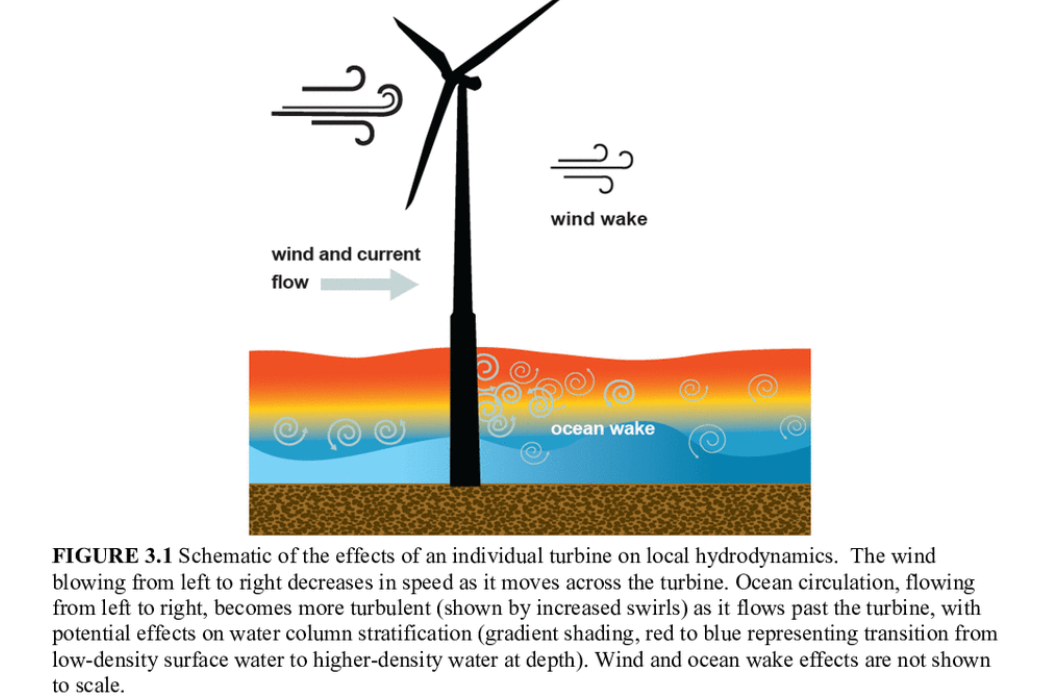
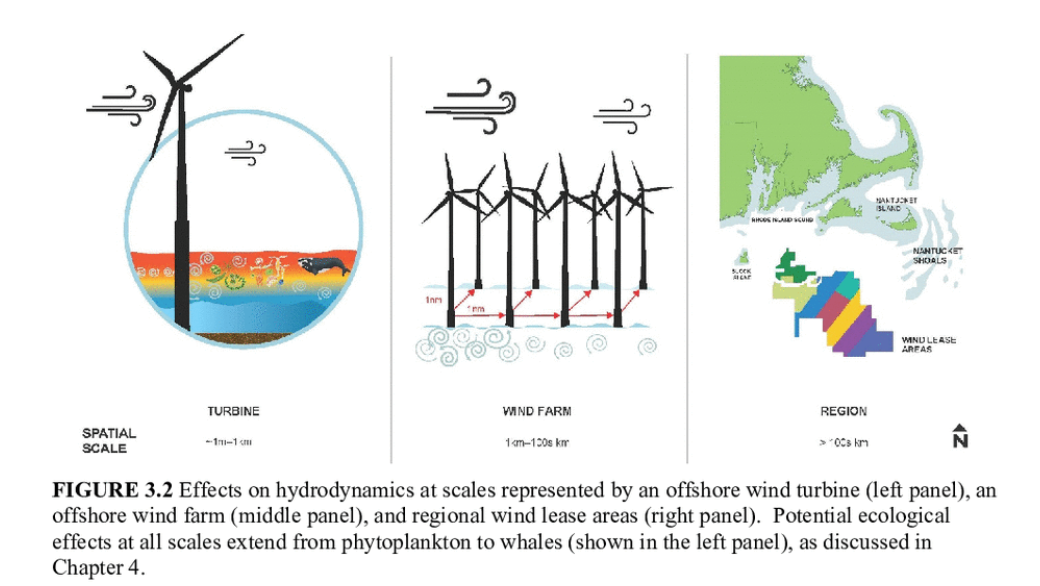
  • p.2: A single offshore wind turbine can alter local hydrodynamics by interrupting circulation processes through a wake effect and induce turbulence in the water column surrounding and downstream of the turbine supporting structure, the pile. Moving away from single turbine effects and looking at arrays of turbines in a wind farm or at multiple adjacent offshore wind farms, these effects become more complex with implications for both local and regional circulation.
  • p.4: At the wind farm scale, the potential impacts include reductions in ocean current speeds, stratification, ocean surface wind speed, and deflection of the pycnocline. At the regional scale, perturbations due to offshore wind turbines are difficult to quantify because of the natural processes that drive significant environmental variability across the region.
  • p.6: Recommendation: The Bureau of Ocean Energy Management, National Oceanic Atmospheric Administration, and others should support, and where possible require, the collection of oceanographic and ecological observations through robust integrated monitoring programs within the Nantucket Shoals region and in the region surrounding wind energy areas before and during all phases of wind energy development: surveying, construction, operation, and decommissioning. This is especially important as right whale use of the Nantucket Shoals region continues to evolve due to oceanographic changes and/or the activities and conditions relevant to offshore wind farms.
  • p.7: Recommendation: The Bureau of Ocean Energy Management, National Oceanic Atmospheric Administration, and others should support, and where possible require, oceanographic and ecological modeling of the Nantucket Shoals region before and during all phases of wind energy development: surveying, construction, operation, and decommissioning. This critical information will help guide regional policies that protect right whales and improve predictions of ecological impacts from wind development at other lease sites.

Read Full Post »

« Newer Posts - Older Posts »