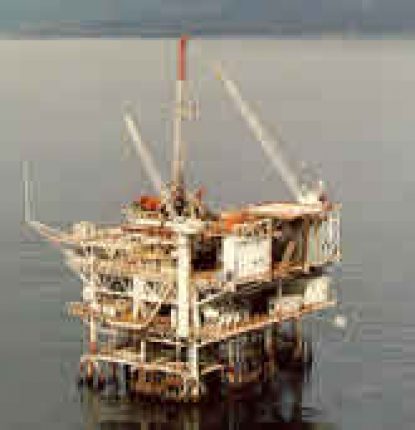
On January 28, 1969, well A-21, the 5th well to be drilled from Union Oil Company’s “A” platform began flowing uncontrollably through fractures into the Santa Barbara Channel.
The absence of any well casing to protect the permeable, fractured cap rock meant that the operator couldn’t safely shut-in a sudden influx of hydrocarbons into the well bore (i.e. a “kick”). Shutting-in the well at the surface would create well bore fractures through which oil and gas could migrate to shallow strata and the sea floor. The probability of an oil blowout was thus essentially the same as the probability of a kick (>10-2). Compare this with the historical US offshore oil blowout probability (<10-4) and the probability of <10-5 for wells with optimal barrier management.
Here, in brief, is the well A-21 story:
Well drilled to total depth of 3203′ below the ocean floor (BOF).
13 3/8″ casing had been set at 238′ BOF. The well was unprotected from the base of this casing string to total depth.
Evidence of natural seeps near the site suggested the presence of fracture channels
The well was drilled through permeable cap rock and a small high pressured gas reservoir before penetrating the target oil sands.
When the well reached total depth, the crew started pulling drill pipe out of hole to in preparation for well logging.
The first 5 stands of drill pipe pulled tight; the next 3 pulled free suggesting the swabbing of fluids into the well bore..
The well started flowing through the drill pipe. The crew attempted to stab an inside preventer into the drill pipe, but the well was blowing too hard. The crew then attempted unsuccessfully to stab the kelly into the drill pipe and halt the flow.
The crew dropped the drill pipe into the well bore and closed the blind ram to shut-in the well.
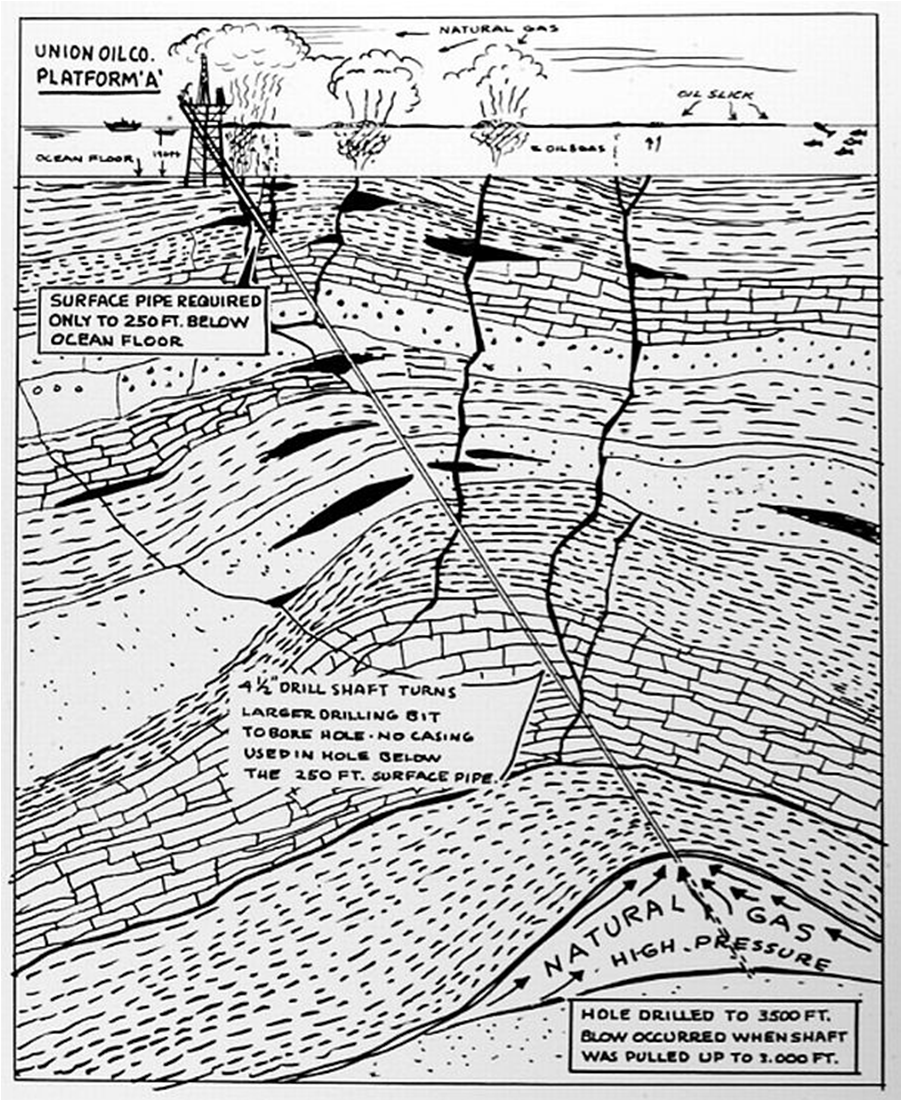
Boils of gas began to appear on the water surface. Oil flowed to the surface through numerous fracture channels. The sketch below by a former colleague depicts the fracturing, which greatly complicated mitigation of the flow.
We need to continue studying these historically important incidents, not just the technical details but also the human and organizational factors that allowed such safety and environmental disasters to occur. The idea is not to shame, but to remember and better understand.
Although OSHA is withdrawing the Vaccination and Testing ETS as an enforceable emergency temporary standard, OSHA is not withdrawing the ETS to the extent that it serves as a proposed rule
The law suit makes reference to the aging offshore facilities and the Huntington Beach pipeline spill:
Oil companies have been drilling off California for more than 50 years. The first platforms were installed in 1968 and production continues today. Much of this infrastructure has outlived its expected lifespan and is well beyond the age scientists say significantly increase the risk of oil spills.
Indeed, just months ago a pipeline connected to a platform in federal waters off Huntington Beach ruptured and spilled tens of thousands of gallons of oil into the marine environment. The spill fouled sensitive marine, beach, and wetland habitat; forced closure of fisheries; and harmed and killed birds, fish, plants, invertebrates, and marine mammals.
The combination of high production of oil and gas from a total of 94 fields, significant demand and high commodity prices led to a historically high level on the State’s revenues from petroleum.
Production in 2021 came to 102 million standard cubic metres of oil (642 million barrels) and 113 billion standard cubic metres of gas. This corresponds to about four million barrels of oil equivalent per day, a minor increase from the previous year.
Norway wisely eased the petroleum tax burden during the pandemic with favorable results.
The temporary change in the petroleum tax has most likely led to an increase in project activity. The projects would most likely have been carried out even without the tax package, but some of them would have been postponed.
An aspect of Norwegian offshore policy that is confusing to this outside observer is the emphasis on transmitting electric power from shore to offshore platforms (see quote below). In most cases, offshore platforms produce sufficient gas to support their power demands. Should platforms be powered from shore, gas that is not used for platform operations would presumably be marketed for consumption elsewhere or reinjected. If the gas is marketed and consumed elsewhere, there is essentially no net (global) CO2 emissions reduction benefit. Gas that is reinjected is wasted unless there is an enhanced oil recovery benefit. So it would seem that importing electric power from shore would only make sense if the net reduction in offshore gas consumption increased ultimate oil production (which could be viewed as undesirable if you take carbon management to the extreme).
While production remains high, CO2 emissions are dropping. The most important reason for this is the use of power from shore. The objective is to cut emissions in half by 2030 compared with the level in 2005.
In a separate article, NPD notes that power from shore increases the cost of platform operations and will also lead to an increase in electricity prices in Norway. Given these considerations, the very small net global reduction in CO2 emissions seems costly.
Platform electrification no doubt helps Norway achieve domestic emission reduction commitments. However, from a global perspective, how important is it for a minor CO2 emitter like Norway to achieve further reductions? Also, isn’t it somewhat contradictory for a major oil and gas exporter to take such extreme measures to reduce the emissions associated with the production of these resources?
Coastkeeper’s upcoming Retiring Offshore Rigs Summit, or ROR, comes roughly ten years after Coastkeeper’s Rigs to Reef Conference in 2010. While that conference succeeded in passing new decommissioning and artificial reef enhancement laws, the language was not workable. In the decade since that legislation, known as AB 2503, or the “California Marine Resources Legacy Act” was signed into law, it was never implemented by the state.
That’s right – a leasing plan with no leasing, a program that is about nothing.
Unfortunately for the proponents, this creative proposal would seem to have some significant legal obstacles, most notably its inconsistency with the statute and the legislative history. The idea was to have an organized approach to leasing, not to eliminate it. Per OCSLA:
The leasing program shall consist of a schedule of proposed lease sales indicating, as precisely as possible, the size, timing, and location of leasing activity which he determines will best meet national energy needs for the five-year period following its approval or reapproval.
How does zero leasing help meet national energy needs? Security? Price stability? Supply chain? Are these groups funded by OPEC+ members and nations that hate us the most? If not, they should be, because they are certainly doing their bidding.
As Daniel Yergin’s excellent Atlantic piece explained, the energy transition will take time and be enormously complex. He quoted French economist Jean Pisani-Ferry who warned that “going into overdrive on transitioning away from fossil fuels would lead to major economic shocks similar to the oil crises that rocked the global economy in the 1970s.”
Empty five year leasing programs are not an option for a diverse nation of 330+ million people that will continue to need oil and gas well into the future. We should and are adding new energy alternatives to the mix, and many of us were involved in developing the framework for these alternatives, but eliminating important sources of oil and gas at this time would be sheer folly.
While the Fieldwood Energy violations drove up the number of Incidents of Non-Compliance (INCs) in the Gulf of Mexico in 2021, most operating companies appear to have had good compliance records. Among companies that were subjected to at least 10 facility inspection and drilled at least one well, BHP Billiton, Eni US, and Murphy (listed alphabetically) had the most impressive compliance records. These three operators were cited for 7 or fewer INCs, none of which required a facility to be shut-in. Other operators that exceeded those activity thresholds and had excellent compliance records were (listed alphabetically) Anadarko, ANKOR Energy, Chevron, EnVen, Shell, and Walter Oil and Gas.
In the Pacific Region, Beta Operating Co., Chevron (now overseeing the former Signal Hill properties), and Exxon had excellent compliance records, although none of these facilities produced for the full year. In Alaska, Hillcorp had an excellent record at the Northstar Unit. (This is a gravel island facility in the State waters of the Beaufort Sea, but some of the wells produce from portions of the reservoir that are in the Federal sector).
Unfortunately, only summary inspection data are posted online. Without knowing the specific violations and circumstances, it’s not possible to fully assess the risk exposure. These oil and gas operations are conducted on public lands and are monitored by Federal employees. Inspection data and reports should be publicly accessible without having to submit Freedom of Information Act requests.
Recommendation 4.2.2: Because accident, incident, and inspection data all are needed to identify and understand safety risks and corrective actions, the committee recommends full transparency such that regulators make all these data readily available to the public in a timely way, taking into consideration applicable confidentiality requirements.
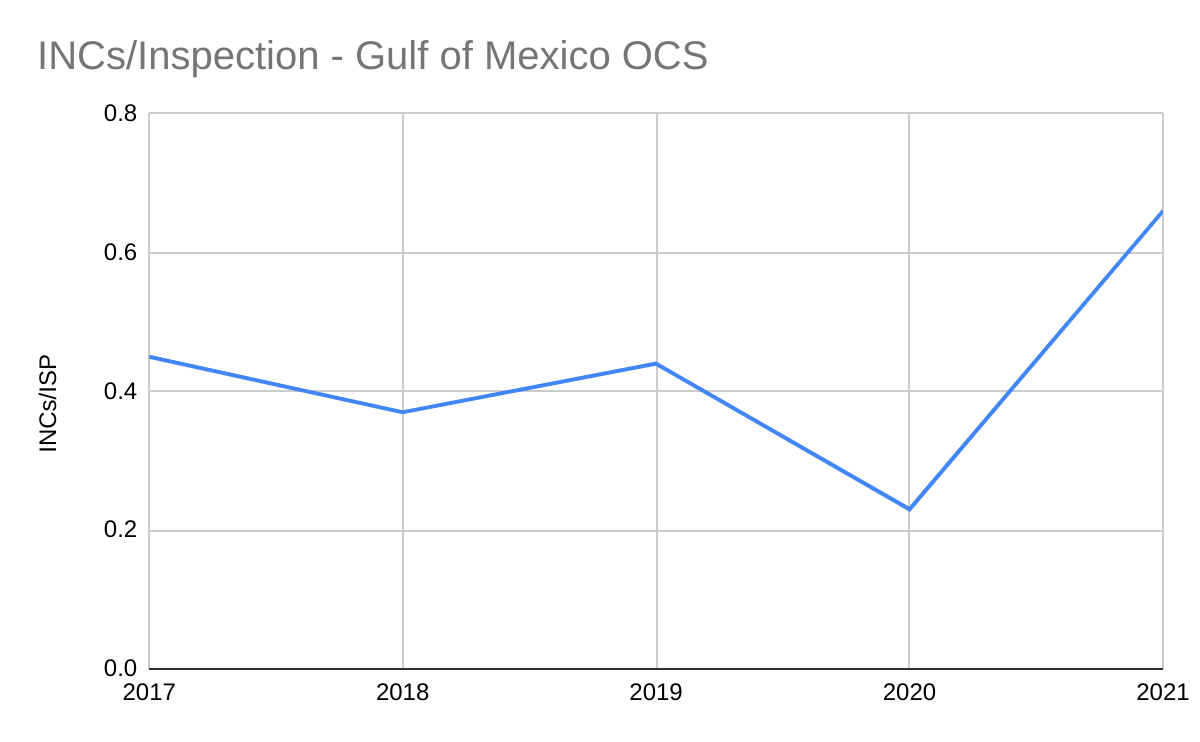
Per BSEE’s Incidents of Non-Compliance (INC) data base, the number of violations surged in 2021, both in terms of the total number of INCs and the INCs/inspection ratio (see chart below). Remarkably, a single company – Fieldwood Energy – was responsible for 845 INCs or 44% of the total number issued. Normalizing for the number of inspections, Fieldwood facilities were cited for 1.46 INCs/inspection versus 0.46 INCs/inspection for all other companies. An unprecedented 61 of Fieldwood’s 2021 INCs called for facility shut-ins, many times more than any other operator. Through the first 17 days of 2022, Fieldwood has already been cited for 21 INCs, 5 of which required facilities to be shut-in.
Fieldwood and its affiliates have experienced multiple bankruptcies and the company has once again been reorganized with the blessing of the courts.Chevron’s comprehensive objection to the reorganization plan asserted that Fieldwood has $9 billion in current and anticipated decommissioning obligations. These enormous decommissioning liabilities and their implications for predecessor lessees (former facility owners) and the Federal government were the main issue in these proceedings, and the bankruptcy plan includes settlements with predecessor companies and the government.
Even more significant than the financial matters and INCs are the following:
While BSEE regulations provide for the removal of operating rights for poor safety performance, companies can reorganize and problem managers can reappear elsewhere. As a result, marginally financed and ineffective operating companies are a major challenge for BSEE as evidenced by the INCs, civil penalties, and investigations. (See the related saga of Platforms Hogan and Houchin in the Pacific Region.)
Poor safety performers drag down the entire industry. The costs of mega-disasters like the Santa Barbara and Macondo blowouts have been widely discussed. However, chronic poor performance and the associated incidents also weaken the industry and damage the integrity of the offshore oil and gas program. These performance issues can’t be left entirely to BSEE and the Coast Guard to resolve. The industry needs to do a better job of self-evaluation, calling out poor performers, and exercising judgement in the assignment of offshore properties.




 Bud's Offshore Energy (BOE)