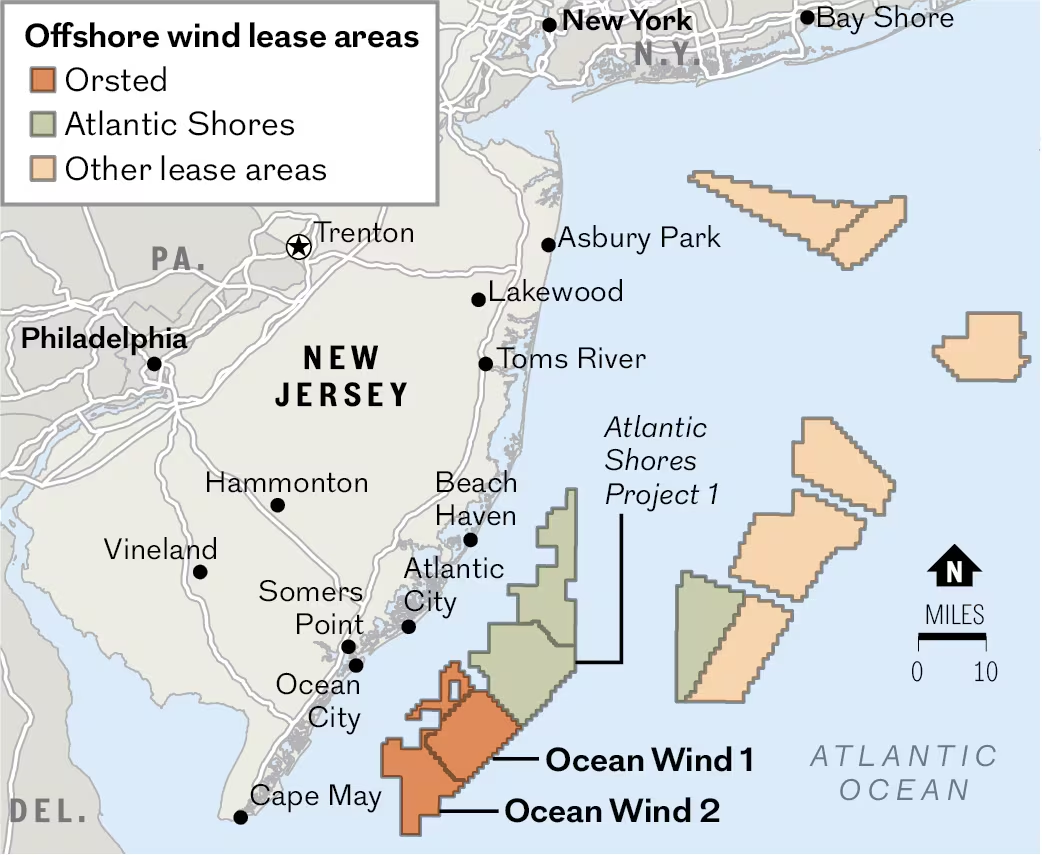
10/31/2023: Citing economic factors, Orsted announces they “will cease development of the Ocean Wind 1 and Ocean Wind 2 projects.” (This should have resulted in termination of the leases.)
1/19/2024: Orsted requests a 2 year “suspension of operations” to extend the leases they had ceased developing. (Presumably, this was a hedge with hopes of marketing the leases or getting better terms.)
2/29/2024: True to form, BOEM approves the questionable 2 year suspension request. The approval letter was dated one day before the leases’ 8th anniversary when they would have presumably expired. (This is unconfirmed because the lease document and BOEM’s wind regulations lack clarity regarding lease expiration.)
BOEM’s approval letter (attached) curiously asserts that “suspension of the operations term is necessary for the Lessee’s full enjoyment of the lease in this circumstance to ensure sufficient time for project operations in support of the Project’s economic viability.” (Interesting wording that expresses the accommodative and promotional philosophy of the Federal wind program.)
8/14/2024: Cape May County comments that they are likely to amend their Federal Court filings “since the actions of the NJBPU would appear to have nullified Orsted’s federal permits.”
8/27/2024: Despite the fact that Orsted has ceased development and New Jersey has vacated its approvals, the Federal leases are still active.
Good luck keeping an oil and gas lease if you cease development and request a suspension of operations. BSEE will rightfully deny your request.
This real-life Spider-Man, seen on a Vineyard Wind turbine blade, is Tyler Paton. Tyler is an independent composite specialist who inspects and repairs blades on site. The Nantucket Current shared these images on X.
We sent our drone up to get a better look at what remains of the damaged blade on one of GE Vernova’s Haliade-X turbines at the Vineyard Wind lease area 15 miles southwest of Nantucket: pic.twitter.com/yynXpsunCv
The offshore safety regulator (BSEE) has a very capable technical staff and should produce an informed report on the Vineyard Wind blade failure. The concern is with the internal review process that has seriously delayed the publication of accident investigation reports and safety alerts.
Presumably, DNV, the Vineyard Wind CVA, will provide input into the BSEE investigation. Perhaps the effectiveness of the CVA process and quality control procedures should be separately considered.
Will Equinor, a major oil and gas producer, Dogger Bank partner, and offshore wind advocate, be investigating the Dogger Bank failures?
A comprehensive International data base on turbine incidents and performance is needed.
As previously noted, offshore substations are large structures. A closeup of the Vineyard Wind 1 substation is pasted below.
The operator of the wind farm released this short statement yesterday (8/22/2024):
We are aware of a blade failure which occurred this morning on an installed turbine at Dogger Bank A offshore wind farm, which is currently under construction. In line with safety procedures, the surrounding marine area has been restricted and relevant authorities notified. No one was injured or in the vicinity at the time the damage was sustained.
We are working closely with the turbine manufacturer, GE Vernova, which has initiated an investigation into the cause of the incident.
Further updates will be issued in due course as more information becomes available.
In the wake of last week’s lackluster Atlantic wind lease auction (summarized above), an excellent Renewable Energy World article documents the sharp decline in participation and bidding since the massive February 2022 sale of 6 leases offshore NY and NJ. That sale garnered bids ranging from $285 million to an astounding $1.1 billion, with total high bids of $4.37 billion! The sale was touted as the “nation’s highest grossing competitive energy lease sale in history.” The extravagant bidding, which made little sense then, seems downright irrational now.
Even the December 2022 California offshore lease sale, where development will be dependent on more expensive floating turbines, attracted substantially higher bids for leases (5) smaller than those auctioned last week.
The highly promoted Gulf of Mexico wind auctions were busts with the first sale receiving only one bid for $6.5 million and the second being cancelled due to lack of interest.
Major oil companies like bp and Shell seem to have exited the market for new US offshore wind leases. That leaves Equinor (2/3 Norwegian govt ownership) as the only major oil company pursuing US offshore wind leases.
“Today’s lease sale reflects the forward momentum we are seeing to power millions of American homes with clean energy and create good-paying, climate jobs,” said White House National Climate Advisor Ali Zaidi. “With nine commercial-scale projects approved in the last three years and more to go, we are using every available tool to grow the American offshore wind industry as we strengthen the nation’s power grid and tackle the climate crisis.”
Additionally, ultimate authority over the wind farm remained unclear, with various federal agencies claiming responsibility over different portions of the permitting, licensing, review, and operation of the wind farm.
“Sometimes I have a hard time figuring out, who do we talk to? Who is going to keep us safe? Who is the responsible boss here? Who is going to make the hard decision?” Select Board member Matt Fee asked.
Separate legislation granting redundant or overlapping authority to different departments or agencies.
Legislation that is non-specific, assigning broad authority to the President or cabinet level level officials, leaving it up to the bureaus to resolve.
Bi- and multi-lateral agreements like MOA’s and MOU’s, which are intended to “coordinate the redundancy,” often cause more confusion than they prevent, creating gaps in the process.
“Fixing” problems by adding redundancy.
The Dept. of the Interior’s division of responsibilities for offshore wind, which was finalized in January 2023, inexplicably assigns review and approval of Construction and Operations Plans to the Bureau of Ocean Energy Management (i.e. the land manager, lessor, and wind energy promoter) rather than the Bureau of Safety and Environmental Enforcement (i.e. the principal regulator of the activities described in those plans).
More significantly, the offshore wind responsibilities of the 2 bureaus are so intertwined (as is also the case for offshore oil and gas), that attempts to separate the functions have, at a minimum, created inefficiencies and increased regulatory and operational costs.
FTR, the idea that having the BOEM and BSEE functions combined in a single bureau, as was the case with the predecessor bureau (MMS), had anything to do with the Macondo blowout is a complete fallacy. Regarding the accusations that were made toward MMS, the Chief Counsel for the national commission that investigated the tragic incident found no evidence that ethical lapses on the part of MMS employees played any role in causing the blowout.
There were important regulatory changes made after the Macondo blowout. These included capping stack requirements, mandatory safety management systems, and updated rules and standards for cementing/zonal isolation and blowout preventer systems. None of these improvements were precipitated by or dependent on the division of MMS into two bureaus.
The Town of Nantucket would like to provide you with an important update regarding the controlled detachment of the Vineyard Wind turbine blade and the ongoing efforts to manage any resulting debris.
August 11, 8:00 PM – Early this morning, portions of the remaining hanging sections of the Vineyard Wind turbine blade detached from the hub. The controlled detachment follows a series of exercises conducted late last week to pitch the blade, which, in combination with storm winds, led to the safe separation of the sections below the root of the blade.
Vineyard Wind and GE Vernova are currently assessing the situation to determine if any remaining sections pose a risk of detachment. The root of the blade, still attached to the turbine, is being monitored, and we are informed that plans are in place for its removal. Vineyard Wind has maritime crews on site to secure and contain any debris immediately.
The U.S. Coast Guard continues to enforce a 500-meter safety exclusion zone around the turbine. Vineyard Wind is utilizing ocean current and wind pattern models to predict potential debris movement. Depending on wind direction, more debris could potentially arrive on Nantucket beaches over the next hours or days. The Town of Nantucket will provide updates when necessary.
Under a federal preservation order, Vineyard Wind is responsible for retaining all debris, and only their employees, contractors, or those appointed by town officials are authorized to handle and recover debris materials. We urge the public to avoid handling any debris.
REMINDER TO THE PUBLIC
DO NOT put any debris in your home garbage.
DO NOT bring the debris to the landfill.
DO notify the proper authorities immediately if you have debris so they can remove it for analysis and proper disposal.
Only trained employees or contractors are responsible for collecting and removing the debris. To report any remaining debris, please contact:
Phone: 833-609-5768
Reports of debris can also be sent to the cleanup contractor here.
As the above examples illustrate, turbine blade failures, like the Vineyard Wind incident near Nantucket, are not unique to GE Vernova. GE’s rivals, Siemens Gamesa and Vestas, have also experienced serious quality control issues.
Per ReviewEconomy (2023), “Unexpected and increasing wind turbine failure rates, largely in newer and bigger models, are savaging the profits of some of the world’s biggest manufacturers, as Siemens Gamesa, GE and Vestas report heavy repair and maintenance losses.”
In light of the manufacturing challenges, all 3 companies report increased emphasis on quality control. Why has quality control to date been inadequate and how will the past problems be corrected?
Has the wind industry’s sense of entitlement, as evidenced in their tax credit, rate increase, and departure expectations, affected their safety and quality culture? Has industry and governmental wind energy promotion rushed development and compromised design and fabrication decisions? It’s time for wind developers, manufacturers, and regulators to make sure their priorities are in order.
Contrary to the regulations, Vineyard Wind was authorized to begin the fabrication of facilities beforeBOEM “received and offered no objections to the their Facility Design Report (FDR) and Fabrication and Installation Report (FIR).” The approval letter is attached, and excerpts (emphasis added) are pasted below. [Note: The requirement that was then at §585.700(b) is found at §585.632 in the current regulations.]
“Vineyard Wind requests a regulatory departure from §585.700(b) requiring that fabrication of approved facilities not begin until BOEM provides notification that it has received and has no objections to the submitted Facility Design Report (FDR) and Fabrication and Installation Report (FIR). Vineyard Wind proposes to fabricate, but not install the following project elements: 1) Monopile foundations; 2) Electrical service platform; 3) Export cable; 4) Inter-array cables; and 5) Wind turbine generator facilities.
….allowing these fabrication activities to take place earlier in time would allow Vineyard Wind to adhere to its construction schedule, maintain its qualification for the Federal Investment Tax Credit, and meet its contractual obligations under the Power Purchase Agreements with Massachusetts distribution companies.
30 cfr 585.103 requires that a departure provide safety and environmental protection equal to or greater than the provision in the regulations that is waived. BOEM’s letter fails to explain how allowing fabrication to begin before fundamental design and fabrication reports are submitted and reviewed meets this test.
Perhaps even more troubling is BOEM’s response to subsequent requests by other companies to waive the FDR and FIR requirement (example). In these responses, BOEM asserts that their “current interpretation” is that no departure is needed because “the regulation prohibits only fabrication and installation activities on the Outer Continental Shelf (OCS) itself.” How does that make sense given the important activities, including the fabrication of turbine blades and other turbine components, that take place onshore?
In their letters approving the Vineyard Wind and other departures, BOEM implies that their review of these reports is unnecessary because “the design and fabrication of these components would occur under the supervision of the approved CVA” (Certified Verification Agent). That assertion misconstrues the role of the CVA. These agents, nominated and funded by the operator, provide third party oversight that is complementary to, not a substitute for, BOEM/BSEE project reviews.
According to this memo, DNV was the CVA for Vineyard Wind. Their insights on the turbine blade failure will presumably be included in BSEE’s investigation report.
… for their coverage of the Vineyard Wind turbine blade incident and their investigative reporting. From a recent Current article (emphasis added):
“The technology may not be new, but the size and scale of the Haliade-X turbine is novel for the offshore wind industry. And these jumbo-sized turbines have only recently been installed in just two locations in the world within the last year – at Vineyard Wind off Nantucket, and the Dogger Bank Wind Farm off the northeast coast of England. The Haliade-X turbine blades – which are supposed to have at least a 25-year lifespan – have suffered failures in both locations.“
“At the Dogger Bank Wind Farm – which is being completed in three sections which combined will make up the largest offshore wind farm in the world – the first GE Vernova Haliade-X turbine was installed in the fall of 2023 and began producing power on Oct. 10. But little is known about the blade failure that occurred just months later during the first week of May 2024. The damaged blade was disclosed by Dogger Bank’s owners – SSE Renewables, Equinor, and Vårgrønn – a week after the incident. In a statement, the companies said only that “damage was sustained to a single blade on an installed turbine at Dogger Bank A offshore wind farm.”
“One reason the turbine blade incident at the Dogger Bank may not have generated more attention at the time is that the wind farm is located 100 miles off the coast of England, rather than just the 15 miles in the case of Vineyard Wind and Nantucket. If any debris was generated, it would have a far wider area to disperse in before nearing land – if it made it that far at all.“
Interestingly per the Current:
The Haliade-X turbine is the same one Orsted – a partner in Vineyard Wind – is planning to use for offshore wind farms slated for the waters off New Jersey and Maryland.
Land-based turbines have come apart in Sweden, Germany, Lithuania, Cypress, Brazil, and the US (and presumably elsewhere).
Greater transparency regarding turbine incidents, both in the US and internationally, is clearly needed. As we have learned from decades of experience with the oil and gas industry, most companies prefer reporting systems (if any) that protect details and information about the responsible parties from public disclosure. It’s the responsibility of the regulators to make sure that incident data and investigation reports are timely, complete, and publicly available. This is made more difficult by the promotional role that government agencies have assumed for offshore wind.