Feeds:
Posts
Comments

Archive for the ‘Regulation’ Category

In light of the ongoing litigation regarding the Department of the Interior’s “leasing pause,” DOI’s Record of Decision for Sale 257 is most encouraging. The viewpoints expressed in the two quotes below are fundamental to the future of the OCS Oil and Gas Program. Hopefully, all parties can put aside their differences and build upon these consensus views.

While offshore exploration and development cannot be made risk free, OCS oil- and gas-related activities can be conducted safely and responsibly with strong regulatory oversight and appropriate measures to protect human safety and the environment.

ROD, p. 5

The decision to hold Lease Sale 257 recognizes the role that GOM oil and gas resources play in addressing the Nation’s demand for domestic energy sources and fosters economic benefits, including employment, labor income, and tax revenues, which are highest in Gulf Coast States and also distributed widely across the United States. Revenues from offshore oil and gas lease sales support national conservation programs and coastal resiliency for applicable coastal states and political subdivisions under the Gulf of Mexico Energy Security Act of 2006.

ROD, p. 7

Read Full Post »

After an amazing 38 year career with MMS and BSEE, Lars Herbst has announced that he will retire at the end of 2021. Lars had important technical and managerial roles in the development of the deepwater Gulf of Mexico, the response to major hurricanes including Ivan, Katrina, and Rita, controlling the Macondo blowout and addressing the related regulatory issues, and the offshore industry’s response to the COVID-19. Lars was an active participant in the International Regulator’s Forum and is recognized worldwide for his operational and regulatory expertise. Best wishes to Lars as he transitions to the next phase of his life.

Read Full Post »

Comprehensive and timely incident data are critical for risk assessments, preventing recurrences, training and safety management programs, assessing the performance of the industry and individual companies, and driving safety culture. The National Academies 2021 review of BSEE’s inspection program included a number of recommendations related to data management including this one:

Recommendation 2. To further its goal of increasing data transparency and facilitating its internal and external use, BSEE should invest in more advanced and creative data collection, analytic and visualization tools, and infrastructure; corresponding data management, analysis, and evaluation capabilities among its personnel; and an outward-facing, online data system that can be navigated with ease and kept current across all fields for the purpose of encouraging and facilitating safety analyses.

National Academies Report, 2021

Unfortunately, BSEE’s incident data are not updated and posted in a timely manner. As we approach September 2021, the 2020 incident statistics are still not publicly available. These incidents include at least one rig fatality that neither BSEE nor the Coast Guard announced at the time of occurrence one year ago today (8/23/2020) or subsequently. The only public information about this fatality is the following self-serving statement by the operator:

“This is a routine operation that was executed with no time pressure as the rig disconnection had been decided well in advance,” Total said.

Upstream

A 37-year old man died, but according to the operator there is nothing to see here. This is not the type of statement you would expect from a company with a leading safety culture.

The keystone of BSEE’s primary mission, protecting workers and the environment, is timely incident information that is regularly reviewed and updated. Continuous improvements in safety are dependent on continuous improvements in data management and analysis. BSEE can do much better, as can other regulators, the offshore industry, and those of us who are interested and concerned observers.

Read Full Post »

Continuous improvement has to be the primary objective of offshore safety leaders, and this independent blog is committed to recognizing initiatives that further reduce safety and environmental risks. Australia’s collaborative mental survey project is an interesting such initiative in its early stages. Two other important initiatives are noted below.

BSEE’s Dropped Object Risk-Based Inspection initiative: As has been the case for 50 years, most offshore fatalities and serious injuries are associated with falls or falling and moving objects/equipment. BSEE’s Dropped Objects initiative, as described in a presentation by Jason Mathews during a recent Center for Offshore Safety (COS) webinar is intended to draw further attention to and better manage these risks. In addition to BSEE’s focused inspections, the “Good Practices” being followed by some operators and contractors, as described on pages 40-50 of the presentation, are encouraging. These types of initiatives are necessary if we are to achieve the elusive “zero fatality” year on the US OCS.

IOGP process safety guidance, Report 456 v.2 : Contrary to some post-Macondo narratives, process safety and well control were always the primary focus of the US OCS regulatory program. In 1974, my boss Richard Krahl (known as “Mr. OCS” for his commitment to offshore safety) dropped a copy of the first edition of API RP 14C (Analysis, Design, Installation, and Testing of Safety Systems for Offshore Production Facilities) on my desk and told me it was an excellent document that I should read. RP 14 C and other process safety standards were incorporated into the USGS OCS Orders (regulations) in the 1970’s. For decades, the USGS and MMS were leaders in well control and production safety research and training. That said, better indicators and improved approaches to offshore facility process safety were needed, and the International Association of Oil and Gas Producers report has provided an excellent framework. Report 456 is comprehensive and technically sound, and provides excellent guidance and examples. Very well done!

Read Full Post »

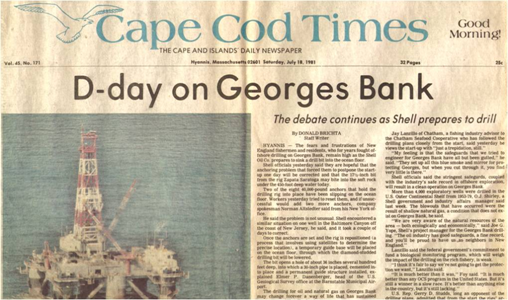
40 years ago today, drilling began on the first two exploratory wells on Georges Bank, a large seafloor feature that separates the Gulf of Maine from the Atlantic Ocean. The Cape Cod Times headline (below) attests to the drama that was unfolding 155 miles southeast of Nantucket. After years of debate, oil embargoes, gas lines, and the threat of future supply disruptions had tipped the political balance in favor of offshore leasing, and OCS Sale No. 42 (North Atlantic) was held one week before Christmas in 1979. Looking back, I find it remarkable that only 19 months elapsed between the lease sale and the initiation of drilling. During that time, bids were evaluated, exploration and spill response plans were drafted by the operating companies and reviewed by the Federal regulators and six coastal states, fisheries issues were addressed, and a comprehensive monitoring program was developed and initiated. Perhaps most impressive was the manner in which government (Federal and State), industry, and academic professionals with very different personal opinions about offshore drilling collaborated to assess and monitor impacts and mitigate risks.

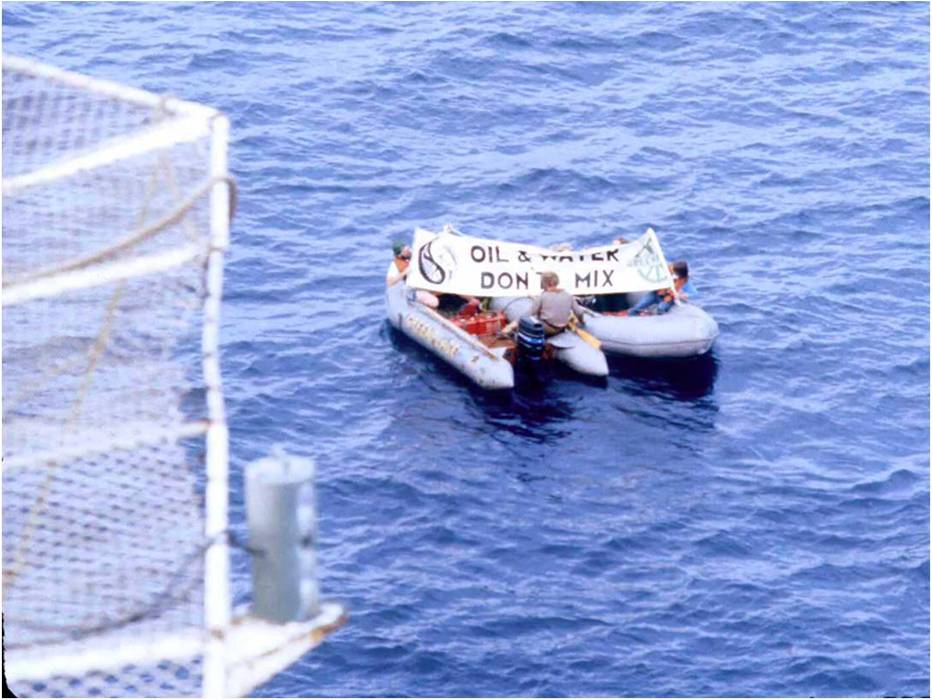
The protesters pictured above were dispatched to the Zapata Saratoga drilling rig from the Greenpeace vessel Rainbow Warrior. Given the remote location, the protest was unexpected. However, the drilling operation was not disrupted and no action was taken against the protesters. Four years later, the Rainbow Warrior was bombed by French commandos while in port in Auckland, NZ prior to planned protests against French nuclear testing in the South Pacific. Sadly, one crew member was killed during this incident.

Below is a list of the exploratory wells that were drilled on Georges Bank. In addition, two off-structure geologic test wells were drilled in 1976 and 1977. None of the wells discovered commercially significant oil and gas resources. However, gas shows led to erroneous press reports such as the article below. In 2000, the Minerals Management Service (MMS) published a summary of the geologic findings.


Operator
Lease No.
Block/Well
Rig

___________

Water
Depth
(ft.)


_________


Lat/Long
Miles SE
Nantucket

____________


Onsite


__________


Spud

________


Offsite


_________


Well
Depth
(ft. )

________

Exxon
0170
133/1
Alaskan Star
22540°49’05”
67°56’03”
112
7/22/817/24/81 11/24/81 13,808

Shell
0218
410/1
410/1R
Saratoga
45240°34’24”
67°12’32”
155
7/10/81
8/8/81
7/24/81
8/10/81
8/8/81
3/31/82
875
15,043

Mobil
0200
312/1
Midland
26040°39’27”
67°45’55”
125
11/21/8112/8/816/27/8219,652

Exxon
0153
975/1
Alaskan Star
20941°00’24”
67°37’19”
125
11/24/8111/25/813/10/8214,313

Tenneco
0182
187/1
Alaskan Star
30040°46’15”
67°23’19”
140
3/10/823/12/828/22/8217,744

Shell
0210
357/1
Saratoga
26540°36’51”
67°44’41″1
128
4/2/824/14/829/27/8219,090

Conoco
0179
145/1
Aleutian Key
30040°49’59”
67°17’06”
145
5/9/825/13/828/25/8214,115

Mobil
0196
273/1
Midland
30240°41’04”
67°30’12”
140
6/28/826/30/829/13/8215,190
Excerpted from “Georges Bank Exploratory Drilling, 1981-1982” by EP Danenberger

Regulatory policy lessons from the Georges Bank experience:

  • Regulators with overlapping responsibilities function best as a joint authority, particularly at the field level.  While MOUs/MOAs tend to be primarily for the purpose of protecting regulatory turf, joint authorities focus on the specific mission and how the performance objectives they can best be achieved. Capt. Barry Eldridge had the foresight to co-locate a USCG Marine Safety Detachment, headed by Bob Pond, adjacent to the USGS office at Barnstable Municipal Airport.  This facilitated cooperative reviews, coordinated inspections, and joint exercises.  This collaboration led to the first ever unannounced offshore response drills.    Similar USCG/DOI organizational arrangements have proven effective in the Pacific and in the Gulf of Mexico, particularly for monitoring hurricane preparations and responses.
  • Strive to conduct regulatory functions at a single field office.  USGS had the foresight to assign exploration plan review, environmental assessment, and coordination with State government responsibilities to our district office.  As a result, our environmental specialists, geologists, engineers, and inspectors worked together, along with our State and Federal partners, from the initial planning to the decommissioning stages.  Positive working relations were developed and everyone was informed and involved.  A subsequent reorganization changed the structure of our office and led to greater control from Washington, which (unsurprisingly) was not helpful.  
  • Transparency may be a bit of a buzzword, but it’s critical to regulatory success.  Other than proprietary geologic information and well reports, we fully informed our regulatory partners about the status of activities, all incidents and near-misses, and any operational issues. Conveying news that is not-so-good, like the mooring failures that were experienced by 2 Georges Bank rigs, is part of the mission.
  • Those regulating the operations should be informed about and a part of the environmental monitoring programs. Our office worked closely with the Woods Hole and other scientist conducting the comprehensive Georges Bank Monitoring Program.  In support of Mike Bothner, USGS Woods Hole scientist, we tracked every drilling fluid additive, and verified the materials that were available on each rig.  Mike conducted a material balance on the barite and looked for chromium and other metals in sediments near the well sites. His outstanding work is summarized in this paper.  

Read Full Post »

Much ado about nothing courtesy of the Associated Press:

Copies of the forms submitted by more than 100 inspectors, engineers and permit reviewers in five Gulf coast offices were obtained by the AP under the Freedom of Information Act. Personal information, such as the names of the employees, their friends and their family members, was blacked out to protect privacy. But the companies with ties to government workers were disclosed, and they represent a who’s who of the offshore oil and gas industry, from majors like Chevron, Shell and BP to smaller companies such as W&T Offshore Inc., Ankor Energy LLC and Hilcorp Energy Co.

So yesterday we linked an article about proposed legislation that would, among other things, require that offshore inspectors have “at least three years experience in the oil and natural gas field.” Today, we read contradictory (and silly) comments like the one below in the AP piece that criticize such experience. How would you like to be an oil and gas inspector or prospective offshore regulator?

“It’s nearly impossible to determine where the oil industry ends and the government’s regulatory agency begins,” said Scott Amey of the Project on Government Oversight, after reviewing AP’s data. “These new instances indicate that BOEMRE staff are connected to individuals and oil companies, which raises concerns about lax oversight and the integrity of the agency. Without enhanced enforcement authority and independent oversight of these potential conflicts, I’m uncertain that BOEMRE can assure the public that it is truly watchdogging the offshore oil industry.”

Give these people a break. I have seen absolutely no evidence that improper government-industry relationships or compromised inspections had anything to do with the Macondo blowout or any other recent incident. Inspection and engineering personnel are under continuous scrutiny well beyond what most employees would accept, and recuse themselves from assignments if there could be even a perception of a conflict of interest.

The US offshore program, and every other safety regulator, needs people who understand the operations and technology that they regulate. These regulators need to communicate regularly with industry personnel on operational and regulatory issues. Too little interaction with their professional peers is a greater danger than too much. You don’t advance safety technology and procedures, and resolve concerns, without communication.

DOI offshore personnel have had and will continue to have more than enough oversight; time to move on to another cause.

Read Full Post »

We now have yet another legislative proposal, this time from the House, that fails to address the fundamental offshore safety and regulatory policy issues.

Read Full Post »

You be the judge.

Read Full Post »

Because of recent involvement with products and systems that have Safety Integrity Level (SIL) ratings, I read the comment (below) in the PSA Deepwater Horizon review with interest. While administrative and effectiveness issues must be carefully assessed, the application of SIL should be part of the BOP performance dialogue.  SIL ratings may also be appropriate for entire well control or well integrity systems.

Today’s requirements stipulate a risk analysis for the control system of a drilling BOP, with specified minimum requirements for its safety integrity level (SIL). As a result of the DwH incident and of the fact that blowouts are not confined to drilling operations, the question is whether such an analysis, with a specified minimum SIL level, should also apply to all types of BOPs, including well-intervention models. In addition, consideration should be given in this context to whether other control and management systems related to well integrity/control exist which should be subject to such requirements.

Read Full Post »

In their comments on the Coast Guard’s Deepwater Horizon Joint Investigation Team Report, Transocean made these statements about BOP maintenance standards incorporated in MMS drilling regulations:

By glossing over the contours of the regulatory language, the Draft Report unilaterally converts API Recommended Practice 53 from an advisory guideline into a mandatory requirement. Notwithstanding the Draft Report’s insistence otherwise, the API’s recommendation that the BOP “should” be disassembled and inspected according to the manufacturer’s guidelines is not mandatory. The API clarifies that the word “should” indicates a recommended practice for which a comparably safe alternative is available or which may be impractical or unnecessary in some conditions. In contrast, to denote a recommended practice that is “advisable in all circumstances,” the API uses the word “shall.” The API also emphasizes that “the formulation and publication of API standards is not intended in any way to inhibit anyone from using any other practices.” Though it recommends specific practices, API acknowledges that “equivalent alternative installations and practices may be utilized to accomplish the same objectives.” On its face, the language of API RP 53 makes clear that the recommendation that the BOP “should” be disassembled and inspected in accordance with the manufacturer’s guidelines is a recommendation, and nothing more.

Although the MMS regulations governing BOP maintenance incorporate API RP 53 sections 17.10 and 18.10 by reference, this does not convert the API’s recommendations into a mandatory requirement. As the MMS has clarified, “[t]he legal effect of incorporation by reference” is merely that “the material is treated as if it were published in the Federal Register.”

Treating API RP 53 as if it had been published in the Federal Register does not imbue its language with more regulatory significance than it had before. The API’s recommendations regarding BOP maintenance—as well as the API’s acknowledgement that alternative practices “may be utilized to accomplish the same objectives”—remain recommendations, not requirements.  Transocean’s complete comments are posted on their website.

I’ll withhold my comments on the above statements, except to say that my opinion differs substantially from Transocean’s.

More significantly, these and other recent industry and government comments demonstrate the complexity of standards policy issues. How are standards most effectively applied by operators in formulating safety management programs, operating plans, and safety cases? Contractors? How should deviations from standards be assessed and documented? How should regulators use standards? To what extent should standards be incorporated into regulations? What is the appropriate role for regulators in standards development? These issues may prove to be more challenging than updating technical requirements. Stay tuned!

Read Full Post »

« Newer Posts - Older Posts »