When the findings from important investigations are delayed, information leaks serve to control the narrative and satisfy political or economic objectives. Why are these intelligence organizations so eager to assign blame within the Ukrainian government? Why are the actual findings of the investigations not being released? Perhaps the WP and Spiegel reporters can answer those questions.
Former secret service agent Roman Chervinskyi in court in Kyiv in April; photo: Nikita Galka
According to the joint research by DER SPIEGEL and The Washington Post, Chervinskyi’s name is circulating both in Ukrainian and international security circles in connection with the attack on the Nord Stream pipelines. The former agent allegedly coordinated the attack and also provided support for the specialist unit behind the sabotage operation.
Cautionary note:
People in Western security circles say that the Ukrainian security apparatus is plagued with rivalries and infighting, and that information obtained from sources there must be handled with caution.
Not only have no official findings been released, but there has been little new speculation since our June 2023 update. Given the political stakes, it is increasingly unlikely that the responsible parties will be identified.
The final NTSB report on the 12/29/2022 GoM helicopter crashthat killed 4.To the NTSB’s credit, their preliminary report was timely. Hopefully, the NTSB is considering the muddled regulatory regime for helidecks (regulatory fragmentation).
Report on the Nord Stream sabotage: As the anniversary nears, the prospects for an official report are fading.The absence of a report from Sweden, Denmark, or Germany speaks volumes.
So at this time, some theories on the culprits appear to have dropped out. Those that are still in play include various versions of the Ukrainian rental yacht narrative and the Hersh account. Hopefully, the responsible parties will be identified, but given the political stakes, this is becoming increasingly unlikely.
Kudos to offshore-energy.biz for drawing attention to the recent Coast Guard medevacs from the pipelay vessel Solitaire. Three health-related medevacs from the same facility in <2 months would seem to warrant further scrutiny. Will the Coast Guard investigate?
The only timely information on medevacs is from Coast Guard news releases. Information on private medevacs is seldom provided, except as included in the BSEE incident tables, which are typically more than 1 year behind, and update presentations by BSEE’s Gulf of Mexico region.
Below is information on 2023 YTD Coast Guard medevacs associated with Gulf of Mexico oil and gas activities. As previously posted, at least 12 workers died at OCS facilities in 2021-22 of natural causes. Unfortunately, “natural cause” fatalities and illnesses receive little industry or regulator attention.
date
vessel or platform
description
condition report
5/18
OSV Brandon Bordelon
50-year-old male crewmember with an injury to his leg
stable
5/17
Allseas’ pipelay vessel Solitaire
65-year-old male crewmember was experiencing heart attack-like symptoms
stable
4/26
crew boat Mr. Fred
halted search for missing crewmember
presumed dead
4/23
Allseas’ pipelay vessel Solitaire
32-year-old male crewmember experiencing severe abdominal pain.
stable
3/22
Allseas’ pipelay vessel Solitaire
crewmember was experiencing seizure-like symptoms
stable
3/18
BP’s Atlantis platform
28 year old male, eye injury
stable
3/13
unidentified platform 40 miles south of Port Fourchon
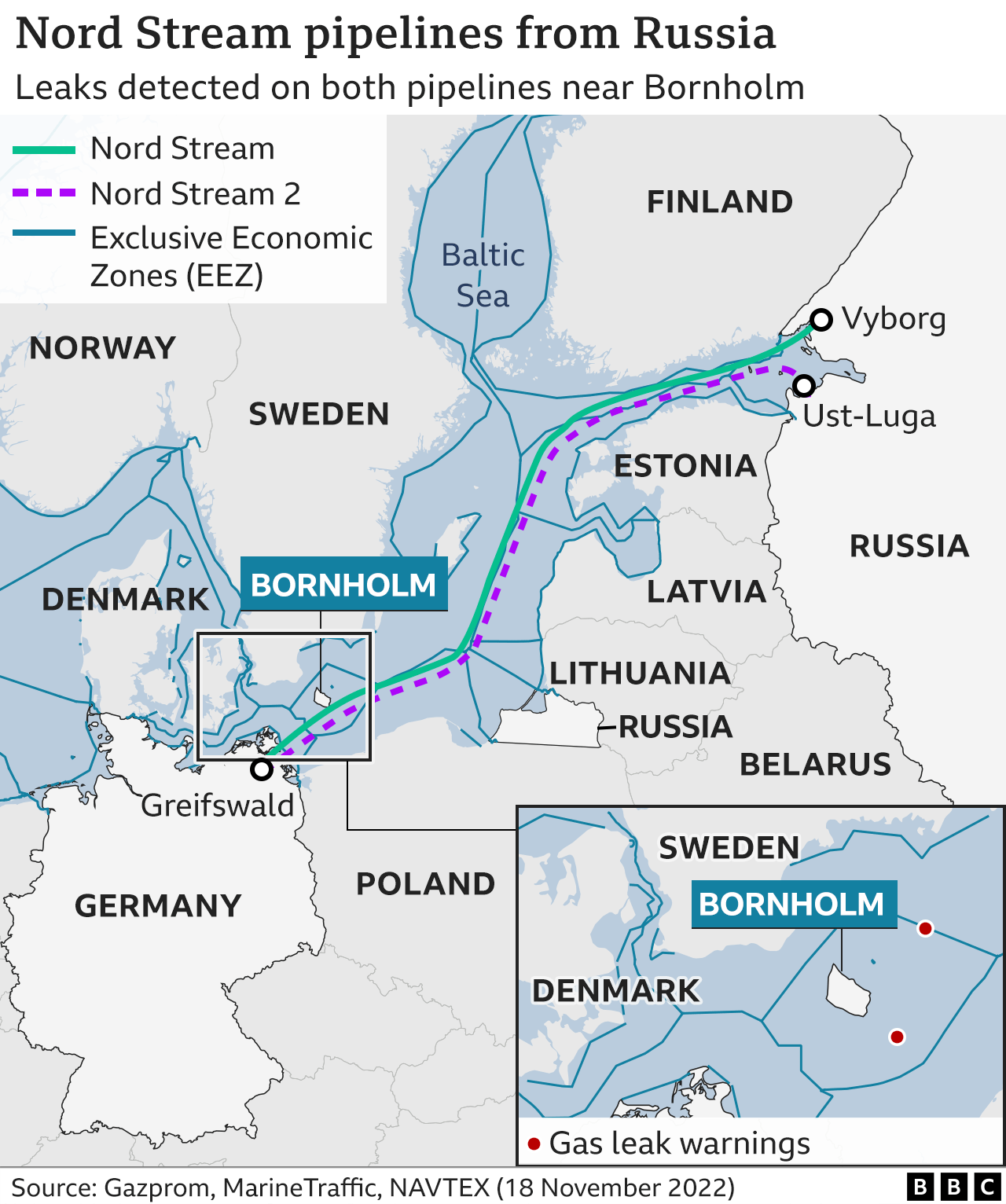
German investigators are sceptical of claims that Russian naval ships sabotaged the Nord Stream gas pipelines and are instead pursuing leads that point to the Ukrainian authorities, according to a report.
The vacuum of official information has been filled by speculation variously pinning the blame on the United States, Russia, the Ukrainian secret services and an unnamed businessman in Ukraine. All three states have denied responsibility.
Regulatory fragmentation occurs when multiple federal agencies oversee a single issue. Using the full text of the Federal Register, the government’s official daily publication, we provide the first systematic evidence on the extent and costs of regulatory fragmentation. We find that fragmentation increases the firm’s costs while lowering its productivity, profitability, and growth. Moreover, it deters entry into an industry. These effects arise from regulatory redundancy and, more prominently, regulatory inconsistency between agencies. Our results uncover a new source of regulatory burden: companies pay a substantial economic price when regulatory oversight is fragmented across multiple government agencies.
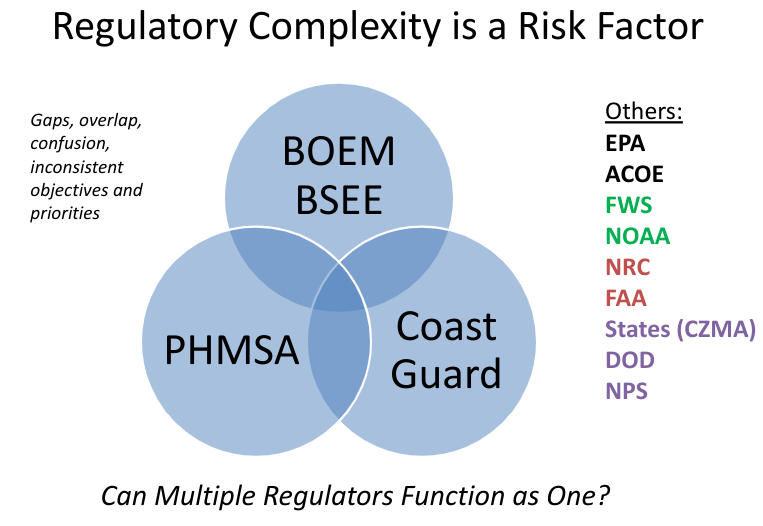
The US has a highly fragmented offshore regulatory regime that has become even more fragmented with the complex division of responsibilities between BOEM and BSEE. The slide below is from a presentation on this topic.
While the linked paper focuses on costs and productivity, fragmentation may also be a significant safety risk factor. A UK colleague once asseted that “overlap is underlap,” and I believe there is something to that. If multiple agencies have jurisdiction over a facility, system, or procedure, the resulting redundancy, inconsistency, and ambiguity may create significant gaps in industry and governmental oversight.
For example, regulatory fragmentation was arguably a significant factor in the most fatal US offshore fire/explosion incidents in the past 35 years – the South Pass B fire in 1989 and the Macondo blowout in 2010. More specifically:
South Pass 60 B: The investigation of the 1989 South Pass 60 B platform explosion that killed 7 workers noted the inconsistency in regulatory practices for the platform, regulated by DOI, and the pipeline regulated by DOT. Cutting into the 18-inch pipeline riser did not require an approved procedure, and the risks associated with hydrocarbon pockets in the undulating pipeline were not carefully assessed. Oversight by the pipeline operator was minimal, and the contractor began cutting into the riser without first determining its contents. A massive explosion occurred and 7 lives were lost.
One would hope that this major spill will lead to an independent review of the regulatory regime for offshore pipelines. Consideration should be given to designating a single regulator that is responsible and accountable for offshore pipeline safety (a joint authority approach might also merit consideration) and developing a single set of clear and consistent regulations.
Macondo: While the root causes of the Macondo blowout involved well planning and construction decisions regarding the casing point, cementing of the production casing, and well suspension procedure, the blowout would likely have been at least partially mitigated (and lives saved) if the gas detection system was fully operable, the emergency disconnect sequence was activated in a timely manner, flow was automatically diverted overboard, or engine overspeed devices functioned properly. Indeed, regulatory overlap led to underlap as summarized below:
Macondo contributing factor
jurisdiction
flow not automatically diverted overboard
DOI/USCG (also concerns about EPA discharge violations)
some gas detectors were inoperable
DOI/USCG
generators did not automatically shutdown when gas was detected
USCG/DOI
failure to activate emergency disconnect sequence in a timely manner (training deficiencies and chain-of-command complications)
USCG/DOI
engine overspeed devices did not function
USCG/DOI
hazardous area classification shortcomings
USCG/DOI
MOUs and MOAs are seldom effective regulatory solutions as they are often unclear or inconclusive, and tend to be more about the interests of the regulator and protecting turf. They also do nothing to ensure a consistent commitment among the regulators. In the case of the US OCS program, BOEM-BSEE have a greater stake in the safety and environmental outcomes given that offshore energy is the reason for their existence. That is not the case for any of the other regulators identified in the graphic above.
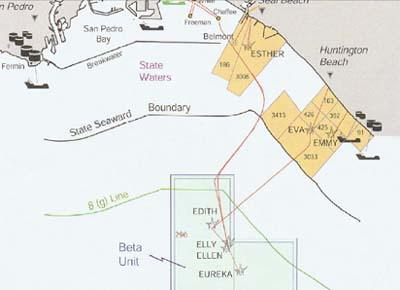
HOUSTON, April 10, 2023 (GLOBE NEWSWIRE) — Amplify Energy Corp. (“Amplify” or the “Company”) (NYSE: AMPY) today announced that it has received the required approvals from federal regulatory agencies to restart operations at the Beta Field. Initial steps to resume full operations will involve filling the San Pedro Bay Pipeline with production, a process which commenced over the past weekend and is expected to take approximately two weeks to complete. Following the line fill process, the pipeline will be operated in accordance with the restart procedures that were reviewed and approved by the Pipeline and Hazardous Materials Safety Administration (PHMSA).
Odd that the news release didn’t mention BSEE, the agency which would have had to approve the resumption of production.
18 months after the pipeline spill near Huntington Beach, settlements have been reached, fines have been paid, and production from the Beta Unit has resumed, but the Federal investigation report is still unavailable. Why?
One would hope that this spill will lead to an independent review of the regulatory regime for offshore pipelines. Consideration should be given to designating a single regulator that is responsible and accountable for offshore pipeline safety (a joint authority approach might also merit consideration) and developing a single set of clear and consistent regulations.
“We don’t rule out anything, but that it is a state actor who is directly or at least indirectly behind this is of course our absolute main scenario, given all the circumstances.”
The agency did its job and, with the help of German intelligence, concocted and planted stories about an ad hoc “off the books” operation that had led to the destruction of the pipelines. The scam had two elements: a March 7 report in the New York Times citing an anonymous American official claiming that “[n]ew intelligence…suggests” that “a pro-Ukrainian group” may have been involved in the pipeline’s destruction; and a report the same day in Der Zeit, Germany’s most widely read weekly newspaper, stating that German investigative officials had tracked down a chartered luxury sailing yacht that was known to have set off on September 6 from the German port at Rostock past Bornholm island off the coast of Denmark.
“It was a total fabrication by American intelligence that was passed along to the Germans, and aimed at discrediting your story,” I (Hersh) was told by a source within the American intelligence community.
The comments following the “SHEERPOST” re-posting of the Hersh update piece are also interesting.


 Bud's Offshore Energy (BOE)