- 2021 (entire year) and 2022 (first half) BSEE incident tables. If safety is the highest priority, these data should be updated quarterly.
- IRF 2021 safety performance data
- An international treaty (accompanied by a standard) on disclosing major offshore accidents and the collection and release of incident data. (Also, see this related post.)
- Hogan and Houchin decommissioning update, most notably the financial responsibility aspects
- Huntington Beach pipeline spill report
- Workable California decommissioning legislation
- ONRR flaring and venting data (update: ONRR advises that they anticipate publication of these data in September.)
- DOI statement on the Sale 257 carbon sequestration bids
- Definitive casualty information and report on the 2-2-2022 Trinity Spirit FPSO fire
- Updated DOI-DOT offshore pipeline regulations
- Coast Guard report on the May 2008 Russell Peterson liftboat tragedy
- Updated US Coast Guard Subchapter N regulations
- Information on the mysterious sinking of the Aban Pearl semi-submersible in May 2010.
Archive for the ‘pipelines’ Category
Still waiting for…
Posted in accidents, CCS, decommissioning, Offshore Energy - General, pipelines, Regulation, tagged aban pearl, BSEE, CCS, flaring, Hogan and Houchin, Huntington Beach, incident data, offshore pipelines, Russell Peterson, Trinity Spirit, USCG on August 11, 2022| Leave a Comment »
Some perspective on offshore California oil spills
Posted in California, Offshore Energy - General, pipelines, seeps, tagged Huntington Beach, NASEM, natural seeps, Oil in the Sea III, pipeline spill, platforms and pipelines on July 18, 2022| Leave a Comment »
Although we are still waiting for the report on the 2021 Huntington Beach pipeline spill, all evidence indicates that the spill was caused by a container ship anchor. Available information to date also suggests that the pipeline was well maintained and properly operated. The volume spilled and resulting damage was less than predicted. Nonetheless, some vocal opportunists took full advantage of the spill to further demonize offshore production.
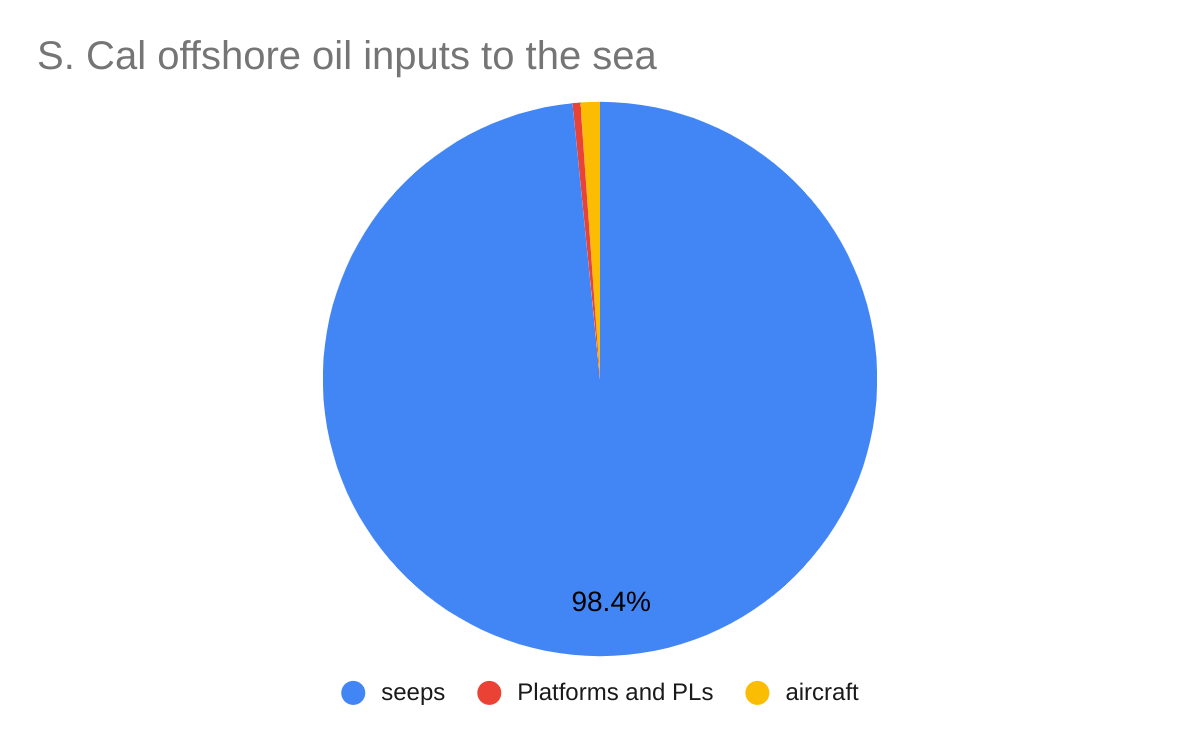
One of our very savvy BOE readers shared data (attached) from Oil in the Sea III, a National Academies report that is the best source of information on oil inputs into US waters. The data for Southern California are presented below in 3 charts. The first chart shows that natural seeps are overwhelmingly the leading offshore source of oil entering SoCal waters, with offshore platforms and pipelines accounting for <0.5% of the oil.
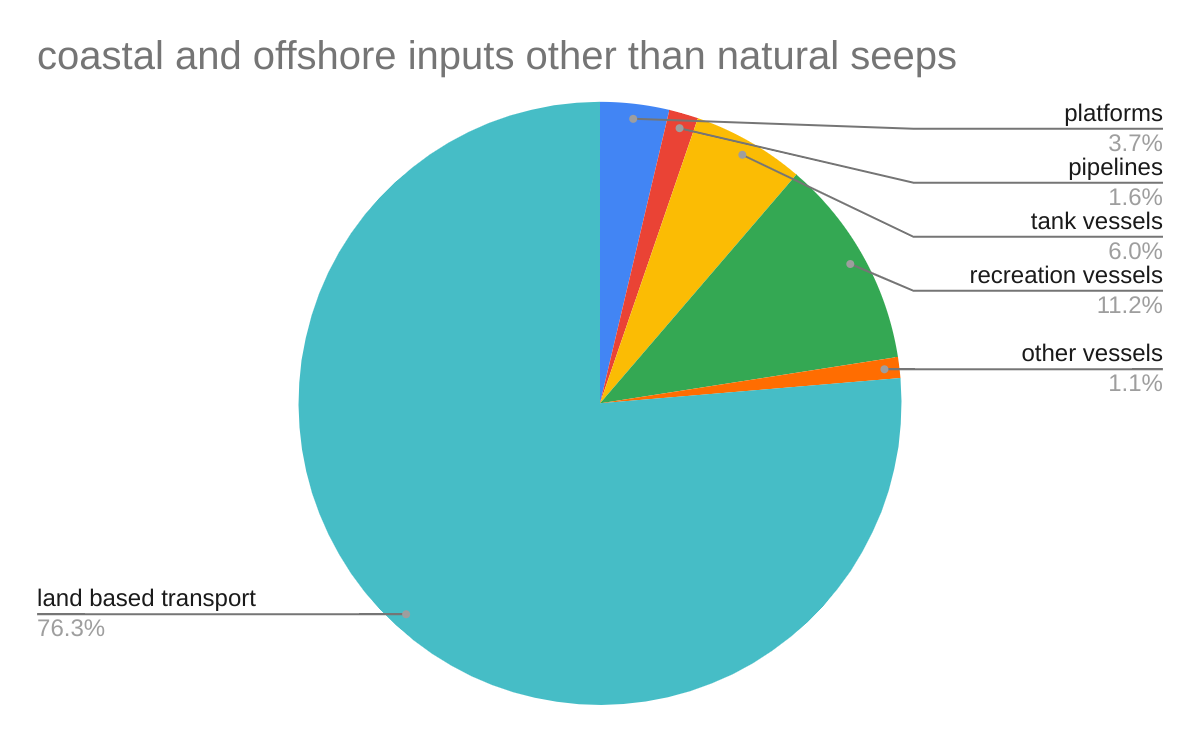
The second and third charts exclude natural seepage and compare the coastal and offshore oil inputs from the other sources. When land based transportation inputs are included (chart 2), platforms and pipelines (combined) account for 5.3% of the oil.
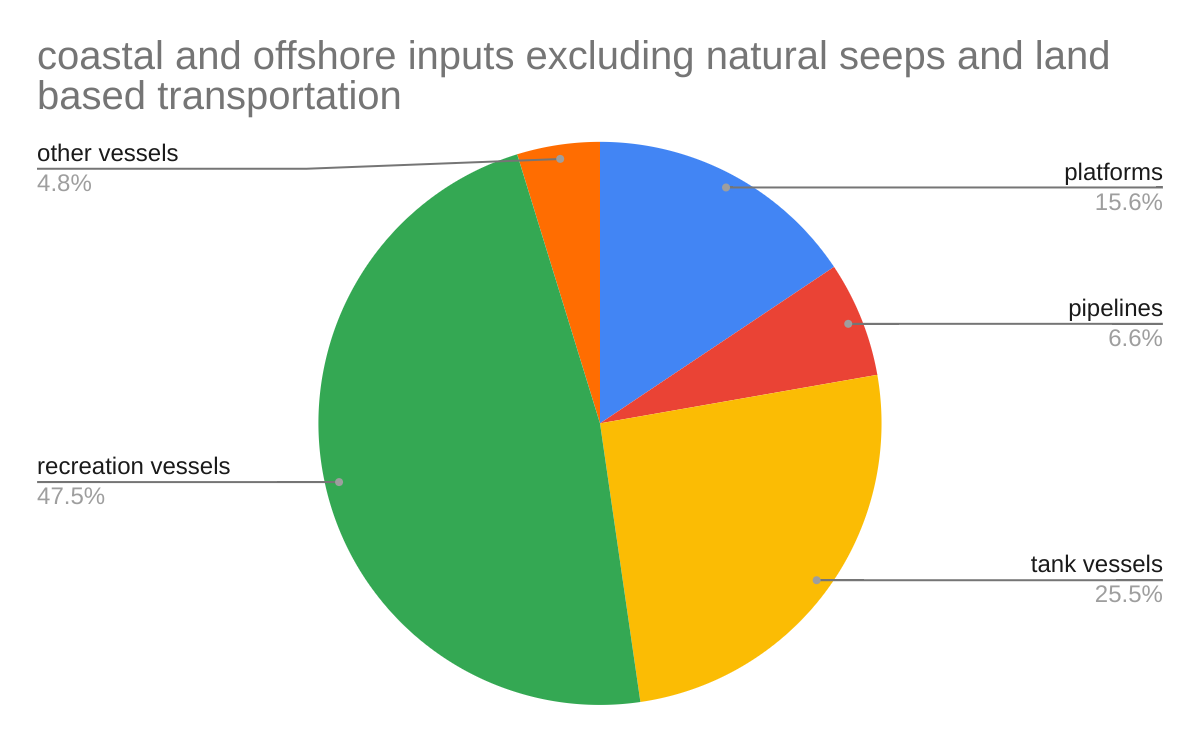
Excluding natural seepage and land based transportation inputs (chart 3), recreation vessels are by far the leading source of oil (47.5%), with platforms and pipelines (combined) accounting for less than half that volume (22.2%).
These data add important perspective, but are not intended to discount platform and pipeline spills. These spills can have significant localized impacts, and every effort must be made to prevent their occurrence.
What is the status of the Huntington Beach pipeline spill investigation?
Posted in accidents, California, Offshore Energy - General, pipelines, tagged ACOE, Amplify, Coast Guard, Huntington Beach, pipeline spill on June 28, 2022| Leave a Comment »
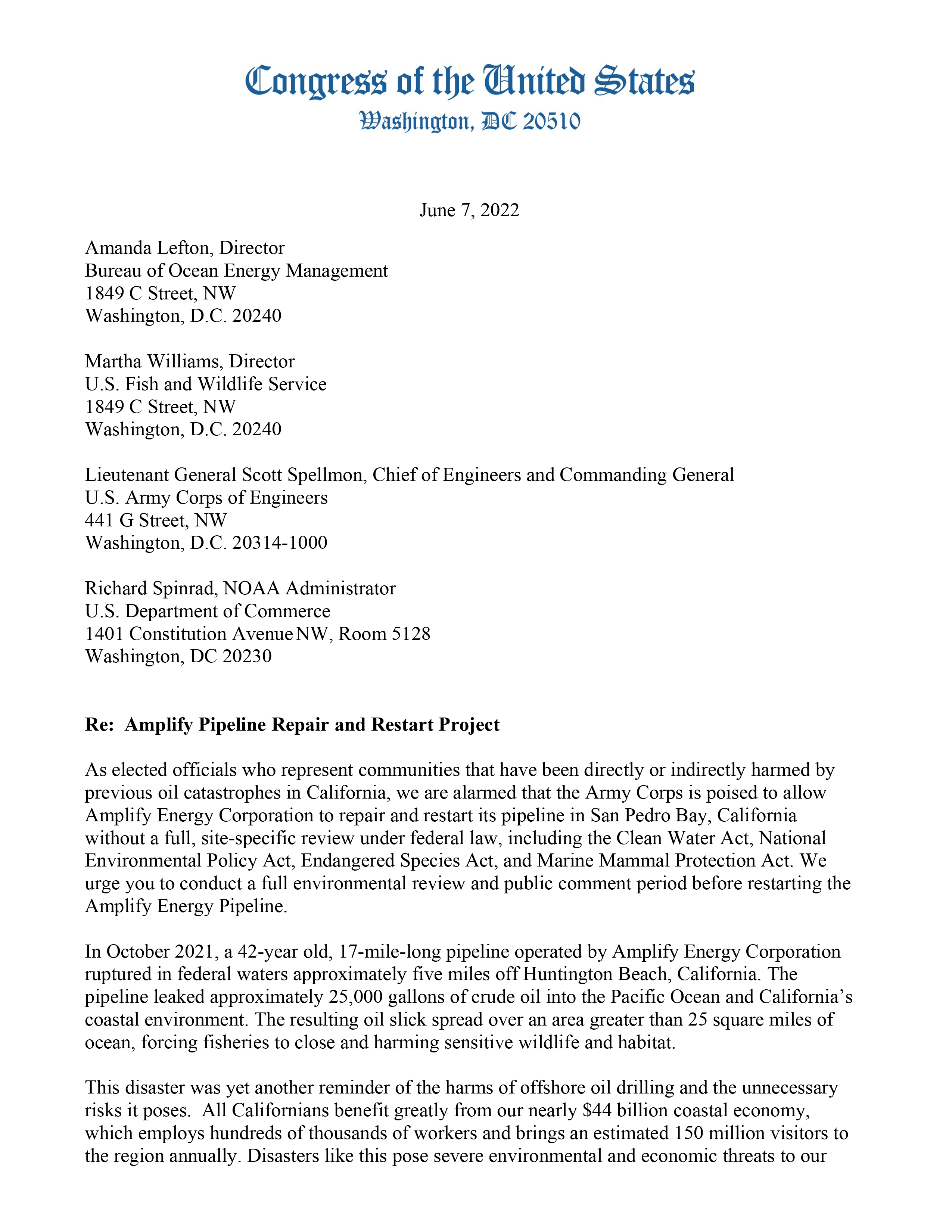
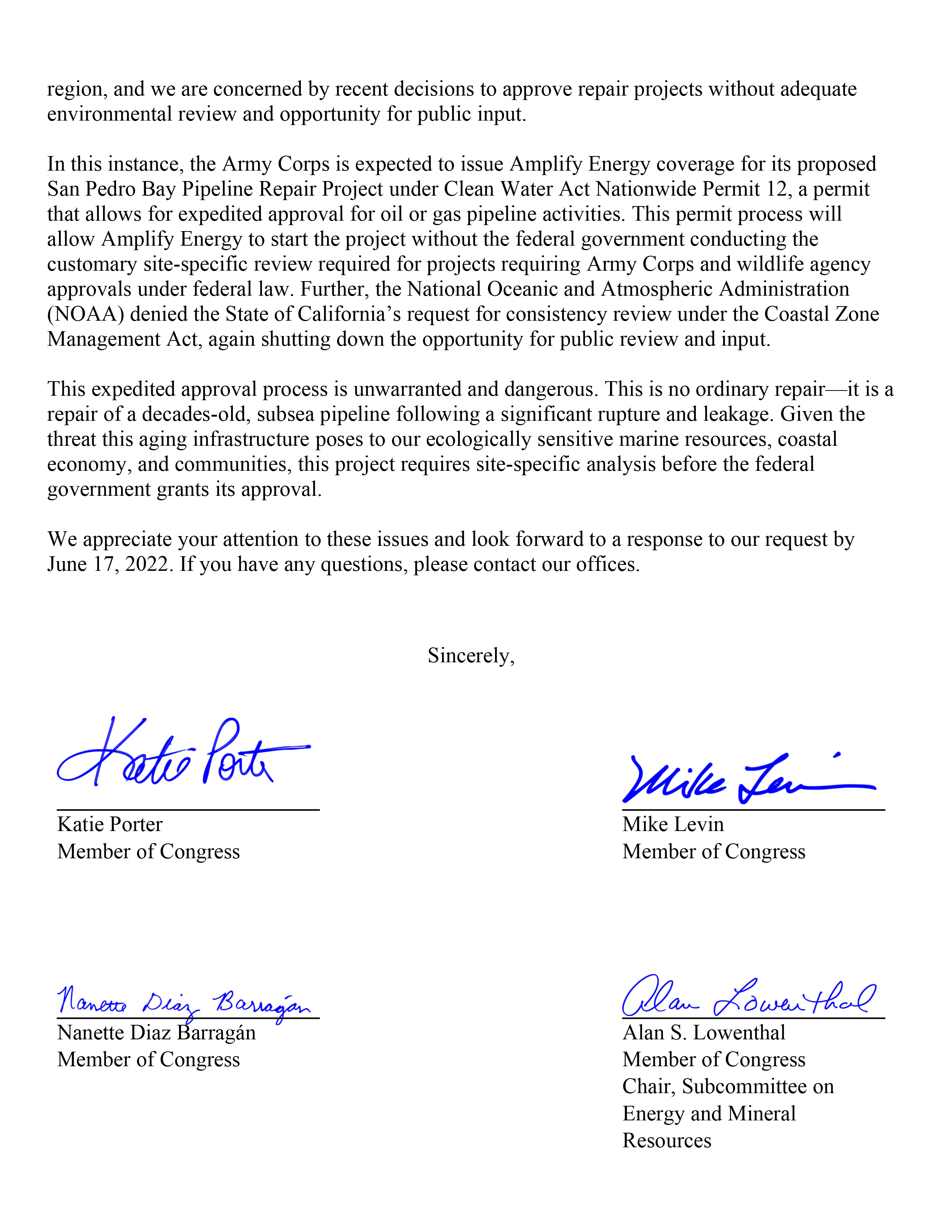
The pipeline rupture, which was apparently caused by a ship’s anchor, occurred almost 9 months ago, but no investigation report has been issued. In February, the LA Times reported that the investigation was being delayed by bureaucratic processes. Meanwhile local politicians (see letter below) seem intent on preventing future production through the pipeline, regardless of the investigation’s findings.
Reports indicate that the pipeline was in excellent condition at the time of the incident. The best reporting and expert commentary on the incident also explains why immediate leak detection can be difficult on low pressure pipelines.
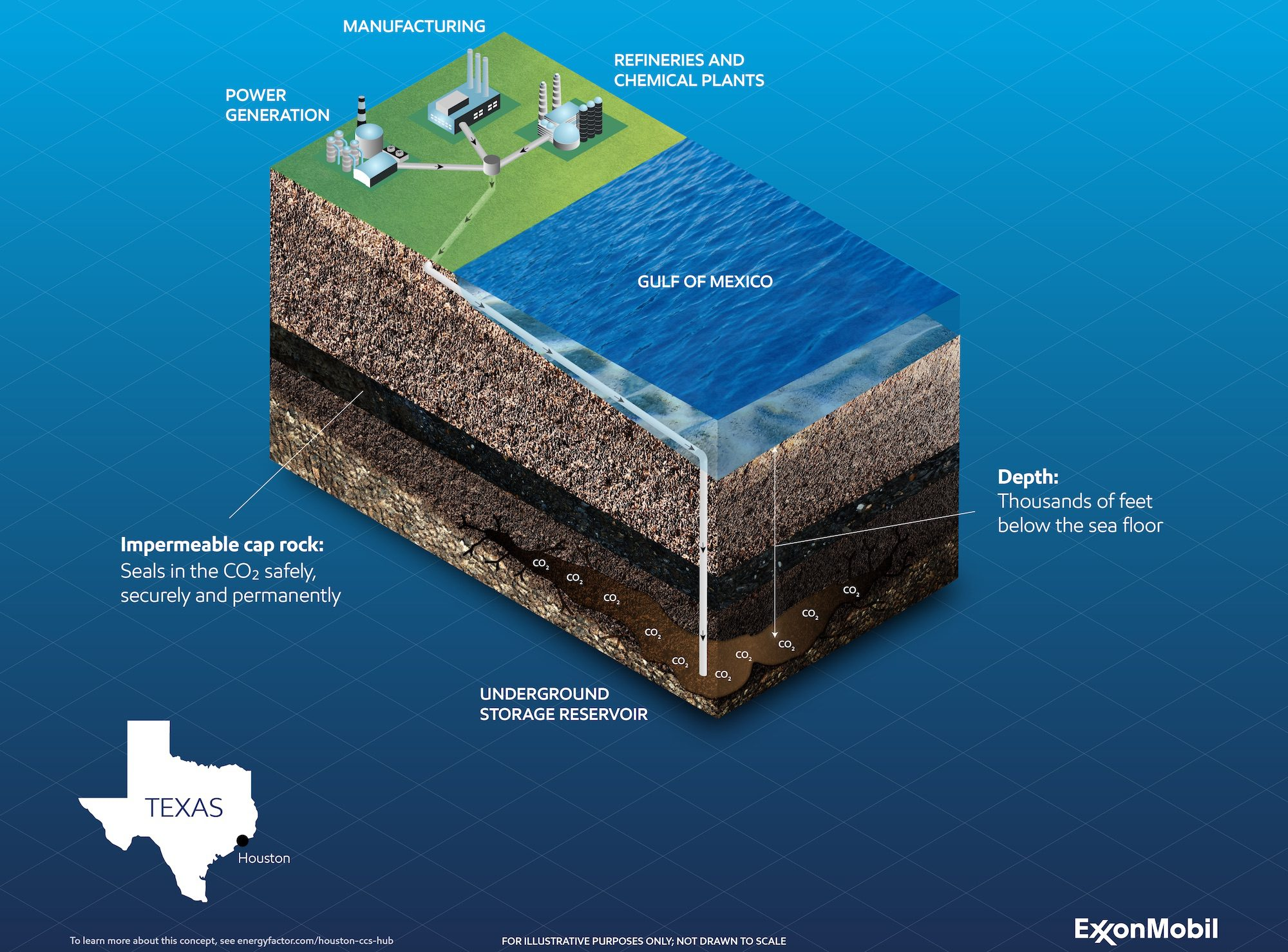
Questions about Gulf of Mexico carbon sequestration
Posted in CCS, climate, energy policy, Gulf of Mexico, pipelines, Regulation, tagged BOEM, carbon sequestration, CCS, DOI, Exxon, Gulf of Mexico, infrastructure bill, Lease Sale 257, OCS Lands Act on May 12, 2022| Leave a Comment »
Background:
- A provision in the “Infrastructure Bill” that was enacted on 11/15/2021 amended the OCS Lands Act to provide for offshore carbon sequestration.
- Because carbon disposal is arguably dumping, the legislation included an exemption from the Marine Protection, Research, and Sanctuaries (Ocean Dumping) Act of 1972.
- The bill mandated that the Secretary of the Interior (DOI) promulgate implementing regulations within one year (l.e. by 11/15/2022).
- These provisions were added to the bill without debate and their inclusion was a surprise to most observers. Presumably, DOI had the opportunity to review the text, because that is standard practice.
- The legislation also authorized $2.5 billion for commercial sequestration projects.
- 2 days after the Infrastructure Bill was signed (11/17/2022), Exxon was the only bidder (Oil and Gas Lease Sale 257) on 94 nearshore tracts off the Texas coast. The sale notice did not mention carbon sequestration; nor had DOI assessed the potential environmental impacts of sequestration as required by NEPA.
- Sale 257 was vacated by the DC Federal Court for reasons unrelated to the sequestration bids.
Questions:
- What are the costs per ton of offshore carbon sequestration including emissions collection, offshore wells and platforms, the associated pipeline infrastructure, ongoing operational and maintenance costs, and decommissioning?
- What is the timeframe given that the starting point is likely years away?
- How long would CO2 sequestration continue.
- Who pays? Polluters? Federal subsidies? Tax credits?
- Who is liable for:
- safety and environmental incidents associated with these projects?
- CO2 that escapes from reservoirs, wells, and pipelines (now and centuries from now)?
- decommissioning?
- hurricane preparedness and damage?
- For Gulf of Mexico sequestration, how much energy would be consumed per ton of CO2 injected? Power source? Emissions?
- To what extent will these operations interfere with other offshore activities?
- Relatively speaking, how important is US sequestration given:
- the steady progress that is being made via natural gas and renewables?
- the massive emissions elsewhere?
- the continued growth in worldwide coal consumption?
- What are the benefits of offshore sequestration relative to investments in other carbon reduction alternatives?
- Will BOEM conduct a proper carbon sequestration lease sale with public notice (as required by BOEM regulations) such that all interested parties can bid?
- What will be the lease terms?
- Environmental assessment?
- How will bids be evaluated?
- What happens to the Exxon bids if the Judge’s Sale 257 decision is reversed?
- What is the status of the DOI regulations mandated in the legislation with an 11/15/2022 deadline?
- When will we see an Advanced Notice or Notice of Proposed Rulemaking?
- Given that DOI has no jurisdiction over the State waters and onshore aspects of these projects, what is the status of parallel regulatory initiatives?
- Finally and most importantly, how does drilling offshore sequestration wells instead of exploration and development wells increase oil and gas production?
Reminder about the massive natural gas resources in the eastern US
Posted in energy, natural gas, pipelines, tagged Marcellus Shale, Ohio, Pennsylvania, US natural gas, West Virginia on April 13, 2022| Leave a Comment »
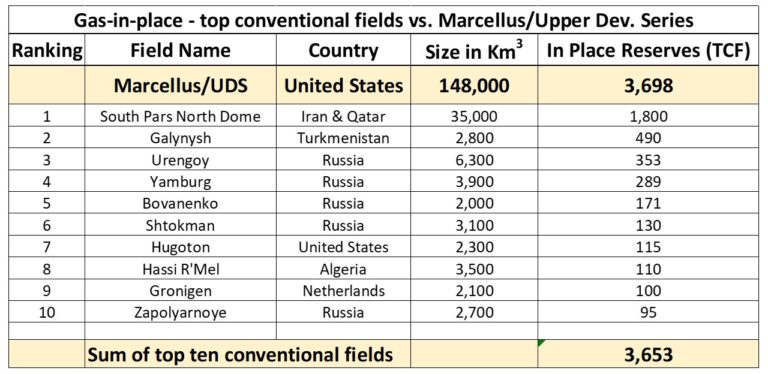
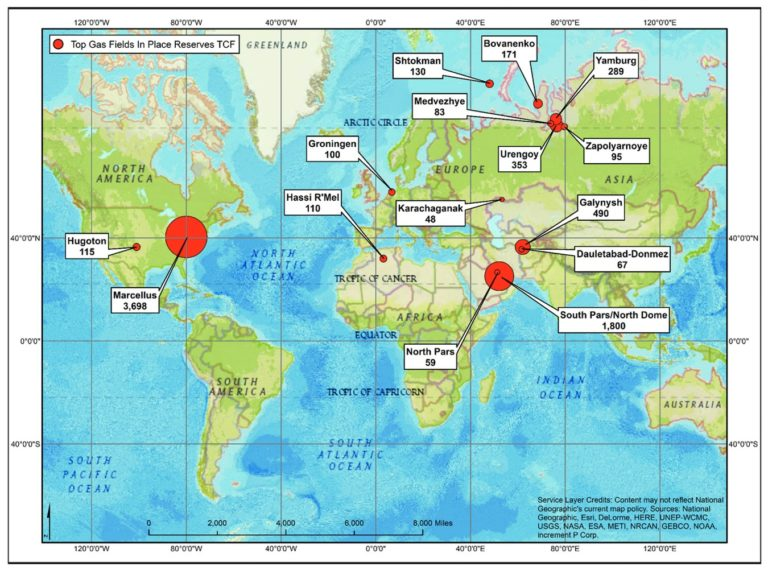
Linked is a good article by geologist Gregory Wrightstone about the stunning non-conventional natural gas resource potential of the Appalachian Basin of the eastern US. Unsurprisingly, development of these resources is constrained by pipeline capacity and the legal and administrative challenges associated with new pipeline construction. Also note that New York has blocked development of its natural gas resources. Fortunately, Pennsylvania, West Virginia, and Ohio have shown better judgement.
According to Bill Zagorski, who was given the moniker of the “Father of the Marcellus,” the gas-in-place of the Marcellus dwarfs all conventional fields in the world. The size is so large that the ten largest conventional fields in the world combined do not equal the in-place reserves of the Marcellus.
You can’t just turn oil supplies on and off to serve your political purposes
Posted in Canada, energy policy, Offshore Energy - General, pipelines, Uncategorized, tagged DOT, fatalities, more oil from Canada, pipelines, rail, spills, truck on April 7, 2022| Leave a Comment »
Wall Street Journal: U.S. Wants More Oil From Canada but Not a New Pipeline to Bring It
WSJ
This WSJ report, if accurate, reflects the mindset that you can increase oil production on demand when absolutely necessary, and avoid committing to longer term oil and gas supplies. The goal of such thinking is to address supply crises without alienating the uncompromising climate ultras. You suspend lease sales, deny new pipelines, and demonize oil and gas and the people who produce it. When supplies tighten and prices spike, you tap the strategic reserve, appeal to OPEC, talk to Venezuela and Iran, and ask Canada to ship more oil in rail cars or trucks (but no new pipelines please!). .
Below is a pie chart constructed using data from a 2018 DOT report to Congress. For logistical and economic reasons, pipelines are overwhelmingly the crude oil transport method of choice. Rail cars and trucks are called on where there are no pipeline options.
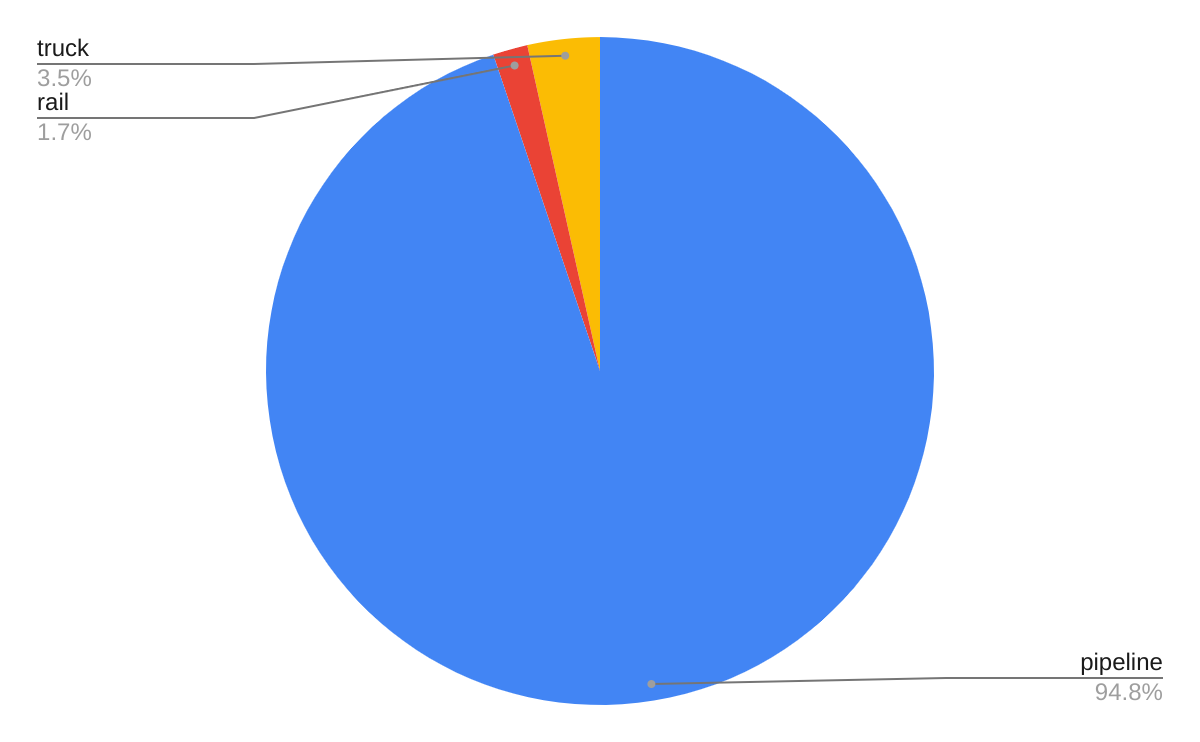
Looking at the systems, one would assume that pipelines have safety and environmental advantages. Loading and unloading hundreds of tanks would seem to be inviting spills, although most would presumably be small. The DOT data bear this out. On a volume transported basis, spill incidents occurred nearly 15 times more frequently for rail cars and trucks than they did for pipelines.
For pipeline(s), an incident occurred approximately once every 720 million gallons of crude oil shipped. For rail, an incident occurred approximately once every 50 million gallons of crude oil shipped. For truck(s), an incident occurred approximately once every 55 million gallons of crude oil shipped.
Looking at the percentage spilled, pipelines also had a significant (7.6 times) advantage over rail, but only a slight advantage over trucks.
Volume of Crude Oil Shipped and Spilled by Pipeline, Rail, and Truck, 2007-2016
| Pipeline | |
| volume shipped (k gal) | 1,298,630,088 |
| volume spilled (k gal) | 13,161 |
| % spilled | 0.0010% |
| Rail | |
| volume shipped (k gal) | 23,052,960 |
| volume spilled (k gal) | 1,751 |
| % spilled | 0.0076% |
| Truck | |
| volume shipped (k gal) | 47,894,868 |
| volume spilled (k gal) | 521 |
| % spilled | 0.0011% |
Because fatalities or hospitalizations were extremely rare, DOT chose not to normalize those data. There were a total of 3 fatalities associated with both pipeline and truck shipments. While no fatalities were associated with rail shipments, DOT noted that 47 deaths resulted from a crude oil derailment in Lac Megantic, Quebec in 2013. BOE further reminds readers that this train was transporting Bakken crude from North Dakota to a refinery in St. John, New Brunswick.
The bottom line is that you have to plan ahead to satisfy future supply needs. This is particularly true for the offshore sector where the lead times are longer, but the production volumes relative to the number of wells and facilities are higher (a good thing). The need for oil and gas is not going away, nor are threats to energy security. There are plenty of people in the U.S. Department of the Interior who understand this. Empower them to safely expedite leasing, exploration, and development!
Build the EastMed Gas Pipeline!
Posted in energy policy, gas, Offshore Energy - General, pipelines, tagged Chevron, EastMed pipeline, Israel, Leviathan on March 9, 2022| Leave a Comment »
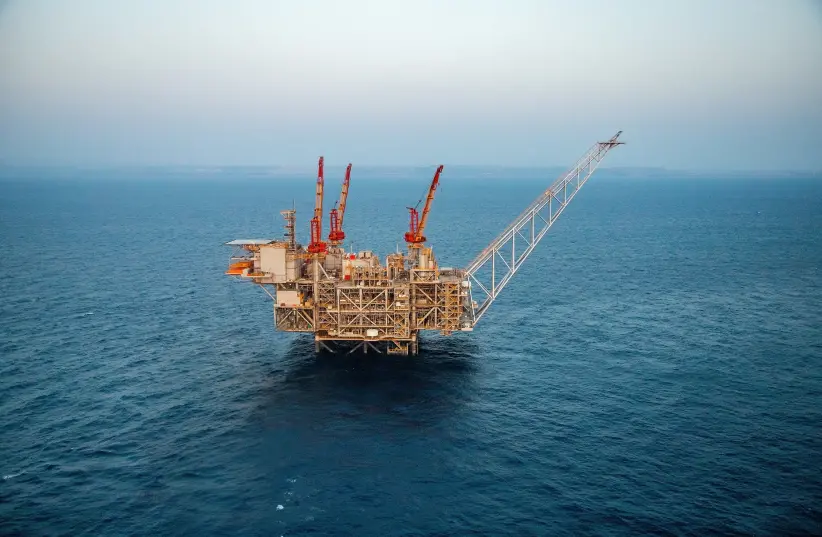
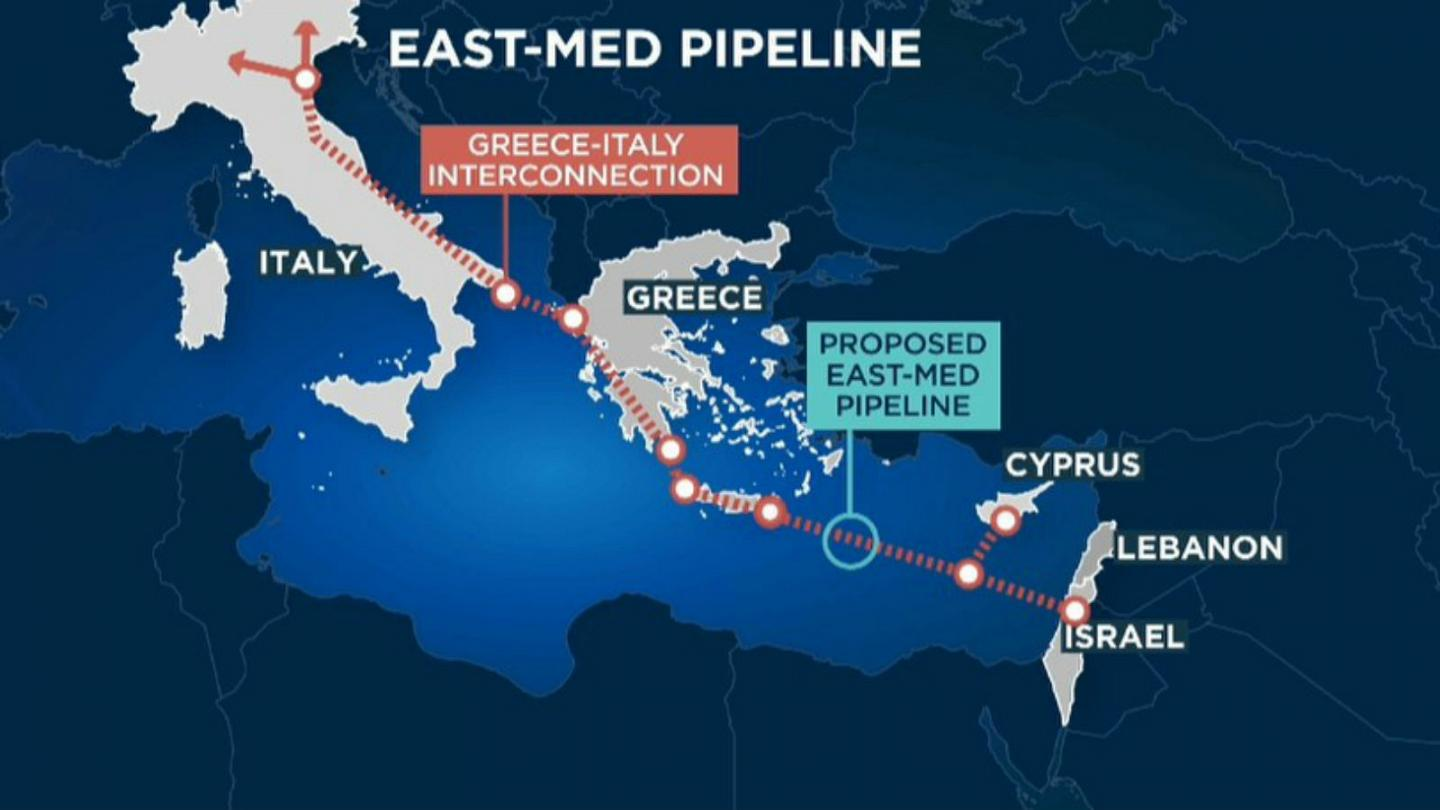
Gas reserves in the Eastern Mediterranean Basin are enormous:
Now the U.S. Geological Survey estimates that as much as 122 trillion cubic feet of gas and 1.7 billion barrels of oil lie in the eastern Mediterranean basin. That amount of gas is equivalent to about 76 years of gas consumption in the European Union.
Forbes
Another US energy/foreign policy blunder?
Last January, the US informed Israel, Greece and Cyprus that they no longer supported the proposed EastMed natural-gas pipeline from Israel to Europe citing the need to “(allow) for future exports of electricity produced by renewable energy sources, benefiting nations in the region.”
Jerusalem Post
It’s time to move forward with this strategically important energy project. Chevron is now the main player in the Eastern Mediterranean after their 2020 acquisition of Noble Energy.
LA Times: “Permit problem stalls investigation into Huntington Beach oil spill”
Posted in accidents, California, Offshore Energy - General, pipelines, tagged Amplify, Coast Guard, Huntington Beach, NTSB, pipeline spill on February 25, 2022| Leave a Comment »
This is inexcusable if true:
A federal investigation into the October oil spill that paved the Orange County coast has been stalled for several months as authorities await approval to cut, remove and analyze part of the ruptured pipeline.
LA Times
Coast Guard and National Transportation Safety Board investigators currently have to rely on video captured during underwater pipeline inspections. Without a more detailed forensic examination of the damage in a lab, investigators won’t know whether to continue with their original investigation or move the investigation in a new direction.
LA Times
It’s not good when bureaucratic processes stall an important investigation. Hopefully the responsible agencies will be sufficiently embarrassed to get the investigation moving.
Another California law suit: Center for Biological Diversity sues BOEM, BSEE, NMFS for failure to protect endangered species
Posted in California, decommissioning, Offshore Energy - General, pipelines, tagged BOEM, BSEE, Center for Biological Diversity, endangered species, law suit, NMFS on January 26, 2022| Leave a Comment »
The law suit makes reference to the aging offshore facilities and the Huntington Beach pipeline spill:
Oil companies have been drilling off California for more than 50 years. The first platforms were installed in 1968 and production continues today. Much of this infrastructure has outlived its expected lifespan and is well beyond the age scientists say significantly increase the risk of oil spills.
Indeed, just months ago a pipeline connected to a platform in federal waters off Huntington Beach ruptured and spilled tens of thousands of gallons of oil into the marine environment. The spill fouled sensitive marine, beach, and wetland habitat; forced closure of fisheries; and harmed and killed birds, fish, plants, invertebrates, and marine mammals.
CBD law suit
Eva joins the long list of shut-in platforms offshore California
Posted in California, Offshore Energy - General, pipelines, tagged California, pipeline spill, Platform Eva on December 27, 2021| 2 Comments »
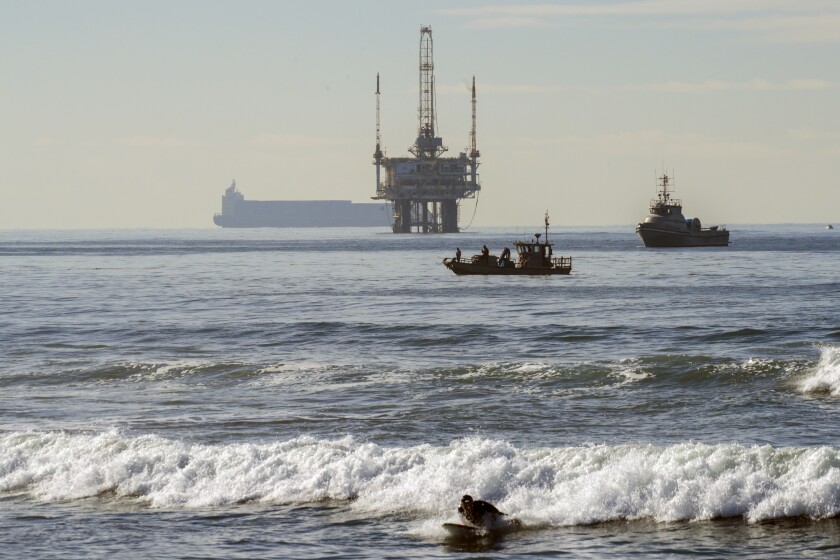

Per the LA Times, a DCOR pipeline has been identified as the source of a sheen in California State waters near Bolsa Chica State Beach. The pipeline transports oil from Platform Eva. All platform and pipeline operations in the vicinity have ceased.
 Bud's Offshore Energy (BOE)