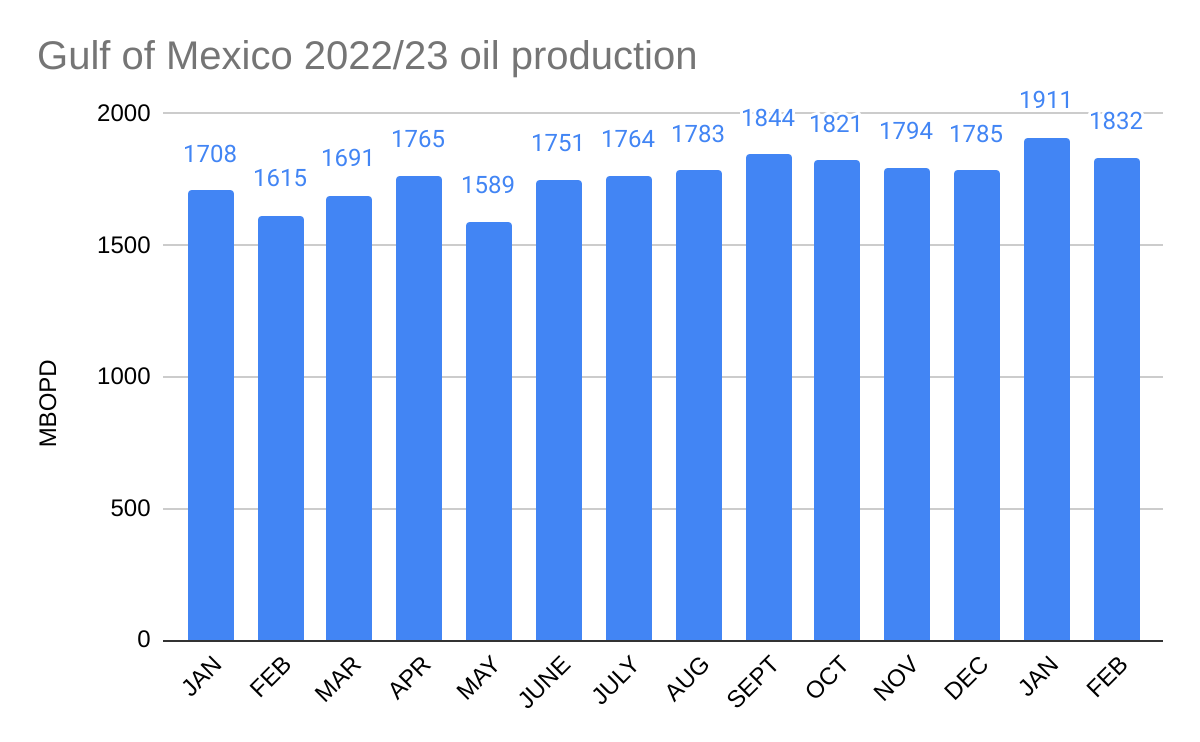
Per EIA, February production averaged 1.832 million bopd vs. 1.911 in January.
Posted in Gulf of Mexico, Offshore Energy - General, tagged 2023 oil production, Gulf of Mexico oil production on May 1, 2023| Leave a Comment »
Posted in Gulf of Mexico, Guyana, Offshore Energy - General, tagged 2035, BOEM, Guyana vs. Gulf of Mexico, oil production on April 30, 2023| Leave a Comment »
Industry consultancy Rystad Energy estimates Guyana will be pumping 1.7 million barrels per day by 2035, which is higher than other major offshore basins including the Gulf of Mexico, ranking the country as the world’s fourth largest offshore oil producer.
OilPrice.com
The GoM is currently producing >1.8 million bopd. If Rystad/OilPrice intended to say that Guyana production will exceed GoM production in 2035, that could be the case. However, sustained GoM production in 2035 could easily be >1.7 million bopd with proper resource management by government and industry. In fact, BOEM’s latest forecast (table below) calls for production >1.8 million bopd in 2031, the last year in their forecast.

Posted in drilling, Gulf of Mexico, Offshore Energy - General, tagged Beacon, bp, Chevron, deepwater drilling, Diamond Offshore, Gulf of Mexico, Kosmos, LLOG, Murphy, Noble, Oxy, QuarterNorth, Shell, transocean, Valeris, Woodside on April 27, 2023| Leave a Comment »

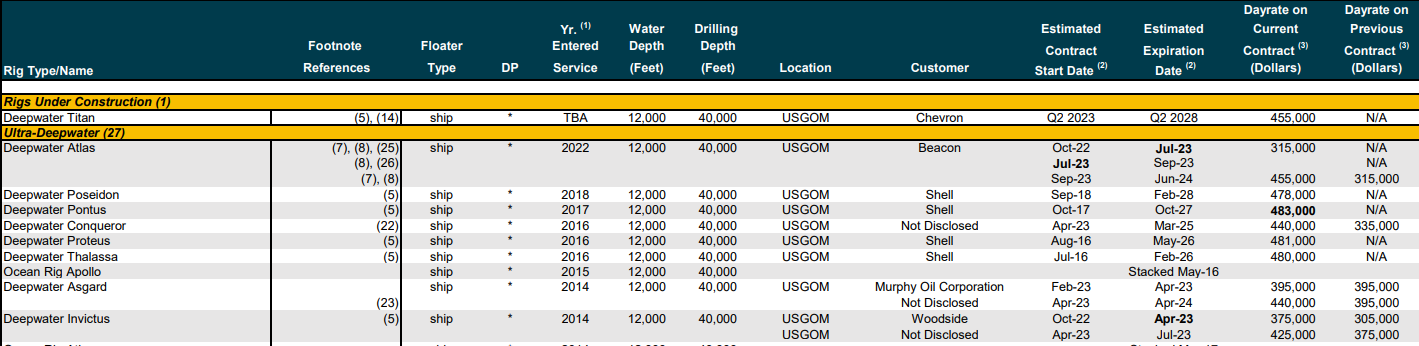
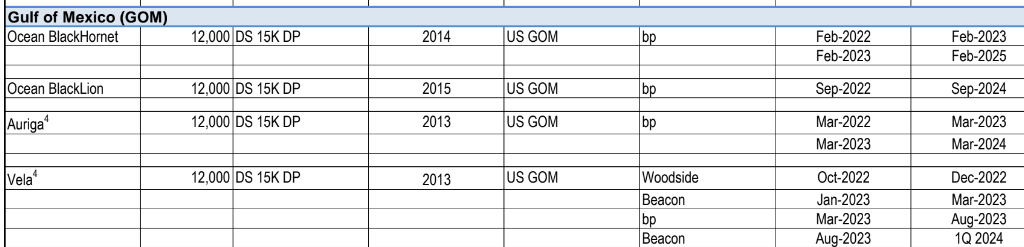
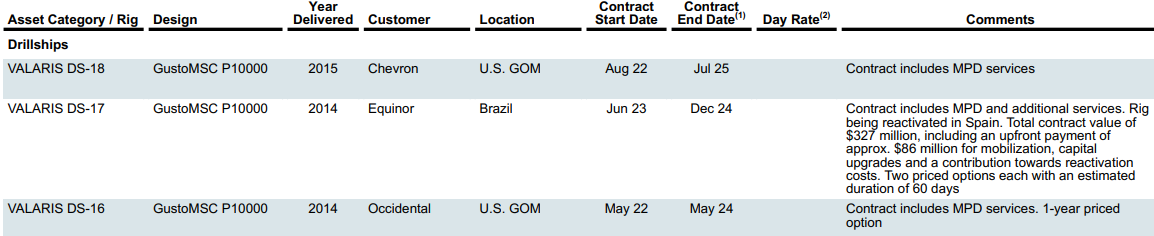
Based on drilling contractor rig activity reports, the table below lists 19 deepwater MODUs under or soon to begin contracts in the GoM. (Further details are pasted at the end of this post.) Per the Valeris report, platform rigs are operating on bp’s Thunder Horse and Mad Dog platforms. Per the BSEE borehole file, Arena and Cantium continue to drill development wells on the GoM shelf.
| Rig Name | Operator |
| Deepwater Titan | Chevron |
| Deepwater Atlas | Beacon |
| Deepwater Poseidon | Shell |
| Deepwater Pontus | Shell |
| Deepwater Proteus | Shell |
| Deepwater Conqueror | not disclosed |
| Deepwater Thalassa | Shell |
| Deepwater Asgard | Murphy |
| Deepwater Invictus | Woodside |
| Globetrotter I | Shell |
| Globetrotter II | Shell |
| Faye Kozack | QuarterNorth LLOG Kosmos |
| Stanley Lafosse | Murphy |
| Valaris DS-18 | Chevron |
| Valaris DS-16 | Oxy |
| Ocean BlackHornet | bp |
| Ocean Black Lion | bp |
| Auriga | bp |
| Vela | bp Beacon |
Excerpts from rig activity reports:




Posted in California, decommissioning, Gulf of Mexico, Offshore Energy - General, Offshore Wind, tagged BOEM, BSEE, decommissioning, regulations on April 25, 2023| Leave a Comment »
“BSEE will continue to evaluate the process for issuing decommissioning orders and will continue to issue decommissioning orders to jointly and severally liable parties on a case-by-case basis.“
Final decommissioning rule (preamble). 4/18/2023
Although the news release for BSEE’s final decommissioning rule asserts that the regulations “provide the certainty requested by industry,” that does not seem to be the case. The main change in the final rule was to delete the reverse chronological order (RCO) provision which called for issuing decommissioning orders to the most recent predecessor first. Instead, BSEE may continue to issue decommissioning orders arbitrarily.
While deleting the RCO provision may be advantageous for the regulator, and in some cases for the public, claiming that the decision provides certainty for industry is quite a stretch. BSEE may continue to issue a decommissioning order to anyone in the ownership chain, whether the company was a recent lessee or one that had owned the lease decades ago. Original or early lessees may be held liable for decommissioning old facilities regardless of subsequent damage, modifications, or neglected maintenance.
The absence of a defined procedure for issuing decommissioning orders may also expose BSEE to new legal challenges, particularly in cases where a company has not held the lease for decades. A 1988 letter from the Director of the Minerals Management Service to Amoco (attached below) explicitly relieves the assignor (predecessor) of decommissioning liability after the lease has been assigned. A revised bonding rule published on May 22, 1997 reversed that policy, but decommissioning liability for leases assigned prior to the 1997 rule may still be very much in question.
Another concern is the split jurisdiction for decommissioning between BSEE and BOEM. The financial, land management, operational, and environmental aspects of decommissioning are inextricably intertwined and attempts to divide these responsibilities between two bureaus with separate regulations is a prescription for gaps, overlap, inconsistency, inefficiency, disputes, and confusion. Decommissioning should be regulated holistically, not with separate “BOEM-only” and “BSEE-only” regulations.
Finally, wind facility decommissioning may prove to be even more challenging given the higher facility density and economic uncertainties. The regulatory regime needs to be clearly established early in the development phase.
Related posts:
Posted in climate, Offshore Energy - General, Uncategorized, tagged Science, seamounts, volcanoes on April 24, 2023| Leave a Comment »
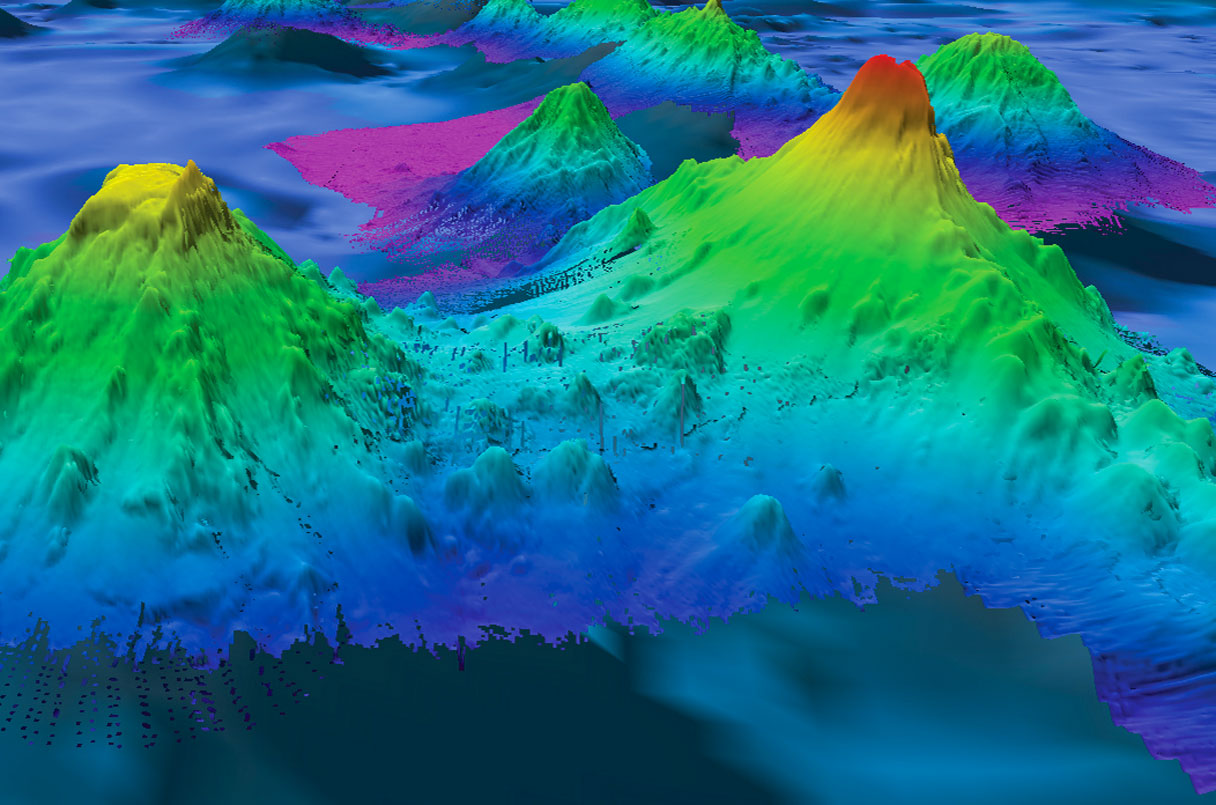
This Science article underscores how little we know about the oceans.
With only one-quarter of the sea floor mapped with sonar, it is impossible to know how many seamounts exist. But radar satellites that measure ocean height can also find them, by looking for subtle signs of seawater mounding above a hidden seamount, tugged by its gravity. A 2011 census using the method found more than 24,000. High-resolution radar data have now added more than 19,000 new ones. The vast majority—more than 27,000—remain uncharted by sonar. “It’s just mind boggling,” says David Sandwell, a marine geophysicist at the Scripps Institution of Oceanography, who helped lead the work.
Besides posing navigational hazards, the mountains harbor rare-earth minerals that make them commercial targets for deep-sea miners. Their size and distribution hold clues to plate tectonics and magmatism. They are crucial oases for marine life. And they are pot-stirrers that help control the large-scale ocean flows responsible for sequestering vast amounts of heat and carbon dioxide, says John Lowell, chief hydrographer of the National Geospatial-Intelligence Agency (NGA), which runs the U.S. military’s satellite mapping efforts.
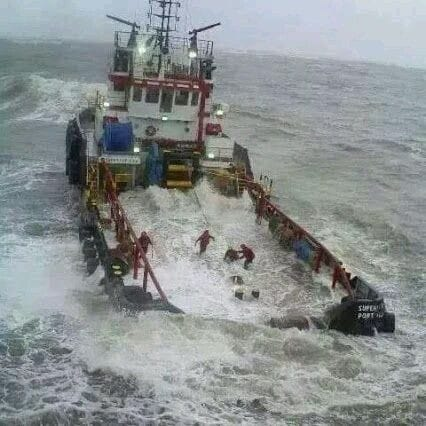
Posted in Offshore Energy - General, tagged offshore energy, workboats on April 24, 2023| Leave a Comment »
Posted in energy policy, Offshore Energy - General, Uncategorized, tagged Earth Day 2023, energy and the environment, offshore platforms on April 22, 2023| Leave a Comment »

Posted in energy, Jamaica, Offshore Energy - General, tagged Envoi, farm-in, Jamaica, offshore drilling, United Oil and Gas on April 21, 2023| Leave a Comment »

In addition to the details previously provided, some interesting insights from Envoi, agent for United Oil and Gas, follow:
Posted in accidents, drilling, Gulf of Mexico, Offshore Energy - General, well control incidents, tagged 4/20/2010, Deepwater Horizon, macondo, Trace Atkins on April 20, 2023| Leave a Comment »
Sharing this touching tribute to the 11 men who died on the Deepwater Horizon on April 20, 2010. These American heroes gave their lives exploring for energy to power our economy. The video is introduced by singer Trace Atkins, a former Gulf of Mexico rig worker. Please take a moment to watch.
Posted in accidents, Offshore Energy - General, Uncategorized, tagged macondo, Offshore Safety Day, safety leadership on April 19, 2023| Leave a Comment »
BOE continues to call for an International Offshore Safety Day each year on April 20th.
Proposal: Let’s make April 20th International Offshore Safety Day to honor those who have been killed or injured, to recognize the many workers who provide energy for our economies and way of life, and to encourage safety leadership by all offshore operators, contractors, and service companies.
BOE

 Bud's Offshore Energy (BOE)